
Mastering Paragraph Counting & Content Structure: The Ultimate Guide to Web Readability and SEO Optimization
In modern digital publishing, the difference between a high-converting article and a page with an 80% bounce rate rarely comes down to vocabulary alone. Instead, it is determined by structural rhythm: the precise length of your paragraphs, the distribution of sentence density, and the scannability of your thoughts. Using the free Paragraph Counter & Content Structure Analyzer, writers, editors, and SEO professionals can instantly evaluate their drafts to prevent cognitive fatigue and win prime search rankings.
💡 Quick Key Takeaways
- The 40–80 Word Optimal Rule: Web readers scan on mobile viewports. Paragraphs between 40 and 80 words (2–4 sentences) maximize reader comprehension and retention.
- Wall of Text Penalty: Paragraphs exceeding 120–150 words create visual friction, prompting mobile users to skim past critical arguments or bounce entirely.
- Passage Ranking & Snippets: Search engines analyze individual semantic paragraph blocks to extract featured snippets and AI overviews.
- Zero Server Transmission: The RiazHub Paragraph Counter processes 100% of your text locally in your browser for absolute data confidentiality.
Why Paragraph Structure Matters More Than Total Word Count
For decades, content creators obsessed over reaching arbitrary word count targets—such as hitting 2,000 words for an in-depth guide. However, modern user experience research reveals that how those words are chunked has a far greater impact on dwell time, comprehension, and conversion rates.
When human eyes land on a webpage, they do not read linearly from start to finish like they would in a printed novel. Eye-tracking studies confirm that visitors scan pages in an F-shaped pattern. They inspect headings, read the first one or two sentences of each paragraph block, and jump forward. If a paragraph looks like a massive, impenetrable wall of text, the brain perceives it as high-effort cognitive labor and skips it entirely.
By running your manuscript through an automated Paragraph Counter and Structure Analyzer, you can immediately identify bloated sections that need to be broken up, trimmed, or restructured before you hit publish.
The 4 Tiers of Paragraph Density: What Your Metrics Mean
Content structure can be systematically categorized into four distinct density tiers. Understanding these brackets ensures you maintain dynamic pacing throughout your writing:
| Density Tier | Word Count Range | Sentence Count | Best Use Case | Reader Experience |
|---|---|---|---|---|
| Short / Punchy | 1 – 39 Words | 1 – 2 Sentences | Introductions, transition hooks, bold declarations, and conclusions. | High momentum, effortless scanning, energetic pacing. |
| Optimal / Balanced | 40 – 100 Words | 2 – 4 Sentences | Core body paragraphs, analytical points, evidence explanation. | Sweet spot for desktop and mobile reading comfort. |
| Long / Dense | 101 – 150 Words | 5 – 7 Sentences | Academic citations, technical code explanations, case study contexts. | Requires dedicated focus; use sparingly on digital screens. |
| Wall of Text (Alert) | 151+ Words | 8+ Sentences | Rarely justified for web publications. | High visual fatigue; causes immediate skimming or bounces. |
How Paragraph Architecture Directly Influences Search Engine Optimization (SEO)
Modern search engine algorithms—including Google’s neural matching, Passage Ranking, and AI overview extraction engines—treat paragraphs as self-contained informational nodes. Here is how your paragraph formatting directly impacts your organic rankings:
1. Winning Google Featured Snippets (Position Zero)
Featured snippets are designed to deliver immediate, concise answers to specific user queries. Algorithms typically extract paragraph blocks that are between 40 and 60 words (approximately 250 to 350 characters) positioned directly beneath a relevant H2 or H3 heading. If your answering paragraph is buried within a 200-word monolith, crawler extraction models may fail to isolate the direct answer.
2. Passage Ranking and Semantic Context
Through passage indexing, search engines can elevate a specific paragraph from a comprehensive guide even if the rest of the page covers related subtopics. Clear, distinct paragraph breaks signal clear topic transitions, making it effortless for indexers to understand where one concept concludes and the next begins.
3. Reducing Dwell-Time Bounces on Mobile
Over 65% of global web traffic originates from mobile devices. A 100-word paragraph that looks reasonable on a 27-inch desktop monitor can stretch across 15 to 20 lines on a smartphone screen, completely filling the viewport. When users see nothing but continuous text with no visual breathing room, bounce rates soar. Checking your article in the online content structure analyzer ensures your paragraphs remain mobile-friendly across all devices.
Step-by-Step Guide: How to Inspect & Optimize Your Drafts
Optimizing your articles with the RiazHub Paragraph Counter takes less than 30 seconds:
- Paste or Drop Your Draft: Copy your text from Google Docs, Microsoft Word, Notion, or Markdown and paste it into the left-hand workspace, or drag and drop your
.txt,.md, or.docxfile. - Select Your Delimiter Rule: Choose between standard Double Line Break (Markdown/Prose), Single Line Break (Poetry/Transcripts), Indented Paragraphs, or HTML <p> Tags.
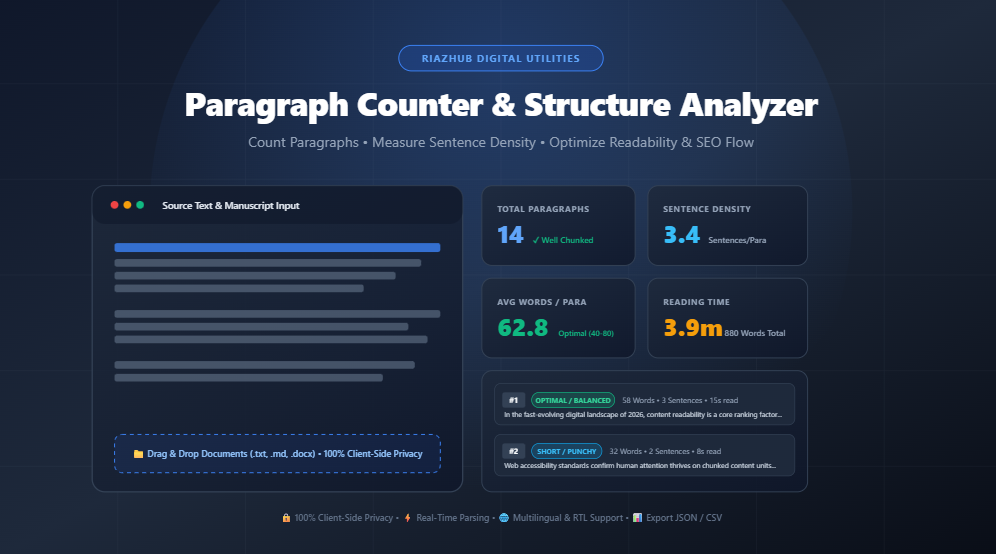
- Inspect the 6 Structural KPIs: Review your total paragraphs, sentence count, average sentences per paragraph, average words per paragraph, and estimated reading/speaking times.
- Audit the Density Inspector: Scroll through the interactive paragraph list on the right. Instantly spot any paragraphs highlighted with the red “Wall of Text” or “SEO Density Warning” badges.
- Transform and Export: Utilize 1-click transformation tools to double-space paragraphs, collapse blank lines, or wrap text in HTML
<p>tags. Export your structured analysis as JSON, CSV, or formatted text.
Advanced Features of the RiazHub Paragraph Analyzer
Unlike rudimentary counter widgets that merely count newline characters, the Universal Paragraph Counter & Analyzer incorporates advanced natural language parsing capabilities:
- Multilingual & RTL Compatibility: Full Unicode tokenization supporting English, Arabic, Urdu, Persian, Hebrew, Spanish, French, and East Asian character sets with bidirectional layout recognition (
dir="auto"). - Intelligent Heading Exclusion: Automatically ignores Markdown title lines (
# Heading) so your structural KPI metrics reflect genuine prose blocks rather than structural headings. - 1-Click HTML <p> Tag Wrapping: Converts raw manuscript copy into web-ready HTML paragraph blocks with clean spacing.
- Sorting by Density: Reorder paragraphs from shortest to longest to review flow progression and identify outliers in complex dissertations or whitepapers.
- Comprehensive Export Suite: Generate CSV reports compatible with Excel and Google Sheets, or export full JSON payloads for automated content audit pipelines.
Frequently Asked Questions (FAQ)
What is the ideal average paragraph length for SEO?
The recommended standard for high-ranking web content is an average of 50 to 70 words per paragraph (approximately 3 sentences). This provides sufficient depth to resolve user intent while maintaining high scannability.
Does this tool store or upload my written content?
No. The Paragraph Counter & Content Structure Analyzer operates 100% on the client side inside your web browser using vanilla JavaScript. No text, essays, confidential manuscripts, or drafts are ever transmitted to or logged on any external server.
How does paragraph count differ from line count?
A line count simply tallies the visual rows of text (which change depending on viewport width and font size) or hard line returns. A paragraph count measures complete, self-contained semantic thought units bounded by configured delimiters (such as double line breaks or HTML paragraph tags).
Can I use this tool for academic papers and essays?
Yes. Academic prose often allows slightly longer paragraph structures (100–140 words). The tool’s live density breakdown allows students, researchers, and professors to ensure their argumentative transitions are balanced and devoid of disjointed single-line fragments or run-on monoliths.
Start Analyzing Your Content Structure Today
Never let poor formatting undermine brilliant writing. Test your latest article, essay, or sales copy today with the free Browser-Based Paragraph Counter & Content Structure Analyzer on RiazHub and build clean, readable, and search-optimized content in real time.
Paragraph Counter & Content Structure Analyzer
Count total paragraphs, evaluate paragraph length, analyze sentence density, and optimize content readability in real time.
Source Text Input
Paragraph Breakdown & Density
0 DetectedEnter or paste your text on the left to see detailed paragraph-by-paragraph density analysis.