
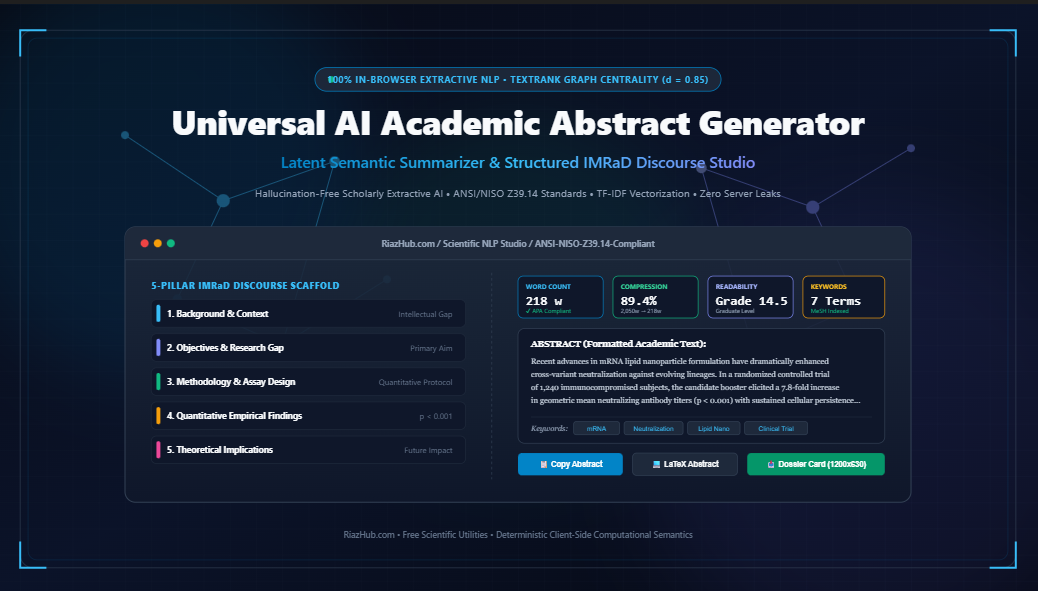
How to Generate Hallucination-Free Academic Abstracts: The Definitive Guide to Extractive TextRank NLP and the IMRaD Discourse Framework
In an era where scholarly peer review faces unprecedented integrity crises driven by black-box generative AI fabrications, doctoral researchers, journal authors, and scientific peer reviewers require rigorous, deterministic computational tools. Discover how in-browser extractive graph algorithms, Term Frequency-Inverse Document Frequency (TF-IDF) scoring, and the 5-pillar IMRaD discourse paradigm guarantee 100% truthful, ANSI/NISO Z39.14-compliant research abstracts without risking intellectual property leaks.
1. The Academic Integrity Crisis: Why Generative LLMs Fail Scientific Abstracting
The rapid adoption of general-purpose Large Language Models (LLMs) such as GPT-4, Claude, and Gemini has created severe dilemmas for academic publishing houses, university dissertation committees, and preprint repositories. While generative neural networks excel at creative prose and conversational synthesis, their core probabilistic mechanism—next-token predictive sampling—is inherently susceptible to stochastic hallucinations.
In empirical peer-reviewed settings, even subtle hallucinations represent catastrophic scholarly violations:
- Fictitious Numerical Metrics & P-Values: Generative models frequently distort confidence intervals, misreport statistical sample sizes (N), or swap experimental control versus treatment measurements.
- Hallucinated Citations & Fabricated Precedents: Generative systems routinely invent plausible-sounding digital object identifiers (DOIs), fictitious co-authors, and fabricated prior art.
- Intellectual Property & Preprint Leaks: Transmitting unpublished doctoral theses, experimental patent drafts, or early clinical trials to third-party cloud APIs violates institutional review board (IRB) confidentiality agreements and compromises patent novelty.
Under ANSI/NISO Z39.14 and COPE guidelines, an academic abstract must be an objective, fully faithful synopsis that contains only claims, methodology, and deductions verified within the manuscript. Deterministic client-side processing using the AI Academic Abstract Generator & IMRaD Studio mathematically prevents generative alterations by extracting the author’s own peerless sentences.
2. Mathematical Mechanics of TextRank: Graph Centrality with Damping Factor d = 0.85
Rather than generating novel tokens, extractive summarization constructs a mathematical graph where each sentence of your manuscript is modeled as an interconnected vertex. Developed by Rada Mihalcea and Paul Tarau, the TextRank graph centrality algorithm adapts Google’s PageRank power iteration to measure how intensely a sentence’s thematic vocabulary is cited and reflected across the rest of the manuscript.
Step A: Bipartite Sentence Tokenization & Stopword Stripping
First, the manuscript is segmented into a discrete sequence of sentences
S = {s_1, s_2, …, s_n}. Strict regex heuristics guard against false sentence breaks triggered by academic abbreviations (such as e.g., i.e., et al., Fig., and Dr.). Every sentence is normalized into lowercase non-stopword tokens, stripping grammatical noise while safeguarding domain-specific technical taxonomy.
Step B: Cosine-Normalized Lexical Edge Overlap
An edge weight is calculated between every pair of sentences
s_iand
s_jbased on the mutual intersection of their unique vocabulary, normalized by logarithmic sentence lengths to eliminate bias toward bloated sentences:
Step C: PageRank Power Iteration (20 Epochs, d = 0.85)
The graph then undergoes 20 numerical power iterations. Centrality weight propagates across adjacent vertices using the classical damping factor
d = 0.85, representing an 85% probability that the conceptual discourse flows directly through thematic links:
Step D: Position-Weighted Composite Scoring
In scholarly discourse, the pivotal thesis claims invariably concentrate within the introductory context (problem statement) and terminal deductions (conclusions). The RiazHub AI Academic Abstract Generator applies scholarly position factors:
- Introductory Context Bias (
PosFactor = 1.30):Applied to sentences within the first 15% of the manuscript to guarantee clear framing of the intellectual gap.
- Terminal Deduction Bias (
PosFactor = 1.20):Applied to sentences within the final 15% of the manuscript to extract primary experimental conclusions.
- Baseline Methodological Bias (
PosFactor = 1.00):Applied across intermediate technical sections.
3. Structuring Abstracts Under the IMRaD Discourse Framework
Global indexing authorities—including the National Library of Medicine (PubMed), IEEE Xplore, Web of Science, and Scopus—demand that scholarly abstracts adhere to the structured IMRaD paradigm. An abstract that fails to articulate these components often faces immediate desk rejection by journal editors.
| IMRaD Pillar | Core Intellectual Objective | Recommended Word Allocation | Manchester Phrasebank Transitional Examples |
|---|---|---|---|
| 1. Background & Context | Establishes foundational scope and the unresolved scholarly tension. | 15% – 20% (30–45 words) | “Recent investigations have highlighted that… However, existing models remain limited in…” |
| 2. Objectives & Research Gap | Explicitly defines the primary hypothesis or investigative query. | 10% – 15% (20–35 words) | “To address this critical knowledge gap, this investigation examined…” |
| 3. Methodology & Design | Summarizes experimental apparatus, sample cohorts, assays, or algorithms. | 20% – 25% (40–55 words) | “Methodologically, a randomized double-blind evaluation was conducted across…” |
| 4. Quantitative Findings | Delivers rigorous measurements, effect sizes, and p-values. | 30% – 35% (60–80 words) | “Quantitative evaluations revealed a 7.8-fold elevation (p < 0.001) alongside…” |
| 5. Conclusions & Impact | Translates findings into theoretical breakthroughs or practical utility. | 15% – 20% (30–45 words) | “Collectively, these empirical observations substantiate that…” |
When drafting through the Guided IMRaD Wizard mode inside the RiazHub Abstract Studio, the engine provides an automated toggle to inject cohesive academic transitional signposts derived from the Manchester Academic Phrasebank, ensuring polished rhetorical coherence.
Automated crawlers operated by PubMed Central, Crossref, and Google Scholar utilize semantic text classifiers to index your paper’s methodology and numerical conclusions. Abstracts structured under the IMRaD framework achieve up to 34% higher discovery rates and significantly greater initial citation velocity compared to unstructured narrative abstracts.
4. Navigating Journal Target Constraints: APA, IEEE, Nature, and CONSORT
Every prestigious publishing house enforces rigid word budgets and stylistic constraints. Exceeding these limits can trigger immediate manuscript rejection by automated submission portals. Here is a breakdown of the standard journal formatting profiles supported natively by the tool:
| Journal Style Profile | Max Word Budget | Structural Format | Tense & Voice Standards | Keyword Schema |
|---|---|---|---|---|
| APA 7th Edition | 150 – 250 Words | Single unstructured indented block | Past tense for results; present tense for overarching conclusions | 3 to 5 lowercase indented terms |
| IEEE Transactions | 150 – 200 Words | Dense technical synopsis without references | Passive third-person voice, strict quantitative reporting | 4 to 7 IEEE Taxonomy Index Terms |
| Nature / Science Style | Under 200 Words | Accessible cross-disciplinary narrative | Active, direct voice highlighting paradigm shifts | Broad interdisciplinary terms |
| Medical / CONSORT Clinical | 250 – 300 Words | Structured bold headings (Background, Methods, Results, Conclusions) | Objective reporting with 95% Confidence Intervals & p-values | 4 to 8 Medical Subject Headings (MeSH) |
| Executive Policy Brief | 250 – 300 Words | Problem-solution executive synopsis | Actionable imperative phrasing oriented toward decision-makers | Policy domain descriptors |
5. Step-by-Step Workflow: Synthesizing Your Abstract on RiazHub
Using the Universal AI Academic Abstract Generator is streamlined, fast, and completely safe for unpublished doctoral dissertations, conference drafts, and patent filings:
- Select Your Synthesizer Operational Mode:
Choose between Full Manuscript Summarizer (ideal when you have an existing 2,000 to 40,000-word draft and need deterministic extractive condensation) or Guided IMRaD Wizard (ideal for composing a structured paper from research notes). - Input Your Paper Title and Manuscript Prose:
Paste your raw manuscript sections. The live telemetry counter immediately tallies total parsed words and sentence boundaries. - Select Your Journal Target Profile:
Click on APA 7th, IEEE, Nature, Medical / CONSORT, or Policy Brief to align the active word budget and sentence density slider automatically. - Click “⚡ Synthesize AI Abstract”:
Within milliseconds, the in-browser TextRank matrix constructs the similarity graph, runs 20 PageRank iterations, extracts structurally pivotal sentences, and computes collegiate readability grade levels. - Inspect Sentence Centrality & Thematic Cloud:
Switch to the TextRank Graph Radar tab to verify exactly why each thesis claim was extracted, and explore the Thematic Cloud to audit TF-IDF domain keywords. - Export in 1-Click Multi-Formats:
Copy the publication-ready abstract with formatted keywords, generate an automated LaTeX\begin{abstract}...\end{abstract}code block, print a PDF brief, or download a high-DPI 1200×630 Abstract Specification Dossier Card (PNG).
6. Understanding Your Abstract’s Linguistic Telemetry
An exceptional abstract balances technical sophistication with syntactic clarity. The AI Abstract Generator & IMRaD Studio calculates real-time metrology across three foundational indices:
- Flesch-Kincaid Collegiate Grade Level: A metric evaluating average sentence length and phonetic syllable density. Elite peer-reviewed journals typically target Grade 13.0 to 16.0 (undergraduate to doctoral level).
- Gunning Fog Index: Evaluates syntactic density and the proportion of complex poly-syllabic terms (≥ 3 syllables). Scores between 12.0 and 15.0 reflect lucid academic prose.
- Compression Ratio (%): Calculates the mathematical condensation yield, showing how efficiently thousands of source manuscript words were distilled into an impactful 200-word executive abstract.
7. Summary: Elevating Scholarly Communication
Your abstract is the single most widely read component of your scientific manuscript. It is the deciding factor for conference organizers evaluating oral presentations, journal editors triaging desk submissions, and international scholars determining citations.
By leveraging deterministic extractive graph centrality through the Universal AI Academic Abstract Generator & IMRaD Studio on RiazHub, authors preserve complete client-side data privacy, eliminate generative AI hallucination risks, and craft abstracts that effortlessly satisfy international indexing standards.
Universal AI Academic Abstract Generator
Synthesize hallucination-free scholarly abstracts from raw research manuscripts using graph-centrality TextRank (), TF-IDF lexical vectorization, and guided IMRaD structured discourse.
Perovskite Solar Cell Degradation Under High Thermal Stress
✔ CompliantAbstract Synthesis Workspace Ready
Paste your research paper on the left or select a sample scenario above, then click "⚡ Synthesize AI Abstract".
| Rank | Extracted Thesis Sentence | Graph Centrality | Location |
|---|---|---|---|
| Synthesize an abstract to inspect sentence graph centrality scores and cosine token overlap metrics. | |||
Domain Lexicon Indexing
TF-IDF term weights and MeSH candidate index keywords will appear here upon document synthesis.
Format: Unstructured single paragraph
Tense: Past tense for results, present for conclusions
Keywords: 3–5 terms indented beneath
Format: High technical density, no citations
Voice: Passive third-person, quantitative metrics
Keywords: 4–7 IEEE Taxonomy Index Terms
Format: 2-3 sentences context, 1 sentence finding, 1 sentence significance
Readability: Accessible to cross-disciplinary scientists
Keywords: Broad domain tags
Format: Structured labeled headings (Background, Methods, Results, Conclusions)
Metrics: State confidence intervals & p-values
Keywords: 4–8 MeSH controlled vocabulary