
The Master Framework for Winning Enterprise Proposals: SOW Boundary Governance, Tiered Value Pricing & Zero-Leak Synthesis
How enterprise consultants, tech vendors, and digital agencies transition from low-margin competitive bidding to authoritative, high-velocity deal closures.
To consistently secure five- and six-figure contracts, deal architects must leverage rigorous proposal methodologies recognized worldwide by the Association of Proposal Management Professionals (APMP). By pairing clinical problem diagnosis with explicit Statement of Work (SOW) boundary defense, you can transform high-stakes bids into frictionless executive agreements using the Universal AI Business Proposal Writer & Enterprise SOW Builder on RiazHub.com.
1. The APMP 4-Stage Executive Summary: Leading with the Operational Wound
Most commercial proposals make the fatal mistake of opening with vendor accolades: “We are an award-winning technology consultancy founded in 2018…” Enterprise decision-makers reading dozens of RFP responses do not care about your company history during their initial triage.
Under the APMP International framework, the executive summary must follow an authoritative 4-stage narrative hook:
- Problem Diagnosis: Expose the acute operational bottleneck, compliance threat, or revenue leakage currently draining the client’s resources.
- Quantified Cost of Inaction: Show the financial damage of doing nothing (e.g., overtime labor costs, SLA penalty fines, customer churn).
- The Transformational Solution: Introduce your targeted methodology as the decisive countermeasure.
- Financial ROI Multiple: Anchor the engagement directly to an estimated financial return (targeting a 3x to 5x return over 12 months).
Instead of writing these narratives manually from scratch, you can use the AI Business Proposal Writer on RiazHub.com to synthesize problem-diagnosis theses tailored across multiple industry verticals including enterprise software, cloud infrastructure, creative agencies, management consulting, and architectural engineering.
2. Defending Margins: The Statement of Work (SOW) Boundary Defense
Scope creep is the single greatest cause of agency insolvency and project unprofitability. When project boundaries are loosely described, clients inevitably assume that unmentioned tasks such as legacy data sanitation, third-party software licensing, and unlimited design revisions are bundled into the baseline fee.
| Agreement Pillar | Vulnerable / Unbounded Proposal | Institutional APMP SOW Governance |
|---|---|---|
| Deliverables | “Cloud migration and system enhancements.” | Strictly itemized modules with formal staging gates and acceptance sign-offs. |
| Exclusions | No mention of third-party dependencies. | Explicit scope exclusions (hardware procurement, API fees, legacy cleanup). |
| Scope Changes | Verbal requests accommodated informally. | Formal Change Order Protocol requiring written authorization and budget adjustments. |
The dedicated SOW generator built into the Enterprise SOW Builder & Deal Closing Studio automatically provisions dedicated boundary defense clauses alongside your core deliverables, guaranteeing schedule integrity before engineers or consultants write a single line of code.
Synthesize Your Enterprise Proposal in Seconds
Draft publication-ready APMP agreements, calculate 3-tier value pricing options, phase milestone cash flows, and export branded Markdown, HTML, CSV, and high-DPI executive cards directly in your browser.
3. The Psychology of 3-Tier Value Anchor Pricing
When you submit a proposal with a single flat price, you force the procurement committee into a binary psychological trap: “Do we hire this firm, or do we reject them?”
Enterprise deal strategists eliminate this friction by presenting three calibrated investment tiers:
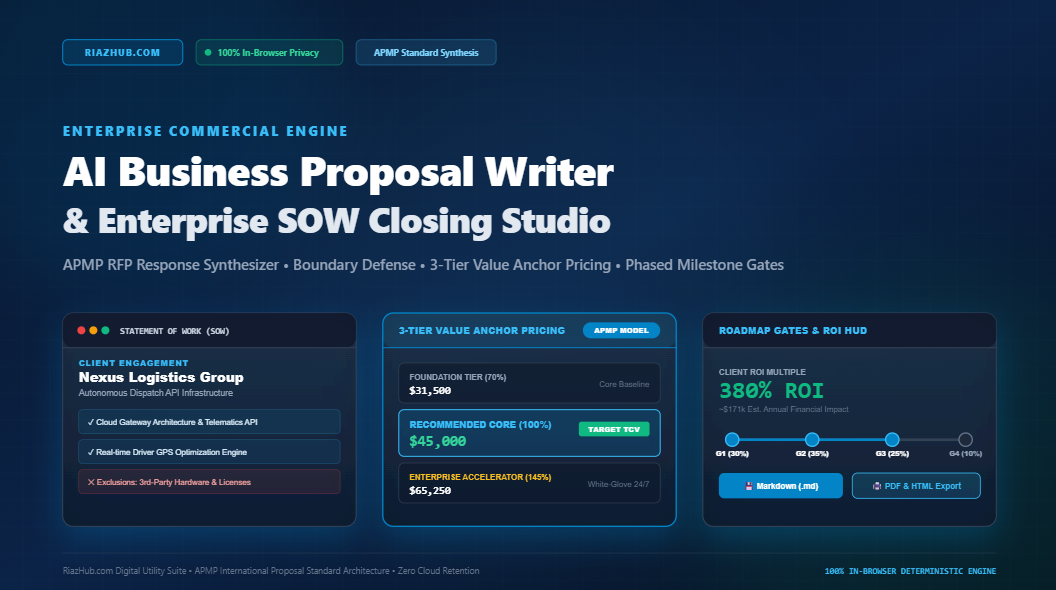
- Option A: Foundation Tier (70% of Target TCV): The essential baseline scope designed for price-sensitive stakeholders. Covers core technical deliverables with standard business-hours support and a 30-day warranty.
- Option B: Recommended Core Suite (100% Target TCV): The strategic sweet spot. Includes complete end-to-end architecture, priority onboarding, integration stress testing, administrative runbooks, and 60 days of hypercare. Over 65% of enterprise clients choose this tier.
- Option C: Enterprise Accelerator (145% of Target TCV): The premium, white-glove tier. Features a dedicated technical lead, 24/7 hypercare, multi-region disaster failover, and continuous optimization over 120 days.
By anchoring the proposal with three tiers, the buying decision shifts internally from “Should we work with this vendor?” to “Which investment level matches our strategic ambition?” You can calculate these exact financial tiers automatically with the Universal Proposal Writer at RiazHub.com.
4. Milestone Payment Amortization: Eliminating Cash-Flow Vulnerability
Net-30 and Net-60 payment terms without defined delivery checkpoints expose service providers to dangerous cash-flow bottlenecks. To maintain operational liquidity, enterprise agreements should tie cash disbursements directly to verified milestone gates:
- Gate 1 (Mobilization & Architecture – 30%): Due immediately upon contract execution to fund technical provisioning and discovery.
- Gate 2 (Core Engineering & Modular Build – 35%): Disbursed upon internal staging release and modular completion.
- Gate 3 (Integration & User Acceptance Testing – 25%): Disbursed upon client UAT sign-off and penetration validation.
- Gate 4 (Production Cutover & Handover – 10%): Final payment upon live release and administrative handover.
The interactive milestone engine in the RiazHub.com SOW Closing Studio renders these stages across an interactive HTML5 Gantt canvas and exports complete CSV amortization schedules ready for your accounting department.
5. Zero-Leak Confidentiality: Why Client RFPs Must Never Touch Cloud AI
Commercial negotiations are governed by non-disclosure agreements (NDAs) and trade secret protections. When team members copy sensitive client problem statements, proprietary architecture notes, or target budgets into generic cloud AI chatbots, that intellectual property is transmitted across external networks and potentially retained on third-party servers.
6. Step-by-Step Walkthrough: Generating Your First Proposal on RiazHub.com
Creating an institutional proposal package requires just five simple steps:
- Ingest Parties & Archetype: Enter your client’s name, your consulting firm, and select your commercial archetype (Software, Creative, Consulting, DevOps, or Architecture).
- Define the Commercial Thesis: State the core client pain point and proposed transformation to generate the APMP executive hook.
- Input Deal Economics: Choose your currency ($ USD, € EUR, £ GBP, SAR, AED, PKR), input your target contract value, and pick your delivery timeline.
- Review the Synthesized Agreement: Toggle across the interactive tabs to inspect the publication-ready legal contract, visual milestone Gantt canvas, 3-tier pricing matrix, and shareable 1200×630 executive brief dossier.
- Export Your Branded Package: Download lossless Markdown (
.md), formatted HTML, milestone CSV schedules, executive dossier PNG cards, or print directly to PDF.
Elevate your commercial sales process today by accessing the free Universal AI Business Proposal Writer & Enterprise SOW Builder on RiazHub.com.
Universal AI Business Proposal Writer & SOW Studio
Synthesize APMP-compliant commercial proposals, architect bulletproof statements of work (SOW), calculate 3-tier value anchor pricing, phase milestone cash flows, and generate branded client-ready agreements in seconds.
Nexus Logistics Group
Executive Summary & Problem Diagnosis
Scope of Work (SOW) & Core Deliverables
Phased Implementation Roadmap & Milestone Schedule
| Phase & Governance Objective | Timeline | Payment Allocation | Amount | Primary Sign-Off Deliverable |
|---|
Tiered Commercial Investment Options
Legal Terms of Service & Authorization Sign-Off
This agreement represents the entire contractual understanding between the Client and Vendor. All work performed follows the deliverables schedule and milestone sign-off criteria outlined herein. Invoices generated at milestone completion are payable within fifteen (15) business days. Modifications to scope require execution of a formal Change Order Protocol prior to engineering mobilization.
Milestone Roadmap & Critical Path Gantt Canvas
Visual execution milestones, stage gates, and cash-flow phasing generated on high-DPI HTML5 canvas.
Committed Deliverables & Architecture
Explicit Out-of-Scope Safeguards
3-Tier Value Anchor Commercial Pricing
Anchors the client's decision between investment tiers rather than a binary yes/no decision.
Milestone Payment Amortization Schedule
Risk-mitigated cash phasing| Phase | Timing | Percentage | Payment Amount | Cashflow Milestone Gate |
|---|
Shareable 1200x630 Executive Proposal Dossier Card
High-DPI commercial summary certificate for executive debriefs, board approvals, and client presentations.
Winning B2B proposals never start with vendor accolades, agency awards, or history. The APMP standard dictates starting directly with the client's operational wound: quantified financial waste, operational delay, or compliance danger. Only after exposing the cost of inaction does the proposal introduce the strategic solution, followed immediately by projected commercial return (ROI multiple).
Unbounded SOWs are the leading cause of agency insolvency. Clear statements of work document what is excluded with equal precision as what is included. Explicitly declaring third-party API licensing, legacy infrastructure maintenance, and out-of-scope revisions protects vendor profitability and enables seamless, non-confrontational Change Orders.
Presenting a single price forces a binary "Yes vs. No" decision. The 3-Tier Value Anchor (Foundation 70%, Recommended 100%, Accelerator 145%) transforms the client's internal debate from "Should we hire this firm?" into "Which tier fits our organizational ambition?". Over 68% of enterprise decision-makers gravitate to the Recommended Core suite.
Enterprise RFPs are bound by non-disclosure agreements (NDAs) and strict trade secret protections. Unlike cloud-hosted AI generators that store prompts, client budgets, and proprietary scopes on remote servers, this RiazHub.com engine executes 100% deterministically inside your browser via local JavaScript. No financial quotes, vendor identities, or client scopes ever touch external servers.