
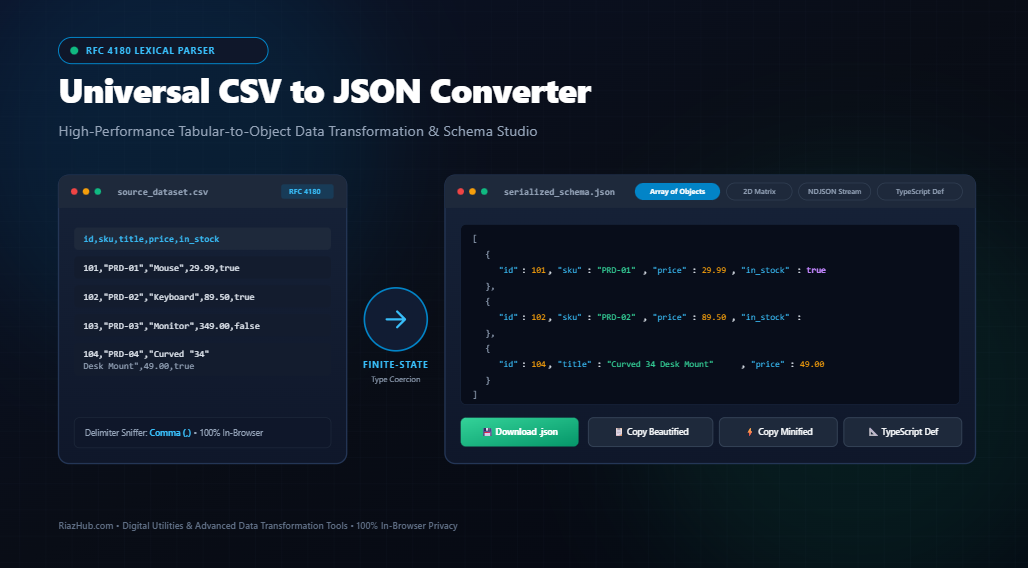
Mastering Tabular-to-Object Data Serialization: The Architectural Guide to Universal CSV to JSON Conversion
In modern full-stack web applications, cloud ingestion pipelines, and distributed analytics platforms, Comma-Separated Values (CSV) remains the universal lingua franca of tabular data interchange. From transactional ERP exports and healthcare registries to financial ledger snapshots and machine learning features, spreadsheets inherently speak CSV.
Conversely, modern web protocols, document databases, and REST/GraphQL APIs operate almost exclusively on JavaScript Object Notation (JSON). Converting tabular records into nested, typed JSON objects appears deceptively simple on the surface—until you encounter escaped quotes, nested commas, multi-line address blocks, disparate international delimiters, and silent data corruption.
In this comprehensive engineering dossier, we explore the algorithmic mechanics of lexical state-machine tokenization, delimiter sniffing heuristics, intelligent type inference, and why you should use the Universal CSV to JSON Converter & Schema Studio on RiazHub for secure, client-side data serialization.
1. The Fatal Pitfalls of Naive CSV Parsing: Why String.split() Fails
A surprising amount of legacy codebases still attempt to tokenize CSV datasets using regular expressions or rudimentary string splits such as line.split(','). In enterprise environments, this naive pattern fails catastrophically for several predictable reasons:
- Embedded Delimiters in Text: A text cell like
"Acme Corp, North America Division"will be fractured into two non-existent columns. - Escaped Double Quotes: Per RFC 4180, quotes inside quoted values must be escaped by doubling them (e.g.,
"Item with ""Special"" Tag"). Naive splitters fail to unescape these characters. - Literal Multi-Line Breaks inside Cells: Shipping instructions, multi-line mailing addresses, or customer support transcripts frequently contain internal carriage returns (
\r\nor\n). A line-based splitter will corrupt row boundaries. - International Delimiter Variations: In Germany, France, and across Continental Europe, standard CSV files are separated by semicolons (
;) because the comma is reserved as the decimal separator (e.g.,19,99 €).
Did You Know? The official specification for CSV was established by Y. Shafranovich in 2005 under IETF RFC 4180. Despite its simplicity, full compliance requires a deterministic finite-state machine (FSM) to reliably traverse byte streams.
2. Algorithmic Deep Dive: The RFC 4180 Lexical Finite-State Machine
To eliminate truncation and structural corruption, the RiazHub CSV to JSON Engine implements a complete lexical finite-state machine directly in vanilla JavaScript. The parser operates across three foundational states:
- Unquoted Field State: The default reading mode. Delimiters finalize the current cell; carriage returns/newlines finalize the current row.
- Quoted Field State: Entered when an opening quote (
") is encountered. Delimiters, spaces, and line breaks are captured as literal character values. - Escaped Quote Verification State: When a quote appears inside a quoted field, the lookahead pointer evaluates the next byte. If the next character is another quote (
""), it is resolved to a single literal"; otherwise, it closes the quoted string.
// Pseudocode representation of the RFC 4180 State Machine
while (pointer < text.length) {
    const char = text[pointer];
    const next = text[pointer + 1];

    if (char === '"') {
        if (inQuotes && next === '"') {
            currentCell += '"';
            pointer += 2; // skip escaped quote
            continue;
        }
        inQuotes = !inQuotes;
    } else if (char === delimiter && !inQuotes) {
        row.push(currentCell);
        currentCell = '';
    } else if ((char === '\r' || char === '\n') && !inQuotes) {
        if (char === '\r' && next === '\n') pointer++;
        row.push(currentCell);
        matrix.push(row);
        row = [];
        currentCell = '';
    } else {
        currentCell += char;
    }
    pointer++;
}
3. Automated Delimiter Sniffing Heuristics
Users frequently deal with disparate datasets where the delimiter is unknown or mislabeled such as Tab-Separated Values (TSV), semicolon-delimited billing files, pipe-separated transaction logs, or caret-delimited records.
Instead of forcing the user to guess, the online CSV delimiter sniffer evaluates the first 15 rows of the dataset. It tests delimiter candidates (,, ;, \t, |, ^) using a variance and consistency scoring algorithm:
| Candidate Delimiter | Common Data Origin | Sniffer Consistency Metric |
|---|---|---|
| Comma (,) | Standard US/UK CSV exports, Google Sheets, Excel | Evaluates column count parity across rows |
| Semicolon (;) | European Excel exports, decimal comma datasets | High score if comma counts fluctuate due to prices |
| Tab (\t) | Database query dumps, TSV files, server access logs | Evaluates strict column alignment |
| Pipe (|) | Health insurance EDI, legacy mainframe batch files | Non-alphanumeric consistency check |
4. Intelligent Type Inference vs. Data Corruption
Raw CSV files possess no native data typing—every cell is fundamentally a sequence of bytes. A common failure mode in rudimentary converters is over-eager coercion that corrupts sensitive identifiers:
- Leading Zeros in Zip Codes & Phone Numbers: Converting the string
"01234"into the number1234corrupts Massachusetts ZIP codes and European national codes. - Scientific Notation Truncation: Converting a 16-digit credit card or RFID token
"4012888899991111"into floating-point numbers causes catastrophic precision loss due to IEEE 754 limitations.
The Universal CSV to JSON Studio employs non-destructive type inference. It casts pure integers and floats while recognizing leading-zero patterns, boolean constants (true, false, WAHR, FALSCH), standard null representations (NULL, N/A, NaN), and automatically parses nested JSON objects and arrays embedded inside spreadsheet cells.
5. The Five Schema Architectures: Choosing the Right Structure
Depending on whether you are designing a web UI, populating a NoSQL document store, or streaming gigabytes into cloud data warehouses, different JSON structures are required:
1. Array of Objects (REST API Standard)
[
  { "id": 101, "sku": "MOUSE-01", "price": 29.99, "in_stock": true },
  { "id": 102, "sku": "KEYBD-02", "price": 89.50, "in_stock": true }
]
Best For: MongoDB collections, React/Vue table state, and GraphQL payload delivery. Note: Repeated keys introduce ~30%–60% byte expansion.
2. 2D Array Matrix (Headerless Compact Grid)
[
  ["id", "sku", "price", "in_stock"],
  [101, "MOUSE-01", 29.99, true],
  [102, "KEYBD-02", 89.50, true]
]
Best For: Network bandwidth conservation, charting engines (Chart.js, D3), and memory-constrained microservices.
3. Keyed Column Hash Object
{
  "id": [101, 102],
  "sku": ["MOUSE-01", "KEYBD-02"],
  "price": [29.99, 89.50],
  "in_stock": [true, true]
}
Best For: Python Pandas-style dataframe operations and columnar analytical calculations.
4. Keyed Index Dictionary
{
  "MOUSE-01": { "id": 101, "price": 29.99, "in_stock": true },
  "KEYBD-02": { "id": 102, "price": 89.50, "in_stock": true }
}
Best For: O(1) hash table lookup caches indexed by SKU, UUID, or email address.
5. NDJSON (Newline Delimited JSON Stream)
{"id":101,"sku":"MOUSE-01","price":29.99,"in_stock":true}
{"id":102,"sku":"KEYBD-02","price":89.50,"in_stock":true}
Best For: High-throughput big data pipelines including Elasticsearch _bulk indexer, Amazon Athena, Apache Spark, and Google BigQuery streaming.
6. Security & Privacy: Why 100% In-Browser Execution Matters
In modern enterprise compliance landscapes (GDPR, HIPAA, SOC 2, CCPA), transmitting raw customer databases, financial records, or patient clinical metrics to third-party web servers introduces massive regulatory liability.
Unlike legacy converters that upload your files to remote cloud servers for PHP or Python processing, the RiazHub CSV to JSON Engine executes 100% client-side inside your browser’s V8 or JavaScript runtime. Your data never touches a remote database, guaranteeing absolute data sovereignty for proprietary corporate tables.
7. How to Convert Your Data: A 4-Step Practical Guide
- Ingest Source Data: Open the CSV to JSON Tool. Either paste your text directly into the code deck, drag-and-drop a
.csvor.tsvfile (up to 25MB), or fetch from a secure remote URL. - Review Detection Telemetry: Check the 4-card telemetry HUD to verify row count, sniffer delimiter detection, byte ratio overhead, and active coercion status.
- Select Target Schema & Inspect: Toggle between Array of Objects, 2D Matrix, Column Hash, Keyed Dictionary, or NDJSON. Use the Interactive Table Preview to filter rows and inspect auto-detected column types.
- Export & Integrate: Click Copy Beautified JSON for instant clipboard access, download production-ready
.jsonor.ndjsonfiles, or generate matching TypeScript Interfaces with one click.
Universal CSV to JSON Converter & Schema Studio
High-performance client-side CSV parser, delimiter sniffer, and multi-schema generator. Safely transforms tabular records into arrays of objects, 2D matrices, keyed dictionaries, or NDJSON streams with zero server data exposure.
// Converted JSON output will appear here...
📖 RFC 4180 Specifications & JSON Schema Architecture
2D Array Matrix: Returns a compact grid of values (e.g., `[["id", "name"], [1, "Alice"]]`). This avoids repeating property names on every single object, reducing JSON payload size by up to 60%.