
Mastering French Numbers in Words: The Definitive Guide to Académie Française Grammar, Échelle Longue, and Banque de France Cheque Writing
Unlike English, where number construction follows a straightforward decimal progression, French blends decimal numbering with a historic vigesimal (base-20) legacy, strict pluralization accords on words like cent and vingt, an invariable treatment of mille, and competing orthographic standards. When preparing high-value corporate checks, mistakes are not merely stylistic errors under Article L131-10 of the French Code Monétaire et Financier, the amount written in words legally overrides the numeric digits in every dispute. To automate this process with zero margin for error, professionals rely on the French Number to Words Converter & Currency Spellout Studio.
In this guide, we break down every rule governing French number spelling, regional dialect adaptations (France, Belgium, Switzerland), the Chuquet-Pellos Long Scale, and statutory anti-fraud cheque formatting.
⚖️ The Golden Rule of Banking: Statutory Word Supremacy
Code Monétaire et Financier (Article L131-10) : « Le chèque dont le montant est écrit à la fois en toutes lettres et en chiffres vaut, en cas de différence, pour la somme écrite en toutes lettres. » If a check displays numeric figures of €148,280.75 but the written text indicates €148,200.75, the bank is legally obligated to clear the written words.
1. The Four Grammatical Pillars of French Number Transcription
A. The Accord Rules for “Cent” (100)
The word cent remains invariable in the singular, but can take a plural s only when two specific conditions are met simultaneously:
- It is multiplied by a number greater than one (e.g., 2 × 100 = 200).
- It finishes the cardinal number without being followed by any other numeral.
Consider the following critical distinctions:
- Deux cents euros (200 €):
centis multiplied by two and not followed by another number; it takes ans. - Deux cent cinquante euros (250 €):
centis multiplied, but followed by 50 (cinquante); it immediately loses itssand becomes invariable. - Trois cent mille euros (300,000 €): Because
milleis a numeral adjective,centdoes not take ansbefore it! - Trois cents millions d’euros (300,000,000 €): Because
millionis a noun (substantif),centdoes take ans!
B. The Accord Rules for “Vingt” (20)
The word vingt only ever takes an s in one exact number: 80 (quatre-vingts). This occurs because 80 reflects the Celtic vigesimal system (4 × 20). Just like cent, vingt retains its plural s only when it terminates the number:
- Quatre-vingts euros (80 €) → Takes an
s. - Quatre-vingt-cinq euros (85 €) → Followed by 5; loses the
s. - Quatre-vingt mille euros (80,000 €) → Followed by mille; loses the
s. - Quatre-vingts millions d’euros (80,000,000 €) → Followed by the noun million; retains the
s.
C. The Invariability of “Mille” (1,000)
In French, mille is strictly invariable. It never takes an s, regardless of magnitude (e.g., cinq mille euros, not cinq milles). Furthermore, 1,000 is written simply as mille, never as « un mille ».
D. Millions, Milliards, and Billions are Nouns
Unlike mille, magnitude words from $10^6$ upward are nouns in French grammar. As nouns:
- They require a preceding unit (un million, not just million).
- They take a regular plural
s(deux millions, trois milliards). - When directly qualifying a currency noun, traditional grammar historically requires the preposition
de(e.g., deux millions d’euros), though commercial check drafts and accounting systems often link currency directly for fraud prevention.
2. Traditional Orthography vs. The 1990 Rectifications
For centuries, the use of hyphens (traits d’union) in French numbers was governed by a complex set of exceptions:
| Rule Set | Hyphenation Convention | Example (148,280 €) |
|---|---|---|
| Traditional Rule (Règle Traditionnelle) |
Hyphens are used only between compound elements strictly under 100 that are not already joined by the conjunction « et ». | cent quarante-huit mille deux cent quatre-vingts euros |
| 1990 Official Reform (Rectifications de 1990) |
All numerical terms forming a complex numeral are systematically joined by hyphens, including before and after et, cent, and mille. | cent-quarante-huit-mille-deux-cent-quatre-vingts-euros |
Both orthographic forms are officially accepted by the Académie Française and French civil administrations. In modern FinTech and digital accounting, the 1990 Rectification is increasingly preferred because continuous hyphenation leaves no whitespace where fraudulent numbers could be inserted. You can test both orthographies seamlessly using the interactive French currency spellout studio.
3. Vigesimal Permutations vs. Swiss and Belgian Regional Dialects
Standard French spoken in France retains vigesimal elements for 70, 80, and 90. However, regional varieties across Francophone Europe employ more regularized Latin-derived decimal terms:
| Number | 🇫🇷 France (Standard) | 🇧🇪 Belgium (Wallonia & Brussels) | 🇨🇭 Switzerland (Suisse Romande) |
|---|---|---|---|
| 70 | soixante-dix (60 + 10) |
septante |
septante |
| 71 | soixante-et-onze |
septante-et-un |
septante-et-un |
| 80 | quatre-vingts (4 × 20) |
quatre-vingts |
huitante (or octante) |
| 81 | quatre-vingt-un |
quatre-vingt-un |
huitante-et-un |
| 90 | quatre-vingt-dix (4 × 20 + 10) |
nonante |
nonante |
| 99 | quatre-vingt-dix-neuf |
nonante-neuf |
nonante-neuf |
Whether preparing a Swiss Franc payment draft in Geneva or settling a corporate invoice in Brussels, the RiazHub French Number to Words Converter allows you to toggle dynamically between France, Belgium, and Switzerland dialects with full grammatical integrity.
4. The Chuquet-Pellos Traditional Long Scale (Échelle Longue)
One of the most frequent financial translation pitfalls between English and French stems from the mathematical scale used for large numbers. While the Anglo-Saxon world uses the Short Scale (powers of $10^3$ after one million), France, Belgium, Switzerland, and most continental European nations adhere strictly to the Échelle Longue (decree n° 61-501):
- $10^6$ (1,000,000):
Un Million(identical in both systems). - $10^9$ (1,000,000,000): In French, this is strictly
Un Milliard. In American English, it is called “one billion”. - $10^{12}$ (1,000,000,000,000): In French, this is
Un Billion(a million millions, $10^6 \times 10^6$). In American English, it is called “one trillion”. - $10^{15}$:
Un Billiard(English: “one quadrillion”). - $10^{18}$:
Un Trillion(English: “one quintillion”).
⚠️ Cross-Border Financial Warning
Translating an American financial document stating “$5 Billion” as « 5 Billions de dollars » represents a thousandfold error! The correct French translation is 5 Milliards de dollars. The online French words studio includes an English mirror comparison specifically to prevent these billion/milliard scale errors.
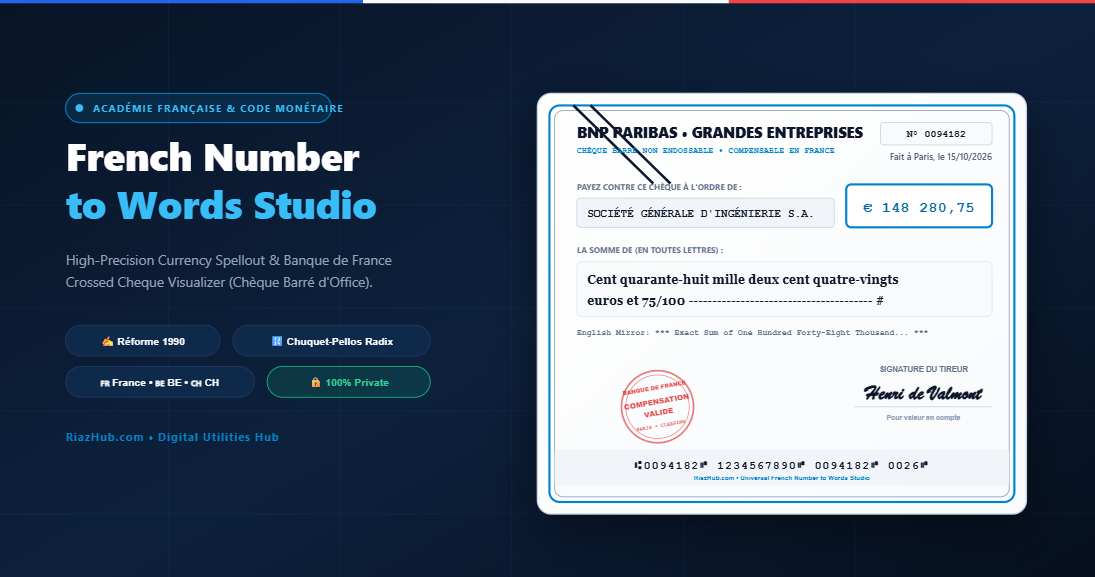
5. Anatomy of a Compliant French Bank Cheque (Chèque Barré)
French banking checks operate under strict anti-fraud conventions supervised by the Banque de France and the European Central Bank:
- Le Barrement d’Office (Crossed Cheque): Two parallel transversal lines drawn in the upper left corner. In France, almost all checkbooks issued to businesses and individuals are pre-crossed (barrés d’office) and non-endorsable (non endossables). This prevents cash payouts at bank tellers and mandates deposit into a verified bank account.
- Numeric Amount Box: Rendered on the right, enclosed with protective asterisks or hash symbols (e.g.,
*** € 148 280,75 ***) to prevent digit interpolation. - The Statutory Amount in Words (La Somme en Toutes Lettres): The amount is preceded by legal mentions such as « Payez contre ce chèque la somme de : » or « Arrêté le présent chèque à la somme de : ». Trailing empty spaces must be closed with safety dashes (
---------------- #) to prevent fraudulent additions. - CMC-7 / E-13B Clearing Line: The magnetic ink characters at the bottom of the draft allow high-speed optical and magnetic reader-sorters at clearing houses to verify the issuing bank branch, check serial number, and routing codes.
You can generate high-resolution, Banque de France compliant drafts using the live canvas visualizer in the French Number to Words Converter, which exports branded check graphics, printable PDFs, and accounting slips with a single click.
6. Privacy & Data Security in Modern Financial Utilities
When drafting checks, preparing payroll vouchers, or transcribing vendor invoices, financial privacy is paramount. Many online conversion tools transmit input data to external servers, exposing commercial balances and payee names to potential data harvesting.
The RiazHub French Spellout Studio operates on a strict 100% Client-Side Architecture. All BigInt calculations, morphosyntactic linguistic chunking, canvas graphics, and file exports execute entirely inside your local browser memory. Zero financial records or payee details are ever sent to an external server or cloud database.
Frequently Asked Questions (FAQ)
vingt takes the plural marker ‘s’ only when it is multiplied (4 × 20 = 80) and terminates the numeral. As soon as another digit follows (such as quatre-vingt-cinq), it immediately reverts to its invariable form.French Number to Words & Cheque Studio
High-precision Francophone morphosyntactic spellout engine conforming to Académie Française orthographic directives, 1990 Rectifications, Chuquet-Pellos Échelle Longue ($10^6$ Million, $10^9$ Milliard, $10^{12}$ Billion), and Code Monétaire et Financier Article L131-10 statutory word supremacy.
💰 Amount & Financial Details Input Deck
🔬 Morphosyntactic Radix Decomposition (Échelle Longue)
| Scale Magnitude | Numeric Value | French Transcription | Grammatical Rule Applied |
|---|
Bordereau de Règlement & Reçu Comptable
📖 Grammaire des Nombres & Droit des Chèques Bancaires Référentiel Académie
1. L'Accord de « Vingt » et « Cent » :
L'Académie Française stipule que cent et vingt prennent un « s » lorsqu'ils sont multipliés et qu'aucun autre numéral ne les suit :
• Exemple : quatre-vingts euros (80), mais quatre-vingt-cinq euros (85).
• Exemple : deux cents euros (200), mais deux cent cinquante euros (250).
• Invariabilité devant mille : On écrit trois cent mille (sans « s » à cent). En revanche, devant million ou milliard (qui sont des noms substantifs), l'accord s'applique : deux cents millions.
2. La Réforme de l'Orthographe de 1990 :
La règle traditionnelle n'utilisait de traits d'union que pour les nombres inférieurs à 100 non liés par « et ». Les rectifications officielles de 1990 recommandent le trait d'union systématique entre tous les termes numéraux composant un nombre (ex : cent-quarante-huit-mille-deux-cents).
3. L'Échelle Longue (Chuquet-Pellos) vs Échelle Courte :
Dans tous les pays francophones et selon le décret n° 61-501, le système numérique utilisé est l'Échelle Longue :
• $10^6$ = Million
• $10^9$ = Milliard (et non "Billion" comme en anglais américain)
• $10^{12}$ = Billion (un million de millions)
• $10^{15}$ = Billiard
• $10^{18}$ = Trillion
4. Code Monétaire et Financier (Article L131-10) :
« Le chèque dont le montant est écrit à la fois en toutes lettres et en chiffres vaut, en cas de différence, pour la somme écrite en toutes lettres. » Les mentions littérales priment toujours légalement sur la saisie numérique pour prévenir la falsification.
En français, le mot vingt (issu du système vigésimal en base 20 hérité des Celtes) ne prend la marque du pluriel que lorsqu'il est multiplié par quatre (4 × 20 = 80) et qu'il n'est pas suivi d'un autre chiffre. Dès qu'un adjectif numéral lui succède (comme quatre-vingt-un, quatre-vingt-deux, quatre-vingt-cinq), il redevient immédiatement invariable. En Suisse romande, ce problème est éludé par l'usage régulier du terme huitante.
La règle traditionnelle impose l'usage du trait d'union uniquement pour lier des numéraux inférieurs à cent qui ne sont pas déjà unis par la conjonction « et » (ex. vingt et un, quarante-deux, mais cent cinquante). La réforme de l'Académie Française de 1990 simplifie radicalement cette règle en recommandant d'unir par un trait d'union tous les termes composant un nombre cardinal : cent-quarante-huit-mille-deux-cent-quatre-vingts.
Le barrement (deux traits parallèles transversaux tracés au recto du chèque) est une mesure de sécurité obligatoire en France (chèque barré d'office et non endossable). Il interdit formellement le paiement au guichet en espèces à un tiers quelconque et impose que le chèque soit exclusivement encaissé par l'intermédiaire d'un compte bancaire ou postal ouvert au nom du bénéficiaire désigné.
Cet outil fonctionne à 100% dans le moteur d'exécution JavaScript de votre navigateur web. Aucune coordonnée bancaire, aucun montant de transaction, aucun nom de tiers ou d'entreprise n'est transmis vers un serveur distant ou un service d'analyse tiers. Toutes les synthèses graphiques, calculs BigInt et fichiers exportés sont compilés localement via les API HTML5 Canvas, Blob et LocalStorage.