
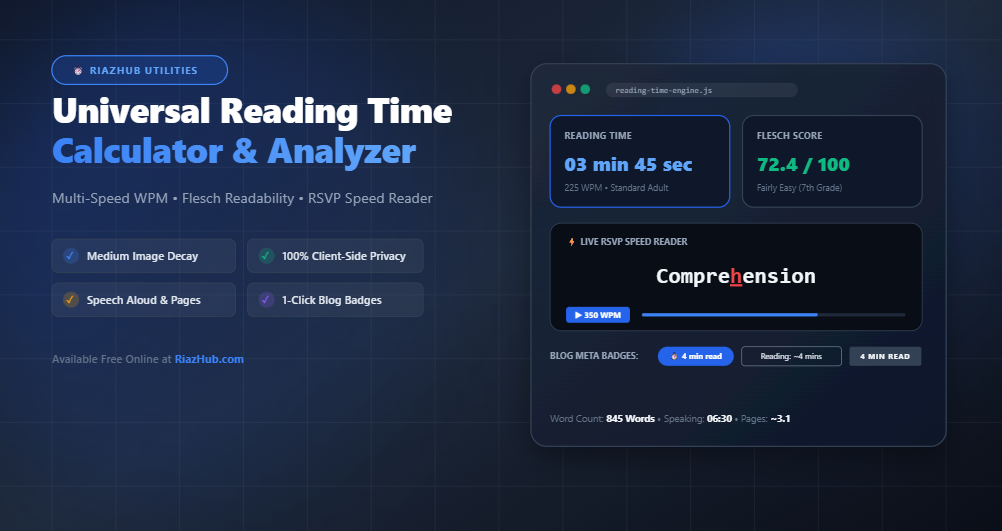
Universal Reading Time Calculator & Content Consumption Analyzer: The Definitive Guide to WPM, Readability, and Audience Engagement
Whether you are an author polishing a novel chapter, a digital marketer optimizing long-form articles for maximum dwell time, or a podcaster scripting a timed speech, you can test your content instantly using the free Universal Reading Time Calculator & Content Consumption Analyzer on RiazHub.com.
Why Calculating Accurate Reading Time is Critical for Digital Publishers
According to cognitive psychology studies, human attention spans in online reading environments are deeply influenced by perceived time investment. Displaying reading times offers several tangible benefits:
- Reduces Bounce Rates & Exit Rates: Readers who know an article takes exactly 4 minutes are significantly more likely to finish it rather than abandoning midway.
- Boosts Dwell Time (SEO Metric): Search engine ranking algorithms reward pages where visitors remain engaged throughout the duration of the content.
- Assists Multi-Demographic Readers: Global audiences encompass native speakers, bilingual ESL learners, fast skimmers, and listeners consuming audio narration.
- Improves Speech & Presentation Rehearsal: Knowing the exact aloud oral speaking duration helps keynote presenters, podcast hosts, and video scriptwriters pace their delivery perfectly.
You can analyze any text across 5 distinct reading demographics using the Universal Reading Time Calculator, which updates all metrics in real time as you type or paste your draft.
The Scientific Standards of Reading Speed: Words Per Minute (WPM)
Reading speed is measured in Words Per Minute (WPM). A landmark 2019 meta-analysis conducted by psychologist Marc Brysbaert (synthesizing 190 studies covering over 17,000 individuals) established universal reading baselines across various cognitive modes:
| Reader Demographic | Average Speed (WPM) | Cognitive Mode & Focus | Common Content Types |
|---|---|---|---|
| Elementary / Early Learner | 100–120 WPM | Phonetic decoding, foundational vocabulary | Children’s books, beginner learning guides |
| Non-Native / ESL Reader | 140–160 WPM | Linguistic translation, syntax processing | Localized documentation, international news |
| Slow / Deep Comprehension | 130–160 WPM | Critical analysis, technical deduction | Legal contracts, academic research, medical journals |
| Average Adult (Standard) | 200–250 WPM (225 WPM) | Fluent lexical retrieval without sub-vocal drag | Standard blogs, online news, fiction & non-fiction |
| Skimmer / Fast Reader | 300–380 WPM | Visual scanning for key terms and summaries | Daily newsletters, executive briefings |
| Speed Reader (RSVP Mode) | 450–700+ WPM | Suppressed sub-vocalization, rapid fixation | Trained rapid skimming, RSVP tools |
| Speaking Aloud / Speech Mode | 120–140 WPM (130 WPM) | Oral articulation, natural pausing, cadence | Podcasts, keynote speeches, YouTube scripts |
With the Reading Time Calculator on RiazHub, you can switch between preset profiles (Slow, Average Adult, Fast Skimmer, Speed Reader) or drag a custom WPM slider anywhere from 100 to 600 WPM to tailor the estimate to your exact target audience.
Accounting for Visual Media: The Medium Image Decay Algorithm
A frequent error in basic reading time widgets is calculating duration solely based on word count while ignoring visual media. In modern blog posts, high-resolution infographics, photos, diagrams, and screenshots require deliberate visual inspection time.
Popular digital publication platforms like Medium.com solved this problem by introducing the Image Attention Decay Formula:
- Image #1: Adds 12 seconds of visual inspection time.
- Image #2: Adds 11 seconds.
- Image #3: Adds 10 seconds.
- Image #4: Adds 9 seconds.
- Subsequent Images: Decrements by 1 second down to a floor of 3 seconds minimum per additional image.
- Interactive Media (Videos & Code Blocks): Add 30 seconds of active engagement time per unit.
When you input the number of images and embedded code blocks into the Content Consumption Analyzer, the tool automatically calculates and layers this media overhead directly into the estimated reading duration.
Measuring Readability with the Flesch Reading Ease Formula
Knowing how long text takes to read is only half the battle; knowing how easy it is to comprehend is equally vital. The Flesch Reading Ease Formula is the global benchmark for assessing textual complexity:
Flesch Reading Ease = 206.835 - 1.015 × (Total Words / Total Sentences) - 84.6 × (Total Syllables / Total Words)The resulting score ranges from 0 to 100:
- 90.0–100.0 (Very Easy): Easily understood by an average 5th-grade student (conversational stories, comics).
- 80.0–89.0 (Easy): 6th-grade level (approachable blog posts, consumer product guides).
- 70.0–79.0 (Fairly Easy): 7th-grade level (standard online journalism, lifestyle magazines).
- 60.0–69.0 (Standard / Plain English): 8th to 9th-grade level (popular non-fiction, major news publications).
- 50.0–59.0 (Fairly Difficult): 10th to 12th-grade level (technical documentation, professional manuals).
- 30.0–49.0 (Difficult): College undergraduate level (academic journals, medical treatises).
- 0.0–29.0 (Very Confusing): University graduate level (legal briefs, patent filings, statutory law).
Whenever you paste your manuscript into the Universal Reading Time Calculator, the built-in natural language processing engine splits sentences, tokenizes syllables, and instantly outputs your Flesch score alongside the matching grade level.
Live RSVP Speed Reader: Training Faster Reading with Optical Focal Points
Standard reading involves ocular saccades—rapid eye movements jumping from word to word. During saccades, processing pauses for 200–250 milliseconds per fixation. Rapid Serial Visual Presentation (RSVP) eliminates saccadic eye movements by projecting words individually in a fixed reticle position.
The Universal Reading Time Calculator & Content Consumption Analyzer includes a built-in Live RSVP Speed Reader featuring:
- Optical Recognition Point (ORP) Highlighting: Automatically highlights the optical focal letter of each word in high-contrast red so your brain recognizes words instantly without eye drift.
- Dynamic WPM Control: Adjust RSVP speeds on the fly from 150 WPM up to 800 WPM.
- Full Step & Progress Controls: Play, pause, skip backward 10 words, jump forward, or restart from the beginning with real-time percentage completion tracking.
How to Generate 1-Click Reading Time Badges for Your Blog
Content creators and webmasters can display sleek reading time badges on their blog posts without needing custom code. The RiazHub Reading Time Calculator provides instant 1-click badge generators in both HTML and Markdown:
- Paste your draft into the canvas or drop a
.txtor.mdfile into the dropzone. - Select your preferred badge style:
- Modern Pill Badge:
⏱️ 4 min read - Minimal Outline Badge:
Reading time: ~4 mins - Caps Dark Badge:
4 MIN READ
- Modern Pill Badge:
- Click Copy HTML or Copy Markdown to paste the snippet directly into WordPress Gutenberg, Medium, Ghost, Dev.to, or GitHub README files.
Comprehensive Multi-Format Export Capabilities
In addition to live metrics, you can export your analysis for editorial reviews or publishing audits:
- Copy Reading Metrics Summary: Copies a formatted summary directly to your clipboard.
- Download Full Markdown Report (.md): Generates a clean Markdown document containing all word counts, sentence lengths, speaking times, and readability scores.
- Export Metrics as JSON (.json): Provides raw JSON data structured for automated build pipelines, CMS integrations, or editorial analytics.
Best of all, the entire calculation takes place 100% inside your browser. No drafts, essays, or personal writings are ever sent to external servers, ensuring strict privacy and confidentiality.
Frequently Asked Questions (FAQ)
What is the standard WPM used by WordPress and Medium for reading time?
Most modern content management systems and publishing platforms (including Medium) standardize silent reading speed at 200 to 250 WPM, with 225 WPM serving as the universally accepted baseline for adult non-fiction.
How many words equal one standard printed book page?
In the publishing industry, a standard book or manuscript page formatted in 12pt font with 1.5 line spacing typically contains approximately 250 to 300 words (standardized at 275 words per page in our analyzer).
How is speaking time different from silent reading time?
Silent reading occurs visually and averages 225+ WPM. Speaking aloud requires physical articulation, breathing pauses, and cadence modulation, which naturally slows delivery down to 120 to 140 WPM (standard: 130 WPM). The Universal Reading Time Calculator calculates both metrics simultaneously.
Does the tool support non-English scripts like Arabic, Urdu, or Cyrillic?
Yes. The tokenization engine uses modern Unicode character property definitions (\p{L}\p{N}) with bidirectional (dir="auto") text rendering to accurately count words and calculate reading metrics across Latin, Arabic, Urdu, Cyrillic, and multilingual texts.
Conclusion: Supercharge Your Editorial Workflow Today
Accurate reading time estimations and readability scoring bridge the gap between content creators and engaged readers. By understanding your content’s consumption metrics before publishing, you can optimize sentence complexity, structure your media elements, and deliver an outstanding user experience.
Ready to analyze your next article, essay, or presentation? Try the free Universal Reading Time Calculator & Content Consumption Analyzer on RiazHub now and take full control of your content metrics!
Universal Reading Time Calculator & Content Analyzer
Calculate accurate silent reading time, speaking duration, readability score, and content consumption benchmarks in real time.
Multi-Demographic Reading Duration Matrix
Real-time comparison across diverse reader personas, linguistic skill levels, and consumption modes.
| Audience / Persona | Typical Speed | Duration (Minutes:Seconds) | Total Minutes | Suitable Use Case |
|---|---|---|---|---|
|
Elementary / Early Reader
Developing vocabulary
|
100 WPM | 00:00 | 0.0 min | Children's books, beginner learning materials |
|
Non-Native / ESL Reader
Secondary language processing
|
150 WPM | 00:00 | 0.0 min | International readership, localized docs |
|
Average Adult Reader
Standard publication benchmark
|
225 WPM | 00:00 | 0.0 min | Medium blogs, news, fiction & non-fiction |
|
Skimmer / Fast Reader
High lexical scanning ability
|
350 WPM | 00:00 | 0.0 min | Tech executives, daily news scans, summaries |
|
Speech / Audio Narration
Natural spoken articulation
|
130 WPM | 00:00 | 0.0 min | Podcasts, audiobooks, conference presentations |
Reading Benchmarks, Science & Readability Guide
Learn the formulas, scientific speed metrics, and algorithm mechanics used to calculate reading times.
Extensive cognitive research (notably Marc Brysbaert's 2019 meta-analysis covering 190 studies and 17,000+ individuals) reveals key consumption benchmarks:
- Silent Reading (English): Average adults read non-fiction text at 200 to 250 WPM, with 225 WPM representing the international standard baseline.
- Oral Reading & Speaking: Articulating words aloud introduces physical speech cadence limits, averaging 120 to 140 WPM (standardized at 130 WPM for presentation timing).
- Speed Reading & RSVP: Without sub-vocalization, rapid serial visual presentation tools allow processing upwards of 400–600 WPM with acceptable comprehension for familiar topics.
Modern publishing platforms (such as Medium.com) do not simply divide word count by WPM. They calculate visual media attention decay as follows:
- First Image: Adds 12 seconds of visual inspection time.
- Second Image: Adds 11 seconds.
- Subsequent Images: Decrements by 1 second for each subsequent image down to 3 seconds minimum per image (10s, 9s, 8s, 7s, 6s, 5s, 4s, 3s for all further images).
- Embedded Videos & Code Blocks: Add a baseline engagement allocation (default: 30s each) to reflect interactive viewing.
The Flesch Reading Ease score measures text complexity on a 0–100 scale using the classic formula:
Score = 206.835 - 1.015 × (Total Words / Total Sentences) - 84.6 × (Total Syllables / Total Words)
| Score | Difficulty | Target Audience |
|---|---|---|
| 90–100 | Very Easy | 5th Grade student (Comics, simple stories) |
| 80–89 | Easy | 6th Grade student (Conversational blog posts) |
| 70–79 | Fairly Easy | 7th Grade student (Standard online news) |
| 60–69 | Standard | 8th–9th Grade (Plain English, popular non-fiction) |
| 50–59 | Fairly Difficult | 10th–12th Grade (High school textbooks) |
| 30–49 | Difficult | College level (Academic journals, specialized press) |
| 0–29 | Very Confusing | University graduate (Legal contracts, patents) |
Your content privacy is absolute. This tool is built entirely with client-side JavaScript (ES6+):
- Zero Server Transmission: Text pasted, uploaded, or analyzed remains strictly inside your browser's local memory sandbox.
- No Analytics Tracking of Text: No words, sentences, or metadata are ever recorded, saved into databases, or transmitted over network sockets.
- Offline Capable: Once loaded, the calculator performs all tokenization and metrics computation without requiring active internet connectivity.