
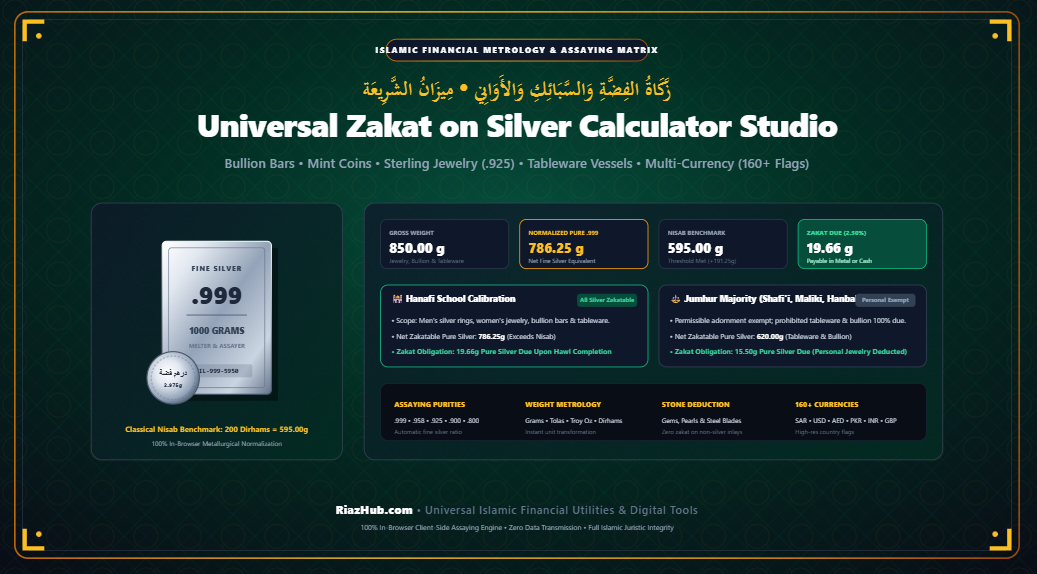
Comprehensive Guide to Zakat on Silver, Bullion Bars, Coins & Silverware: Classical Fiqh, Nisab Metrology & Multi-Purity Assaying
1. The Sacred Obligation of Zakat on Silver (Zakat al-Fiddah)
In the Islamic financial matrix, silver (al-Fiddah – الفضة) alongside gold (al-Dhahab) forms the foundational monetary benchmark (Al-Athman – الأثمان) of the Shari’ah. Under the divine imperative established in the Holy Qur’an and authentic prophetic traditions, silver in all its held stores whether minted into currency, cast into investment bars, fashioned into jewelry, or crafted into tableware is subject to an annual wealth purification duty of 2.50% (one-fortieth / ربع العشر) once it satisfies the Nisab threshold and completes a Hawl (one lunar year in possession).
While many believers are well-versed in calculating Zakat on cash and gold, silver calculations frequently induce confusion due to varied alloy purities (.999 Fine Silver, .925 Sterling Silver, .800 European Silverware), embedded non-silver gemstones, weight conversion standards across global cultures (Tolas, Troy Ounces, Grams, Dirhams), and diverging rulings between the Hanafi school and the Jumhur majority (Shafi’i, Maliki, Hanbali).
To address these intricate calculations with mathematical rigor and juristic precision, scholars and developers created the Universal Zakat on Silver, Bullion & Silverware Calculator at RiazHub.com, providing immediate multi-purity normalization and Fiqh school calibration directly in your browser.
2. The Classical Nisab of Silver: Authenticated Hadith Evidence & Metrology
Unlike contemporary fiat wealth where the Nisab is derived by analogy, the Nisab of silver is explicitly, unequivocally established by the Prophet Muhammad ﷺ:
Two hundred classical silver Dirhams (Mi’atay Dirham – مائتي درهم) equals five Awqas (أواق). According to rigorous contemporary metrological consensus adopted by major Islamic academies including the International Islamic Fiqh Academy (IIFA), AAOIFI (Accounting and Auditing Organization for Islamic Financial Institutions), and the Permanent Committee for Scholarly Research (IFTA):
- Standard Consensus Nisab: 595.00 Grams of pure fine silver (.999).
- Classical Hanafi Metrology Lineage: 612.36 Grams (based on 1 Dirham = 3.0618g).
If your net normalized pure silver holdings equal or exceed 595.00 grams (or 612.36g under classical Hanafi standards) and remain above this threshold upon the completion of your lunar Hawl, Zakat is obligatory. You can test your holdings against both standards simultaneously using the Zakat on Silver Nisab Validation Studio.
3. The Four Sunni Schools on Silver Jewelry & Personal Adornment
One of the most consequential divergences in Islamic jurisprudence concerns whether silver worn as personal adornment is exempt from Zakat or subject to compulsory annual assessment.
| Jurisprudential School | Personal Adornment (Jewelry & Rings) | Bullion, Bars & Coins | Silverware & Vessels |
|---|---|---|---|
| Hanafi School (Imam Abu Hanifah) | Obligatory (All silver regardless of form) | Obligatory | Obligatory |
| Shafi’i School (Imam al-Shafi’i) | Exempt (If permissible & customary) | Obligatory | Obligatory |
| Maliki School (Imam Malik) | Exempt (If permissible & customary) | Obligatory | Obligatory |
| Hanbali School (Imam Ahmad) | Exempt (If permissible & customary) | Obligatory | Obligatory |
The Hanafi School Ruling
The Hanafi jurists (including Imam Abu Hanifah, Imam Abu Yusuf, and Imam Muhammad al-Shaybani) rule that the prophetic texts regarding Zakat on gold and silver are universal and absolute. They argue that gold and silver are Nuqud (inherent money) created by Allah to facilitate trade and measure value. Therefore, any silver possession whether a woman’s sterling silver necklace, a man’s silver ring, bullion casts, or ornamental displays is subject to Zakat if total net weight meets Nisab.
The Jumhur (Majority) School Ruling
The Jumhur (Shafi’i, Maliki, and Hanbali schools) hold that permissible personal jewelry (al-Huliyy al-Mubah) is exempt from Zakat. They draw an analogy to personal clothing, riding animals, and household residences, which are non-zakatable assets intended for lawful personal utility rather than growth (Nama’). However, this exemption is strictly conditional:
- The jewelry must be designated for permissible, non-extravagant personal wear.
- If silver is acquired for commercial hoarding, store-of-value investment, or capital preservation, the exemption is immediately voided and Zakat becomes obligatory across all schools.
- If the item is prohibited in Islam (such as silver dining plates or cups), it can never qualify for the personal wear exemption.
4. The Absolute Prohibition of Silver Vessels & Tableware (Awani al-Fiddah)
A critical area often overlooked by households is antique silverware, heavy silver trays, tea services, cutlery, and ornamental chalices. In Islamic law, eating or drinking from vessels made of silver or gold is an explicit, severe prohibition:
Because utilizing silver vessels for dining, drinking, or banquet service is unlawful (Haram), no jurist across any of the four schools permits exempting silverware from Zakat. Unlawful assets cannot enjoy the concession granted to permissible jewelry. Consequently, all silver tea sets, cutlery, goblets, and trays are treated strictly as stored bullion alloys and are 100% subject to Zakat based on their net silver weight once the Nisab is achieved.
5. Men’s Silver Rings vs. Women’s Silver Adornment
Unlike gold, which is categorically unlawful for men to wear as adornment, silver possesses an established Sunnah concession for male believers. The Prophet Muhammad ﷺ wore an engraved silver signet ring on his pinky finger to seal formal diplomatic correspondence to foreign emperors:
- Permissible Weight for Men: Classical jurists specify that a man’s silver ring should be modest, customarily not exceeding one Mithqal (approximately 4.25 to 4.36 grams).
- Juristic Treatment: Under the Jumhur, this single customary silver ring is completely exempt from Zakat. Under the Hanafi school, it is weighed alongside all other silver assets.
- Other Male Silver Adornment: Silver bracelets, chains, or medallions for men are deemed prohibited by classical scholars due to mimicking women’s jewelry or vanity, and thus carry full Zakat liability.
6. Multi-Purity Assaying & Metallurgical Normalization Equation
Silver is rarely held in its 100% pure metallurgical state. Because fine silver is ductile and soft, it is alloyed with copper, nickel, or zinc to provide mechanical durability for jewelry and utensils. To accurately calculate Zakat, Islamic jurisprudence requires determining the exact weight of pure fine silver (.999 equivalent) within the alloy.
| Alloy Standard | Purity Stamp / Millesimal | Silver Content Ratio | Common Applications |
|---|---|---|---|
| Fine Silver | .999 (99.9% Pure) | 0.999 | Cast investment bars, sovereign mint coins |
| Britannia Silver | .958 (95.8% Pure) | 0.958 | High-grade British bullion & tableware |
| Sterling Silver | .925 (92.5% Pure) | 0.925 | Global jewelry standard, rings, chains, flatware |
| Coin Silver | .900 (90.0% Pure) | 0.900 | Vintage US & European circulation coinage |
| European Silver | .835 (83.5% Pure) | 0.835 | Continental European tea sets & ornaments |
| European Silverware | .800 (80.0% Pure) | 0.800 | Heavy antique cutlery, candleholders, jugs |
The Assaying Normalization Formula
To convert any mixed portfolio into pure silver equivalent:
Example: If you possess 800 grams of antique .800 silverware and 400 grams of .925 sterling silver jewelry:
- Silverware pure content: $800\text{g} \times 0.800 = 640.00\text{g}$ of pure silver.
- Jewelry pure content: $400\text{g} \times 0.925 = 370.00\text{g}$ of pure silver.
- Total Net Pure Silver: $640.00\text{g} + 370.00\text{g} = \mathbf{1,010.00\text{g}}$.
- Because $1,010.00\text{g} \ge 595.00\text{g}$ Nisab, Zakat of $2.5\%$ is obligatory ($1,010 \times 0.025 = \mathbf{25.25\text{g}}$ pure silver).
Rather than performing these manual conversions, the Online Zakat on Silver Assaying Matrix automatically applies official metallurgical ratios to every row in your ledger.
7. The Gemstone, Glass & Non-Silver Deduction Protocol
Under classical Shari’ah principles, non-monetary precious stones (such as diamonds, emeralds, rubies, sapphires, cubic zirconia, or glass beads) and structural non-silver inlays (such as stainless steel knife blades, wooden handles, or lead base weights in candelabras) carry 0% Zakat unless held explicitly as business trading inventory (Urud al-Tijarah).
When assessing jewelry or utensils:
- Measure or Estimate Non-Silver Materials: Note the weight of embedded gemstones, pearls, or steel inserts.
- Subtract from Gross Weight: Deduct non-silver weight before applying purity multipliers.
- Calculate Only on Remaining Metal Alloy: Ensure Zakat is levied purely on genuine silver content.
8. Global Weight Metrology: Grams, Tolas, Troy Ounces & Dirhams
Silver is bought, traded, and inherited across different regional metrological systems. To maintain mathematical integrity, all global weight units must be converted to standard metric grams:
- 1 Tola (South Asian Standard): $11.6638\text{ Grams}$ (common in Pakistan, India, Bangladesh, and diaspora communities).
- 1 Troy Ounce (oz t – Global Bullion Standard): $31.1035\text{ Grams}$ (standard for 1oz coins, Silver Eagles, Maple Leafs, Philharmonics).
- 1 Classical Dirham: $2.975\text{ Grams}$ (the historical benchmark of Medina al-Munawwarah).
- 1 Kilogram (kg): $1,000.00\text{ Grams}$ (standard wholesale bullion bar).
When using the RiazHub Universal Silver Metrology Tool, you can switch between Grams, Tolas, Ounces, and Kilograms with instant automated conversion.
9. Settlement: Paying in Physical Silver vs. Cash Valuation (Al-Qimah)
Once your silver Zakat is computed, Islamic jurisprudence provides believers with two valid settlement modalities:
Option A: Settlement in Physical Silver Metal
You may physically distribute 2.50% of the pure silver weight (or equivalent coins/bars) directly to eligible Zakat recipients (the eight categories defined in Surah at-Tawbah 9:60). For instance, if your Zakat due is 25.00 grams of pure silver, gifting a 25g fine silver bar or minted dirhams fulfills the obligation completely.
Option B: Settlement in Cash Currency Equivalent (Al-Qimah)
According to the school of Imam Abu Hanifah and accepted by contemporary Fatwa bodies, it is permissible—and often more beneficial for the poor to settle silver Zakat in fiat currency. The cash valuation must be calculated using the live spot market price of pure silver per gram on the exact day your Hawl completes, multiplied by your total zakatable pure silver grams.
The RiazHub calculator integrates over 160+ global currencies (including SAR ﷼, USD $, AED د.إ, PKR ₨, INR ₹, GBP £, EUR €, CAD $) complete with authentic country flags and sensible market price baselines.
10. Lunar Hawl (2.50%) vs. Solar Fiscal Year (2.577%)
The default Islamic year is lunar (Hijri), comprising approximately 354 days. Zakat calculated on a lunar Hawl is exactly $2.50\%$ ($1/40$). However, if an individual, institution, or family office tracks wealth according to the Gregorian solar calendar (365.25 days), the rate must be mathematically reconciled to account for the additional 11 days:
The RiazHub Silver Zakat Calculator features an instant toggle between Lunar Hawl (2.50%) and Solar Fiscal Year (2.577%) to ensure zero underpayment.
11. Step-by-Step: How to Calculate Your Silver Zakat on RiazHub
Auditing your silver holdings takes less than two minutes:
- Access the Tool: Open the Universal Zakat on Silver, Bullion & Silverware Calculator.
- Select Currency & Weight Unit: Choose your local currency (with country flag) and select Grams, Tolas, or Ounces.
- Choose Your Fiqh School: Toggle between Hanafi (All Silver Zakatable) and Jumhur (Permissible Wear Exempt).
- Enter Silver Holdings: Add items to the ledger, select their purity (.999 to .800), enter gross weights, and input non-silver stone deductions.
- Review Audited Statement: Examine the real-time Nisab gauge, side-by-side Hanafi vs. Jumhur variance, and total Zakat due in both pure silver weight and currency.
- Generate & Download Share Card: Export a high-resolution 1200×630 social audit card in Sacred Emerald or Platinum Silver themes for your records, or copy an itemized WhatsApp summary with one click.
12. Frequently Asked Questions (FAQ)
Is Zakat due on silver-plated cutlery or electroplated jewelry?
No. In electroplated items (often stamped “EPNS” or “Silver Plated”), the layer of silver is microscopic often mere microns thick. Because the actual precious metal content is negligible and cannot be extracted economically, scholars treat plated items as base metal alloys (carrying zero Zakat unless held as commercial shop inventory).
Can I combine gold and silver weights to reach Nisab?
Under the Hanafi school, if a person owns both gold and silver and neither alone reaches its respective Nisab, their cash values may be combined. If the total combined value equals or exceeds the silver Nisab (595g of silver), Zakat is payable. Under the Shafi’i and Hanbali schools, gold and silver are distinct categories and are not combined by weight to reach Nisab.
Does the calculator send my financial details to a server?
No. The RiazHub Zakat on Silver Calculator operates with 100% in-browser client-side JavaScript. All calculations, purity normalizations, local storage caching, and canvas statement generation occur entirely on your device with complete privacy.
Universal Zakat on Silver, Bullion & Silverware Calculator
Precision metallurgical assaying, non-silver gemstone deduction protocol, multi-currency valuation with authentic country flags, and classical Islamic jurisprudence calibration (Hanafi vs. Jumhur schools) for fine silver (.999), sterling silver (.925), coins, and silverware vessels.
| Item / Description | Purity | Usage Classification | Gross | Stones | Pure .999 | Status |
|---|---|---|---|---|---|---|
| No items in ledger. Click "Add Silver Item" or choose a preset profile. | ||||||
| Total Net Zakatable Holdings: | 0.00 | 0.00 | 0.00 g | Exempt | ||
Under classical Islamic law, Zakat on silver may be settled in either physical pure silver metal or in cash currency equivalent based on spot market prices upon completion of the lunar Hawl:
 0.00 SAR
Ruling: All silver is zakatable, including customary personal jewelry, silver rings, ornaments, utensils, and bullion without exception.
Ruling: Permissible personal adornment (women's jewelry, men's silver ring) is exempt. Prohibited utensils & bullion are fully zakatable.
📚 Fiqh al-Fiddah: Classical Islamic Jurisprudence of Silver & Silverware
The Nisab of silver is explicitly defined by the Prophet Muhammad ﷺ across multiple authentic traditions:
— Sahih al-Bukhari (1447), Sahih Muslim (979)
Classical Metrology: 200 Islamic Silver Dirhams equals 5 Awqas (أواق), precisely calibrated by contemporary consensus to 595.00 grams of pure silver. In classical Hanafi scholarship according to certain metrological lineages, 1 Dirham = 3.0618g, yielding 612.36 grams. Both benchmarks are supported within this calculator.
Eating, drinking, or serving food from silver vessels, plates, cups, jugs, or silverware cutlery is strictly forbidden in Islam:
— Sahih Muslim (2065)
Unanimous Consensus on Zakat: Because the acquisition and use of silver tableware is unlawful, Islamic jurists across all four major schools (Hanafi, Shafi'i, Maliki, Hanbali) agree without dissent that silver silverware, tea sets, cutlery, and decorative vessels carry zero exemption. They are treated purely as stored metal alloys and are 100% subject to Zakat based upon their net silver weight once the Nisab threshold is reached.
Men's Silver Ring: It is an established Sunnah for men to wear a silver ring (the Prophet ﷺ possessed an engraved silver signet ring for sealing treaties). The permissible weight is customarily up to one Mithqal (~4.25 grams). Under the Jumhur (Shafi'i, Maliki, Hanbali), this permissible ring is exempt from Zakat. The Hanafi school maintains that all silver holdings are calculated together toward Nisab.
Women's Silver Jewelry: Under the Jumhur, customary silver bracelets, necklaces, and anklets kept for permissible adornment are exempt from Zakat. If kept for hoarding, commercial investment, or extravagant taboo weights, they become zakatable. Under the Hanafi school, all women's silver jewelry is zakatable if the Nisab is reached.
Under classical Islamic law, non-monetary precious stones (diamonds, emeralds, rubies, pearls, sapphires, or glass/wood/steel components) are not subject to Zakat unless held explicitly as business trading inventory (Urud al-Tijarah).
When calculating Zakat on silver jewelry or silverware, the weight of inlays, non-silver knife blades, or gemstones must be deducted first. The net alloy weight is then normalized using assaying factors (.999 Fine Silver = 0.999, .925 Sterling Silver = 0.925, .800 Silverware = 0.800) to find the exact net fine silver weight.
The owner possesses the Islamic legal flexibility to fulfill their Zakat obligation in either of two valid manners:
- In Physical Metal: By distributing 2.5% of the pure silver weight directly to eligible recipients (e.g. gifting 15g of pure silver or bullion).
- In Currency Value (Al-Qimah): Permissible according to Imam Abu Hanifah and widely adopted today for modern practical utility, by calculating the spot cash value of the required silver weight on the date the Hawl matures.