
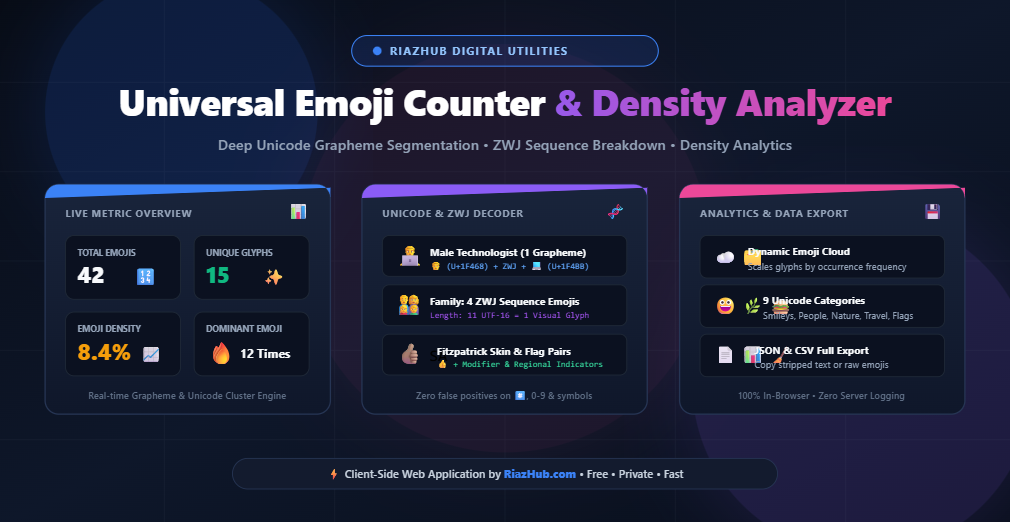
Universal Emoji Counter & Density Analyzer: The Ultimate Guide to Unicode Grapheme Segmentation and Social Media Density Optimization
:-)) into a sophisticated, multi-byte Unicode pictographic language. Whether you are crafting viral captions for Instagram, optimizing Twitter/X character limits, writing engaging LinkedIn thought-leadership posts, or processing natural language datasets, emojis play a pivotal role in audience engagement and sentiment analysis.
However, accurately counting emojis is surprisingly complex. Standard word processors and basic programming string counters often miscalculate compound emojis such as profession sequences (👨💻), multi-person families (👨👩👧👦), skin tone variations (👍🏽), and international flags (🇸🇦) counting a single visual emoji as 2, 4, or even 11 separate characters.
To solve this fundamental digital formatting hurdle, we built the free Universal Emoji Counter, Density Analyzer & Unicode Segmenter on RiazHub. In this comprehensive guide, we examine the inner workings of Unicode grapheme segmentation, explore how Zero-Width Joiners (ZWJ) construct complex glyphs, and provide actionable tips for optimizing emoji density across your social media channels.
Why Traditional Character Counters Fail with Emojis
Most text counters calculate length based on UTF-16 code units (such as JavaScript’s native string.length property) or byte sizes. While this works smoothly for standard English ASCII characters (where 1 character = 1 byte = length 1), emojis violate these assumptions in multiple ways:
1. Surrogate Pairs (Multi-Byte Glyphs)
Standard emojis (like 🚀 Rocket or 🔥 Fire) exist outside the Basic Multilingual Plane (BMP). They reside in Unicode Supplementary Planes (above U+FFFF) and require two 16-bit code units (a high surrogate and a low surrogate) to represent in UTF-16. Consequently, "🚀".length yields 2 instead of 1.
2. Zero-Width Joiner (ZWJ) Sequences
Compound emojis link individual characters using an invisible glue character called the Zero-Width Joiner (\u200D). For instance:
- Man Technologist (👨💻): Composed of
Man (U+1F468)+ZWJ (U+200D)+Personal Computer (U+1F4BB). In standard string counting, this occupies 5 code units, yet visually displays as 1 emoji. - Family Sequence (👨👩👧👦): Composed of
Man+ZWJ+Woman+ZWJ+Girl+ZWJ+Boy. This occupies 11 code units in memory while representing only 1 perceived glyph.
3. Fitzpatrick Skin Tone Modifiers
Modifiers (Unicode range U+1F3FB to U+1F3FF) apply tone variations to human emojis (e.g., 👍 + 🏽 = 👍🏽). Without proper grapheme clustering, naive algorithms count the hand and the pigment swatch as two independent entities.
4. Regional Indicator Flag Pairs
National flags do not have isolated codepoints. Instead, they are formed by pairing two Regional Indicator Symbols representing the ISO 3166-1 alpha-2 country code (e.g., 🇸 + 🇦 = 🇸🇦 Saudi Arabia, 🇵 + 🇰 = 🇵🇰 Pakistan, 🇺 + 🇸 = 🇺🇸 United States).
By using the RiazHub Emoji Counter & Density Analyzer, our client-side engine harnesses the modern Intl.Segmenter Grapheme Cluster API to guarantee that every compound sequence is counted as precisely 1 single visual emoji.
What is Emoji Density and Why Does It Matter?
Emoji Density is the mathematical ratio of total emojis to the total perceived character count in a block of text, expressed as a percentage:
Emoji Density (%) = (Total Emojis ÷ Total Grapheme Characters) × 100
Social media algorithms and audience psychology research demonstrate a clear correlation between strategic emoji placement and post performance:
- Twitter / X: An optimal emoji density of 2% to 4% increases retweets and click-through rates by up to 25% without appearing spammy.
- Instagram & TikTok: Higher visual densities of 5% to 9% improve caption readability, separate key bullet points, and boost comment engagement.
- LinkedIn: A conservative density of 1% to 2% serves as visual bullet points or thematic anchors while preserving executive professionalism.
- Email Subject Lines: Including 1 to 2 relevant emojis boosts open rates by 10%–15%, whereas exceeding 3 emojis triggers spam filters.
Before scheduling your posts, paste your draft into the online Emoji Counter tool to audit your density percentage and dominant emoji frequencies in real-time.
Comparison: Naive String Counting vs. RiazHub Unicode Segmentation
| Emoji / Sequence Example | JavaScript .length |
Basic Regex \p{Emoji} |
RiazHub Grapheme Segmenter | Visual Accuracy |
|---|---|---|---|---|
| 🚀 Standard Rocket | 2 (False) | 1 | 1 | ✅ Accurate |
| 👍🏽 Thumbs Up (Skin Tone) | 4 (False) | 2 (Broken) | 1 | ✅ Accurate |
| 👨💻 Male Technologist (ZWJ) | 5 (False) | 2 (Broken) | 1 | ✅ Accurate |
| 👨👩👧👦 Family Sequence | 11 (False) | 4 (Broken) | 1 | ✅ Accurate |
| 🇸🇦 Saudi Arabia Flag | 4 (False) | 2 (Broken) | 1 | ✅ Accurate |
| #️⃣ Keycap Number Sign | 3 (False) | Matches ASCII # |
1 | ✅ Accurate |
Features of the RiazHub Emoji Counter & Unicode Segmenter
When utilizing the RiazHub Emoji Analyzer, users gain access to a comprehensive suite of analytical and formatting utilities:
1. 4-Card Live KPI Dashboard
Get instant visibility into your total emoji count, unique emoji glyphs, percentage density against total characters, and dominant emoji identification.
2. 3-Tab Interactive Breakdown
- Frequency Table: View occurrence counts, percentage shares, visual progress bars, and Unicode codepoint badges (e.g.,
U+1F680). Sort alphabetically or by frequency. - Dynamic Emoji Cloud: Visually explore your text with emojis sized dynamically according to their usage frequency.
- 9-Category Classification Matrix: Automatically categorize discovered glyphs across Smileys & Emotion, People & Body, Animals & Nature, Food & Drink, Travel & Places, Activities, Objects, Symbols, and Flags.
3. Text Manipulation & Emoji Stripping
Need clean text without emojis for academic submissions, database storage, or SMS delivery? Click “Strip All Emojis” or copy sanitized text with one click. Conversely, click “Extract Only Emojis” to isolate all glyphs into a concentrated string.
4. Multi-Format Data Export (JSON & CSV)
Content strategists and data scientists can instantly download the complete analysis as structured JSON or CSV spreadsheets for downstream reporting and NLP workflows.
How to Analyze Emoji Counts in 3 Simple Steps
- Paste or Upload Your Text: Navigate to the Universal Emoji Counter. Paste your draft, social caption, or tweet into the workspace textarea, or drag and drop any
.txt,.md, or.csvfile. - Review Real-Time Analytics: As you type, the engine automatically calculates your total emojis, unique glyphs, and overall emoji density. Switch between the Breakdown Table, Emoji Cloud, and Category Matrix tabs for deeper insights.
- Export or Copy Results: Copy the extracted emojis, copy the cleaned plain text, or export your full analytical report as JSON/CSV.
100% Client-Side Privacy Guarantee
Unlike server-side analysis tools that upload your private drafts, confidential business communications, and social captions to remote cloud servers, the RiazHub Emoji Counter & Density Analyzer executes 100% of calculations in your local web browser. Your data never leaves your device, guaranteeing zero latency and absolute privacy.
Frequently Asked Questions (FAQ)
Can this tool count emojis in Right-to-Left (RTL) languages like Arabic or Urdu?
Yes. The tool features native bidirectional (dir="auto") support and properly segments emojis embedded within Arabic, Urdu, Hebrew, or Persian text without breaking sentence alignment or glyph grouping.
Does the counter support the newest Unicode 15 and 16 emojis?
Yes. By employing standard ECMAScript Unicode Property Escapes (\p{Extended_Pictographic}) and the browser’s native grapheme clustering engine, the tool automatically supports all newly released emojis without requiring manual updates.
How do I extract only emojis from a long text?
Simply paste your text into the RiazHub Emoji Counter and click the “Extract Only Emojis” button in the action toolbar or the “Copy All Extracted Emojis” button at the bottom.
Universal Emoji Counter & Density Analyzer
Count total and unique emojis, analyze density percentages, decode complex Zero-Width Joiner (ZWJ) sequences, and export multi-format Unicode breakdown in real-time.
| Glyph | Unicode Codepoint(s) | Type & Sequence | Count | Share / Density | Action |
|---|---|---|---|---|---|
|
No emojis detected yet. Type or paste some text above. |
|||||
Emoji cloud is empty. Add emojis to generate dynamic visual sizing.
\u200D) is an invisible Unicode character used to connect two or more individual emojis into a single visual glyph. For example, the Technologist emoji (👨💻) is composed of Man (U+1F468) + ZWJ (U+200D) + Laptop (U+1F4BB). This tool utilizes the modern Intl.Segmenter Grapheme Cluster engine to ensure compound emojis and family sequences (e.g., 👨👩👧👦) are counted accurately as 1 single emoji rather than broken across multiple parts.
👍🏽 can have a .length of 4, and 👨👩👧👦 can have a .length of 11. Our parser separates Unicode grapheme clusters from UTF-16 code units so your analytics reflect true visual density.
#) as emojis. By leveraging modern Unicode property escapes (\p{Extended_Pictographic}) in combination with regional indicator pair checks (\p{Regional_Indicator}{2}) and keycap sequence matching (#️⃣), our engine ensures 100% precision across all Unicode 15 & 16+ releases.