
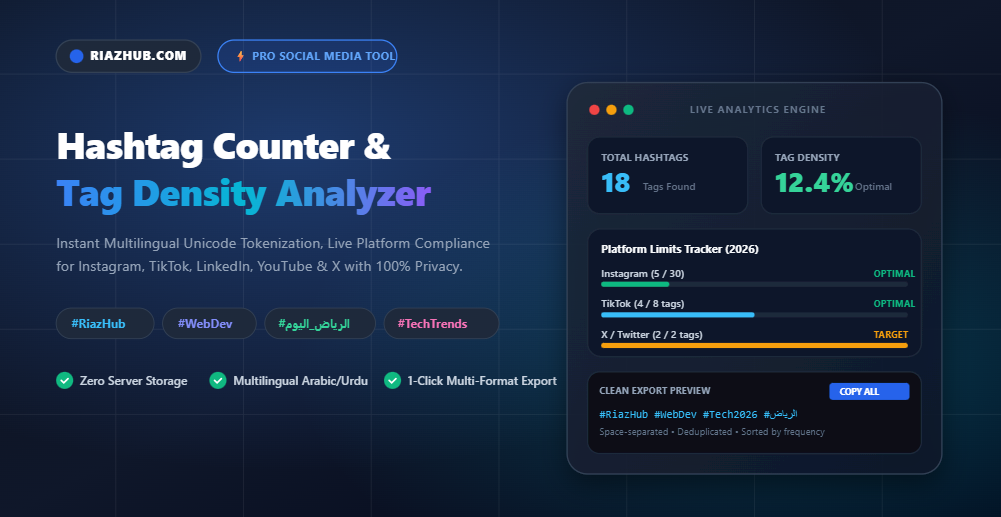
In modern digital marketing and social media algorithms, hashtags have fundamentally evolved. Gone are the days when stuffing thirty unrelated tags into an Instagram caption or stacking twenty buzzwords under a TikTok video guaranteed viral distribution. In 2026, social platforms deploy sophisticated Natural Language Processing (NLP) and contextual vector embeddings to parse your captions.
Hashtags now act as precision category signals. Using too few leaves your content unindexed in search discovery feeds; using too many triggers anti-spam suppression filters; using duplicated or malformed multilingual tags pollutes your topical authority. To maintain algorithmic balance, social media managers and creators use the dedicated Hashtag Counter & Social Media Tag Density Analyzer to inspect every draft before publishing.
⚡ Audit Your Post’s Hashtags in Real Time
Count total tags, identify duplicates, monitor platform limit thresholds, and extract clean lists instantly.
Why Exact Hashtag Counting & Density Analysis Matters
When drafting reels, carousel slides, LinkedIn thought leadership articles, or short-form video descriptions, creators face two distinct metric challenges: absolute platform limits and relative hashtag density.
1. Absolute Platform Thresholds
Every major network enforces hard boundaries or strict algorithmic penalty thresholds:
- Instagram: Enforces a hard maximum of 30 hashtags per post. However, Instagram’s creator guidance recommends 3 to 5 targeted tags to prevent shadow-filtering.
- TikTok: Caps descriptions at 2,200 characters, with an optimal sweet spot of 4 to 8 relevant hashtags. Over-tagging crowds the viewport on mobile devices.
- X (formerly Twitter): Restricts standard posts to 280 characters. The platform’s algorithm penalizes tweets with more than 2 hashtags, viewing excessive tagging as engagement bait.
- LinkedIn: Optimally indexes posts with 3 to 5 industry tags. Stacking more than five tags reduces corporate feed visibility.
- YouTube & YouTube Shorts: Allows up to 15 hashtags in video descriptions before ignoring every tag completely.
2. The Concept of Hashtag Density
Hashtag density is calculated as the mathematical ratio of hashtag tokens relative to the total word count in your post:
$$\text{Hashtag Density } (\%) = \left( \frac{\text{Total Hashtags}}{\text{Total Words}} \right) \times 100$$
A post with 20 total words and 10 hashtags has a density of 50%, which spam detection bots flag as low-quality filler. A balanced post features a density between 5% and 15%. The RiazHub Hashtag Density Analyzer computes this percentage live as you type or paste your copy.
Platform Compliance Comparison Guide (2026 Rules)
| Platform | Hard Limit | Recommended Count | Character Limit | Algorithm Focus |
|---|---|---|---|---|
| 30 tags | 3 – 5 tags | 2,200 chars | Niche Community & Explore page categorization | |
| TikTok | Caption length | 4 – 8 tags | 2,200 chars | For You Page (FYP) semantic vector indexing |
| X (Twitter) | 280 chars total | 1 – 2 tags | 280 chars | Real-time topic clustering & conversation threads |
| No hard limit | 3 – 5 tags | 3,000 chars | Professional skill categories & hashtag followers | |
| YouTube | 15 tags | 3 – 5 tags | 5,000 chars | Search ranking & Suggested Video sidebar signals |
Deep Multilingual Unicode Tokenization (Arabic, Urdu, Asian Scripts)
A common pitfall with legacy hashtag counters is their reliance on outdated regex patterns like /#\w+/g. In standard ASCII regular expressions, word characters (\w) only recognize Latin letters (A–Z), digits (0–9), and underscores. When social media managers paste international or Right-to-Left (RTL) captions containing Arabic (#الرياض_اليوم), Urdu (#پاکستان_زندہ_باد), Persian, Japanese (#ウェブ開発), Chinese, or Cyrillic characters, standard tools fail completely or truncate the words.
The Universal Hashtag Counter tool on RiazHub implements native ECMAScript Unicode property escapes (\p{L} and \p{N}). This guarantees flawless hashtag detection, extraction, and frequency calculation across every written language without character corruption.
Step-by-Step: How to Optimize Your Posts in 30 Seconds
- Paste or Draft Your Post: Paste your social media caption or drop a
.txtor.mdfile directly into the input workspace on the Hashtag Counter online utility. - Inspect the Diagnostic Hero Grid: Instantly check your Total Hashtags, Unique Hashtags, Hashtag Density Ratio, and your Top Hashtag badge.
- Check Platform Compliance Gauges: Review the color-coded progress bars for Instagram, TikTok, LinkedIn, YouTube, and X to ensure you don’t exceed platform limits.
- Filter and Reformat: Toggle Remove Duplicates, Exclude Pure Numbers, or switch casing to PascalCase, lowercase, or UPPERCASE with one click.
- Export or Copy: Click Copy Extracted Hashtags to grab your cleaned tag list, or click Copy Clean Caption to obtain your text with all hashtags stripped out for clean multi-platform cross-posting.
🚀 Clean and Reformat Your Social Media Captions
No downloads, no logins, and zero cloud tracking. Process unlimited hashtags directly in your browser.
The 3-Tier Hashtag Strategy for 2026 Viral Reach
Rather than randomly picking hashtags, top-performing creators deploy the 3-Tier Formula to maximize discoverability across search and recommendation engines:
- Tier 1: Broad Industry Anchors (1–2 Tags): High-volume tags that signal broad topical category (e.g.,
#WebDev,#DigitalMarketing). - Tier 2: Targeted Niche Keywords (2–3 Tags): Medium-volume tags where community engagement is high and competition is low (e.g.,
#WordPressTips,#HashtagOptimization). - Tier 3: Branded & Campaign Identity (1 Tag): Your unique brand identity marker (e.g.,
#RiazHub) to aggregate your audience’s conversations.
100% Client-Side Privacy Guarantee
Content creators, brand managers, and PR agencies frequently work on embargoed announcements, unreleased campaign copy, and confidential client captions. Unlike third-party SaaS services that upload your text to remote servers, the RiazHub Hashtag Counter & Density Analyzer runs 100% in-browser using pure client-side JavaScript. No text is ever saved, logged, or transmitted across the web.
Frequently Asked Questions (FAQ)
What is the ideal hashtag density for social media captions?
An optimal hashtag density ranges between 5% and 15% of total word count. Posts where hashtags make up more than 30% of the text are frequently flagged by spam detection algorithms as low quality.
Can I remove hashtags from my caption while keeping the text?
Yes. The Hashtag Counter utility includes a dedicated Strip Hashtags action and a Copy Clean Caption button that removes all hashtag tokens and formats the remaining text cleanly for publication.
Does the tool support Arabic and non-Latin hashtags?
Yes. Full multilingual Unicode regex patterns ensure that hashtags written in Arabic, Urdu, Persian, Chinese, Japanese, and Cyrillic are detected and counted with complete accuracy.
Can I export my hashtag analysis to CSV or JSON?
Yes. You can export a structured CSV spreadsheet containing tag names, occurrence counts, and density ratios, or download a full JSON dataset with a single click.
Start Optimizing Your Social Media Hashtags Today
Ensure platform compliance, prevent shadow-penalties, and streamline your workflow with RiazHub’s free suite.
Hashtag Counter & Social Media Tag Analyzer
Count total & unique hashtags, monitor platform limits, analyze keyword tag density, and extract clean, formatted hashtag lists instantly.
Type, paste, or load a sample post to inspect tags.
Social Media Hashtag Strategy & Algorithmic Best Practices (2026)
- 1-2 Broad/Industry Tags: Establish high-level context (e.g.,
#WebDev,#DigitalMarketing). - 2-3 Niche/Sub-topic Tags: Target active communities with lower competition (e.g.,
#WordPressTips,#HashtagStrategy). - 1 Branded Tag: Build recognizable digital brand equity (e.g.,
#RiazHub).
/#\w+/g) fail when encountering non-Latin alphabets such as Arabic, Urdu, Persian, Chinese, Japanese, or Cyrillic characters. The RiazHub Hashtag Analyzer leverages modern ECMAScript Unicode property escapes (\p{L} and \p{N}) to guarantee 100% accurate tokenization across every world language and Right-to-Left (RTL) script.