
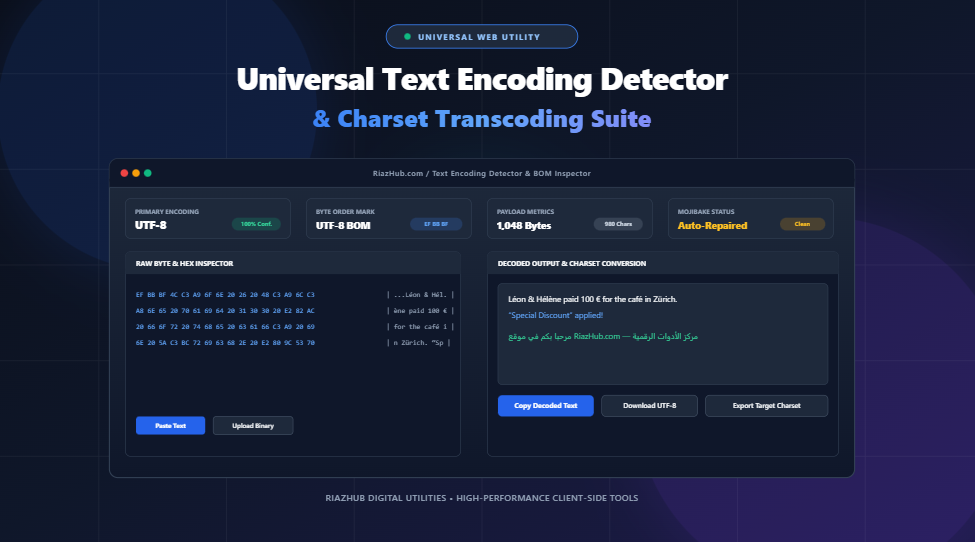
Mastering Character Encodings: How to Detect Charsets, Inspect BOM Headers, and Fix Garbled Mojibake Text
Have you ever opened an imported SQL database dump, a CSV export, or a server log file only to see strange, scrambled glyphs like é, €, or مرØبا? Or perhaps your WordPress site suddenly threw a mysterious “Cannot modify header information – headers already sent” PHP error out of nowhere?
These frustrating bugs are the direct consequence of character encoding mismatches, invisible Byte Order Mark (BOM) headers, and Mojibake corruptions. In this comprehensive guide, we will break down the mechanics of text encoding standards, analyze why software misinterprets binary character streams, and show you how to diagnose and transcode any payload in real time with the RiazHub Universal Text Encoding Detector & Charset Transcoder.
⚡ Need to Identify or Fix an Encoding Immediately?
Analyze binary files, detect magic BOM headers, unscramble Mojibake, and convert charsets with 100% in-browser client-side privacy.
1. The Evolutionary Hierarchy of Character Encodings
Computers do not store letters, emojis, or punctuation marks—they store strictly 0s and 1s grouped into 8-bit bytes. A character encoding is simply a lookup table (code page) that tells the computer which sequence of binary numbers maps to which visual character.
A. US-ASCII (7-Bit Standard)
Established in 1963, standard US-ASCII uses only 7 bits per character, providing 128 unique code points (0 through 127). It accommodates unaccented English alphabet letters (A–Z, a–z), numbers (0–9), basic punctuation, and control characters (like newline \n and carriage return \r). Any byte value containing the 8th bit set (≥ 128) is invalid pure ASCII.
B. ANSI & ISO-8859 Code Pages (8-Bit Extended ASCII)
As computers expanded globally, 128 characters proved insufficient for languages with diacritics and accents (such as French, Spanish, German, and Scandinavian languages). Manufacturers utilized the 8th bit to offer 256 code points (0 to 255):
- ISO-8859-1 (Latin-1): Covers Western European languages.
- Windows-1252 (CP-1252): Microsoft’s superset of ISO-8859-1, filling code points
0x80through0x9Fwith useful typographical symbols like the Euro symbol (€), curly quotation marks (“and”), en-dashes (–), and em-dashes (—). - Windows-1256: Dedicated code page for Arabic, Urdu, and Farsi.
- Shift-JIS & GBK: Multi-byte legacy encodings for Japanese and Chinese.
C. UTF-8: The Modern Universal Standard
Because hundreds of conflicting 8-bit code pages created constant cross-platform chaos, the Unicode Consortium introduced UTF-8. UTF-8 is a variable-length encoding (1 to 4 bytes) that is 100% backward compatible with ASCII while capable of encoding all 149,000+ characters across every world language, ancient script, mathematical symbol, and emoji.
| Encoding | Byte Length | Character Space | ASCII Compatible? |
|---|---|---|---|
| US-ASCII | 1 Byte (7-bit) | 128 characters | Native Standard |
| Windows-1252 / ISO-8859-1 | 1 Byte (8-bit) | 256 code points | Yes (Lower 128) |
| UTF-8 | 1 to 4 Bytes | 1,114,112 code points | Yes (100% Backward Compatible) |
| UTF-16 LE / BE | 2 or 4 Bytes | 1,114,112 code points | No |
| UTF-32 LE / BE | Fixed 4 Bytes | 1,114,112 code points | No |
2. What is a Byte Order Mark (BOM) & Why Does It Break Web Apps?
A Byte Order Mark (BOM) is a sequence of magic bytes prepended to the beginning of a text file to signify the character stream’s encoding and byte order (endianness):
EF BB BF: UTF-8 with BOMFF FE: UTF-16 Little Endian (LE)FE FF: UTF-16 Big Endian (BE)FF FE 00 00: UTF-32 Little Endian (LE)00 00 FE FF: UTF-32 Big Endian (BE)
In UTF-8, endianness is meaningless because UTF-8 is processed byte-by-byte in stream order. When legacy text editors (like Windows Notepad) save a PHP script with a UTF-8 BOM, PHP silently outputs those 3 invisible bytes (
EF BB BF) to the browser before executing your script. This sends HTTP headers prematurely, triggering:
Warning: Cannot modify header information - headers already sent by (output started at /file.php:1)
Using the RiazHub BOM Inspector, you can immediately detect invisible BOM signatures in scripts, configuration files, and JSON payloads, and strip them with a single click.
🔍 Clean Hidden BOM Headers & Fix Header Conflicts
Strip breaking BOM bytes or add legacy UTF-8 BOM signatures in real time.
3. The Anatomy of “Mojibake”: Why Text Becomes Scrambled Garbage
Mojibake (文字化け) is the Japanese term meaning “character transformation,” describing the garbled, unreadable text produced when a file encoded in one character set is decoded using a different, incompatible character set.
The Double-Encoding Mechanism:
Consider the accented letter é:
- In modern UTF-8, the character
éis encoded as a 2-byte sequence:0xC3 0xA9. - If legacy database software or an email client configured for Windows-1252 / ISO-8859-1 reads those two raw bytes, it looks up each byte individually:
- Byte
0xC3in Windows-1252 =Ã(Capital A with tilde) - Byte
0xA9in Windows-1252 =©(Copyright sign)
- Byte
- The software renders
éinstead ofé. - If that file is saved again in UTF-8, the corruption becomes baked into the file as 4 bytes (
0xC3 0x83 0xC2 0xA9), creating compound distortion!
Common Real-World Mojibake Artifacts:
éinstead ofé€instead of€(Euro currency symbol)“andâ€instead of curly quotes“and”—instead of em-dash—مرØباinstead of Arabicمرحبا
The RiazHub Mojibake Repair Engine utilizes custom reverse-mapping heuristics to trace misread byte streams back through original code pages, reconstructing original Unicode text flawlessly.
4. How RiazHub’s Universal Text Encoding Detector Works
The tool provides a comprehensive, deep-inspection environment equipped with:
- Heuristic Multi-Charset Scoring Matrix: Evaluates UTF-8 continuation sequence validity (
0x80–0xBF), 7-bit ASCII purity, and language-specific distributions. - Live Hex & Magic Byte Drawer: Displays the first 32 raw bytes in hexadecimal notation along with an ASCII side-view.
- 1-Click Auto-Fix Mojibake Suite: Reverses double-encoded Latin, Middle Eastern, and Asian character scrambles.
- Line Endings Normalizer: Convert seamlessly between Unix LF (
\n) and Windows CRLF (\r\n). - Zero-Knowledge Browser Privacy: 100% of binary ArrayBuffer operations execute in your browser thread via HTML5
FileReaderandTextDecoder. No data is ever uploaded to any server.
🚀 Try RiazHub’s Universal Encoding Detector & Transcoder Now
Clean your data, remove BOM headers, unscramble corrupt code, and convert between UTF-8, Windows-1252, ISO-8859, and UTF-16 in milliseconds.
Universal Text Encoding Detector & Charset Converter
Identify file & string character encodings, detect Byte Order Marks (BOM), repair garbled Mojibake artifacts, and transcode charsets with sub-millisecond precision.
| Encoding / Standard | Confidence Probability | BOM & Magic Byte Status | Byte Validity | Quick Actions |
|---|---|---|---|---|
| Enter text or upload a file to calculate real-time charset probability rankings. | ||||
📚 Deep Dive: Encodings, BOM Headers & Mojibake Explained
🎯 What is a Byte Order Mark (BOM) & Why Does UTF-8 BOM Break PHP / Shell Scripts? ▾
A Byte Order Mark (BOM) is a sequence of magic bytes at the very beginning of a stream (e.g. EF BB BF in UTF-8 or FF FE in UTF-16LE). In UTF-16 and UTF-32, the BOM is required to signal endianness (Little Endian vs. Big Endian).
However, in UTF-8, endianness does not exist. Including a UTF-8 BOM often causes critical software malfunctions:
- PHP "Headers Already Sent" Errors: PHP outputs the invisible 3-byte BOM before your script runs, prematurely triggering HTTP response headers and breaking session cookies or
header('Location: ...')redirects. - JSON Parsing Crashes: Strict JSON parsers (RFC 8259) reject inputs starting with BOM bytes as invalid syntax.
- Unix Shebang Failures: Shell scripts beginning with
#!/bin/bashfail if preceded by BOM magic bytes.
🧩 What Causes "Mojibake" Garbled Text & How Does RiazHub Auto-Repair It? ▾
Mojibake (文字化け) is the Japanese term for corrupted character rendering caused when binary data encoded in one character set is decoded using a completely different, incompatible character set.
The most ubiquitous real-world corruption is Double-UTF-8 / Windows-1252 mismatch:
- A UTF-8 string containing accented letters (e.g.
é, encoded in bytesC3 A9) is mistakenly read by legacy software as two separate Latin-1 / Windows-1252 single-byte characters (Ãand©). - The resulting scrambled characters (
é) are re-saved as UTF-8, compounding the corruption. - Our Repair Engine: Our client-side pipeline extracts the raw byte values of the garbled string, maps them back through Windows-1252/ISO-8859 code points, and re-interprets them through a strict UTF-8 stream to flawlessly recover original characters (e.g.,
é➔é,€➔€,مرØبا➔مرحبا).
🌐 ASCII (7-bit) vs. ISO-8859 (8-bit) vs. Variable-Length Unicode (UTF-8) ▾
Understanding the evolutionary hierarchy of text encodings:
- US-ASCII (7-bit): Defined in 1963, covers 128 characters (0–127) including basic English letters, digits, and control codes. Any byte with the 8th bit set (≥ 128) is invalid ASCII.
- ISO-8859 & Windows-1252 (8-bit): Extended ASCII to 256 code points (0–255) to support Western European accented glyphs. Because 256 spots were inadequate for all world languages, hundreds of incompatible code pages emerged (e.g. CP-1256 for Arabic, CP-1251 for Cyrillic, Shift-JIS for Japanese).
- UTF-8 (Variable 1–4 Bytes): The universal standard powering >98% of the modern web. Backward compatible with 7-bit ASCII (1 byte), while seamlessly encoding over 149,000 Unicode characters (including Arabic, Chinese, emojis, math symbols) across 1 to 4 bytes.
🔒 100% In-Browser Privacy Guarantee — Zero Server Transmission ▾
Your security and confidentiality are paramount on RiazHub.com. This utility operates strictly inside your browser's sandboxed JavaScript execution thread using the HTML5 FileReader, Uint8Array, and TextDecoder APIs.
No text payloads, proprietary code files, SQL dumps, or authentication tokens are ever sent over network sockets or saved on external servers. You can safely disconnect your internet connection and the entire detector will continue running at full speed offline.