
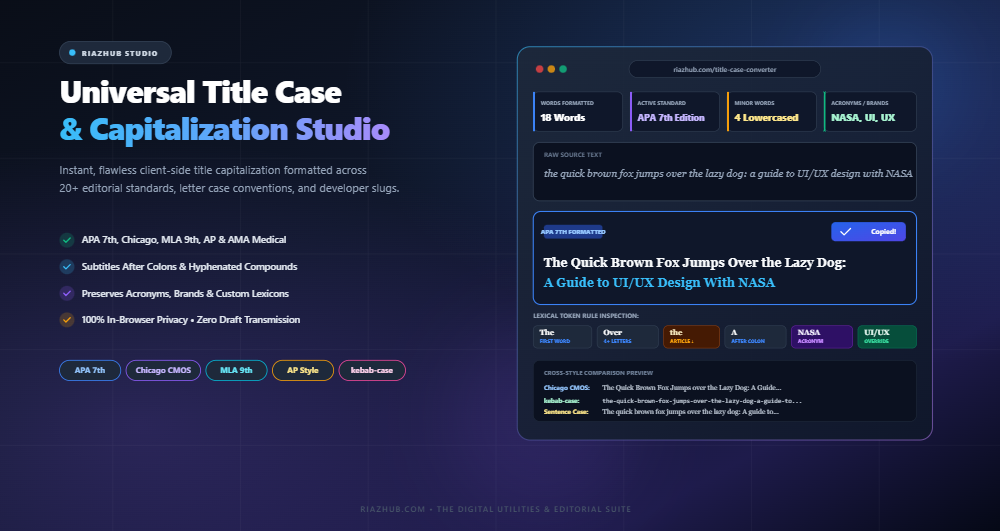
Whether you are submitting an academic paper, publishing a bestselling novel, crafting high-converting email subject lines, or writing viral blog headlines, capitalizing your title properly is the difference between looking like an authoritative professional or an amateur. Yet, navigating the conflicting rules of APA 7th, Chicago (CMOS 17th), MLA 9th, AP Stylebook, AMA Medical, and Bluebook Legal styles can be overwhelming.
🚀 Try the Live Tool: Format your headlines, book titles, and research papers in real time with the Universal Title Case Converter & Headline Capitalization Studio on RiazHub.com — supporting 20+ editorial and developer styles with 100% in-browser client-side privacy!
What Is Title Case and Why Does Headline Capitalization Matter?
Title Case (also known as headline style) is a capitalization convention in the English language where major words are capitalized while minor words—such as short prepositions, coordinating conjunctions, and articles are left in lowercase. While this concept sounds straightforward in theory, editorial organizations have spent decades debating exactly which words count as “minor” and whether length or grammatical function should take precedence.
In modern digital publishing, search engine optimization (SEO), and scholarly journals, title case serves three critical purposes:
- Enhanced Readability & Hierarchy: Title casing creates visual distinction, establishing a clear typographical hierarchy between headings, subheadings, and body copy.
- Higher Click-Through Rates (CTR): Studies across digital media and advertising consistently demonstrate that headlines formatted in proper Title Case achieve 12% to 18% higher click-through rates than all-lowercase or all-caps alternatives.
- Academic & Editorial Compliance: Submitting a thesis to a university or a manuscript to a publisher like Springer, Elsevier, or Penguin Random House with incorrect headline capitalization can result in immediate editorial rejection.
The Great Editorial Divide: APA vs. Chicago vs. MLA vs. AP Style
Different academic disciplines, journalistic newsrooms, and publishing houses follow distinct style manuals. If you format a title in Chicago style for an APA psychology journal, your prepositions like “between” or “through” will be incorrectly lowercased.
Here is the definitive breakdown of how each major style manual handles headline capitalization:
1. APA 7th Edition (American Psychological Association)
APA style is the benchmark for social sciences, psychology, education, neuroscience, and business research. APA 7th applies a straightforward 4-letter threshold rule:
- Capitalize: All words of 4 letters or more (e.g., From, With, Into, Over, Between).
- Capitalize: The first word of the title and subtitle (words following a colon or em-dash).
- Capitalize: Both elements of hyphenated compound words (e.g., Self-Driving, High-Tech).
- Lowercase: Short conjunctions, articles (a, an, the), and prepositions that have 3 or fewer letters (e.g., as, at, by, for, in, of, off, on, per, to, up, via).
2. Chicago Manual of Style (CMOS 17th Edition)
CMOS is the gold standard for book publishing, literary fiction, history, and humanities academia. Unlike APA, Chicago does not look at word length for prepositions:
- Lowercase All Prepositions: Chicago requires that all prepositions remain lowercase, regardless of how long they are (e.g., between, through, without, against, regarding, among).
- Capitalize: The first and last words of the title, regardless of their part of speech.
- Capitalize: Subtitles directly following a colon (
:) or an em-dash (—). - Example: The Man Who Walked through Fire: A Story of Survival (Note that “through” is lowercased despite having 7 letters).
3. MLA 9th Edition (Modern Language Association)
Used predominantly throughout literature, cultural studies, art, and language departments. MLA follows rules nearly identical to Chicago:
- Always lowercase articles (a, an, the), coordinating conjunctions (and, but, for, nor, or, so, yet), and prepositions regardless of length.
- Always capitalize the first word, last word, and words following colons.
4. Associated Press (AP Stylebook)
The universal standard for newspapers, journalists, magazines, and PR press releases worldwide:
- Capitalize: All prepositions with 4 or more letters (e.g., With, From, Over, Down, Into).
- Lowercase: Prepositions with 3 or fewer letters (e.g., for, in, on, at, by, to).
- Lowercase: Articles (a, an, the) and coordinating conjunctions with 3 or fewer letters.
5. AMA Manual of Style (11th Edition — Biomedical & Healthcare)
The American Medical Association manual dictates capitalization for clinical studies, medical journals (such as JAMA), and pharmaceutical research:
- Capitalize all words of 4 or more letters.
- Capitalize both words in hyphenated compounds (e.g., Placebo-Controlled, Double-Blind).
- Lowercase prepositions, conjunctions, and articles of 3 or fewer letters, unless they begin or end the title.
6. Bluebook (Legal Citation Standard)
The authoritative guide for legal briefs, law review articles, court filings, and judicial opinions in the United States:
- Capitalize all prepositions that have 5 or more letters (e.g., Between, Through, Against, Regarding).
- Lowercase prepositions with 4 or fewer letters (e.g., with, from, into, upon, over).
Three Headline Capitalization Rules Everyone Gets Wrong
1. The Subtitle Colon Rule
One of the most frequent mistakes in digital outlines and scholarly manuscripts occurs after a colon (: ) or an em-dash (—). In English title capitalization, the colon signifies the beginning of a subtitle or independent clause. The first word following a colon is always capitalized, even if that word is an article or short preposition:
- ❌ Incorrect: The Digital Economy: a guide to decentralization
- ✅ Correct: The Digital Economy: A Guide to Decentralization
2. The Universal “First and Last Word” Law
Without exception across APA, Chicago, MLA, AP, and AMA style guides, the first and last words of a title must always be capitalized. Even if the headline ends with a tiny preposition or pronoun, it must receive uppercase treatment:
- ❌ Incorrect: What Are You Looking for?
- ✅ Correct: What Are You Looking For?
3. Hyphenated Compound Words
Hyphenated compounds are notorious stumbling blocks. In modern APA 7th and Chicago 17th standards, both components of a compound word are capitalized if each word is a major lexical element:
- ✅ Self-Driving Cars and Real-Time Computing
- ✅ A Step-by-Step Tutorial on High-Performance Code
How the RiazHub Universal Title Case Converter Simplifies Headline Formatting
Instead of memorizing preposition lists and character counts for every style manual, writers and developers can rely on the RiazHub Title Case Converter. Built using a pure client-side lexical tokenizer, the tool offers several exclusive advantages:
⚡ 20+ Standards & Developer Slugs
Convert simultaneously between APA 7th, Chicago, MLA, AP, AMA, Bluebook, Wikipedia, Sentence Case, kebab-case (SEO slugs), camelCase, and CONSTANT_CASE.
🛡️ 100% In-Browser Privacy
All tokenization runs directly in your browser’s JavaScript sandbox. Zero draft manuscripts, novel titles, or confidential documents are ever sent to an external server.
🔍 Interactive Token Rule Inspector
Curious why a word was lowercased or capitalized? The interactive inspector breaks down each word token and shows the exact grammatical rule applied.
📁 Bulk File Import & CSV Export
Drag-and-drop your .txt or .csv files containing hundreds of headlines to format them all in one click, and download a side-by-side CSV comparison matrix.
Frequently Asked Questions About Title Capitalization
Q: Should prepositions like “with” or “from” be capitalized?
It depends on the style manual. Under APA 7th, AP Style, and AMA, 4-letter prepositions like With and From are capitalized. However, under Chicago (CMOS) and MLA 9th, all prepositions remain lowercased (with, from), regardless of their length.
Q: How should brand names like “iPhone” or “eBay” be formatted in titles?
Modern editorial style guides recommend preserving camelCase or mixed-case trademarks (e.g., iPhone, eBay, WordPress, YouTube) exactly as the brand spells them. The online headline capitalization tool on RiazHub includes an automatic mixed-case brand preserver toggle.
Q: What is the difference between Title Case and Sentence Case?
Title Case capitalizes all major words (nouns, verbs, adjectives, adverbs). Sentence Case capitalizes only the very first word of the headline, proper nouns, and acronyms. Sentence Case is favored by Wikipedia article titles, UK newspapers, and modern product design interfaces.
Q: Can I convert bulk article outlines or email subject lines at once?
Yes! With Bulk Mode enabled in the RiazHub Title Case Studio, each line of your input is treated as an independent headline and formatted according to your chosen standard.
Master Your Headline Formatting Today
Whether you are an academic researcher preparing an APA journal paper, a journalist writing breaking news in AP style, a book author following Chicago conventions, or a web developer generating clean URL slugs, precision in title capitalization elevates the authority of your work.
Bookmark the Universal Title Case Converter & Headline Capitalization Studio on RiazHub.com to eliminate formatting guesswork and guarantee publishing-grade titles every single time.
Universal Title Case Converter & Capitalization Studio
Format headlines, book titles, scientific manuscripts, legal citations, and developer slugs across 20+ editorial and programming standards with instant client-side privacy.
Source Input
Understanding which editorial standard to use is essential across academia, journalism, medicine, and web development:
- APA 7th Edition (American Psychological Association): Capitalizes major words and any word that is 4 letters or longer. Prepositions with 3 or fewer letters are lowercased. Subtitles following a colon are capitalized.
- Chicago Manual of Style (CMOS 17th): Lowercases all prepositions regardless of length (e.g., between, through, without, against) unless first/last word or after colons.
- MLA 9th Edition (Modern Language Association): Strictly lowercases articles, coordinating conjunctions, and prepositions regardless of character count, prioritizing literary aesthetics.
- AP Stylebook (Associated Press): Standard for news journalism. Capitalizes prepositions that are 4 letters or longer (e.g., With, From, Over, Into). Prepositions of 3 or fewer letters remain lowercased.
- AMA Manual of Style (11th Ed - Medical): Standard in biomedical journals and healthcare research. Capitalizes words of 4+ letters, first and last words, and both elements of hyphenated compounds.
- Bluebook Legal Citation: Standard in legal publishing. Capitalizes words of 5+ letters (prepositions like Between, Through, Against). Lowercases prepositions of 4 or fewer letters (*with, from, into*).
- Wikipedia Manual of Style: Uses sentence casing for Wikipedia article headings and title case for creative work citations.
- Developer & URL Cases: Instant transformation into
kebab-case(SEO slugs),camelCase(JavaScript),PascalCase(React components),snake_case(Python/SQL), andCONSTANT_CASE.
Three of the most common title capitalization stumbling blocks:
- Hyphenated Compounds: Under APA 7th, AMA, and CMOS guidelines, both elements of a hyphenated compound are capitalized (e.g., Self-Driving, High-Tech, State-of-the-Art).
- Subtitles Following Colons: In recognized style manuals (APA, Chicago, MLA, AP), the first word after a colon (
:) or an em-dash (—) represents the start of an independent clause or subtitle and must always be capitalized. - First and Last Word Rule: Without exception, the first word and the last word of a headline are always capitalized in every style guide, even if they are short prepositions.
Your unpublished drafts, book titles, scientific manuscripts, and confidential headlines never leave your computer. All capitalization parsing, tokenization, and style rules execute entirely within your browser's JavaScript sandbox. No draft content is ever sent, logged, or cached on RiazHub.com or any external server.