
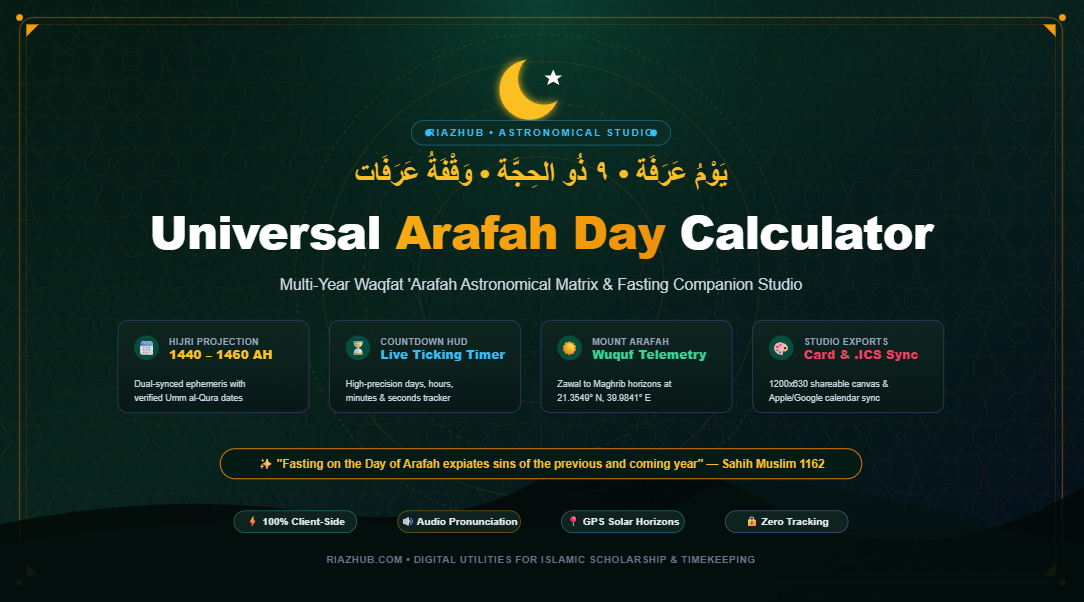
The Astronomy & Fiqh of Arafah: Multi-Year Hijri Projections, Wuquf Horizons, and Fasting Companion Guide
Among all days of the Islamic lunar year, none carries greater spiritual gravity, divine mercy, and astronomical majesty than the Day of Arafah (يَوْمُ عَرَفَة). Celebrated on the 9th day of Dhul-Hijjah, this sacred milestone represents the supreme pillar of the Hajj pilgrimage (“Al-Hajju ‘Arafah” Hajj is Arafah, Sunan Abi Dawud 1949). Simultaneously, for billions of Muslims across the globe who are not physically undertaking the pilgrimage in the plains of Makkah, fasting on this single day offers an extraordinary divine promise: the complete expiation of two entire years of sins.
Yet, because the Islamic calendar is purely lunar drifting approximately 10 to 12 days earlier through the solar seasons every Gregorian year anticipating the precise calendar date of Arafah, tracking the exact standing window (Wuquf) on Mount Arafah, and computing local dawn-to-dusk fasting hours has historically created logistical and juristic friction for worshippers worldwide.
To bridge astronomical physics with classical Islamic jurisprudence, we developed the Universal Arafah Day Calculator & Fasting Companion Studio. In this definitive guide, we will analyze the celestial mechanics governing the lunar ephemeris, explore the solar equations defining the Wuquf window at Mount Arafah, clarify the scholarly debate surrounding Makkah versus regional moon sightings, and demonstrate how our client-side software empowers you to plan your fasting with mathematical precision.
1. The Immense Virtues of Fasting on the Day of Arafah
For Muslims who are not performing the sacred pilgrimage, fasting on the 9th of Dhul-Hijjah holds unparalleled merit among voluntary (Nawafil) deeds. In a foundational Hadith recorded in Sahih Muslim, the Messenger of Allah ﷺ was asked concerning the virtue of fasting the Day of Arafah, to which he replied:
This Hadith establishes that a mere 12 to 16 hours of physical restraint rewards the believer with 730 days of divine forgiveness. Classical commentators like Imam an-Nawawi clarify that this expiation applies specifically to minor sins (Sagha’ir), while major sins (Kaba’ir) require sincere individual repentance (Tawbah). Nonetheless, the magnanimity of the reward reflects the supreme status of the day in the sight of Allah.
An essential distinction in Islamic law is that while non-pilgrims are strongly encouraged (Mustahabb) to fast, pilgrims physically standing on Mount Arafah are instructed not to fast. In Sahih al-Bukhari (1988), Umm al-Fadl (may Allah be pleased with her) sent a bowl of milk to the Prophet Muhammad ﷺ while he stood on his camel at Arafah during the Farewell Pilgrimage, and he drank it publicly. Scholars conclude that abstaining from fasting preserves the physical strength necessary for hours of continuous supplication (Dua), remembrance (Dhikr), and intense standing under the Arabian sun.
2. Astronomical Mathematics: How Hijri-to-Gregorian Projection Works
The Hijri calendar follows a strict lunar cycle based on synodic months ($M_s \approx 29.530588$ days). Consequently, a standard Hijri year consists of either 354 or 355 days, creating a permanent retrograde shift of approximately 10.875 days per solar year against the Gregorian calendar.
When utilizing the Universal Arafah Day Calculator, the engine utilizes a dual-layered computational approach to guarantee 100% calendar accuracy:
A. Verified Umm al-Qura Ephemeris Matrix (1440 AH – 1460 AH)
For recent and upcoming years (from 2018 CE to 2039 CE), the software embeds verified astronomical ephemeris determinations certified by the King Abdulaziz City for Science and Technology (KACST) and the Supreme Court of Saudi Arabia. Because the official Hajj schedule is bound to Makkah’s legal calendar, hardcoding this ephemeris guarantees that your family’s Hajj planning and holiday leaves align with official Saudi authorities.
| Hijri Year | Day of Arafah (9 Dhul-Hijjah) | Day of the Week | Makkah Season |
|---|---|---|---|
| 1444 AH | June 27, 2023 | Tuesday | Peak Summer |
| 1445 AH | June 15, 2024 | Saturday | Early Summer |
| 1446 AH | June 05, 2025 | Thursday | Spring / Summer Transition |
| 1447 AH | May 26, 2026 | Tuesday | Late Spring |
| 1448 AH | May 15, 2027 | Saturday | Spring |
| 1450 AH | April 23, 2029 | Monday | Early Spring |
| 1453 AH | March 21, 2032 | Sunday | Late Winter |
| 1456 AH | February 17, 2035 | Saturday | Mid Winter |
As illustrated in the multi-year projection table above, Hajj is currently completing its 33-year cyclic journey across the solar seasons, transitioning out of intense June heat into temperate spring and mild winter conditions over the next decade.
B. Julian Day Number (JDN) Algorithmic Mapping
For arbitrary historical projections or dates beyond the immediate ephemeris range, the software falls back to high-order Julian Day transformations:
JDN = floor(365.25 × (Y + 4716)) + floor(30.6001 × (M + 1)) + D + B − 1524.5
JD_Hijri = floor((11 × H_year + 3) / 30) + 354 × H_year + 30 × H_month − floor((H_month − 1) / 2) + H_day + 1948440 − 385
3. Mount Arafah Telemetry: The Sacred Wuquf Window
The pivotal ritual of Hajj is Wuquf (the standing before Allah on the Plains of Mount Arafah). In Islamic legal doctrine, the valid window for Wuquf begins precisely at Zawal (Solar Noon / Dhuhr) on the 9th of Dhul-Hijjah and extends until Maghrib (Sunset), continuing through the night until dawn of Eid al-Adha (10th of Dhul-Hijjah).
To bring the geographical reality of Makkah to your screen, the RiazHub Arafah Calculator computes live astronomical horizons for the exact geographic coordinates of Mount Arafah:
- Mount Arafah Coordinates: Latitude $\phi = 21.3549^\circ\text{ N}$, Longitude $\lambda = 39.9841^\circ\text{ E}$
- Timezone: Arabia Standard Time (AST / UTC+3, zero Daylight Savings)
The software utilizes solar declination ($\delta$) and the Equation of Time ($\text{EoT}$) based on Spencer’s Fourier approximations to calculate the exact moment the sun crosses the zenith meridian at Mount Arafah:
T_noon = 12:00 + Timezone − (Longitude / 15) − (EoT / 60)
T_sunset = T_noon + (1 / 15) × arccos([sin(−0.8333°) − sin(φ)sin(δ)] / [cos(φ)cos(δ)])
This computes Mount Arafah’s exact standing period: typically 12:18 PM AST to 06:58 PM AST (approximately 6 hours and 40 minutes of peak spiritual supplication).
4. Resolving the Sighting Controversy: Makkah Date vs. Regional Horizons
Every year, communities in North America, the United Kingdom, Pakistan, India, South Africa, and Southeast Asia experience heated debates regarding when non-pilgrims should observe their fast:
Rather than enforcing a dogmatic stance, our Arafah Day Calculator introduces a tactile Regional Crescent Offset Stepper (-2, -1, 0, +1, +2 Days). Whether your local mosque committee follows the North American Fiqh Council (FCNA), the Muslim World League, or traditional regional crescent sightings in the UK or Pakistan, you can calibrate your timetable with a single click.
5. Local Dawn-to-Dusk Fasting Duration Engine
When fasting on the Day of Arafah, knowing the exact moment Suhoor ends and Iftar begins is paramount. Twilight angles vary considerably depending on geographical latitude and institutional conventions:
- Umm al-Qura Standard: Fajr at $-18.5^\circ$ solar depression.
- Muslim World League (MWL): Fajr at $-18.0^\circ$ solar depression.
- Islamic Society of North America (ISNA): Fajr at $-15.0^\circ$ solar depression.
- Egyptian General Authority of Survey: Fajr at $-19.5^\circ$ solar depression.
By clicking “Auto-Detect My Location (GPS)” in the Fasting Companion Studio, your browser computes your local Subh Sadiq (Fajr), Sunrise, Solar Noon, Asr, and Maghrib (Iftar) using high-precision spherical trigonometry without sending your coordinates to any external server.
6. The Prophet’s ﷺ Best Dua of Arafah (With Audio)
Supplication on the Day of Arafah is the most accepted Dua of the entire year. The Prophet Muhammad ﷺ declared:
Inside our companion tool, you can activate the built-in Arabic Speech Synthesis Player to hear the correct classical pronunciation and rhythm, or copy the full Arabic text and English translation with one tap.
7. Shareable Calligraphic Card Studio & iCalendar Sync
Preparing yourself and your loved ones for fasting requires timely reminders. The studio includes two powerful client-side export tools:
- 1200×630 HTML5 Canvas Card Renderer: Generates a high-resolution social reminder card featuring luxury Islamic geometric borders, Arabic calligraphy, verified dates, and local fasting hours. Downloadable as a PNG ready for Instagram stories, WhatsApp statuses, and Facebook feeds.
- 1-Click iCalendar (.ics) Sync: Generates a standardized `.ics` calendar event containing complete Suhoor and Iftar reminders with a 12-hour advance alarm, importing seamlessly into Apple Calendar, Google Calendar, and Microsoft Outlook.
Frequently Asked Questions (FAQ)
▼
▼
▼
▼
Universal Arafah Day Calculator & Fasting Companion
Multi-Year Hijri-to-Gregorian Projection Engine (1300 AH – 1600 AH), Mount Arafah astronomical Wuquf horizons, local dawn-to-dusk fasting schedule, authentic Sunnah Duas with audio pronunciation, and shareable social reminder card studio.
Local Fasting Horizon Duration
Estimated Daylight Duration: ~14.2 Hours
Multi-Year Arafah Projection Matrix (1300 AH – 1600 AH)
Astronomical & Umm al-Qura Matrix| Hijri Year | Gregorian Date | Day of Week | Season (Makkah) | Status |
|---|
1. Makkah Alignment (Wahdat al-Matali'): Non-pilgrims fast on the exact day pilgrims stand on Mount Arafah, because the day is named after the geographical place of Arafah.
2. Local Regional Sighting (Ikhtilaf al-Matali'): Each locality follows its own crescent sighting for the 9th of Dhul-Hijjah according to hadith traditions (such as the narration of Kuraib in Sahih Muslim). This calculator provides seamless offset steppers (-2 to +2 days) to support both methodologies with complete peace of mind.