
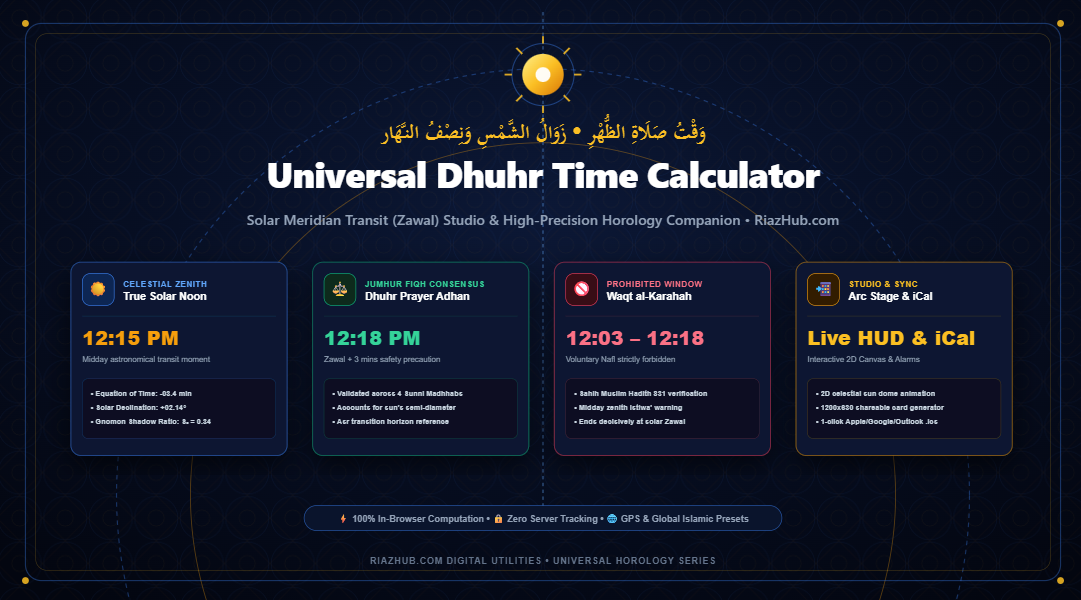
Dhuhr Prayer Time & Solar Meridian Transit: The Complete Astronomical and Fiqh Guide to Zawal, Waqt al-Karahah, and Midday Shadows
Millions of Muslims recite their daily prayers assuming that Dhuhr begins precisely at 12:00 PM or at the exact peak of solar noon. However, in Islamic jurisprudence and celestial mechanics, praying at exact solar noon is strictly prohibited. Understanding the precise moment of Zawal (زوال الشمس), the 10-to-15 minute prohibited window of Waqt al-Karahah (وقت الكراهة), and the orbital phenomenon of the Equation of Time is crucial for ensuring the spiritual and legal validity of your Salah.
To eliminate guesswork and calculate the exact moment the sun declines in your specific city with a customized jurisprudential safety buffer, use our interactive Universal Dhuhr Time Calculator & Solar Meridian Transit Studio. It runs high-precision astronomical ephemeris equations entirely in your browser without tracking your location or sending coordinates to external servers.
1. The Authentic Prophetic Sunnah Definition of Dhuhr
The canonical prayer times in Islam are not arbitrary milestones on a clock face; they are direct reflections of celestial horizons and cosmic alignments established by Allah Almighty in the Quran and elaborated in profound detail by the Prophet Muhammad ﷺ.
In Surah Al-Isra, Allah commands:
Classical Quranic exegetes and Hadith commentators, including Ibn Kathir, Al-Qurtubi, and Al-Nawawi, affirm that Duluk al-Shams refers specifically to Zawal—the moment the sun departs from its midday celestial peak and inclines toward the west.
The definitive boundary of the Dhuhr prayer window is established in Sahih Muslim:
Notice the critical legal precision: the Prophet ﷺ did not say “when the sun reaches its zenith” (حين استواء الشمس), but rather “when the sun has departed its zenith” (إذا زالت الشمس). This subtle distinction marks the boundary between a strictly forbidden prayer window and an obligatory one.
Verify Today’s Exact Zawal Timestamp
Determine your local celestial meridian crossing, minimum midday shadow ratio, and Dhuhr Adhan time with 1-click GPS auto-detection.
2. True Solar Noon (Istiwa’) vs. Zawal: Why Exact Midday is Forbidden
To understand the fiqh of midday prayer, one must examine the daily journey of the sun across the local sky dome.
As the sun rises in the east, an upright vertical rod (known as a gnomon) casts a long shadow pointing west. As the morning advances, the shadow steadily contracts. The exact moment the sun intersects the observer’s local celestial meridian (an imaginary line running from true North to true South through the zenith overhead) is known astronomically as Solar Noon or Meridian Transit, and in Islamic horology as Istiwa’ (نصف النهار / الاستواء).
The prohibition is articulated by the companion Uqbah ibn Amir (may Allah be pleased with him):
The Prophet ﷺ further explained the metaphysical reality behind this prohibition: at midday zenith, the fires of Jahannam (Hellfire) are stoked to their peak intensity, and pagan idolaters historically prostrated to the sun at the pinnacle of its ascent. Muslims are commanded to differentiate their worship completely from pagan celestial veneration.
3. The Jurisprudential Consensus on the Precautionary Safety Buffer (Ihtiyat)
If praying at exact solar noon is forbidden, when exactly does Dhuhr become permissible?
Astronomically, the sun is not an infinitely small point of light; it is a massive celestial disk with an average angular diameter of approximately 0.53 degrees (32 arcminutes). It takes roughly two minutes for the entire solar disk to travel across the celestial meridian line.
Furthermore, observing the physical lengthening of the gnomon’s shadow by a millimeter with the naked eye requires measurable time. For this reason, the four major schools of jurisprudence (Hanafi, Maliki, Shafi’i, and Hanbali) unanimously recommend adding a precautionary safety buffer (احتياط الزوال) of +2 to +5 minutes after astronomical solar noon before making the Adhan.
| Methodology / Institution | Safety Buffer (Δt) | Astronomical Rationale | Primary Usage Region |
|---|---|---|---|
| Strict Astronomical Transit | +1 Minute | Minimal transit of solar center beyond meridian | Observatories & Research Institutes |
| Umm al-Qura Standard | +2 Minutes | Complete disk clearance past meridian line | Kingdom of Saudi Arabia & Gulf Region |
| Jumhur Fiqh Consensus | +3 to +4 Minutes | Accounts for refraction, atmospheric haze & human observation | Egypt, Turkey, Levant, Global Masajid |
| Precautionary Conservative | +5 Minutes | Guarantees complete exit from Waqt al-Karahah window | South Asia, UK, North America |
Inside the Dhuhr Time Calculator Studio, you can toggle between these exact buffers (+1m, +2m, +3m, +4m, +5m) or set a custom minute stepper to align precisely with your local mosque’s convention.
4. The Astronomical Mechanics: The Equation of Time (EoT)
A widespread misconception among worshippers is that solar noon always aligns with 12:00 PM on civil wall clocks. In reality, solar noon coincides with 12:00 PM civil time on only four days of the entire year (approximately April 15, June 13, September 1, and December 25).
On every other day, the exact moment of solar noon shifts back and forth due to the Equation of Time (EoT), caused by two fundamental astronomical realities:
- Earth’s Elliptical Orbit (Eccentricity): Earth does not travel around the sun in a perfect circle; its orbit is elliptical. According to Kepler’s Second Law of Planetary Motion, Earth moves faster when it is closest to the sun (perihelion in early January) and slower when it is farthest (aphelion in early July).
- Earth’s Axial Obliquity: Earth’s rotational axis is tilted at approximately 23.44 degrees relative to its orbital plane. As the sun moves along the ecliptic, its projection onto the celestial equator varies in speed throughout the seasons.
T_transit = 12 + Timezone - (Longitude / 15) - (EoT / 60)T_dhuhr = T_transit + (Safety_Buffer / 60)Throughout the calendar year, the Equation of Time causes apparent solar noon to deviate from mean clock noon by up to +16.4 minutes in early November (when solar noon occurs earlier in the clock day) and -14.2 minutes in mid-February (when solar noon occurs significantly later).
This daily shift explains why the Dhuhr Adhan continuously drifts forward and backward across weeks and months, even in equatorial cities where daylight duration remains nearly constant. You can observe this phenomenon visually in the 30-Day Transit Shift Calendar tab of our Universal Dhuhr Calculator Tool.
5. Gnomon Physics & The Minimum Shadow Ratio (S₀)
Classical Islamic jurists did not carry digital atomic wristwatches; they relied upon the elegant geometry of shadows.
At exact solar midday, the shadow cast by a vertical gnomon rod reaches its absolute shortest length for that date. This minimum shadow length is denoted in Islamic astronomy as Zill al-Istiwa’ (ظل الاستواء) or the Base Shadow Ratio ($S_0$).
S₀ = tan | Latitude - Solar_Declination |This value $S_0$ is not merely an interesting academic metric; it is the fundamental mathematical baseline required to calculate the onset of the Asr prayer. According to the Shafi’i, Maliki, and Hanbali schools, Asr begins when the shadow of any object equals the length of the object plus its midday shadow:
Shadow at Asr Onset = Object Height + S₀
In the Hanafi school (according to the dominant opinion of Imam Abu Hanifah), Asr begins when the shadow equals twice the object’s height plus $S_0$. Without knowing the exact midday shadow ratio, an observer cannot accurately determine when the Dhuhr prayer window closes.
Synchronize Dhuhr & Friday Jumu’ah to Your Device Calendar
Download automated iCalendar (.ics) events equipped with built-in 15-minute advance warnings for the prohibited Waqt al-Karahah window.
6. Friday Jumu’ah Prayers: Khutbah Timing and Midday Exceptions
On Fridays (Yawm al-Jumu’ah), the Dhuhr prayer is replaced by the two-Rak’ah congregational Jumu’ah prayer, preceded by the obligatory sermon (Khutbah).
Islamic scholars have extensively discussed whether the prohibition of voluntary prayers at midday applies on Friday. According to the Shafi’i and Hanbali jurists, worshippers sitting inside the mosque waiting for the Friday Khutbah are exempt from the prohibition of voluntary prayer at Istiwa’. They may continue performing Nafl prayers until the Imam mounts the Minbar.
Regarding the Khutbah itself, the Jumhur consensus holds that the Friday Khutbah must begin after Zawal has entered. Starting the Khutbah or the congregational prayer before Zawal invalidates the Jumu’ah prayer according to the Hanafi, Maliki, and Shafi’i Madhhabs (with a well-known exception in the Hanbali school allowing the Khutbah slightly earlier during the sixth hour).
Mosque committees and Khateebs can utilize the Friday Jumu’ah Horizon Mode in our tool to configure custom congregation offsets (e.g., 30 or 45 minutes after Zawal entry) to guarantee full legal compliance.
7. Step-by-Step: How to Use the Dhuhr Time Calculator Studio
The Dhuhr Time Calculator & Solar Transit Studio was engineered from the ground up for high-precision astronomical accuracy, complete browser privacy, and mobile responsiveness:
- Auto-Detect or Select Your Location: Click “Auto-Detect My Location (GPS)” for 1-click geolocation, choose from major Islamic metropolises (Makkah, Madinah, Al-Quds, Cairo, Istanbul, Karachi, Jakarta, London, New York), or enter your exact decimal coordinates.
- Choose Your Jurisprudential Buffer: Select between +1 min (Strict Transit), +2 mins (Umm al-Qura), +3 mins (Global Consensus), +5 mins (Conservative), or slide the stepper to match your local mosque.
- Review the Live Countdown HUD: Observe real-time ticking metrics showing the exact hours, minutes, and seconds remaining until Dhuhr, alongside instant color-coded alerts if the prohibited Waqt al-Karahah window is currently active.
- Explore the 2D Solar Arc Stage: Switch to Tab 2 to watch an interactive canvas simulation tracking the sun’s trajectory across the celestial meridian dome, showing the gnomon shadow length in real time.
- Generate Social Reminder Cards: Open Tab 5 to create an authentic 1200×630 social reminder card displaying today’s Dhuhr and Zawal times overlaid upon luxury Arabesque geometry and Hadith calligraphy, ready for 1-click PNG download.
- Export to Your Calendar: Click “Add Dhuhr to Calendar (.ics)” to export certified recurring alarms with built-in 15-minute advance warnings straight to Apple Calendar, Google Calendar, or Microsoft Outlook.
8. Frequently Asked Questions (FAQ)
Calculate Your Exact Dhuhr & Zawal Horizons Now
Experience the precision of astronomical meridian solar transit computation combined with authentic Islamic jurisprudence.
Universal Dhuhr Time Calculator & Solar Transit Studio
High-precision astronomical solar noon & Zawal engine. Compute the true celestial zenith, monitor the prohibited midday prayer window (Waqt al-Karahah), visualize real-time celestial sun arcs, and synchronize verified prayer horizons.
| Horizon Phase | Islamic Nomenclature | Calculated Time | Fiqh Significance |
|---|
| Date | EoT (Shift) | True Solar Noon | Dhuhr Adhan | Forbidden Window |
|---|
📖 Fiqh of Dhuhr, Zawal Science & Forbidden Prayer Horology
In Islamic jurisprudence (Fiqh), the canonical time for the obligatory Dhuhr prayer does NOT begin at the exact moment of astronomical solar midday when the sun is at its highest celestial peak (Istiwa' / نصف النهار). Rather, all four Sunni legal schools (Hanafi, Maliki, Shafi'i, and Hanbali) hold consensus that Dhuhr begins strictly at Zawal (زوال الشمس) — the precise instant the sun departs from the celestial meridian and begins its descent toward the west.
— Sahih Muslim (Hadith 612)
The interval when the sun is stationed precisely at its midday zenith (حين يقوم قائم الظهيرة حتى تزول الشمس) is one of the three explicitly prohibited prayer windows (أوقات النهي) in the Sunnah. Performing voluntary Nafl or Sunnah prayers during this window is strictly prohibited (Makruh Tahrimi).
— Sahih Muslim (Hadith 831)
Astronomically, the sun's visual disk measures approximately 0.53° in angular diameter. It takes around 2 minutes for the entire body of the sun to cross the celestial meridian line. Islamic jurists therefore mandate adding a +2 to +5 minute precautionary safety buffer (احتياط) after astronomical noon before announcing the Dhuhr Adhan, ensuring that the prohibited window has decisively concluded.
Many people assume that solar noon always happens at 12:00 PM standard clock time. However, due to two astronomical factors — the Earth's 23.44° axial obliquity and its eccentric elliptical orbit around the sun — apparent solar days vary throughout the year.
This discrepancy is quantified by the Equation of Time (EoT). Throughout the calendar year, True Solar Noon can oscillate by as much as -14 minutes in early February to +16 minutes in early November relative to mean solar time. Our built-in ephemeris algorithm calculates the exact solar transit coordinates in real time for any observer on Earth.
On Fridays (Yawm al-Jumu'ah), the jurists discuss the prohibited window prior to Zawal. According to the Shafi'i and Hanbali schools, voluntary prayers in the mosque on Friday are exempted from the prohibition while waiting for the Imam. The Friday Jumu'ah prayer and Khutbah time arrives with the entry of Dhuhr (at Zawal), replacing the four Rak'ahs of regular Dhuhr with two Rak'ahs preceded by the sermon.