
Days Until Ramadan: The Complete Guide to Islamic Moon Sighting, 33-Year Solar Cycles, and Spiritual Readiness
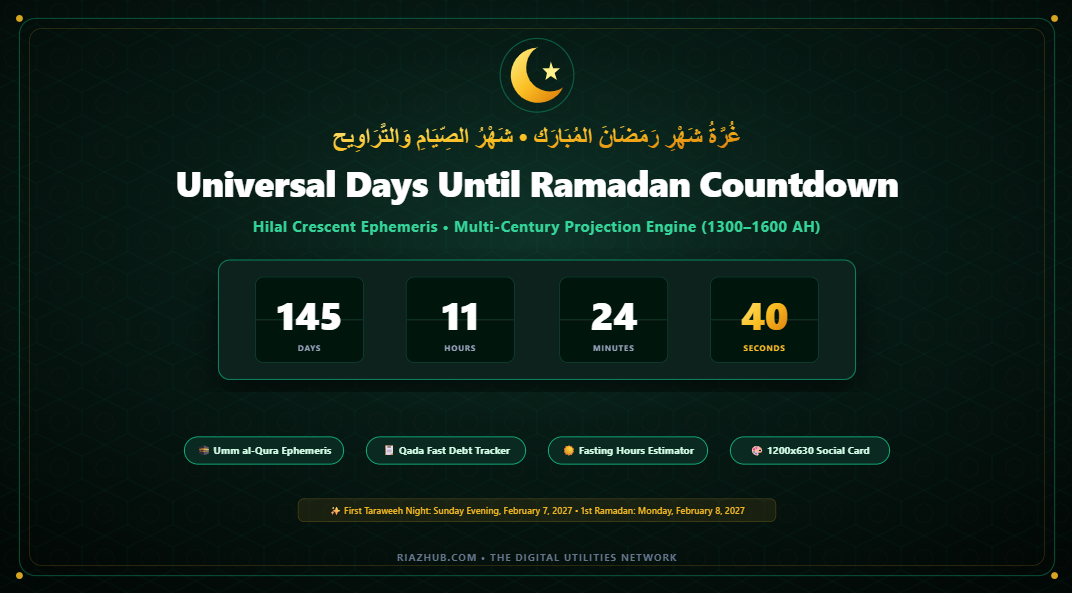
🌙 Live Real-Time Ramadan Countdown HUD
Looking for an instant, high-precision ticking clock down to the exact second, along with Taraweeh night alerts and 1-click calendar sync?
1. Why Does the Date of Ramadan Change Every Year?
Unlike the civil Gregorian calendar which tracks Earth’s 365.2422-day revolution around the Sun the Islamic Hijri calendar is strictly lunar. Each Islamic month begins with the physical or calculated conjunction of the new crescent moon (Hilal) and lasts either 29 or 30 days, averaging 29.53 days per synodic cycle.
Consequently, a full 12-month Hijri year spans roughly 354.36 days. This creates an annual difference of approximately 10.88 days between the two calendar systems:
- Gregorian Solar Year: ~365.25 days
- Hijri Lunar Year: ~354.36 days
- Annual Migration Shift: ~10 to 12 days earlier each Gregorian year
Because of this annual drift, Ramadan does not stay locked in a single season. If Ramadan begins in May this decade, it will cycle through April, March, February, January, and eventually circle through autumn and summer over a span of three decades.
To track this progression across any year from 1440 AH to 1460 AH, you can use the interactive multi-year lookahead engine on RiazHub’s Days Until Ramadan Studio, which pre-calculates the expected Gregorian start dates and seasonal shifts for the next decade.
2. The 33-Year Solar Migration Cycle: Divine Wisdom in Shifting Seasons
It takes approximately 33 solar years for the Islamic lunar calendar to make one complete revolution through all four Gregorian seasons (Winter, Spring, Summer, and Fall).
This celestial rotation carries profound spiritual wisdom and divine equity:
- Equitable Fasting Conditions: Believers in the Northern Hemisphere experience 16-to-18-hour summer fasts during certain decades, followed by comfortable 11-to-12-hour winter fasts fifteen years later. Simultaneously, Muslims in the Southern Hemisphere (such as South Africa, Australia, and Argentina) experience the inverse. Over a lifetime of 66 years, every community on Earth fasts under identical seasonal variations twice.
- Agricultural and Economic Equality: Fasting during harvesting seasons, planting periods, and harsh winter cold is shared universally rather than falling perpetually upon one geographic region.
3. The Rare 2030 CE Dual-Ramadan Phenomenon
Because a lunar year is shorter than a solar year, a single Gregorian calendar year occasionally experiences two separate Ramadans. This phenomenon occurs once every 32 to 33 solar years.
The next occurrence is scheduled for the year 2030 CE:
- Ramadan 1451 AH: Projected to begin on Sunday, January 6, 2030.
- Ramadan 1452 AH: Projected to begin on Thursday, December 26, 2030.
During 2030, Muslims will fast for approximately 36 days within a single solar calendar year (roughly 30 days in January and the first 6 days in late December). You can preview and inspect this historical celestial event directly on the RiazHub Days Until Ramadan Countdown & Hilal Ephemeris Studio by selecting the 2030 preset button.
4. Multi-Year Ephemeris Reference Matrix (1444 AH – 1455 AH)
The table below provides a verified reference timeline based on the official Umm al-Qura astronomical ephemeris:
| Hijri Year | Projected 1st Ramadan | Day of the Week | Estimated Season | First Taraweeh Night |
|---|---|---|---|---|
| 1444 AH | March 23, 2023 | Thursday | Spring | Wed Evening, Mar 22, 2023 |
| 1445 AH | March 11, 2024 | Monday | Winter / Early Spring | Sun Evening, Mar 10, 2024 |
| 1446 AH | March 1, 2025 | Saturday | Winter | Fri Evening, Feb 28, 2025 |
| 1447 AH | February 18, 2026 | Wednesday | Winter | Tue Evening, Feb 17, 2026 |
| 1448 AH | February 8, 2027 | Monday | Winter | Sun Evening, Feb 7, 2027 |
| 1449 AH | January 28, 2028 | Friday | Winter | Thu Evening, Jan 27, 2028 |
| 1450 AH | January 16, 2029 | Tuesday | Winter | Mon Evening, Jan 15, 2029 |
| 1451 AH | January 6, 2030 2030 Double Part 1 | Sunday | Winter | Sat Evening, Jan 5, 2030 |
| 1452 AH | December 26, 2030 2030 Double Part 2 | Thursday | Winter | Wed Evening, Dec 25, 2030 |
| 1453 AH | December 15, 2031 | Monday | Autumn | Sun Evening, Dec 14, 2031 |
| 1454 AH | December 4, 2032 | Saturday | Autumn | Fri Evening, Dec 3, 2032 |
| 1455 AH | November 23, 2033 | Wednesday | Autumn | Tue Evening, Nov 22, 2033 |
📅 Never Miss the First Night of Taraweeh
Sync exact Ramadan fasting and Taraweeh prayer start dates straight to your iPhone, Android, Google Calendar, or Outlook with custom alarms.
5. The Fiqh of Crescent Sighting (Ru’yat al-Hilal) vs. Astronomical Calculations
Every year, discussions arise regarding the sighting of the new moon. Islam recognizes both observational witnessing and astronomical ephemeris:
The Prophetic Principle
The Prophet Muhammad (ﷺ) said: “Fast when you see it [the crescent] and break your fast when you see it. If it is obscured from you, then complete the thirty days of Sha’ban.” (Sahih al-Bukhari 1909).
In the modern era, Muslim jurists and scientific committees operate under several recognized methodologies:
- Umm al-Qura Calendar (Kingdom of Saudi Arabia): Utilizes civil astronomical criteria where the astronomical new moon conjunction occurs before sunset at the Holy Sanctuary in Makkah, and moonset occurs after sunset. When this condition is met, the following day is designated the 1st of the new month.
- Global Naked-Eye Crescent Sighting: Holds that if a credible, verified physical sighting of the crescent moon is attested anywhere on Earth where Muslims share a night with the sighting location, all communities should commence fasting.
- Astronomical Calculation (FCNA / ECFR): Adopted by the Fiqh Council of North America and European Council for Fatwa and Research, which pre-calculates the crescent birth based on strict solar conjunction and minimum crescent altitude above the horizon, allowing families, mosques, and schools to plan months in advance.
- Regional Local Sighting: Requires local moon-sighting committees (e.g., in the UK, India, Pakistan, or Morocco) to verify physical sightings within their geographic horizon.
To accommodate these differing legal jurisdictions, the calibration matrix on RiazHub’s Universal Days Until Ramadan Studio features a dedicated Regional Moonsighting Offset Tuner (-2 to +2 Days). This allows users in any country to align the countdown HUD precisely with their local mosque or national moonsighting committee.
6. When Does Taraweeh Start? The Crucial Evening Distinction
A frequent point of confusion for new Muslims or young families is understanding when the first Taraweeh prayer takes place.
In the Islamic calendar, the new day begins at sunset (Maghrib), NOT at midnight.
Therefore, if the 1st day of Ramadan is declared to be Monday, February 8:
- The month of Ramadan spiritually commences at sunset on Sunday evening, February 7.
- The very first Taraweeh prayer is offered on Sunday night, immediately following the Isha prayer.
- Fasting begins the next morning at dawn (Subh Sadiq / Fajr) on Monday, February 8.
The countdown engine on RiazHub’s Countdown Studio explicitly separates the countdown into dual milestones: one tracking the first night of Taraweeh and the other tracking the first dawn of fasting.
7. Pre-Ramadan Spiritual Readiness & Missed Fast (Qada) Tracker
The righteous predecessors (Al-Salaf al-Salih) used to spend the six months prior to Ramadan supplicating to Allah to let them reach the blessed month, and the following six months praying that their deeds be accepted.
Preparing for Ramadan requires intentional action before the crescent is sighted:
A. Repaying Outstanding Missed Fasts (Qada)
If you missed any fasts during the previous Ramadan due to illness, travel, pregnancy, or menstruation, it is an obligation to make them up before the arrival of the upcoming Ramadan:
Sayyidah Aisha (may Allah be pleased with her) reported: “I used to have missed fasts from Ramadan, and I was not able to make them up except in the month of Sha’ban.” (Sahih al-Bukhari 1950).
To assist you in clearing your debts without stress, use the built-in Qada Debt Tracker on RiazHub’s Days Until Ramadan Studio. It stores your remaining debt locally on your device with complete privacy, features Sha’ban milestone reminders, and tracks your progress as you complete each make-up day.
B. Reviving Sunnah Fasting in Sha’ban
The month of Sha’ban serves as the spiritual training ground for Ramadan. Fasting frequently on Mondays, Thursdays, and the 13th, 14th, and 15th of the lunar month (Ayam al-Beed) conditions your digestive system, minimizes caffeine withdrawal, and prepares your mind for thirty consecutive days of devotion.
C. Establishing a Realistic Quran Reading Plan (Khatmah)
The Holy Quran consists of 30 Juz (parts) and approximately 604 pages in the standard Madinah Mus’haf. To complete one complete recitation (Khatmah) during Ramadan:
- Read 4 pages after each of the 5 daily prayers (4 pages × 5 prayers = 20 pages = 1 full Juz daily).
- Or read 10 pages before Fajr and 10 pages after Taraweeh.
8. Estimating Daily Fasting Hours: The Science of Solar Declination
How long will you fast each day during the upcoming Ramadan? The duration depends strictly on your local latitude and the Sun’s celestial declination ($\delta$) on the 1st of Ramadan:
$$\text{Daylight Fasting Window} = T_{\text{Maghrib (Sunset)}} – T_{\text{Subh Sadiq (Dawn / Fajr)}}$$
During winter months, northern cities (such as London, Toronto, or Chicago) enjoy short 11-hour fasts, whereas equatorial regions (such as Mecca, Kuala Lumpur, or Nairobi) maintain steady 13-to-14-hour fasting days year-round.
By visiting RiazHub.com’s Days Until Ramadan Calculator, you can click the “Detect My Location (GPS)” button to automatically compute the estimated daylight fasting duration for your exact coordinates.
🎨 Create & Download Shareable Islamic Greeting Cards
Generate high-resolution 1200×630 social reminder cards featuring authentic Arabic calligraphy, your local countdown tally, and luxury emerald arabesque geometry.
9. Authentic Sunnah Supplication upon Sighting the Crescent Moon
When the new crescent of Ramadan is sighted, the Sunnah teaches us to recite this beautiful supplication recorded in Jami’ at-Tirmidhi:
“O Allah, bring this crescent over us with security and faith, safety and Islam. My Lord and your Lord is Allah.”
You can listen to the authentic audio pronunciation of this Dua using the built-in speech synthesizer on the RiazHub Ramadan Countdown Tool.
10. Frequently Asked Questions (FAQ)
.ics calendar file with pre-configured alarms for the first night of Taraweeh and the first morning of fasting, compatible with Apple Calendar, Google Calendar, and Outlook.✨ Begin Your Ramadan Countdown Today
Access the complete astronomical ephemeris suite, monitor your live countdown HUD, review the 10-year projection table, and download your free iCalendar schedule right now.
Universal Days Until Ramadan Countdown Studio
High-precision 60 FPS real-time ticking countdown to Ramadan, multi-century astronomical projection matrix (1300 AH to 1600 AH), missed fast (Qada) debt tracker, and instant social card generator.
| Hijri Year | Gregorian Date (1st Ramadan) | Day of Week | Season | Action |
|---|
Track your Sunnah preparation habits before Ramadan arrives (saved locally in your browser):