
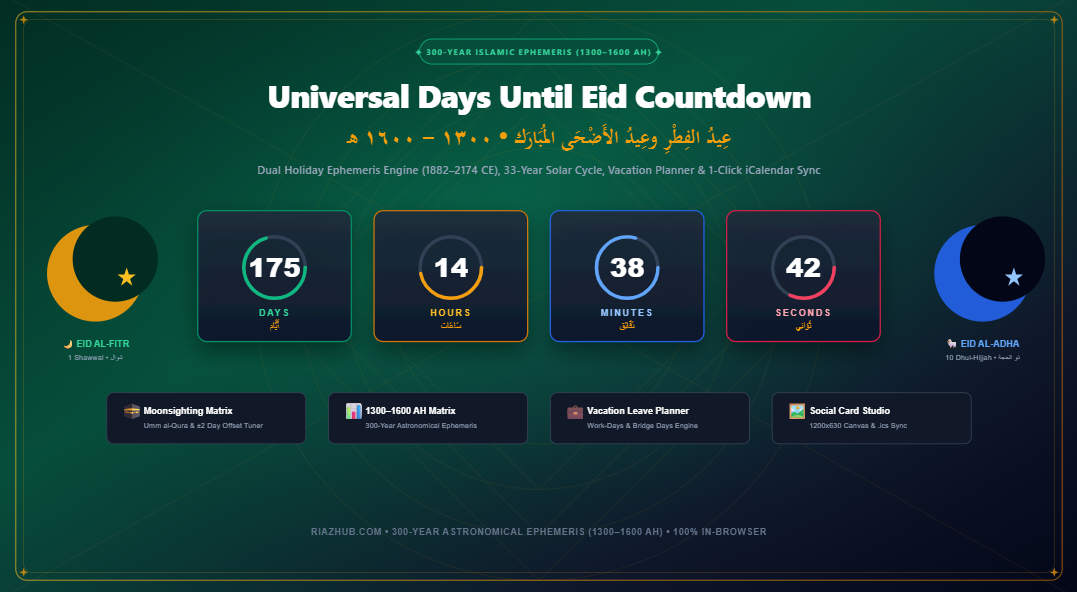
The Science of the Islamic Calendar: Dual Eid Ephemeris, Lunar Drift, and Holiday Countdown Systems (1300 AH – 1600 AH)
عِيدُ الفِطْرِ وعِيدُ الأَضْحَى: الفَلَكُ والرُّؤْيَةُ والتَّقْوِيم (١٣٠٠ – ١٦٠٠ هـ)
In the global Islamic tradition, time is governed by the continuous rhythm of the lunar cycle. Unlike solar calendars whose annual solstices and equinoxes remain tethered to specific seasons, the Hijri lunar calendar advances through the solar year in reverse, causing the two great festive milestones Eid al-Fitr (1st of Shawwal) and Eid al-Adha (10th of Dhul-Hijjah) to cycle through winter, spring, summer, and autumn across a continuous 33-year solar cycle. Spanning three full centuries from 1300 AH to 1600 AH (1882 CE to 2174 CE), this celestial choreography bridges historical eras, present celebrations, and distant future horizons.
1. The Two Canonical Eids: Theological Distinction & Milestone Significance
Islamic jurisprudence strictly recognizes two recurring annual Eid celebrations established by the Prophet Muhammad ﷺ upon his migration to Madinah:
- Eid al-Fitr (عِيدُ الفِطْرِ – The Feast of Breaking the Fast): Observed on the 1st of Shawwal, this holiday marks the successful completion of the month-long spiritual endurance test of Ramadan. It begins with the distribution of Zakat al-Fitr (charity for the poor before prayer) and is celebrated as a day of thanksgiving, permissible feasting, family visitation, and sweet confectioneries. Fasting on this day is strictly forbidden (Haram) under Islamic consensus.
- Eid al-Adha (عِيدُ الأَضْحَى – The Feast of the Sacrifice): Observed on the 10th of Dhul-Hijjah, this holiday represents the major Eid (al-Eid al-Kabir). It immediately follows the standing at Mount Arafah (the pinnacle of the Hajj pilgrimage) and commemorates the peerless devotion of Prophet Ibrahim (Abraham) when tested with the command to sacrifice his son Ismail. It spans four consecutive days, including the three Days of Tashreeq (11th, 12th, and 13th of Dhul-Hijjah), and is marked by the ritual slaughter of sacrificial livestock (Udhiyah / Qurbani).
Because both holidays represent the spiritual crescendo of their respective seasons, calculating their dates ahead of time is critical for worldwide travel itineraries, animal sacrifice logistics, family reunions, and corporate holiday leave scheduling. Using the Days Until Eid Countdown and Dual Holiday Planner, worshippers, researchers, and organizations can view synchronized dates across 1300 AH to 1600 AH (1882 CE to 2174 CE).
2. Astronomical Mechanics of the Lunar Drift: The 33-Year Solar Cycle
Why do Eid dates change every single year on our conventional Gregorian wall calendars? The answer lies in the celestial mechanics governing the Moon’s synodic orbit around the Earth.
Gregorian Solar Year: ~365.2422 Mean Solar Days
Islamic Lunar Year (12 Synodic Months): 12 × 29.530588 ≈ 354.367 Mean Solar Days
Annual Differential ($\Delta T$): $365.2422 – 354.367 \approx 10.875 \text{ days per year}$
Because a purely lunar year is approximately 10 to 12 days shorter than a solar Gregorian year, every Islamic date moves forward through the solar calendar in retrograde:
Cycle_full = 365.2422 / 10.875 ≈ 33.58 Solar Years
This 33-year astronomical cycle guarantees that over the course of an average human lifespan, a Muslim will celebrate both Eid al-Fitr and Eid al-Adha across all four seasons. Across the 300-year span from 1300 AH to 1600 AH, this full seasonal rotation repeats approximately nine consecutive times! An Eid celebrated in the sweltering heat of July gradually drifts through June, May, and April, reaching the brisk chill of January 16 years later, before completing its full journey back to summer after ~33 solar years.
Comparative Ephemeris Matrix: 300-Year Milestone Sample (1300 AH – 1600 AH)
Below is an astronomical sample drawn from the ephemeris database embedded inside the Days Until Eid Countdown Ephemeris Engine:
| Hijri Year | Eid al-Fitr (1 Shawwal) | Eid al-Adha (10 Dhul-Hijjah) | Fitr Solar Season | Adha Solar Season |
|---|---|---|---|---|
| 1300 AH | Sun, Aug 05, 1883 | Fri, Oct 12, 1883 | ☀️ Summer | 🍂 Autumn |
| 1350 AH | Mon, Feb 08, 1932 | Fri, Apr 15, 1932 | ❄️ Winter | 🌸 Spring |
| 1400 AH | Tue, Aug 12, 1980 | Sun, Oct 19, 1980 | ☀️ Summer | 🍂 Autumn |
| 1445 AH | Wed, Apr 10, 2024 | Sun, Jun 16, 2024 | 🌸 Spring | ☀️ Summer |
| 1446 AH | Sun, Mar 30, 2025 | Fri, Jun 06, 2025 | 🌸 Spring | ☀️ Summer |
| 1447 AH | Fri, Mar 20, 2026 | Wed, May 27, 2026 | 🌸 Spring / Equinox | ☀️ Late Spring |
| 1448 AH | Tue, Mar 09, 2027 | Sun, May 16, 2027 | ❄️ Late Winter | 🌸 Spring |
| 1455 AH | Fri, Dec 23, 2033 | Wed, Mar 01, 2034 | ❄️ Winter (Solstice) | ❄️ Late Winter |
| 1500 AH | Thu, Jan 14, 2077 | Tue, Mar 23, 2077 | ❄️ Winter | 🌸 Early Spring |
| 1600 AH | Wed, Jun 17, 2174 | Mon, Aug 24, 2174 | ☀️ Late Spring / Summer | ☀️ Summer |
Notice that in solar year 2033 CE, an extraordinary phenomenon occurs: Eid al-Fitr is celebrated twice in one solar year (January 2, 2033 for 1454 AH, and December 23, 2033 for 1455 AH) due to the cumulative 11-day advancement!
3. Moonsighting Calibration: Umm al-Qura, Physical Sighting & Astronomical Calculations
One of the most frequent dilemmas faced by Muslim communities worldwide is the discrepancy of one (and rarely two) days in holiday announcements between different countries. This is not due to clerical error, but stems from distinct classical and modern legal-astronomical methodologies:
A. The Umm al-Qura Calendar of Makkah (Official Civil Standard)
Administered by the King Abdulaziz City for Science and Technology (KACST) in Riyadh, the Umm al-Qura calendar establishes the civil baseline for Saudi Arabia. Its astronomical rule states that a new lunar month begins if the astronomical conjunction (new moon birth) occurs before sunset at Makkah al-Mukarramah, and the Moon sets after the Sun. While primarily intended for administrative and civil operations, it serves as the global anchor for Hajj and Eid al-Adha, where pilgrims converge in the plains of Arafah.
B. Global vs. Regional Naked-Eye Moonsighting (Ikhtilaf al-Matali)
Classical jurists recognized that observers at different longitudes and latitudes have different sighting horizons (Matali). Traditional regional sighting organizations (such as the Central Hilal Committee of North America, Wifaqul Ulama UK, and the moonsighting committees of Pakistan, India, and Morocco) require physical verification of the slender crescent (Hilal) with the naked eye or optical telescopes on the 29th evening of the preceding month. If atmospheric clouds, dust, or horizon geometry prevent visibility, the month is rounded to 30 full days based on the prophetic directive:
“Fast when you see it [the crescent] and break your fast when you see it, and if it is cloudy above you, then complete the count of thirty days.” (Sahih al-Bukhari 1909)
C. Scientific Astronomical Calculation (FCNA & ECFR)
Bodies such as the Fiqh Council of North America (FCNA) and the European Council for Fatwa and Research (ECFR) adopt pre-calculated astronomical criteria. If conjunction occurs anywhere on Earth before 12:00 GMT and the crescent meets minimum altitude and elongation thresholds, the subsequent day is declared the first of the month.
To address this practical diversity across centuries, the Days Until Eid Countdown & Holiday Ephemeris Tool incorporates a dedicated Regional Moonsighting Offset Tuner (-2 to +2 Days). Users can calibrate the baseline ephemeris to mirror their local mosque or regional religious authority with a single click.
4. Corporate & Vacation Strategy: Maximizing Eid Bridge Days
For professionals and families living in both Muslim-majority nations and Western diasporas, maximizing public holiday breaks around Eid is essential. Because Eid days fall on weekdays that shift annually, understanding “bridge days” enables employees to take fewer official leave days while enjoying extended consecutive family vacations:
- Tuesday / Wednesday Eid: Taking Monday as a bridge day creates a seamless 5 to 6-day consecutive break connecting the previous weekend.
- Thursday Eid: In Saturday/Sunday weekend schemes, taking Friday off transforms a single holiday into a continuous 4-day festive retreat.
- Weekend Scheme Tuning: GCC countries and regions observing Friday/Saturday weekends face different bridge dynamics compared to Europe, the Americas, and Southeast Asia observing Saturday/Sunday weekends.
The vacation calculator inside the Days Until Eid Holiday Planner automatically strips out weekend intervals to yield your precise remaining office and school days, alongside total consecutive days off.
5. Sunnah Practices & The Spiritual Etiquette of Eid
Beyond dates and calendars, the beauty of Eid resides in adhering to the established Sunnah practices of the Prophet Muhammad ﷺ:
- Ghusl (Ritual Purification): Taking a complete ritual bath on the morning of Eid prior to departing for the prayer ground (Musalla).
- Best Clothing & Fragrance: Adorning one’s finest clean clothes, applying non-alcoholic Itr (perfume) for men, and presenting an appearance of festive dignity.
- Food Protocol:
- Eid al-Fitr: Eating an odd number of dates (3, 5, or 7) before leaving for prayer to symbolize the conclusion of fasting.
- Eid al-Adha: Refraining from eating in the morning until returning from prayer to partake first from the sacrificial meat.
- Recitation of Takbeerat al-Eid: Reciting aloud when walking to the prayer ground and during gatherings:
اللَّهُ أَكْبَرُ، اللَّهُ أَكْبَرُ، لَا إِلَهَ إِلَّا اللَّهُ، اللَّهُ أَكْبَرُ، اللَّهُ أَكْبَرُ، وَلِلَّهِ الحَمْدُ“Allāhu Akbar, Allāhu Akbar, Lā ilāha illallāh, Allāhu Akbar, Allāhu Akbar, wa lillāhil-ḥamd.”
- Walking via Alternate Routes: Traveling to the prayer place via one route and returning home via a different path to multiply blessings and greetings.
- Mutual Supplications & Greetings: Greeting fellow worshippers with the traditional prophetic phrase: “Taqabbal Allāhu minnā wa minkum” (تَقَبَّلَ اللَّهُ مِنَّا وَمِنْكُمْ – May Allah accept good deeds from us and from you).
6. Instant iCalendar (.ics) Synchronization & Social Greetings
Modern busy schedules require digital coordination. With the Days Until Eid Studio on RiazHub, users can instantly generate and download native .ics calendar event files compatible with Apple Calendar, Google Calendar, and Microsoft Outlook. Each calendar file includes an automatic 1-day advance notification to prepare your attire and begin reciting the Takbeerat.
Furthermore, the built-in 1200×630 Social Card Studio renders high-resolution celebratory graphics directly onto your device using HTML5 Canvas complete with authentic Arabic calligraphy and live countdown tallies ready for immediate sharing across WhatsApp, Instagram, and Facebook without watermarks or signups.
Universal Days Until Eid Countdown Studio
عِيدُ الفِطْرِ وعِيدُ الأَضْحَى المُبَارَكCalculates and tracks the exact dates for both major Islamic holidays: Eid al-Fitr (1st of Shawwal) and Eid al-Adha (10th of Dhul-Hijjah) across 1300 AH to 1600 AH (1882 CE to 2174 CE). Synchronized with verified Umm al-Qura ephemeris data, moonsighting calibration, 300-year multi-year projection matrices, vacation work-days planner, and 1-click social greeting card generator.
The Islamic lunar calendar shifts approximately 10 to 12 days earlier each solar year. Browse across 300 years (1300 AH to 1600 AH) or jump directly to any year.
| Hijri Year | Eid al-Fitr (1 Shawwal) | Eid al-Adha (10 Dhul-Hijjah) | Season Cycle | Action |
|---|
It is an established Sunnah of the Prophet ﷺ and his companions to take a complete ritual bath before heading out to the Eid prayer ground.
Men are recommended to apply fine fragrance and dress in their cleanest, most dignified garments. Women dress modestly for the festive gathering.
For Eid al-Fitr, eat an odd number of dates (3, 5, or 7) before leaving for prayer. For Eid al-Adha, it is Sunnah to delay eating until after the prayer to eat from the Udhiyah.
Zakat al-Fitr must be given before the Eid prayer begins so the needy can celebrate without hunger. Delaying it past the prayer nullifies it as Fitr.
Slaughtering the sacrificial animal begins strictly after the Eid al-Adha prayer and continues across the 3 Days of Tashreeq (11th, 12th, and 13th Dhul-Hijjah).
It is Sunnah to take one path to the prayer ground and return by another, allowing more greetings of peace and witnessing of blessings.
اللَّهُ أَكْبَرُ، اللَّهُ أَكْبَرُ، وَلِلَّهِ الحَمْدُ