
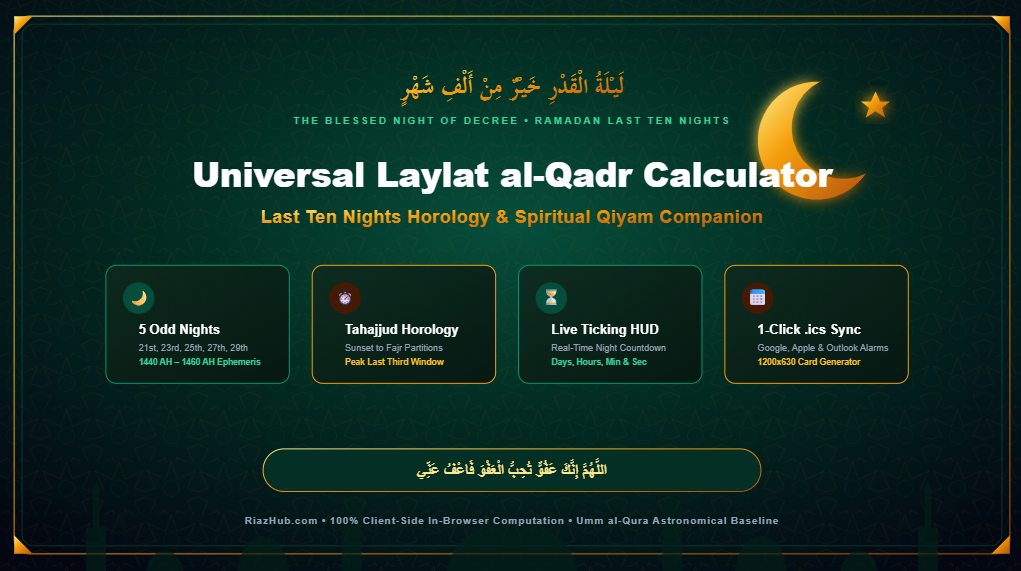
The Ultimate Guide to Laylat al-Qadr: Calculating the Odd Nights, Tahajjud Horology, and Spiritual Qiyam Companion
🌙 Quick Fasting & Night Horology Rule
In Islamic astronomical reckoning, the night precedes the day. Each Islamic date begins at sunset (Maghrib), not at midnight. Therefore, the 21st night of Ramadan commences at sunset immediately following the 20th day of fasting. Striving begins as soon as the Maghrib Adhan is called.
1. The Sacred Virtue of Laylat al-Qadr (Surah Al-Qadr)
Allah Almighty dedicated an entire chapter of the Holy Quran to celebrate the preeminence of this evening:
“Indeed, We sent the Quran down during the Night of Decree. And what can make you know what is the Night of Decree? The Night of Decree is better than a thousand months. The angels and the Spirit (Jibril) descend therein by permission of their Lord for every matter. Peace it is until the emergence of dawn.”
Surah Al-Qadr (97:1–5)
Islamic scholars emphasize that a single prayer, a solitary verse of Quran recited, or a heartfelt tear shed in repentance during this night outweighs a lifetime of 83.3 years lived without it. The descending legions of angels carry divine peace (Salam) that envelops the earth from the instant the sun sets until the initial light of dawn (Fajr).
To ensure you never miss the critical twilight and late-night windows across any Ramadan year, explore the multi-century projections on the Laylat al-Qadr Horology Companion, calibrated across 1300 AH to 1600 AH (spanning 1882 CE to 2175 CE).
2. When Does Laylat al-Qadr Occur? The 5 Blessed Odd Nights
The Messenger of Allah ﷺ spent the last ten days in complete spiritual seclusion (I’tikaf) in the Prophet’s Mosque in Madinah, exerting himself in prayer and supplication more than at any other time of the year. He explicitly advised:
“Search for Laylat al-Qadr in the odd nights of the last ten days of Ramadan.”
Sahih al-Bukhari (2017), Sahih Muslim (1169)
These five pivotal evenings are:
- Night of the 21st: Begins at Maghrib sunset after completing the 20th day of fasting.
- Night of the 23rd: Begins at Maghrib sunset after completing the 22nd day of fasting.
- Night of the 25th: Begins at Maghrib sunset after completing the 24th day of fasting.
- Night of the 27th: Begins at Maghrib sunset after completing the 26th day of fasting. Historically, this is the most anticipated and widely observed odd night according to Ubayy ibn Ka’b and many early scholars.
- Night of the 29th: Begins at Maghrib sunset after completing the 28th day of fasting.
Because regional moon-sighting decisions can cause Ramadan to begin on slightly different Gregorian dates between North America, the United Kingdom, and the Middle East, the RiazHub Laylat al-Qadr Calculator includes a regional calibration matrix featuring Umm al-Qura (Makkah official), Global Crescent Sighting, and a manual ±2 day adjustment stepper.
3. The Horology of the Islamic Night: Calculating the Golden “Last Third”
A common mistake among worshippers is assuming that “Islamic Midnight” occurs at 12:00 AM on the clock. Astronomically and jurisprudentially, the Islamic night is defined strictly from sunset (Maghrib) to dawn (Fajr).
Mathematical Partitioning of the Night
- Total Night Duration (ΔT): Calculated as the total hours and minutes between sunset and the break of true dawn the following morning.
ΔT = Time(Fajr) - Time(Maghrib) - Islamic Midnight (Nisf al-Layl): The exact chronological midpoint of the night, marking the canonical end time for Isha prayer according to the preferred opinion.
Midnight = Time(Maghrib) + (ΔT / 2) - Prime Last Third Window (Thuluth al-Layl al-Akhir): The peak hours of Tahajjud, divine descent, and guaranteed acceptance of supplication.
Last Third Starts = Time(Maghrib) + (2 × ΔT / 3)
The Prophet ﷺ declared:
“Our Lord descends every night to the nearest heaven when the last third of the night remains, saying: ‘Who is calling upon Me that I may answer him? Who is asking of Me that I may give him? Who is seeking My forgiveness that I may forgive him?’”
Sahih al-Bukhari (1145), Sahih Muslim (758)
Instead of doing complex solar declination and equation-of-time math by hand, you can instantly pinpoint your exact local Tahajjud window using the GPS-powered astronomical engine in the online Laylat al-Qadr Horology Tool.
4. Comparison Matrix: Verified Gregorian Odd Night Projections
Below is a quick comparative reference for upcoming Ramadan cycles, calibrated against the official Umm al-Qura astronomical ephemeris:
| Hijri Year | Ramadan 1st (Sunset Prior) | 21st Night (Sunset) | 25th Night (Sunset) | 27th Night (Most Anticipated) | 29th Night (Sunset) |
|---|---|---|---|---|---|
| 1447 AH | Feb 18, 2026 | Mon, Mar 9, 2026 | Fri, Mar 13, 2026 | Sun, Mar 15, 2026 | Tue, Mar 17, 2026 |
| 1448 AH | Feb 8, 2027 | Fri, Feb 26, 2027 | Tue, Mar 2, 2027 | Thu, Mar 4, 2027 | Sat, Mar 6, 2027 |
| 1449 AH | Jan 28, 2028 | Wed, Feb 16, 2028 | Sun, Feb 20, 2028 | Tue, Feb 22, 2028 | Thu, Feb 24, 2028 |
| 1450 AH | Jan 16, 2029 | Sun, Feb 4, 2029 | Thu, Feb 8, 2029 | Sat, Feb 10, 2029 | Mon, Feb 12, 2029 |
To browse projections across the entire multi-century catalog from 1300 AH through 1600 AH (1882 CE to 2175 CE) or download synchronized calendar alerts directly to your mobile device, launch the Universal Laylat al-Qadr Calculator.
5. Authentic Hadith Signs of Laylat al-Qadr vs. Cultural Myths
Many folklore tales surround Laylat al-Qadr such as trees bowing to the ground, animals speaking, or dogs refraining from barking. Classical scholars have clarified that none of these claims possess authentic foundation in the Sunnah. Rather, the Prophet Muhammad ﷺ described clear, dignified, authentic signs:
1. A Placid, Tranquil, and Temperate Night
The Messenger of Allah ﷺ stated: “Laylat al-Qadr is a calm and pleasant night, neither excessively hot nor cold, and the sun rises on its following morning with weak redness without rays.” (Sahih Ibn Khuzaymah 2192). Believers often report a palpable, serene stillness in the atmosphere, attributed to the vast descent of angels.
2. The Morning Sun Rising White Without Dazzling Rays
Ubayy ibn Ka’b (may Allah be pleased with him) reported that the Prophet ﷺ taught: “On the morning following Laylat al-Qadr, the sun rises without rays, resembling a brass dish until it ascends.” (Sahih Muslim 762). This occurs because the sheer multitude of ascending angels momentarily veils the brilliance of the sun’s blinding rays.
6. The Prophetic Supplication: The Profound Meaning of Al-‘Afuw
The Mother of the Believers, Aisha (may Allah be pleased with her), asked the Prophet ﷺ: “O Messenger of Allah, if I know which night is Laylat al-Qadr, what should I say during it?” He instructed her to repeat this concise yet all-encompassing prayer:
(Sunan at-Tirmidhi 3513, Sunan Ibn Majah 3850 — Sahih)
Why ‘Afuw (العفو) Exceeds Maghfirah (المغفرة)
In classical Arabic linguistics, scholars explain a sublime nuance: Maghfirah comes from the root meaning to conceal or cover a sin protecting the servant from public humiliation and shielding them from penalty, though the sin remains recorded in their scroll of deeds. By contrast, ‘Afuw signifies complete obliteration, erasure, and wiping away of the sin as though it never took place. When Allah grants ‘Afuw, the sin is erased from your record, and the guardian angels who wrote it are made to forget it.
You can listen to authentic Arabic audio pronunciation and generate high-resolution 1200×630 social reminder cards featuring this dua inside the Spiritual Qiyam Companion Studio.
7. Nightly Ibadah Checklist: Maximizing Your Worship
To avoid burnout and ensure balanced striving across all ten nights, adopt this proven spiritual framework:
- Establish Isha and Fajr in Congregation: The Prophet ﷺ stated: “Whoever prays Isha in congregation, it is as if he spent half the night in prayer. And whoever prays Subh (Fajr) in congregation, it is as if he spent the entire night in prayer.” (Sahih Muslim 656).
- Perform Taraweeh with the Imam: Do not leave early. The Prophet ﷺ promised: “Whoever stands with the Imam until he finishes, it will be recorded for him that he prayed the whole night.” (Jami` at-Tirmidhi 806).
- Schedule Focused Tahajjud (Qiyam al-Layl): Wake up 60 to 90 minutes before Fajr. Pray in units of two rak’ahs with deliberate recitation, heartfelt ruku’, and prolonged prostration.
- Recite and Ponder the Holy Quran: Devote time to reflect upon Surah Al-Qadr and recite designated portions with translation and contemplation (Tadabbur).
- Give Sadaqah (Charity) Every Night: Even donating $5 or $10 each evening guarantees that your charity coincides with Laylat al-Qadr—equating to continuous daily charity for over 83 years!
- Engage in Abundant Istighfar & Supplication: Before the break of dawn, pour out your heart in personal du’a for your parents, children, the global Ummah, and your eternal salvation.
Keep track of your nightly worship goals using the interactive checklist with local habit persistence built into the Laylat al-Qadr Qiyam Planner.
8. Frequently Asked Questions (FAQ)
A: While the explicit command of the Prophet ﷺ emphasizes the odd nights (21st, 23rd, 25th, 27th, and 29th), classical scholars such as Ibn Taymiyyah and Ibn Hajar noted that depending on whether the lunar month ends with 29 or 30 days, counting from the end of the month can technically shift the odd count relative to the start. For this reason, the most prudent and rewarded approach is to strive with sincere devotion across all ten nights.
A: Absolutely. While ritual formal prayer (Salah) and fasting are suspended, all other gates of worship remain wide open: abundant Dhikr, reciting the Prophetic supplication (Allāhumma innaka ‘Afuwwun…), listening to Quran recitation, giving Sadaqah, serving others, and making sincere personal du’a. The reward is determined by the sincerity of the heart.
A: You can visit the Universal Laylat al-Qadr Calculator and click the “Add All 5 Nights to Calendar (.ics)” button. This instantly downloads an RFC-compliant calendar file with pre-set sunset and Tahajjud wake-up notifications for Google Calendar, Apple Calendar, and Microsoft Outlook.
Conclusion: Strive with Resolve
Ramadan departs swiftly, but the blessings of the Night of Decree endure for eternity. Do not let these golden hours slip away in distraction or procrastination. Recalculate your local partitions, align your schedule, recite the master supplication with conviction, and enter the final stretch of Ramadan with unyielding determination.
Plan your schedule today using the free, privacy-first Universal Laylat al-Qadr Calculator, Last Ten Nights Horology & Spiritual Qiyam Companion on RiazHub.com.
Universal Laylat al-Qadr Calculator & Spiritual Qiyam Companion
Project the exact dates of the 5 blessed odd nights of the last ten days, calculate local Maghrib-to-Fajr night partitions, monitor real-time Tahajjud countdowns, and organize your nightly worship.
| Odd Night | Gregorian Evening (Begins at Sunset) | Sunset (Maghrib) | Peak Tahajjud (Last Third) | Fajr / Imsak | Status |
|---|
Spiritual Context: Aisha (may Allah be pleased with her) asked the Prophet Muhammad ﷺ: “O Messenger of Allah, if I know which night is Laylat al-Qadr, what should I say in it?” He replied: “Say: Allāhumma innaka ‘Afuwwun tuḥibbul-‘afwa fa‘fu ‘annī.”
Nightly Ibadah Checklist
0% CompletedHigh-res 1200x630 format optimized for WhatsApp Status, Instagram, Facebook, and X (Twitter).
Authentic Hadith Dossier, Signs & Spiritual Fiqh
🌟 Greater Than 1,000 Months
Allah says in Surah Al-Qadr: “The Night of Decree is better than a thousand months.” (Quran 97:3). A thousand months equates to roughly 83 years and 4 months of continuous worship, during which the angels descend with peace until Fajr.
🔍 Why Hidden in the Odd Nights?
The Prophet ﷺ said: “Search for Laylat al-Qadr in the odd nights of the last ten days of Ramadan.” (Sahih al-Bukhari 2017). It is hidden so believers actively strive with devotion across all nights rather than relying on a single evening.
🌅 Verified Prophetic Signs
The Prophet ﷺ described the night as peaceful, temperate, neither hot nor cold (Sahih Ibn Khuzaymah). The following morning, the sun rises pure white without dazzling rays (Sahih Muslim 762).
🛡️ ‘Afuw vs. Maghfirah
While Maghfirah shields a servant from punishment while the sin remains in the records, ‘Afuw signifies total erasure, wiping away the sin so completely that even the recording angels forget it.