
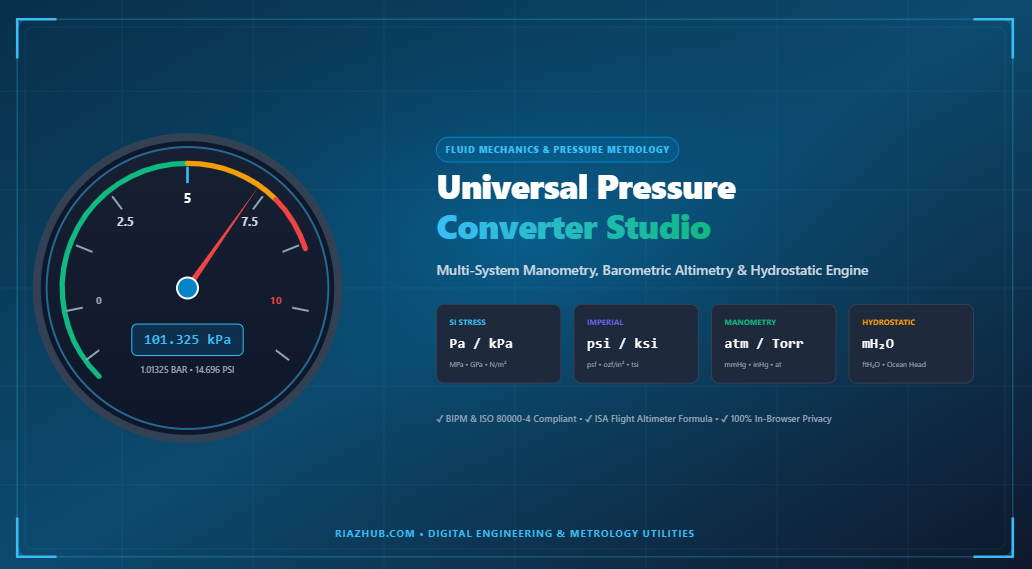
Mastering Pressure Metrology: SI Pascals, Barometric Altimetry, Hydrostatic Depth, and Absolute vs. Gauge Engineering
From microscopic vacuum chambers to deep-sea abyssal trenches and aerospace flight altimeters, pressure is one of the most critical state variables in physics and industrial engineering. Here is your definitive guide to understanding its units, mechanics, and precision conversions.
1. What is Pressure? Mechanical Definition & The SI Base Pascal
In classical continuum mechanics and fluid dynamics, pressure (P) is defined as the scalar magnitude of compressive force (F) exerted perpendicularly (normal) across a unit boundary area (A):
Under the International System of Units (SI), standardized by the International Bureau of Weights and Measures (BIPM) and codified in ISO 80000-4, the coherent derived unit of pressure and mechanical stress is the Pascal (symbol: Pa), named in honor of the French polymath Blaise Pascal:
Because 1 Pascal is a delicate physical quantity roughly equivalent to the force of an ordinary paper dollar bill or single postage stamp resting on a desk—engineering disciplines employ decimal SI multipliers:
- Hectopascal (1 hPa = 100 Pa): The international standard in synoptic meteorology, mathematically identical to 1 millibar (1 mbar).
- Kilopascal (1 kPa = 1,000 Pa): Standard for automotive intake manifold absolute pressure (MAP) sensors, building ventilation ducts, and HVAC airflow.
- Megapascal (1 MPa = 1,000,000 Pa): Identical to 1 N/mm², the universal standard for material tensile strength, concrete compressive yield ratings, and high-pressure hydraulic circuits.
- Gigapascal (1 GPa = 10⁹ Pa): Utilized in geophysics, seismic crustal fault modeling, and synthetic diamond anvil cell metallurgy.
You can effortlessly switch across all metric decimal scale tiers using the Universal Pressure Converter Studio with real-time arbitrary precision from 2 to 10 decimal places.
2. The 5 Distinct Pressure Families in Modern Engineering
Pressure measurement is uniquely diverse because sensors historically evolved around differing physical phenomena—from mercury columns in glass tubes to Bourdon spring coils and piezoelectric transducers. Today, five distinct unit families coexist across global industry:
Pa, hPa, kPa, MPa, GPa, N/m², and N/mm². The global scientific standard. Completely coherent with SI thermodynamic energy laws and structural finite element analysis (FEA).
Bar, Millibar (mbar), and Microbar (μbar). Calibrated so that 1 bar = 100,000 Pa. Widely utilized in European manufacturing, compressed gas tanks, scuba regulators, and espresso machines.
Pound-force per sq inch (psi), Kilopound (ksi = 1,000 psi), and psf. Predominant in US automotive, aerospace hydraulics, oilfield drilling, and ASME boiler certifications.
Standard atmosphere (atm), Technical atmosphere (at), Torr, and mmHg. Grounded in mercury column physics; foundational to clinical blood pressure (120/80 mmHg) and high-vacuum sputtering.
Meter of water (mH₂O), Centimeter of water (cmH₂O), and Inch of water (inH₂O). Represents the static head pressure generated by a column of pure distilled water at its maximum density (1,000 kg/m³). Crucial in civil water storage towers, irrigation piping, aquifer hydrology, and low-differential cleanroom draft sensors.
3. Absolute Pressure (psia / bara) vs. Gauge Pressure (psig / barg)
One of the most dangerous oversights in mechanical engineering and gas storage design is confusing gauge pressure with absolute pressure. A failure to account for ambient atmospheric pressure can result in catastrophic vessel collapse or valve failure.
| Parameter | Gauge Pressure (psig / barg) | Absolute Pressure (psia / bara) |
|---|---|---|
| Reference Datum | Local ambient atmosphere (1 atm = 0 psig) | Absolute perfect vacuum (0 Pa = 0 psia) |
| Open Sea-Level Air | Reads exactly 0 barg (0 psig) | Reads exactly 1.01325 bara (14.696 psia) |
| Vehicle Tire Pressure | Tire gauge reads 32.0 psig | Actual internal pressure is 46.7 psia |
| Full Vacuum Limit | Reaches -1.01325 barg (-14.696 psig) | Reaches 0.000 bara (0.000 psia) (Cannot be negative) |
| Thermodynamic Equations | Invalid in Ideal Gas Law (PV = nRT) | Strictly required in all thermodynamic calculations |
Our online pressure converter features a dedicated reference datum toggle, enabling you to switch any measurement between absolute and gauge modes with automatic sea-level atmospheric offsets.
4. Barometric Altimetry & The International Standard Atmosphere (ISA) Formula
In aviation and atmospheric science, an aircraft’s barometric altimeter is essentially a high-precision pressure gauge that reads the ambient static air pressure surrounding the fuselage and translates that value into physical geopotential altitude.
Because air is a compressible gas governed by hydrostatic equilibrium and the Ideal Gas Law, air density and pressure decline exponentially with increasing altitude. Within the Earth’s troposphere (up to 11,000 meters / 36,089 feet), altitude is derived via the standard barometric formula:
Pilots calibrate their altimeters to local meteorological station pressures using the Kollsman window, adjusting for barometric shifts in either inches of mercury (inHg, standard in North America) or hectopascals (hPa / mbar, standard internationally):
- Standard Sea Level: 1013.25 hPa (29.92 inHg) → Altitude = 0 m (0 ft).
- Mile High City (Denver, Colorado – 1,609 m): Ambient pressure drops to ~83.4 kPa (12.1 psi / 24.6 inHg).
- Mount Everest Summit (8,848 m / 29,029 ft): Ambient pressure drops to ~33.7 kPa (4.89 psi / 9.95 inHg). Water boils at just 71°C (160°F) due to the drastically lowered vapor pressure threshold.
- Commercial Jet Flight Level (FL350 – 10,668 m): Ambient pressure is ~23.8 kPa (3.45 psi). Cabins are actively pressurized to an equivalent altitude of 1,800–2,400 meters (~75–80 kPa) to sustain human respiration.
5. Hydrostatic Columns & Ocean Submersion Depth Dynamics
Unlike air, liquids such as fresh water and ocean seawater are virtually incompressible across typical engineering pressures. Consequently, hydrostatic liquid pressure increases linearly with depth in accordance with Pascal’s Hydrostatic Law:
Fluid density varies based on salinity and temperature:
- Fresh Pure Water (@ 4°C): ρ = 1,000 kg/m³ → Pressure gradient = 9.80665 kPa per meter (0.4335 psi/ft).
- Standard Ocean Seawater (@ 15°C, 35 PSU): ρ = 1,025 kg/m³ → Pressure gradient = 10.0518 kPa per meter (0.4444 psi/ft).
A practical rule of thumb in scuba diving is that every 10 meters (33 feet) of ocean descent adds approximately 1 bar (14.7 psi) of gauge pressure.
At the deepest known point on Earth the Challenger Deep in the Mariana Trench at an astonishing depth of 10,994 meters (36,070 feet) the ambient hydrostatic pressure reaches:
You can evaluate any liquid column head or submerged depth in seconds using the Hydrostatic Solver on RiazHub.
6. Hydraulic & Pneumatic Cylinder Actuator Force Physics
In automated manufacturing, robotic assembly, construction excavators, and industrial punch presses, fluid pressure is converted into linear mechanical thrust through pistons:
1 Worked Industrial Actuator Example:
Consider a standard automated clamp equipped with a 63 mm (0.063 m) bore pneumatic cylinder connected to standard workshop air regulated at 6.5 bar (650,000 Pa). What is the theoretical clamping force?
- Step 1: Calculate Cross-Sectional Piston Area (A):
A = π × (0.063 / 2)² = π × 0.0315² = 0.003117 m² (31.17 cm²). - Step 2: Calculate Output Thrust Force (F):
F = 650,000 Pa × 0.003117 m² = 2,026.2 Newtons. - Step 3: Convert into Common Force Units:
F = 455.5 pounds-force (lbf) ≈ 206.6 kilograms-force (kgf).
Model any pneumatic or hydraulic piston cylinder configuration instantly with the built-in Actuator Force Engine.
7. Master Pressure Units Conversion Reference Matrix
The following metrological matrix provides exact and high-precision multiplier factors for converting any unit into the base SI Pascal (Pa):
| Unit Name | Symbol | Exact Multiplier to Pascals (Pa) | Primary Engineering Discipline |
|---|---|---|---|
| Pascal (Base SI) | Pa | 1.0 (Exact) | Thermodynamics, acoustics, academic physics |
| Hectopascal | hPa | 100.0 (Exact) | Meteorology, barometric weather maps |
| Kilopascal | kPa | 1,000.0 (Exact) | Automotive MAP sensors, ventilation HVAC |
| Megapascal | MPa | 1,000,000.0 (Exact) | Structural steel yield, concrete strength, hydraulics |
| Newton per sq millimeter | N/mm² | 1,000,000.0 (Exact) | Mechanical stress, tensile testing |
| Gigapascal | GPa | 1,000,000,000.0 (Exact) | Planetary geology, diamond synthetic crystals |
| Bar | bar | 100,000.0 (Exact) | Fluid power, scuba diving, gas distribution |
| Millibar | mbar | 100.0 (Exact) | Weather forecasts, vacuum packaging |
| Pound-force per sq in | psi | ≈ 6,894.757293 | US automotive tires, plumbing, process piping |
| Kilopound per sq in | ksi | ≈ 6,894,757.293 | Aerospace stress analysis, bolt yield strength |
| Pound-force per sq ft | psf | ≈ 47.880259 | Civil architecture roof loads, wind pressure |
| Standard Atmosphere | atm | 101,325.0 (Exact) | Standard temperature & pressure (STP), diving |
| Technical Atmosphere | at (kgf/cm²) | 98,066.5 (Exact) | Legacy European and Russian steam boilers |
| Torr | Torr | 101,325 / 760 ≈ 133.322368 | Vacuum deposition, semiconductor manufacturing |
| Millimeter of Mercury (@ 0°C) | mmHg | ≈ 133.322387 | Cardiovascular clinical blood pressure gauges |
| Inch of Mercury (@ 0°C) | inHg | ≈ 3,386.389 | Aviation altimeter setting (Kollsman window) |
| Meter of Water Head (@ 4°C) | mH₂O | 9,806.65 (Exact) | Municipal water towers, pump impeller total head |
| Centimeter of Water Head (@ 4°C) | cmH₂O | 98.0665 (Exact) | Medical respirators, CPAP sleep apnea therapy |
| Inch of Water Head (@ 4°C) | inH₂O | ≈ 249.0889 | HVAC duct static pressure, air filter draft |
8. Practical Step-by-Step Conversion Walkthroughs
Case Study 1: Converting Vehicle Tire Pressure (psi → bar & kPa)
An automobile manufacturer specifies a recommended cold tire inflation pressure of 35.0 psi. A European technician needs to set the digital workshop compressor in bar, and an automotive OBD-II scanner records the telemetry in kPa.
- Step 1: Convert psi to base SI Pascals:
PPa = 35.0 × 6,894.757 = 241,316.5 Pa - Step 2: Convert Pascals to bar:
Pbar = 241,316.5 / 100,000 = 2.413 bar - Step 3: Convert Pascals to kPa:
PkPa = 241,316.5 / 1,000 = 241.3 kPa
Result: 35.0 psi = 2.41 bar = 241.3 kPa.
Case Study 2: Converting Aviation Altimeter Setting (inHg → hPa)
A flight crew flying an international transatlantic route approaches London Heathrow Airport. Air Traffic Control transmits the local barometric altimeter setting (QNH) as 1022 hPa. The American aircraft altimeter subscale is calibrated in inches of mercury (inHg).
- Step 1: Convert hPa to base Pascals:
PPa = 1,022 × 100 = 102,200 Pa - Step 2: Convert Pascals to inHg:
PinHg = 102,200 / 3,386.389 = 30.179 inHg
Result: The pilot rotates the Kollsman setting knob to 30.18 inHg to ensure vertical guidance accuracy during instrument landing.
9. Frequently Asked Questions (FAQ)
Universal Pressure Converter & Barometric Studio
High-precision manometric matrix converting 30+ units across SI Metric stress, US engineering, atmospheric manometry, and hydrostatic water column head. Features live ISA altimeter, ocean subsea depth solver, pneumatic cylinder force calculator, and calibrated dial gauge.
$$h = 44330.77 \cdot \left[1 - \left(\frac{P}{101325}\right)^{0.190263}\right]\text{ meters}$$
Aircraft pilots rotate the Kollsman setting on their altimeter to calibrate for local weather barometric variations (QNH), ensuring precise terrain clearance.