
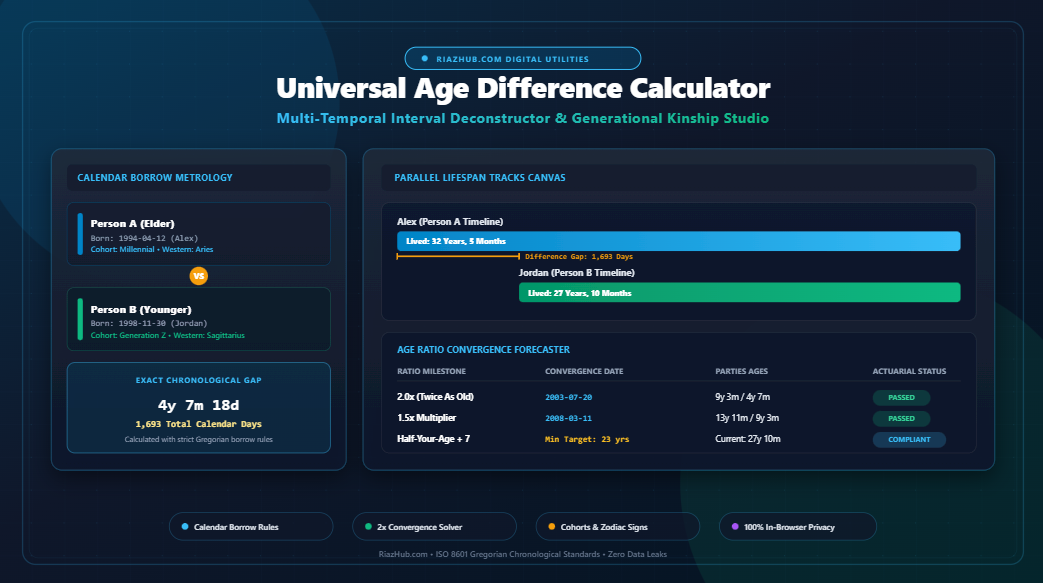
Universal Age Difference Calculator: The Science of Calendar Borrow Arithmetic, Twice-As-Old Milestones & Generational Kinship
Why dividing elapsed days by 365 produces fractional errors, how to calculate the exact calendar day someone is twice your age, and why generational kinship bridges define human relationships.
The Pitfalls of Crude Date Subtraction
When two individuals wish to determine the exact chronological gap between their birthdates, they frequently turn to standard calculators or generic date subtractors. Unfortunately, the vast majority of web utilities employ a crude mathematical simplification: they convert both dates into milliseconds, subtract the timestamps, and divide the resulting day count by 365 or 365.25.
While dividing by 365.25 yields a reasonable rough estimate for planetary physics, it fails completely under civil Gregorian metrology. Our civil calendar does not distribute days in smooth, symmetrical intervals. Months alternate between 28, 29, 30, and 31 days. Leap years introduce an intercalary day every four years (excluding centuries not divisible by 400).
For instance, an individual born on January 31 and another born on March 1 of a non-leap year have a gap of exactly 29 calendar days (0 years, 0 months, and 29 days). If you divide 29 by 30.43 (the average month length), you get an arbitrary decimal like 0.95 months. To solve this with absolute precision, you need genuine calendar-borrow arithmetic, which you can test directly using the Universal Age Difference Calculator on RiazHub.com.
When subtracting day $D_1$ from $D_2$, if $D_2 < D_1$, the algorithm must borrow the exact number of days in the preceding calendar month relative to the younger individual’s birth year—not a fixed 30-day average. Similarly, if months require borrowing, exactly 12 months are borrowed from the younger individual’s birth year.
Compute Your Exact Age Difference in Seconds
Want to see your exact chronological separation in Years, Months, Days, Weeks, Hours, and Elapsed Seconds with zero external data leaks?
The Mathematical Solution to the “Twice-As-Old” Milestone
One of the most fascinating queries in chronological dynamics is forecasting the Golden Age Ratio: “On what exact date was (or will) one person be exactly twice as old as the other?”
Many assume this date requires complex iterative simulations. In reality, it yields to an elegant algebraic proof. Let Person A be the elder individual born at date $T_A$, and Person B be the younger individual born at date $T_B$. Let the absolute chronological gap between them be denoted as $\Delta D$ days:
Let Age_B(t) = elapsed days lived by Person B at date t
Then Age_A(t) = Age_B(t) + ΔD
We seek the instant t* where:
Age_A(t*) = 2 × Age_B(t*)
Substituting Age_A(t*):
Age_B(t*) + ΔD = 2 × Age_B(t*)
ΔD = Age_B(t*)
// Therefore, the Twice-As-Old milestone occurs precisely when the younger person reaches the exact age difference between them!
Target Date = T_B + ΔD
This fundamental theorem applies across any arbitrary multiplier $K$. If you want to know when Person A is $1.5\times$ or $3.0\times$ the age of Person B, the younger individual’s age at that milestone is simply:
$\text{Age}_B(t) = \frac{\Delta D}{K – 1}$
You can verify every historical and future milestone date including 3x, 2.5x, 2x, 1.5x, and 1.25x ratios using the dedicated forecasting table in the Age Difference & Kinship Studio.
Cultural Norms: The “Half-Your-Age-Plus-Seven” Formula
In sociology and relationship dynamics, the “Half-Your-Age-Plus-Seven” adage is frequently cited as a cultural boundary for dating age discrepancies. Popularized in Western literature at the turn of the 20th century (specifically in Max O’Rell’s 1901 work Her Royal Highness Woman), the rule establishes:
- Minimum Acceptable Partner Age: $\lfloor (\text{Age}_{\text{Elder}} / 2) + 7 \rfloor$
- Maximum Acceptable Partner Age: $(\text{Age}_{\text{Younger}} – 7) \times 2$
What makes this formula mathematically compelling is its asymptotic behavior. When individuals are in their early twenties, a 5-year age gap represents a major developmental divergence (a 22-year-old dating a 17-year-old violates the threshold). However, when the elder individual reaches 40, the acceptable minimum age is 27 a 13-year margin.
The mathematical crossover point where any two individuals with an age gap of $\Delta Y$ years permanently satisfy the Half-Plus-Seven boundary occurs precisely when the younger individual reaches:
$\text{Younger Target Age} = \Delta Y + 14 \text{ Years}$
Our interactive suite automatically checks this rule in real time, displaying compliance badges and the exact future age when boundary compliance is achieved. Experience it live at the RiazHub Age Difference Calculator.
Sociodemographic Cohorts & Generational Kinship Bridges
Chronological age is not merely a quantity of elapsed seconds it defines an individual’s sociodemographic reality. Demographers at the Pew Research Center, the United Nations Population Division, and national census bureaus classify generational cohorts based on pivotal technological and geopolitical shifts:
| Cohort Designation | Birth Span | Defining Technological & Cultural Milestones |
|---|---|---|
| Silent Generation | 1928 – 1945 | Great Depression, World War II, post-war reconstruction |
| Baby Boomers | 1946 – 1964 | Post-war economic expansion, space race, television proliferation |
| Generation X | 1965 – 1980 | Personal computing, MTV, fall of the Berlin Wall, cable news |
| Millennials (Gen Y) | 1981 – 1996 | Rise of the World Wide Web, mobile phones, 9/11, 2008 recession |
| Generation Z | 1997 – 2012 | Ubiquitous smartphones, social media algorithmic feeds, climate activism |
| Generation Alpha | 2013 – 2024 | Generative AI, remote learning, tablet-first childhood |
| Generation Beta | 2025 – 2039 | The emerging post-2025 demographic frontier |
When calculating the gap between siblings, partners, or parents, the tool bridges these demographic cohorts alongside Western Zodiac elements and Chinese Lunar Zodiac animal cycles. You can analyze your generational kinship bridge on the Generational Kinship Studio on RiazHub.com.
Visualizing Parallel Lifespans & Exporting Certification Dossiers
Numbers on a screen often fail to convey the visceral reality of shared time. The RiazHub application integrates an HTML5 Parallel Lifespan Tracks Canvas that dynamically renders two horizontal proportional lifelines on a common temporal axis. You immediately observe:
- The Elder Solitary Horizon: The exact quantity of days the older person experienced on Earth prior to the younger person’s arrival.
- The Shared Overlap Bridge: The 100% mutual lifespan shared since the younger person’s birth date.
- The Chronological Gap Bracket: A high-visibility visual bracket detailing the exact interval separation.
Furthermore, the built-in Dossier Card Studio allows users to generate crisp 1200×630 social specification graphics in Cyber Azure, Kinship Emerald, Deep Obsidian, or Celestial Amber palettes. These cards are rendered client-side on an HTML5 canvas and can be downloaded as lossless PNG files or printed via a dedicated PDF stylesheet.
Zero-Server Privacy Guarantee
In an era where personal identifiable data is routinely harvested and monetized, birthdates and anniversary records must remain confidential. Unlike third-party APIs that upload your family data to external servers, the Universal Age Difference Calculator on RiazHub.com operates 100% locally in your web browser.
All interval decomposition, multiplier forecasting, canvas drawing, and clipboard operations occur on your machine’s CPU. No network packets containing personal records are ever transmitted over the wire.
Try the Universal Age Difference Calculator Today
Whether analyzing sibling spacing, celebrating relationship anniversaries, or exploring generational kinship bridges, experience precision chronological metrology for free.
Universal Age Difference Calculator & Kinship Studio
Deconstruct exact chronological gaps down to years, months, days, and seconds with calendar-accurate borrow arithmetic. Forecast twice-as-old convergence milestones, inspect sociodemographic cohorts, and export print-ready specifications.
Individual Ingestion Engine
| Ratio | Convergence Date | Elder Age | Younger Age | Status |
|---|
Let the chronological age gap between them be $\Delta D$ days. We seek the point in time $t$ where:
$$\text{Age}_{\text{Elder}}(t) = 2 \times \text{Age}_{\text{Younger}}(t)$$ $$\text{Age}_{\text{Younger}}(t) + \Delta D = 2 \times \text{Age}_{\text{Younger}}(t) \implies \text{Age}_{\text{Younger}}(t) = \Delta D$$
This proves mathematically that Person A is exactly twice as old as Person B on the exact calendar day when Person B reaches the age difference $\Delta D$!
- Silent Generation (1928–1945): Shaped by the Great Depression and World War II.
- Baby Boomers (1946–1964): Post-war economic boom and cultural revolution.
- Generation X (1965–1980): The advent of personal computing, MTV, and dual-income households.
- Millennials / Gen Y (1981–1996): The rise of the commercial internet, mobile telephony, and 9/11.
- Generation Z (1997–2012): Digital natives immersed in smartphones and social media algorithms from early youth.
- Generation Alpha (2013–2024): AI era, pandemic-era schooling, and ubiquitous screen interactivity.
- Generation Beta (2025–2039): The emerging post-2025 demographic frontier.