
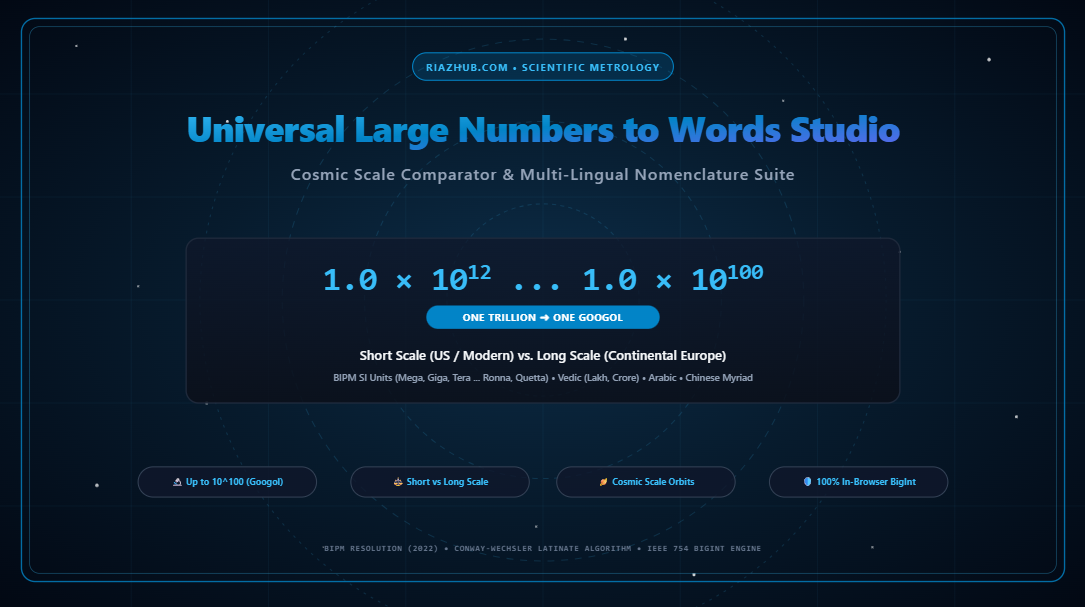
Demystifying Cosmic Quantities: The Universal Guide to Large Numbers, Scientific Notation, and Scale Metrology
When humanity looks beyond everyday commerce into national debts, astrophysics, planetary geology, and quantum mechanics, standard numerical language begins to break down. How do you verbalize a sovereign debt reaching $35,000,000,000,000? What is the formal name for the Sun’s mass in kilograms ($1.989 \times 10^{30}\text{ kg}$), the total estimated grains of sand across all of Earth’s coastlines ($7.5 \times 10^{18}$), or the total subatomic particles in the observable universe ($\sim 10^{80}$)?
To bridge this divide between incomprehensible scientific exponents and standardized human linguistics, researchers, educators, and quantitative analysts rely on the Universal Large Numbers (Scientific, Millions, Billions, Trillions) to Words Studio & Cosmic Scale Comparator. This deep-dive guide explores the mathematical architectures, historical naming schisms, BIPM SI metric standards, and computational linguistics that govern numbers from a thousand up to a Googol ($10^{100}$).
1. The Fundamental Scale Schism: American Short Scale vs. European Long Scale
One of the most consequential points of confusion in international finance, public policy, and scientific reporting is the divergent definition of terms like Billion and Trillion. This linguistic divide traces back to two distinct mathematical systems:
- American / Modern International Short Scale ($10^{3k+3}$):
Under this system, each successive -illion represents a quantity 1,000 times larger than the previous step ($10^3$). One million is $10^6$, one billion is $10^9$ (a thousand million), one trillion is $10^{12}$, and one quadrillion is $10^{15}$. Adopted officially by the United States and subsequently embraced across global financial markets, international journalism, and modern English usage. - Continental European Long Scale ($10^{6k}$ for -illions, $10^{6k+3}$ for -illiards):
Formulated by French mathematician Nicolas Chuquet in the 15th century and popularized by Jacques Peletier du Mans, this system requires a multiplier of one million ($10^6$) between successive -illion names. An intermediate suffix, -illiard, is assigned to intermediate steps ($10^9 = \text{Milliard}$, $10^{15} = \text{Billiard}$, $10^{21} = \text{Trilliard}$). In this paradigm, a billion is $10^{12}$ one million times larger than the American billion!
| Power of Ten | Standard Decimal (Digits) | Short Scale (US / Modern) | Long Scale (Traditional EU) | Scale Ratio Shift |
|---|---|---|---|---|
| 106 | 1,000,000 (7 digits) | Million | Million | 1:1 (Identical) |
| 109 | 1,000,000,000 (10 digits) | Billion | Milliard | 1,000× Shift |
| 1012 | 1,000,000,000,000 (13 digits) | Trillion | Billion | 1,000,000× Shift |
| 1015 | 1,000,000,000,000,000 (16 digits) | Quadrillion | Billiard | 1,000× Shift |
| 1018 | 1018 (19 digits) | Quintillion | Trillion | 1,000,000× Shift |
| 1021 | 1021 (22 digits) | Sextillion | Trilliard | 1,000× Shift |
| 1024 | 1024 (25 digits) | Septillion | Quadrillion | 1,000,000× Shift |
| 1027 | 1027 (28 digits) | Octillion | Quadrilliard | 1,000× Shift |
| 1030 | 1030 (31 digits) | Nonillion | Quintillion | 1,000,000× Shift |
| 1033 | 1033 (34 digits) | Decillion | Quintilliard | 1,000× Shift |
| 10100 | 1 followed by 100 zeros (101 digits) | Googol | Googol | 1:1 (Universal Constant) |
Because of this 1,000,000-fold discrepancy, converting financial statements or technical specifications between American English and languages like Spanish, French, or German requires extreme care. With the RiazHub Large Numbers to Words Studio, you can instantaneously toggle between Short Scale and Long Scale representations to ensure absolute metrological precision.
2. Beyond Decillion: The Conway-Wechsler Latinate Algorithm
What happens when numbers surpass a Decillion ($10^{33}$)? For centuries, writers coined arbitrary prefixes, producing chaos in scientific literature. In 1996, Princeton mathematician John Horton Conway and linguist Allan Wechsler codified a standardized Latin prefix grammar capable of systematically naming quantities up to $10^{3000}$ without ambiguity.
The Conway-Wechsler system constructs names through modular combinations of units, tens, and hundreds Latin roots:
- Units roots: un- (1), duo- (2), tre- (3), quattuor- (4), quin- (5), ses- (6), septen- (7), octo- (8), noven- (9).
- Tens roots: decillion ($10^{33}$), vigintillion ($10^{63}$), trigintillion ($10^{93}$), quadragintillion ($10^{123}$).
- Hundreds roots: centillion ($10^{303}$), ducentillion ($10^{603}$), trecentillion ($10^{903}$).
Under this deterministic grammar, $10^{63}$ is a Vigintillion, $10^{66}$ is an Unvigintillion, $10^{69}$ is a Duovigintillion, and $10^{100}$ (a Googol) sits comfortably between Trigintillion ($10^{93}$) and Untrigintillion ($10^{96}$). Testing and visualizing these naming structures is seamless in the Cosmic Scale Comparator.
3. BIPM 2022 SI Metric Modernization: Welcoming Ronna and Quetta
In November 2022, the 27th General Conference on Weights and Measures (CGPM) under the International Bureau of Weights and Measures (BIPM) passed an historic resolution expanding the International System of Units (SI) prefixes for the first time since 1991:
- Ronna (Symbol: R, $10^{27}$): Accommodates global data metrics and planetary mass representations (Earth’s mass is approximately 6 ronnagrams).
- Quetta (Symbol: Q, $10^{30}$): Addresses cosmic astrophysical quantities (Jupiter’s mass is approximately 1.9 quettagrams, and the Sun is approximately 1,989 quettagrams).
These official BIPM prefixes replace speculative, informal terms like “hella-” or “bronto-” with rigorous scientific standards. The Large Numbers Studio automatically resolves any exponent from $10^3$ to $10^{30}$ to its corresponding BIPM SI symbol and unit designation in real time.
4. Multi-Lingual Computational Linguistics: Arabic, Vedic, and Chinese Radices
Different linguistic cultures decompose massive numerals using distinct grouping strategies rather than standard Western triplets:
🇸🇦 Classical Arabic (التفقيط الملياري)
Classical Arabic utilizes rigorous grammatical case agreements (*معدود*) across orders of magnitude: ألف ($10^3$), مليون ($10^6$), مليار ($10^9$), تريليون ($10^{12}$), and كوادريليون ($10^{15}$). The tool dynamically verbalizes these scales with correct syntactic structure.
🇮🇳 South Asian Vedic Scale
Unlike Western triplets (3 digits per comma), the Vedic system groups by pairs after the initial thousands: Lakh ($10^5$), Crore ($10^7$), Arab ($10^9$), Kharab ($10^{11}$), Neel ($10^{13}$), Padma ($10^{15}$), and Shankh ($10^{17}$).
🇨🇳 Chinese Myriad Radix
East Asian languages utilize base-10,000 ($10^4$) groupings rather than base-1,000: 万 (Wàn, $10^4$), 亿 (Yì, $10^8$), 兆 (Zhào, $10^{12}$), 京 (Jīng, $10^{16}$), 垓 (Gāi, $10^{20}$), and 秭 (Zǐ, $10^{24}$).
5. Real-World Cosmic & Physical Magnitude Benchmarks
Pure exponents often feel abstract. Grounding logarithmic jumps in physical reality helps conceptualize the immense scale of our cosmos:
- $10^6$ (One Million): The number of seconds contained within approximately 11.5 days.
- $10^9$ (One Billion): The cumulative heartbeats in an average human lifetime (~2.5 billion beats).
- $10^{12}$ (One Trillion): The approximate scale of major sovereign national debts and the estimated count of stars in the Andromeda galaxy.
- $10^{14}$ (One Hundred Trillion): The total cells comprising an adult human body (~37 to 100 trillion cells).
- $10^{18}$ (One Quintillion): Total seconds elapsed since the Big Bang ($\sim 4.3 \times 10^{17}$ seconds).
- $10^{19}$ (Ten Quintillion): Estimated total grains of sand across all the beaches on planet Earth ($\sim 7.5 \times 10^{18}$).
- $10^{23}$ (Hundred Sextillion): Avogadro’s constant—the number of atoms in 12 grams of pure Carbon-12 ($6.022 \times 10^{23}$).
- $10^{30}$ (One Nonillion): The physical mass of our Sun in kilograms ($1.989 \times 10^{30}\text{ kg}$).
- $10^{80}$ (Observable Universe Particles): The estimated total subatomic particles (protons, neutrons, and electrons) in the observable universe.
- $10^{100}$ (One Googol): A digit 1 followed by one hundred zeros, coined in 1920 by 9-year-old Milton Sirotta and immortalized by mathematician Edward Kasner.
Explore each of these benchmarks with live interactive visualizations on the Universal Large Numbers to Words Studio.
6. Arbitrary-Precision BigInt Engineering & 100% In-Browser Privacy
Standard computing environments (such as JavaScript’s standard 64-bit IEEE 754 floating-point numbers) suffer catastrophic precision loss when handling integers beyond $2^{53} – 1$ (9,007,199,254,740,991). To overcome this barrier, the studio uses arbitrary-length string-chunking algorithms and native ECMAScript BigInt pipelines.
Crucially, every calculation, canvas render, and document export executes entirely inside your client browser’s local memory. Whether you are analyzing confidential sovereign balance sheets, proprietary fintech models, or sensitive scientific discoveries, no numerical inputs or personal data are ever transmitted across external cloud APIs or servers.
Experience the Studio in Action
Convert any massive figure or scientific notation, compare Short vs. Long scale nomenclature, inspect triplet comma clusters, and export branded high-DPI specification cards instantly.
Frequently Asked Questions (FAQ)
What is the difference between scientific notation and engineering notation?
Scientific notation expresses numbers as $m \times 10^e$, where the coefficient $1 \le |m| < 10$. Engineering notation constrains the exponent $e$ to multiples of 3 ($10^3, 10^6, 10^9, 10^{12}\dots$), aligning directly with standard SI metric prefixes such as kilo, mega, giga, and tera.
Why did Britain change from the Long Scale to the Short Scale in 1974?
Historically, the UK utilized the Long Scale where a billion represented a million millions ($10^{12}$). However, due to the dominant usage of the Short Scale ($10^9$) across global financial markets and US economic reports, Prime Minister Harold Wilson declared in 1974 that the UK government would adopt $10^9$ for official statistics to eliminate international misunderstandings.
Can this tool parse scientific e-notation like 6.022e23 or 1.989e30?
Yes! The RiazHub Large Numbers Studio accepts scientific e-notation (e.g. 1e12, 6.022e23, 1.989e30), power-of-ten strings (e.g. 10^100), and raw comma-separated digits up to 100 powers of ten.
🪐 Universal Large Numbers to Words Studio
High-precision verbalizer for astronomical figures, scientific e-notation, and exponents up to 10100 (Googol). Compare American Short Scale vs. European Long Scale, inspect BIPM SI prefixes, and explore cosmic physical benchmarks with 100% in-browser privacy.
| Exponent (10n) | Short Scale (US/Modern) | Long Scale (Traditional EU) | SI Prefix | Difference Factor |
|---|
🌌 The Conway-Wechsler System & BIPM Metrology
The Conway-Wechsler naming system provides a deterministic, mathematically rigorous Latinate prefix mechanism to verbalize numbers of arbitrary magnitude up to $10^{3000}$ without ambiguity.
- American / Modern Short Scale: Each new -illion represents $10^{3k+3}$ (multiplier of $10^3 = 1,000$). Billion is $10^9$, Trillion is $10^{12}$, Quadrillion is $10^{15}$.
- European Long Scale: Each new -illion represents $10^{6k}$ (multiplier of $10^6 = 1,000,000$), with intermediate steps named -illiard ($10^9 = \text{Milliard}$, $10^{15} = \text{Billiard}$).
- BIPM 2022 SI Expansion: The General Conference on Weights and Measures (CGPM) ratified Ronna ($10^{27}$) and Quetta ($10^{30}$) to prevent unscientific ad-hoc nomenclature.