
The Definitive Guide to English Number to Words Translation, International Banking Check Writing, and UCC § 3-114 Legal Compliance
In modern commerce, billions of dollars change hands every day via commercial checks, promissory notes, real estate closing deeds, and corporate settlement drafts. While automated accounting software handles digits with ease, the moment a financial dispute arises, global legal frameworks such as the Uniform Commercial Code (UCC) defer to a centuries-old rule: written legal words supersede numerical figures.
A typographical transposition or ambiguous phrasing on a negotiable draft can trigger bank clearing rejections, expensive litigation, or vulnerability to check washing fraud. To solve this, financial controllers, corporate treasurers, and paralegals rely on the Universal English Number to Words Converter & Currency Spellout Studio. This comprehensive guide deconstructs the mathematical, linguistic, and statutory principles that govern English financial orthography from British versus American syntax to anti-fraud check drafting standards.
1. The UCC § 3-114 Statutory Standard: Why Words Govern Numbers
One of the most consequential principles of negotiable instruments law is codified under Section 3-114 of the Uniform Commercial Code (UCC § 3-114):
“If an instrument contains contradictory terms, typewritten terms prevail over printed terms, handwritten terms prevail over both, and words prevail over numbers.”
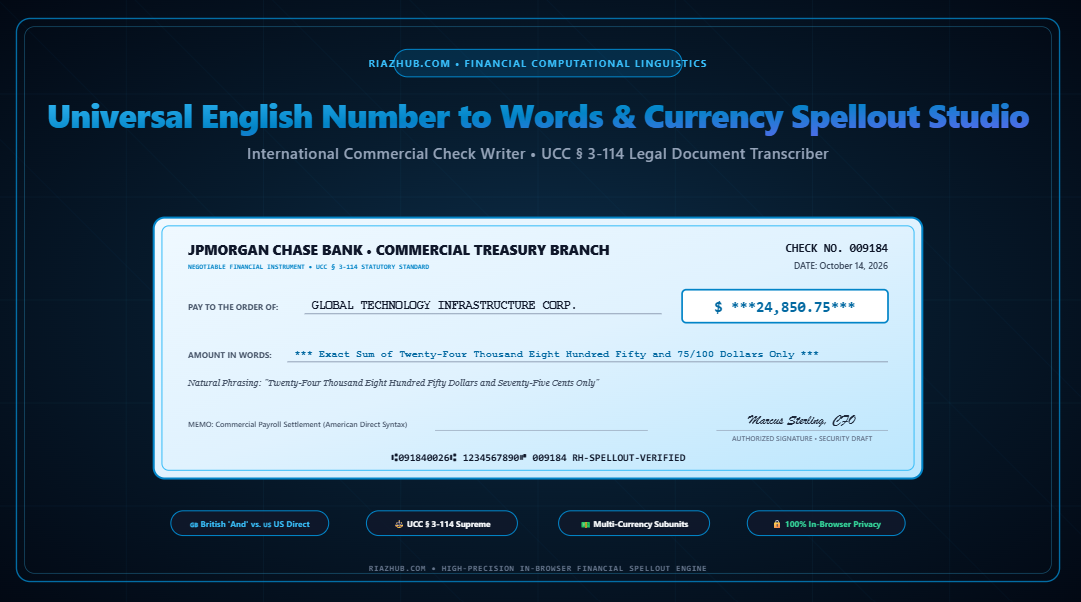
If a business issues a commercial check where the numerical courtesy box reads $24,850.75, but the legal line reads Twenty-Four Thousand Eight Hundred Five and 75/100 Dollars, the drawee bank is legally required under UCC § 3-114 to disburse $24,805.75, not $24,850.75.
Because human eyes and automated clearinghouse optical scanners treat the words line as the definitive statement of payer intent, drafting errors carry immediate commercial liability. Using an automated, deterministic phonetic generator like the RiazHub Currency Spellout Studio guarantees that numeric inputs and legal lines align with 100% mathematical precision.
2. British Formal ‘And’ vs. American Direct Orthography
A frequent point of friction in international business communications is whether the word “and” belongs within integer numbers. This syntactic divergence traces back to two distinct style traditions:
- British English Formal Orthography:
Mandates the conjunction “and” between hundreds and tens/units within every triplet cluster. For example:1,250 ➜ “One Thousand Two Hundred and Fifty”
105 ➜ “One Hundred and Five” - American English Direct Syntax:
Traditionally omits “and” from whole integer transcriptions to prevent conflating spoken words with decimal boundaries:1,250 ➜ “One Thousand Two Hundred Fifty”
105 ➜ “One Hundred Five”In American accounting, the word “and” is reserved exclusively to separate the integer currency unit from fractional subunits (e.g., “…Dollars and 75/100 Cents”).
Both orthographic variations are fully supported in the English Number to Words Studio, allowing users to switch between American direct and British formal conventions with a single click.
3. Chicago Manual of Style (CMOS) vs. AP Stylebook Guidelines
When preparing corporate annual reports, financial press releases, or legal disclosures, editors and authors must adhere to authoritative publishing stylebooks:
| Editorial Rule | Chicago Manual of Style (CMOS § 9.2) | Associated Press (AP) Stylebook |
|---|---|---|
| Whole Numbers in Running Text | Spell out zero through one hundred in full words (e.g., fifty-two employees). | Spell out one through nine; use digits for 10 and above (e.g., 9 vendors, 52 employees). |
| Large Round Quantities | Spell out round multiples of hundreds, thousands, millions, and billions (e.g., two million dollars). | Combine numerals and words for large scales (e.g., $2 million, 14 billion). |
| Compound Hyphenation (21–99) | Strictly hyphenate all compound numerals from 21 through 99 (e.g., twenty-four, ninety-nine). | Strictly hyphenate all compound numbers from 21 through 99 (universal rule). |
| Sentence Starters | Never begin a sentence with a numeral. Spell out the number or rephrase. | Never begin a sentence with a numeral, except for calendar years (e.g., 2026 was a pivotal year…). |
Regardless of whether you are publishing under CMOS, AP, or statutory legal guidelines, compound tens and units between 21 and 99 (such as twenty-one, forty-five, or eighty-eight) must always be hyphenated.
4. Multi-Currency ISO 4217 Orthography Matrix
Converting monetary sums into words requires managing country-specific subunit naming conventions, pluralizations, and fractional clearing notations. The Currency Spellout Studio natively supports major international currencies:
| Currency (ISO) | Major Unit (Singular / Plural) | Minor Subunit | Standard Commercial Cheque Legal Phrasing |
|---|---|---|---|
| USD ($) | US Dollar / Dollars | Cent / Cents | *** Exact Sum of [Words] and 75/100 Dollars Only *** |
| GBP (£) | Pound / Pounds Sterling | Penny / Pence | *** Exact Sum of [Words] and 50/100 Pounds Sterling Only *** |
| EUR (€) | Euro / Euros | Cent / Cents | *** Exact Sum of [Words] and 20/100 Euros Only *** |
| SAR (ر.س) | Saudi Riyal / Saudi Riyals | Halala / Halalas | *** Exact Sum of [Words] and 00/100 Saudi Riyals Only *** |
| AED (د.إ) | UAE Dirham / UAE Dirhams | Fils / Fils | *** Exact Sum of [Words] and 50/100 UAE Dirhams Only *** |
| CAD (CA$) | Canadian Dollar / Canadian Dollars | Cent / Cents | *** Exact Sum of [Words] and 99/100 Canadian Dollars Only *** |
| AUD (A$) | Australian Dollar / Australian Dollars | Cent / Cents | *** Exact Sum of [Words] and 15/100 Australian Dollars Only *** |
5. Anatomy of Anti-Fraud Banking Check Drafting
According to the Financial Crimes Enforcement Network (FinCEN), check washing and alteration schemes cause billions in commercial losses annually. Check washers use solvent baths to eradicate ink in numeric boxes and payee fields, altering amounts like $500.00 to $5,000.00.
Proper legal formatting creates robust defense layers against financial alteration:
- Anti-Fraud Bounding Asterisks:
Surrounding numeric boxes and words lines with asterisks (e.g.,$ ***24,850.75***and*** Exact Sum of ... ***) prevents unauthorized prefixing of additional digits. - Fractional Subunit Clearing (XX/100):
Representing cents or pence as a fraction over 100 (e.g.,75/100 Dollars) closes the door to decimal shifting or pen tampering. - Trailing Safety Fill Lines:
Extending horizontal dashes or security rules (-------------------) from the last word of the amount line to the edge of the draft prevents fraudulent suffix additions. - Statutory ‘Only’ Suffix:
AppendingOnlyconfirms that the stated sum represents the complete and total obligation.
The interactive canvas visualizer inside the RiazHub Check Writer Studio renders high-DPI security drafts incorporating every one of these anti-alteration standards.
6. Arbitrary Precision Triplet Decomposition via Native BigInt
Most browser-based web tools compute numbers using standard 64-bit IEEE 754 floating-point variables. This architecture introduces subtle rounding inaccuracies once integers surpass 253 – 1 (9,007,199,254,740,991).
The RiazHub English Number to Words Studio bypasses floating-point limitations by implementing arbitrary-precision JavaScript BigInt arithmetic. It decomposes large quantities into powers-of-ten short scale (103) triplets:
Trillions (10^12) ➜ Quadrillions (10^15) ➜ Quintillions (10^18)
Sextillions (10^21) ➜ Septillions (10^24) ➜ Octillions (10^27) ➜ Nonillions (10^30)
Whether transcribing a modest invoice or a multi-billion dollar sovereign treasury allocation, every digit chunk is isolated, verbalized, and hyphenated with mathematical exactitude.
7. Complete Client-Side Privacy: Zero Server Retention
In an era of corporate data collection and third-party AI scraping, financial controllers cannot risk uploading sensitive payroll amounts, vendor banking references, or executive compensation figures to external servers.
The Universal English Number to Words Converter operates 100% client-side in your web browser:
- Zero Server Transmission: Calculations run locally via JavaScript and native Canvas 2D contexts.
- No Cloud Storage or Cookies: Figures disappear when your tab is closed, ensuring complete compliance with corporate confidentiality standards.
- Instant Export Options: Generate losslessly compressed PNG bank checks, Markdown payment vouchers, and CSV ledger registers directly from your device’s memory.
8. Frequently Asked Questions (FAQ)
Why are checks written with “XX/100” instead of spelling out the cents?
Writing cents as a fraction (such as 75/100) is standard commercial banking practice under UCC guidelines. It creates a distinct typographical separation between integer currency and decimal subunits, preventing check washing alterations and easing automated optical clearing.
Should numbers between 21 and 99 always be hyphenated?
Yes. Under both the Chicago Manual of Style (CMOS) and the Associated Press (AP) Stylebook, all compound numbers from twenty-one to ninety-nine must include a hyphen (e.g., twenty-four, eighty-five).
Does this tool support uppercase output for formal banking drafts?
Yes. The studio allows users to toggle between Title Case, UPPERCASE (the recognized standard for negotiable checks and commercial drafts), Sentence case, and lowercase.