
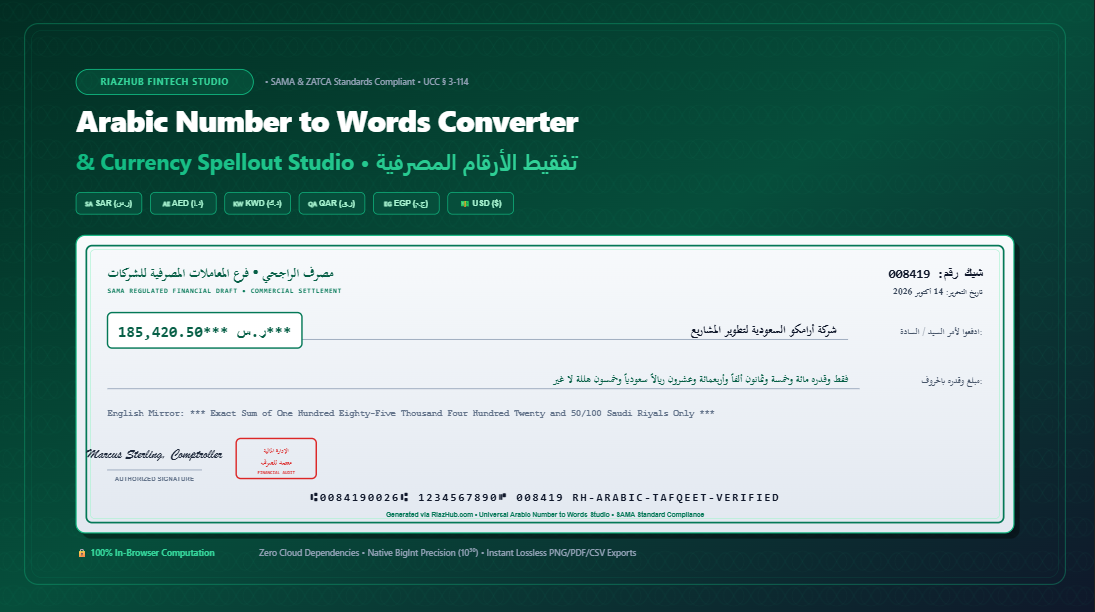
The Definitive Guide to Classical Arabic Tafqeet: Converting Currency Figures into Words with Grammatical Concordance and Banking Compliance
Under the directives of the Saudi Central Bank (SAMA), the UAE Central Bank, and international commercial statutes such as Uniform Commercial Code (UCC) § 3-114, the written words on negotiable instruments supersede numeric digits whenever a discrepancy arises. However, Classical Arabic grammar (نحو وصرف العدد والمعدود) imposes rigorous morphosyntactic rules of gender agreement, inflectional declension, and accusative nunation that generic translation tools frequently butcher.
To address this enterprise challenge, financial institutions, comptrollers, and accounting teams rely on the Universal Arabic Number to Words Converter & Currency Spellout Studio, an in-browser platform engineered specifically to handle Classical Arabic financial linguistics with 100% deterministic precision.
⚡ Experience High-Precision Arabic Tafqeet Instantly
Convert numbers up to 1030 into Classical Arabic words with automatic gender agreement, banking cheque rendering, and certified SAMA/ZATCA compliance.
1. The Morphosyntactic Grammar of Arabic Numbers (نحو العدد والمعدود)
Arabic is one of the world’s most morphologically rich languages. Unlike English or French, where cardinal numbers remain mostly invariable regardless of the following noun, Arabic numbers change their grammatical gender, dual suffixes, and case endings based on the gender of the currency unit:
A. Units 1 and 2: Complete Gender Concordance (المطابقة)
The numbers 1 and 2 always match the gender of the counted currency unit (المعدود). If the currency is masculine, the number takes the masculine form; if feminine, it takes the feminine form:
- Masculine Currency (ريال سعودي / درهم إماراتي): “ريال واحد” (One Riyal), “ريالان اثنان / ريالين اثنين” (Two Riyals).
- Feminine Subunit (هللة / بيسة): “هللة واحدة” (One Halala), “هللتان اثنتان / هللتين اثنتين” (Two Halalas).
B. Units 3 to 9: Morphosyntactic Gender Inversion (المخالفة)
The cardinal numbers from 3 to 9 strictly invert their gender against the noun. When qualifying a masculine noun like Riyal (ريال) or Dirham (درهم), the number must take the feminine suffix Ta’ Marbuta (ـة). Conversely, when qualifying a feminine noun like Halala (هللة) or Baisa (بيسة), the number must remain masculine without the suffix:
خمس هللات (هللة مؤنثة ⟵ خمس بدون تاء التأنيث)
C. Compound Numbers (11 to 19: الأعداد المركبة)
In compound numbers, the tens unit (عشر/عشرة) matches the currency’s gender, while the units digit follows the standard rule: 1 and 2 match, while 3 through 9 invert:
- 15 Saudi Riyals: “خمسة عشر ريالاً” (خمسة inverts, عشر matches masculine ريال).
- 15 Halalas: “خمس عشرة هللة” (خمس inverts, عشرة matches feminine هللة).
You can verify these morphosyntactic gender agreements across every major Arab and international currency automatically using the Universal Arabic Number to Words Converter & Currency Spellout Studio.
2. Banking Inflectional Cases: Nominative vs. Accusative/Genitive (الرفع مقابل النصب والجر)
In Classical Arabic grammar, numbers inflect according to their syntactic position (موقعها الإعرابي). On commercial drafts, cheques, and promissory notes, the stated sum serves as the direct object of an implicit directive command: “Pay to the order of [Payee] the sum of…” (ادفعوا لأمر فلان مبلغ…).
Because the financial amount acts as a direct object (مفعول به منصوب), standard banking and legal metrology enforces the Accusative/Genitive case (حالة النصب والجر):
- Dual Form: “ألفين” instead of “ألفان”, “مليونين” instead of “مليونان”.
- Decades (العقود 20-90): “عشرين، ثلاثين، أربعين” instead of “عشرون، ثلاثون، أربعون”.
- Accusative Specification (التمييز المنصوب): For integers 11 through 99, the counted currency noun must take an accusative singular nunation: “خمسة وأربعون ريالاً” or “تسعة وتسعون درهماً”.
| Numeric Value | Nominative Case (حالة الرفع) | Banking Accusative Case (النصب والجر المصرفي) | Legal Application |
|---|---|---|---|
| 2,000 SAR | ألفان ريال سعودي | ألفين ريال سعودي | Commercial Cheque Direct Object |
| 20,000 AED | عشرون ألف درهم | عشرين ألف درهم | Accounts Payable Ledger |
| 2,000,000 KWD | مليونان دينار كويتي | مليونين دينار كويتي | Institutional Escrow Contract |
3. Currency Decimal Precision: 2-Decimal vs. 3-Decimal Denominations
Not all decimal currencies operate on hundredths (1/100). The Gulf Cooperation Council (GCC) features several high-value sovereign currencies that divide into 1,000 subunits:
- Kuwaiti Dinar (KWD): 1 KWD = 1,000 Fils (3 decimal digits, e.g., 28,650.750 KWD).
- Bahraini Dinar (BHD): 1 BHD = 1,000 Fils (3 decimal digits).
- Omani Rial (OMR): 1 OMR = 1,000 Baisa (3 decimal digits, e.g., 4,120.350 OMR).
Truncating or incorrectly verbalizing these subunits as 2-digit fractions can result in significant financial variance during audit reconciliations. The Universal Arabic Number to Words Converter & Currency Spellout Studio dynamically switches its fractional denominator between /100 and /1000 based on the selected ISO 4217 currency metadata.
4. Statutory Anti-Fraud Delimiters: The Sharia Closing Clause
On commercial cheques and vouchers, leaving open whitespace before or after the written words creates a severe anti-fraud vulnerability, enabling bad actors to append fraudulent digits. Classical commercial law mandates an inviolable boundary delimiter clause:
By prefixing the statement with “فقط وقدره” (Exact Sum Of) and sealing it with “لا غير” (Nothing Else / Only), the financial draft establishes an airtight statutory enclosure that is universally recognized by commercial courts, SAMA clearing systems, and ZATCA Phase 2 FATOORA electronic invoicing standards.
🖨️ Create Ready-to-Print Banking Cheques & Vouchers
Generate authentic High-DPI bank drafts complete with security Guilloche tints, payee line protection, red finance stamps, and MICR routing lines.
5. 100% In-Browser Client-Side Processing: Zero Financial Data Leaks
In an era of stringent corporate governance, uploading proprietary payroll figures, confidential vendor invoices, or executive cheque drafts to external cloud APIs or third-party AI chatbots introduces catastrophic data privacy risks.
The Universal Arabic Number to Words Converter & Currency Spellout Studio operates 100% inside your web browser using native JavaScript BigInt arithmetic and client-side HTML5 Canvas rendering. No private ledger data, account numbers, or payee names are ever transmitted across external servers, guaranteeing total financial privacy and instant sub-millisecond execution.
Universal Arabic Number to Words Converter & Currency Spellout Studio
High-precision morphosyntactic Arabic Tafqeet engine, dynamic gender concordances, official commercial bank drafts, accounting vouchers, and shareable dossier cards. 100% private in-browser computation with zero external dependencies.
سند صرف وقبض مالي معتمد
| البيان المحاسبي | مركز التكلفة / الحساب | المبلغ الإجمالي |
|---|---|---|
| صرف مستحقات المستفيد: شركة أرامكو السعودية لتطوير المشاريع | حساب المصروفات العامة (GL-4100) | 185,420.50 SAR |
| المبلغ كتابة بالحروف: | ||
⚖️ مخالفة العدد للمعدود (3-9)
تخالف الأعداد من 3 إلى 9 جنس العملة: خمسة ريالات (ريال مذكر، العدد مؤنث بالتاء) مقابل خمس هللات (هللة مؤنثة، العدد مذكر بلا تاء).
🏛️ أحكام الإعراب المصرفي
تعتمد المصارف وهيئات المحاسبة حالة النصب والجر (ألفين / مليونين / ريالاً) لكون الشيك مفعولاً به لفعل الدفع الضمني (ادفعوا ألفين).
🪙 العملات ثلاثية الكسور (KWD/OMR/BHD)
تُقسم إلى 1000 وحدة فرعية (فلس / بيسة). يُكتب الجزء العشري بدقة 3 خانات (مثل 750 فلساً أو بيسة) لضمان عدم وجود كسور مهملة.
📜 سيادة الحروف على الأرقام UCC § 3-114
عند حدوث أي تناقض بين الرقم الحسابي والتفقيط المكتوب، يُعتبر النص بالحروف هو المعول عليه قانوناً وقضائياً في صرف السند.
- العددان (1 و 2): يطابقان المعدود دائماً تذكيراً وتأنيثاً (ريال واحد، هللة واحدة، ريالان اثنان، هللتان اثنتان).
- الأعداد من (3 إلى 9): تخالف المعدود؛ فإذا كانت العملة مذكرة (مثل الريال والدرهم والدينار والجنيه والدولار) يؤنث العدد بالتاء المربوطة (خمسة ريالات)، وإذا كانت مؤنثة (مثل الهللة والبيسة) يذكر العدد (خمس هللات).
- العدد (10): يخالف المعدود إذا كان مفرداً (عشرة ريالات / عشر هللات)، ويطابق إذا كان مركباً (خمسة عشر ريالاً / خمس عشرة هللة).
- ألفاظ العقود (20 إلى 90): تلزم صيغة جمع المذكر السالم وتتبع الموقع الإعرابي (عشرون في الرفع / عشرين في النصب والجر المعتمد مصرفياً).