
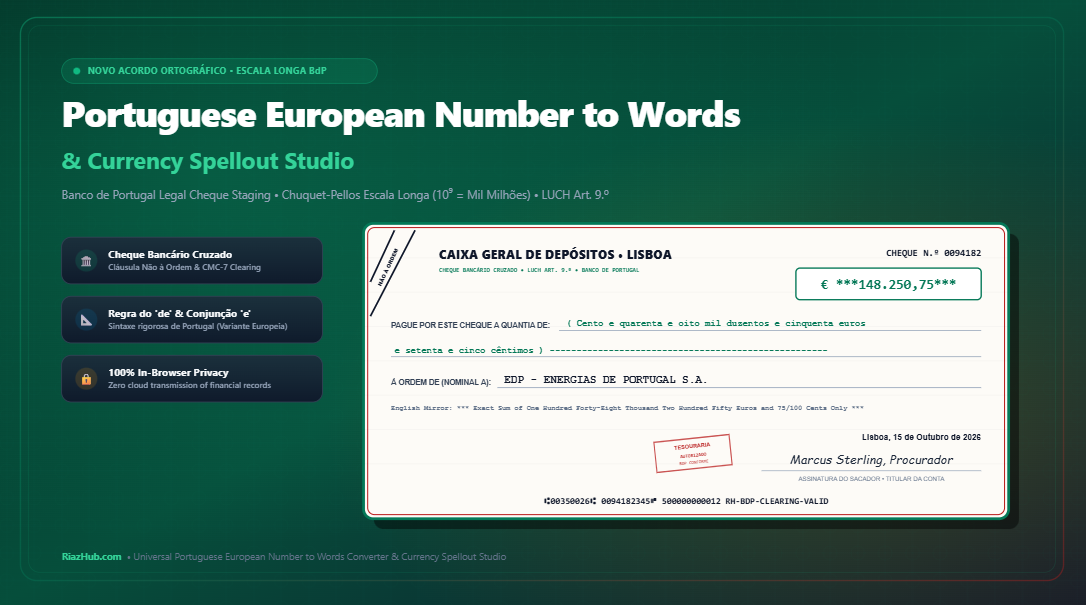
Mastering European Portuguese Financial Spellout: The Comprehensive Guide to Numbers in Words, Banco de Portugal Cheque Staging, and Escala Longa Metrology
1. The Chuquet-Pellos Traditional European Long Scale (Escala Longa Europeia)
The most dangerous potential pitfall for international financial analysts converting large numerical sums into Portuguese words is the distinction between the Short Scale (Escala Curta) and the Long Scale (Escala Longa).
While the United States, modern English commercial practice, and Brazilian Portuguese utilize the Short Scale where every $10^3$ increment above one million changes the root noun ($10^9 = \text{one billion / um bilhão}$) Portugal, the European Union, the European Central Bank (ECB), and the Banco de Portugal (BdP) strictly follow the Chuquet-Pellos Traditional European Long Scale. In the Long Scale, root nouns advance by powers of one million ($10^6$):
| Magnitude Order | Scientific Value | European Portuguese (Portugal / BdP Standard) | US / Brazilian Short Scale False Friend |
|---|---|---|---|
| $10^6$ | 1.000.000 | Milhão (plural: milhões) | One Million |
| $10^9$ | 1.000.000.000 | Mil Milhões (ou milhar de milhões) | One Billion (⚠️ Fatal translation error if translated as “um bilião”) |
| $10^{12}$ | 1.000.000.000.000 | Bilião (plural: biliões = um milhão de milhões) | One Trillion |
| $10^{15}$ | 1.000.000.000.000.000 | Mil Biliões | One Quadrillion |
| $10^{18}$ | 1.000.000.000.000.000.000 | Trilião (plural: triliões = um milhão de biliões) | One Quintillion |
⚠️ Critical Metrological DistinctionIn Portugal, a commercial invoice or cheque specifying € 1.000.000.000,00 is legally and grammatically verbalized as «mil milhões de euros». Writing *«um bilião de euros»* on a Portuguese bank cheque legally denotes $10^{12}$ (€ 1.000.000.000.000,00) a discrepancy of three orders of magnitude (1,000×) that will cause immediate rejection or legal dispute under Banco de Portugal clearing regulations. You can test and inspect high-digit figures up to $10^{30}$ on the Portuguese European Number to Words Converter.
2. Morphosyntactic Precision: The Mandatory Preposition ‘de’ Rule
In Portuguese computational linguistics and European grammar, numerical magnitude words like milhão, milhões, mil milhões, and bilião are categorized as collective masculine nouns rather than pure numeral adjectives (unlike cem or mil). Because they function as nouns, they govern their complement using the preposition ‘de’, but strictly under specific grammatical conditions:
- Rule A (Exact Magnitude — Preposition ‘de’ Mandatory): When a currency figure represents an exact number of millions, milliards, or billions with zero trailing thousands, hundreds, tens, or units, the preposition «de» must be inserted immediately before the monetary unit name:
€ 2.000.000,00$\implies$ «dois milhões de euros»€ 50.000.000,00$\implies$ «cinquenta milhões de euros»€ 1.000.000.000,00$\implies$ «mil milhões de euros» - Rule B (Lower Subordinate Class Present — Preposition ‘de’ Omitted): As soon as any inferior numeric class (thousands, hundreds, tens, or units) is present, the monetary noun attaches directly to the terminal numeral without the preposition ‘de’:
€ 2.000.500,00$\implies$ «dois milhões e quinhentos euros» (NOT *«dois milhões de euros e quinhentos»*)€ 148.250,75$\implies$ «cento e quarenta e oito mil duzentos e cinquenta euros e setenta e cinco cêntimos»
Automating this conditional inflection is critical for financial accounting systems. The Portuguese European Number to Words Converter & Currency Spellout Studio dynamically parses BigInt radix boundaries to verify whether lower classes are zeroed out, applying the preposition ‘de’ only when legally and syntactically mandated.
3. The European Portuguese Conjunction ‘e’ Protocol vs. Brazilian Practice
Another marked divergence between Portugal’s European variety and other Lusophone variants lies in the syntactic placement of the additive conjunction ‘e’ (and).
| Numeric Case | Number | European Portuguese (Portugal / Novo Acordo) | Linguistic Rationale in Portugal |
|---|---|---|---|
| Between Hundreds & Tens/Units | 248 | duzentos e quarenta e oito |
The conjunction ‘e’ connects hundreds, tens, and units continuously. |
| Simple Thousand | 1.000 | mil (Never *«um mil»*) |
In standard European Portuguese, ‘mil’ never takes the numeral article ‘um’. |
| Thousands Followed by Round Hundred | 2.100 | dois mil e cem |
Conjunction ‘e’ is preserved after ‘mil’ because 100 is an exact round hundred. |
| Thousands Followed by Remainder < 100 | 2.030 | dois mil e trinta |
Conjunction ‘e’ is preserved after ‘mil’ because the remainder is below 100. |
| Thousands Followed by Complex Hundreds | 148.250 | cento e quarenta e oito mil duzentos e cinquenta |
No ‘e’ after ‘mil’. Because 250 is neither a round hundred nor below 100, the blocks are juxtaposed without conjunction. |
In contrast to Brazilian Portuguese—which frequently inserts ‘e’ indiscriminately across all scale transitions—European Portuguese demands rigorous syntactic restraint. Drafting contracts or issuing commercial drafts with erroneous conjunction placements can reveal non-native drafting and trigger compliance reviews during cross-border banking settlements.
4. Banco de Portugal Directives & Lei Uniforme sobre Cheques (LUCH)
The legal efficacy of paper bank cheques in Portugal is governed by the Uniform Law on Cheques (Lei Uniforme sobre Cheques — LUCH), enacted via Decree-Law no. 41 665, and supervised by the Banco de Portugal.
Article 9.º of the LUCH: Absolute Supremacy of Words Over Figures
Article 9.º of the Uniform Law on Cheques establishes the fundamental statutory rule of financial discrepancy:
⚖️ Artigo 9.º da Lei Uniforme sobre Cheques (LUCH)«O cheque em que a soma for expressa por extenso e em algarismos vale, em caso de divergência, pela soma indicada por extenso. Se a soma for expressa mais de uma vez por extenso ou mais de uma vez em algarismos, o cheque vale, em caso de divergência, apenas pela menor soma.»
Under Portuguese banking law, if a check is handwritten or printed with € 148.250,75 in the numeric box but the written words line states «cento e quarenta mil euros», the clearing institution (such as Caixa Geral de Depósitos, Millennium BCP, or Novo Banco) is legally compelled to clear the check for € 140.000,00. The written words prevail over numerical digits in every judicial and interbank forum.
Cheque Crossing (Cheque Cruzado) & The “Não à Ordem” Clause
To prevent fraudulent misappropriation, loss, or unauthorized endorsement, commercial payments in Portugal utilize protective markings on the face of the draft:
- Cruzamento Geral (General Crossing): Two parallel oblique lines across the face of the check (typically in the upper-left margin). Under LUCH Art. 38.º, a crossed check can only be paid by the drawee bank to another bank or to an existing client of the drawee bank, mandating deposit into a verified bank account and eliminating cash over-the-counter redemption.
- Cláusula «Não à Ordem» (Not to Order): Inserting the restrictive clause «Não à Ordem» makes the check non-negotiable by endorsement. It guarantees that only the specifically designated nominal payee (beneficiary) can clear the funds, protecting corporate issuers against third-party check-kiting or unauthorized resale.
5. Anti-Fraud Cheque Layout: The Two Preprinted Lines Protocol
Authentic commercial bank drafts in Portugal feature two dedicated preprinted horizontal baselines for the legal amount por extenso:
- Line 1 (Primary Formulation): Begins with the statutory phrase
PAGUE POR ESTE CHEQUE A QUANTIA DE:followed by an underline spanning to the right margin. - Line 2 (Secondary Formulation & Safety Trail): An entire preprinted underline spanning from the left margin to the right margin.
In banking anti-fraud security, these two lines serve an active defense mechanism:
- Intelligent Word-Boundary Wrapping: Long spellouts (such as numbers with large thousands and decimal cents) must wrap cleanly at word boundaries so words are never severed mid-syllable.
- Trailing Anti-Fraud Fill Lines (Linhas de Segurança): Whenever written text concludes before reaching the right edge of Line 1 or Line 2, the remaining empty void must be sealed with continuous hyphens (
--- --- ---) or protective asterisks. This eliminates blank paper space where a fraudulent third party could unlawfully insert unauthorized words (e.g., turning «dez mil euros» into «dez mil euros e duzentos»).
When using the Portuguese European Number to Words Studio, the built-in HTML5 Canvas engine calculates font metrics dynamically, ensuring both lines are preprinted, text wraps naturally, and trailing safety lines automatically protect any unoccupied void.
6. Multi-Currency Lusophone & Global Matrix (ISO 4217)
While the Euro (EUR) is the statutory currency of Portugal, corporate treasuries in Lisbon and Porto conduct extensive commerce across the Lusophone economic sphere (CPLP) and international financial markets. Each currency demands precise inflectional gender and fractional subunit declension:
| Currency & ISO Code | Gender Agreement | Singular / Plural Unit | Fractional Subunit (Cêntimos) | Example Spellout |
|---|---|---|---|---|
| EUR (€) — Euro | Masculino | euro / euros | cêntimo / cêntimos | duzentos euros e cinquenta cêntimos |
| GBP (£) — Libra Esterlina | Feminino | libra / libras | péni / pénis (pence) | duzentas libras e dez pénis |
| USD ($) — Dólar Americano | Masculino | dólar / dólares | cêntimo / cêntimos | cem dólares e vinte cêntimos |
| CHF (CHF) — Franco Suíço | Masculino | franco suíço / francos suíços | cêntimo / cêntimos | mil francos suíços |
| AOA (Kz) — Kwanza Angolano | Masculino | kwanza / kwanzas | cêntimo / cêntimos | um milhão de kwanzas |
| MZN (MT) — Metical Moçambicano | Masculino | metical / meticais | centavo / centavos | cinquenta meticais |
| SAR (ر.س) — Rial Saudita | Masculino | rial saudita / riais sauditas | halala / halalas | oitenta e cinco mil riais sauditas |
Notice the grammatical inflection of GBP (£): because libra is grammatically feminine, numerical modifiers in hundreds and units must decline into feminine form (e.g., «duzentas libras» instead of *«duzentos libras»*, and «uma libra» instead of *«um libra»*). The Portuguese European Number to Words Converter automatically handles gender concordances based on the selected monetary standard.
7. 100% In-Browser Privacy & Data Security for Corporate Treasury
In corporate treasury and enterprise payroll operations, data privacy is paramount. Transmitting executive bonus figures, confidential supplier invoice totals, bank account numbers, or payee names across unencrypted public networks or cloud API converters exposes organizations to severe security vulnerabilities, GDPR (RGPD) non-compliance, and commercial espionage.
The Portuguese European Number to Words Converter & Currency Spellout Studio operates on a zero-cloud, 100% client-side deterministic computing model:
- Native JavaScript BigInt Arithmetic: Eliminates floating-point inaccuracies up to 30 digits within your device’s memory.
- Local Canvas 2D Rendering: Check graphics, guilloche watermarks, and verification certificates are rendered entirely inside the browser GPU.
- No Server Database Retention: Zero telemetry packets, tracking cookies, or confidential payroll figures ever leave your local browser session.
Conclusion: Standardizing Lusophone Financial Documentation
Whether settling trade contracts with Portuguese suppliers, drafting commercial cheques compliant with Banco de Portugal standards, or validating complex numerical strings under the Escala Longa, linguistic precision is the cornerstone of legal certainty.
Equip your finance team with the authoritative digital suite: access the Universal Portuguese European Number to Words Converter & Currency Spellout Studio on RiazHub for instant, tamper-resistant, and grammatically flawless Portuguese financial spellouts.
Universal Portuguese European Number to Words Converter
Transform numeric currency figures into grammatically sound European Portuguese words (números por extenso — Portugal). Engineered with Chuquet-Pellos Traditional European Long Scale (Escala Longa: Mil Milhões = 10⁹, Bilião = 10¹²), conjunction 'e' syntactic rules, mandatory 'de' placement, and Banco de Portugal compliant cheque and voucher staging.
Amount & Instrument Parameters
Escala Longa BdPExtenso Oficial Portugal (Words Only)
⚙️ Linguistic Formatting & Legal Clauses ▼
Live High-DPI Portuguese Bank Cheque Staging
Modelo Comercial da CGD / Millennium BCP / Novo Banco (Padrão Banco de Portugal)Dual-Language Financial Spellout Matrix
Concordância BilínguePortuguês Europeu (Extenso Legal)
Variante de Portugal • Escala LongaEnglish Financial Mirror
International Commercial Draft (UCC § 3-114)Análise Morfossintática da Escala Longa Europeia
| Ordem de Grandeza | Valor Numérico | Nomenclatura (Portugal) | Regra da Conjunção 'e' / Preposição 'de' |
|---|
Recibo de Quitação e Guia de Pagamento Comercial
Contabilidade CertificadaShareable Financial Spellout Dossier Card Studio
Generate High-DPI 1200x630 Social & Verification CardsLinguistic Rules, BdP Standards & Check Fraud Safeguards
Manual Lusófono de Metrologia1. A Escala Longa Europeia (Chuquet-Pellos) em Portugal vs Escala Curta
Ao contrário do Brasil e dos países anglo-saxónicos que utilizam a escala curta ($10^9 = \text{bilhão}$), Portugal, a União Europeia e os países da CPLP (Angola, Moçambique, Cabo Verde) adotam rigorosamente a Escala Longa Europeia de potências de um milhão ($10^6$):
- Milhão: $10^6 = 1.000.000$
- Mil Milhões (ou Milhar de Milhões): $10^9 = 1.000.000.000$ (Nunca «bilião»!)
- Bilião: $10^{12} = 1.000.000.000.000$ (Um milhão de milhões)
- Mil Biliões: $10^{15} = 1.000.000.000.000.000$
- Trilião: $10^{18} = 1.000.000.000.000.000.000$ (Um milhão de biliões)
Na contabilidade portuguesa e nos extratos do Banco de Portugal, emitir um cheque de «um bilião» refere-se a $10^{12}$, gerando um erro de três ordens de magnitude se interpretado à maneira americana.
2. A Regra Gramatical da Preposição 'de' Antes da Moeda
Em português europeu padrão, as palavras milhão, milhões, mil milhões e bilião são substantivos masculinos e não meros numerais adjetivos. Por conseguinte:
- Quando o montante termina exatamente na classe dos milhões sem classes inferiores: exige-se a preposição «de». Exemplo:
€ 2.000.000,00$\implies$ «dois milhões de euros». - Logo que surge uma centena, dezena ou unidade inferior, a preposição «de» é eliminada: Exemplo:
€ 2.000.500,00$\implies$ «dois milhões e quinhentos euros».
3. Sintaxe da Conjunção 'e' no Português Europeu de Portugal
Existe uma diferença crucial entre o uso da conjunção aditiva 'e' em Portugal e noutras variantes lusófonas:
- Usa-se sempre o 'e' entre centenas, dezenas e unidades: «cento e quarenta e oito», «duzentos e cinco».
- Após a palavra «mil», insere-se a conjunção 'e' apenas se o número que se segue for uma centena redonda terminada em dois zeros (ex.: «dois mil e cem euros», «três mil e duzentos euros») ou se for uma quantia inferior a 100 (ex.: «dois mil e vinte euros», «cinco mil e sete euros»).
- Se a quantia que se segue a «mil» tiver centenas e dezenas/unidades que não sejam redondas, não se usa 'e' após o mil: ex.: «cento e quarenta e oito mil duzentos e cinquenta euros» (e não *«...mil e duzentos...»).
- No milhar simples, grafa-se apenas «mil euros» e nunca *«um mil euros».
4. Lei Uniforme sobre Cheques (LUCH Artigo 9.º) e Cheque 'Não à Ordem'
Em conformidade com o Decreto-Lei n.º 41 665 (Lei Uniforme sobre Cheques) regulamentado pelo Banco de Portugal:
- Supremacia do Extenso (Art. 9.º): Caso ocorra divergência de caligrafia ou digitação entre o valor em algarismos e o valor por extenso, prevalece incondicionalmente a quantia indicada por extenso.
- Cláusula «Não à Ordem»: A aposição das palavras «não à ordem» ou «intransmissível» no anverso do cheque impede o seu endosso a terceiros, garantindo que o cheque apenas pode ser liquidado ou depositado na conta do beneficiário nominal expressamente designado.
- Cruzamento Geral: Duas linhas paralelas oblíquas no anverso determinam que o cheque só pode ser pago pelo sacado a um banqueiro ou a um cliente do sacado (depósito obrigatório em conta bancária).
5. Privacidade Absoluta e Execução In-Browser
Esta ferramenta processa todos os números, nomes de entidades beneficiárias, números de conta e carimbos de validação exclusivamente na memória temporária do seu navegador (Client-Side Vanilla JS). Nenhum montante, folha salarial ou elemento contabilístico é enviado para servidores externos ou armazenado em bases de dados em nuvem, cumprindo os padrões mais exigentes do RGPD (Regulamento Geral sobre a Proteção de Dados) e do sigilo bancário.