
Mastering Norwegian Financial Spellout: The Complete Guide to Tall i Ord, Språkrådet Rules, European Long Scale, and Sjekkloven av 1932
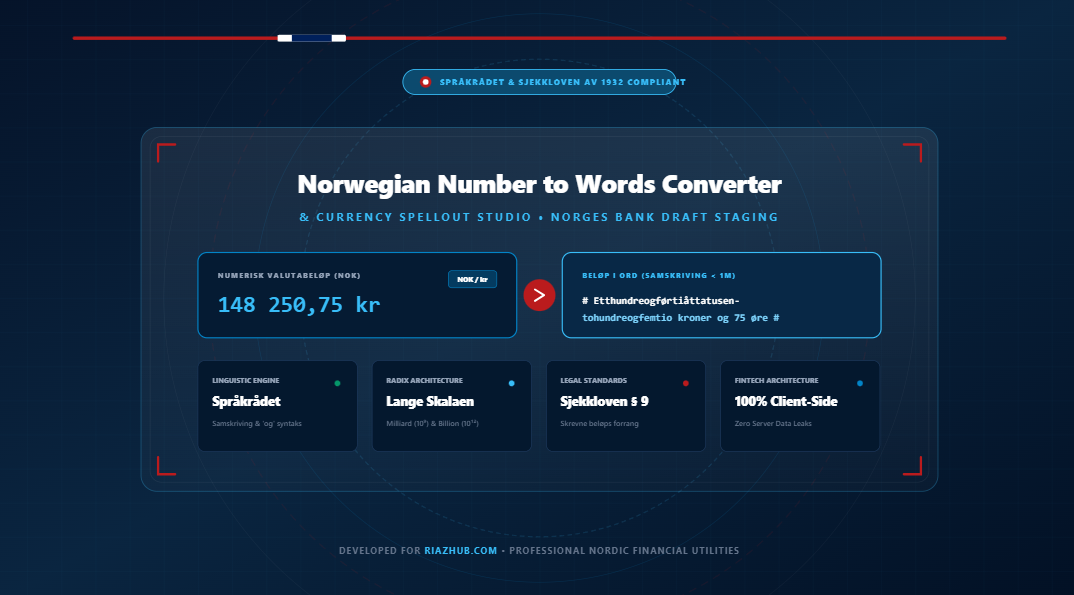
To address these challenges, finance teams and legal draftsmen rely on the browser-based Norwegian Number to Words Converter & Currency Spellout Studio, which executes 100% deterministic client-side conversions adhering strictly to Norwegian regulatory and banking statutes.
Statutory Authority: Sjekkloven § 9
«Er sjekkbeløpet angitt med både bokstaver og tall, gjelder ved uoverensstemmelse det beløp som er angitt med bokstaver.»
Where the amount payable is expressed in both letters and figures and there is a conflict between the two, the amount denoted by letters is legally binding. This statutory supremacy prevents numeric tampering, unauthorized zero-padding, and clerical digit transposition.
1. The Core Rule of Språkrådet: Solid Compounding Under One Million (Samskriving)
The single most distinctive feature of the Norwegian number system and the one most frequently violated by generic translation APIs is samskriving (compound word agglutination). According to official orthographic standards established by Språkrådet (The Language Council of Norway), all numbers under one million must be concatenated into a single, continuous word without spaces or hyphens.
While English writes one hundred forty-eight thousand two hundred fifty as six distinct words separated by spaces and hyphens, Norwegian requires a single unbroken lexical compound:
Why Does Norwegian Enforce Samskriving in Financial Instruments?
Beyond preserving historical North Germanic linguistic morphology, samskriving serves a critical anti-fraud function in corporate checks, debt instruments (gjeldsbrev), and contracts. By eliminating inter-word spaces, it prevents unauthorized third parties from inserting fraudulent modifier words (such as writing “five” into an empty space).
When processing figures through the interactive Norwegian spellout studio, numbers under 1,000,000 are synthesized with flawless solid compounding, ensuring that both banking drafts and accounting ledger slips fulfill official legal standards.
2. Syntactic Placement of the Conjunction «Og»
The conjunction «og» (and) is not distributed arbitrarily throughout a Norwegian number; its placement follows precise morphosyntactic criteria codified by Språkrådet:
- Between Hundreds and Tens/Units: Conjunction «og» is mandatory between hundreds and the following tens or units. For example:
108 ➔ etthundre og åtte;250 ➔ tohundre og femti. In solid compounding below one million, this becomesetthundreogåtteandtohundreogfemtio. - After Thousands with Remainder Under 100: If a thousand has no hundreds digit but has a remainder in tens or units, «og» is inserted:
1 005 ➔ etttusen og fem(solid:etttusenogfem);4 050 ➔ firetusen og femti. - Omission Between Thousands and Hundreds: When a hundreds value is present directly following a thousand, no «og» connects them:
1 200 ➔ etttusentohundre(never etttusen og tohundre).
| Numeric Value | Norwegian Spellout (Språkrådet Samskriving) | English Word Mirror |
|---|---|---|
| 108 kr | etthundreogåtte kroner | One Hundred and Eight Kroner |
| 1 050 kr | etttusenogfemti kroner | One Thousand and Fifty Kroner |
| 2 345 kr | totusentrehundreogførtifem kroner | Two Thousand Three Hundred Forty-Five Kroner |
| 148 250 kr | etthundreogførtiåttatusentohundreogfemtio kroner | One Hundred Forty-Eight Thousand Two Hundred Fifty Kroner |
3. The European Long Scale (Lange Skalaen) vs. The American Short Scale
A common source of catastrophic financial disputes in cross-border Nordic transactions is the discrepancy between the European Long Scale (Lange skalaen) and the American Short Scale.
Norway, Sweden, Denmark, Germany, France, and most continental European economies utilize the Long Scale architecture dating back to mathematician Nicolas Chuquet. In this system, each magnitude tier increases by powers of $10^6$ (a million-fold increase):
- Million: $10^6$ (1 000 000)
- Milliard: $10^9$ (1 000 000 000) — In US English, this is called a billion.
- Billion: $10^{12}$ (1 000 000 000 000) — A million millions. In US English, this is called a trillion.
- Billiard: $10^{15}$ (1 000 000 000 000 000)
- Trillion: $10^{18}$ (1 000 000 000 000 000 000) — A million billions.
The Multi-Billion Dollar Mistranslation Risk
In Norwegian commercial documents, $1\ 000\ 000\ 000$ (one thousand million) is ubetinget én milliard. If an automated script improperly translates an American balance sheet figure of “$5 Billion” as «fem billioner kroner», it commits the document to $5\ 000\ 000\ 000\ 000$ kr an error of three orders of magnitude ($1000\times$ the intended sum).
To eliminate this hazard, the Norwegian financial voucher and cheque studio incorporates native arbitrary-precision BigInt logic configured to European Long Scale standards, ensuring seamless parsing of astronomical values up to 30 digits without floating-point degradation.
4. Gender Concordance and Currency Agreement
Norwegian grammar requires numeral agreement with the grammatical gender of the governing noun. While digits above 1 are gender-invariant (to, tre, fire), the numeral “1” reflects three distinct grammatical genders:
- Maskulinum / Felleskjønn (Masculine / Common):
én(oren) ➔ én krone, én million, én milliard. - Femininum (Feminine):
éi(orei) ➔ éi krone (in dialectal or Nynorsk varieties). - Nøytrum (Neuter):
ett(oret) ➔ ett hundre, ett tusen, ett øre.
Fraud Prevention via Explicit «Ett»
In conversational speech, Norwegians often say simply «hundre kroner» or «tusen kroner». However, in banking drafts and legal debt notes, Språkrådet and Finans Norge directives mandate the explicit prefix «ett» (e.g., etthundre kroner, etttusen kroner). Omitting “ett” leaves the front of the written line vulnerable to fraudulent alteration (such as prepending “fem” to make “femhundre kroner”).
5. Fractional Øre Formulations and the Mandatory «Blankt / Slett» Terminal Closure
While physical 50-øre coins were withdrawn from circulation by Norges Bank in May 2012, the øre remains an active unit of account in electronic payments, commercial wholesale trade, and retail invoicing under the Norwegian Central Bank Act.
In official cheque writing and accounting registers, three standard subunit representations are employed:
- Full Verbalization (Øre i Ord):
75 øre ➔ syttifem øre. Notice that øre is a neuter noun with an invariable zero-inflected plural (ett øre, femti øre, syttifem øre). - Fractional Subunit (Brøkform):
75 øre ➔ 75/100(e.g., «etthundre kroner og 75/100»). - The Commercial Banking Terminal Closure («kroner blankt»): When a financial transaction contains exactly zero øre (such as
148 250,00 kr), Norwegian commercial custom dictates terminating the phrase with «kroner blankt» (or «kroner slett»). This definitive terminal marker prevents any unauthorized subsequent addition of fractional amounts.
You can dynamically toggle between full øre words, fractional xx/100 syntax, and terminal blankt closures using the Norwegian currency spellout generator.
6. Commercial Cheques, Crossed Drafts, and Voucher Staging
Although consumer paper cheques have largely transitioned to electronic BankAxept and Vipps in Scandinavia, high-value corporate bank cheques (banksjekker), bank drafts (bankremisser), and formal accounting payment vouchers (utbetalingsbilag) remain standard instruments for:
- Commercial real estate settlements (eiendomsoppgjør).
- Large corporate vendor liquidations and judicial auctions.
- Cross-border trade notes governed by maritime and petroleum supply agreements.
- Formal corporate auditor archives compliant with Bokføringsloven § 13.
Accounting Ledger Allocations (Norsk Standard Kontoplan NS 4102)
Under Norwegian corporate accounting law, every disbursement voucher must maintain a strict debit/credit ledger allocation referencing the Norwegian Standard Chart of Accounts (NS 4102). A typical corporate vendor payment of 148 250,75 kr is allocated across:
- Konto 4000 (Innkjøp av varer og tjenester): Net debit amount (
118 600,60 kr). - Konto 2700 (Inngående merverdiavgift): Standard 25% MVA breakdown (
29 650,15 kr). - Konto 1920 (Bankinnskudd driftskonto): Gross credit disbursement (
148 250,75 kr).
Audit Trail Compliance
Every voucher generated through the Universal Norwegian Voucher & Cheque Hub compiles complete NS 4102 ledger allocations, 9-digit Organisasjonsnummer (MVA) headers, and Chief Accountant signature lines ready for immediate PDF or Markdown export.
Try the Interactive Norwegian Number to Words Studio
Instantly convert any numeric figure into Språkrådet-compliant Norwegian text, stage High-DPI Norges Bank bank drafts, and download audit-ready accounting vouchers with zero data leaks.
7. Language Varieties: Bokmål vs. Nynorsk, and Ny vs. Gammel Tellemåte
Norway maintains two official written standards: Bokmål (used by roughly 85–90% of the population) and Nynorsk (used predominantly in Western Norway). Furthermore, Norwegian numbers possess two counting traditions: the modern ny tellemåte and the traditional gammel tellemåte.
| Numeric Value | Bokmål (Ny Tellemåte) | Bokmål (Gammel Tellemåte) | Nynorsk Standard |
|---|---|---|---|
| 21 | tjueén | enogtyve | tjuéin |
| 32 | trettito | toogtredve | trettito |
| 75 | syttifem | femogsyvti | syttifem |
| 1 000 000 | én million | en million | éin million |
| 2 000 000 | to millioner | to millioner | to millionar |
While the ny tellemåte (tens followed by units, e.g. førtiåtte) has been the mandatory pedagogical and administrative standard since 1951, the Norwegian spellout engine on RiazHub allows financial professionals to toggle seamlessly between Bokmål and Nynorsk, as well as modern and traditional counting styles.
8. Step-by-Step: How to Use the Studio for Professional Compliance
Converting complex transactions into legally verified Norwegian words takes less than five seconds using the dedicated studio:
- Ingest Numeric Currency Figure: Type or paste your amount into the numeric input field. The engine dynamically parses spaces (
148 250,75), dots, or standard commas. - Select Currency Matrix: Choose between Norwegian Krone (NOK), Euro (EUR), US Dollar (USD), Swedish Krona (SEK), Danish Krone (DKK), British Pound (GBP), Saudi Riyal (SAR), or UAE Dirham (AED). For mathematical or ordinal conversions, select «Rent Grunntall».
- Instant Copy from Dedicated Words Box: Immediately copy the inflected text string (e.g., «Etthundreogførtiåttatusentohundreogfemtio kroner og syttifem øre») using the prominent 1-click clipboard button located directly below the input field.
- Preview the High-DPI Canvas Cheque: Switch to Tab 1 to inspect a realistic Norges Bank draft visualizer complete with security Guilloche background, clear bank header, date line (Oslo, den 15. oktober 2026), payee line, and protective hash amount box.
- Export Audit Artifacts: Download lossless PNG cheque graphics, Markdown voucher slips, or accounting CSV ledger logs formatted with mandatory branding (e.g.,
riazhub-norwegian-words-nok-148250.png).
9. Frequently Asked Questions (FAQ)
Why does Norwegian write 148 250 as a single continuous word?
Språkrådet’s official orthographic rules dictate that all numbers under one million are compound adjectives/numerals and must be written together (samskriving). Only nouns of magnitude such as million, milliard, and billion are written as separate words with plural inflections.
What happens if a Norwegian check shows different amounts in numbers and words?
Under Sjekkloven av 1932 § 9, the amount expressed in words holds absolute legal supremacy over numeric figures. If a check prints #148 250 kr# in figures but writes «Etthundreogførtitusen kroner» in words, the paying bank is legally bound to honor only 140 000 kr.
Is my corporate financial data secure when using the tool?
Yes. The RiazHub Norwegian number converter executes 100% inside your browser’s local JavaScript runtime. No invoice figures, payee names, bank identifiers, or client IP addresses are ever transmitted to external cloud servers.
Why is $10^9$ called a milliard instead of a billion?
Norway follows the European Long Scale, where magnitude prefixes advance every $10^6$ powers. A milliard is $10^9$ (one thousand millions), while a billion is $10^{12}$ (one million millions).
Universal Norwegian Number to Words & Cheque Studio
Accurately convert currency figures into grammatically inflected Norwegian words (tall i ord) according to Språkrådet rules (samskriving av tall under én million, European Long Scale radix), stage high-DPI Norges Bank compliant commercial bank cheques, and generate legal financial vouchers. 100% client-side calculation with zero server storage.