
Mastering Finnish Number to Words: Kotus Compounding, Euro Declensions & Suomen Pankki Commercial Cheque Standards
A comprehensive examination of Fenno-Ugric numeral syntax, solid compound word concatenation, European Long Scale radix architectures, and statutory wording supremacy under Finnish Cheque Law (Shekkilaki 1932/244).
In global enterprise accounting, cross-border treasury settlements, and legal drafting, spelling out monetary amounts in natural words is the supreme defense against fraudulent document alteration. When dealing with the Finnish language (suomen kieli), financial engineers, accountants, and software architects encounter one of the world’s most intricate morphosyntactic systems.
Unlike Germanic or Romance languages that separate hundreds, tens, and units with spaces or hyphens, standard written Finnish adheres to strict solid agglutination rules defined by the Institute for the Languages of Finland (Kotimaisten kielten keskus, or Kotus). Furthermore, commercial transactions governed by the Bank of Finland (Suomen Pankki) and the Finnish Cheque Act (Shekkilaki 14.7.1932/244) impose rigorous legal standards where written words hold absolute legal precedence over figures.
To eliminate transcription errors and streamline financial document preparation, finance teams and developers rely on the dedicated Finnish Number to Words Converter & Currency Spellout Studio. In this architectural guide, we dissect the linguistic mechanics, grammatical declensions, and banking protocols required to verbalize Finnish currency amounts with mathematical perfection.
1. Kotus Morphological Agglutination: The Sub-Million Compounding Protocol
The cardinal rule of Finnish numeral orthography is established in Kotus’s official guidelines (Kielitoimiston ohjepankki): all cardinal numbers below one million (1 000 000) are written as a single, uninterrupted compound word (yhdyssana).
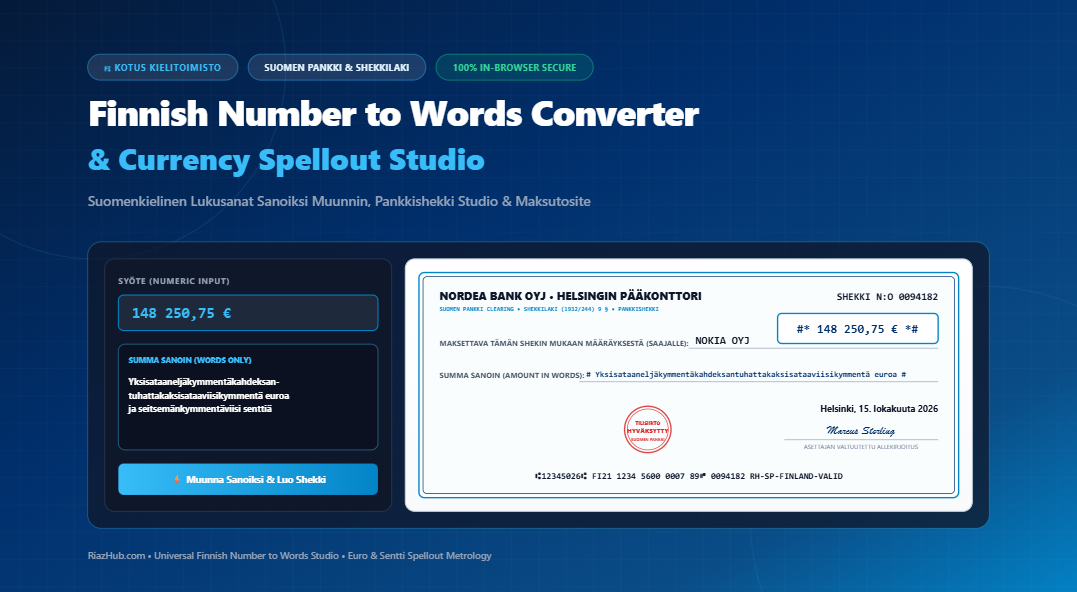
Consider the figure 148 250. In English, this is formatted as “one hundred forty-eight thousand two hundred fifty” (six separate words). In Finnish, this transforms into an imposing 56-letter compound string:
148 250 → yksisataaneljäkymmentäkahdeksantuhattakaksisataaviisikymmentäTo construct this string correctly, computational parsers must follow a precise morphological sequence:
- Hundreds:
100is rendered assata(oryksisatain banking contexts to prevent prefix tampering). Hundreds from 200 to 900 append the partitive singular suffix-sataa(e.g.,kaksisataa,kolmesataa). - Tens: Numbers from 20 to 90 append the partitive singular suffix
-kymmentäto the base digit (e.g.,kaksikymmentä,neljäkymmentä). Teens (11–19) utilize the invariant suffix-toista(e.g.,yksitoista,kaksitoista). - Thousands Join: The thousands group is inflected with
tuhat(for 1 000) ortuhatta(for 2 000+), directly glued to the preceding thousands multiplier and following hundreds without spaces.
Whenever drafting invoices, contracts, or tax returns, you can immediately verify Kotus agglutination compliance with the Finnish Number to Words Converter & Currency Spellout Studio, which ensures no errant whitespace compromises document integrity.
2. Partitive Case Suffix Inflection: Euro vs. Euroa & Sentti vs. Senttiä
Finnish is an agglutinative language featuring 15 distinct grammatical cases. In monetary expressions, the principal noun (such as euro or sentti) is governed by numeral concord rules:
| Numeric Quantity | Grammatical Case | Euro Form | Cent Subunit Form |
|---|---|---|---|
| 1 (Exact unit) | Nominative Singular (Yksikön nominatiivi) | yksi euro |
yksi sentti |
| 2 to 9 | Partitive Singular (Yksikön partitiivi) | kaksi euroa |
viisi senttiä |
| Compound Tens & Hundreds | Partitive Agreement | kaksikymmentä euroa |
seitsemänkymmentäviisi senttiä |
| Zero Minor Units (.00) | Terminal Banking Closure | euroa tasan |
(Suppressed or zero clause) |
In official Finnish commercial banking drafts, when an amount has zero cents (such as 4 500,00 €), best practices dictate adding the terminal adverb tasan (e.g., “neljätuhattaviisisataa euroa tasan”). This unequivocally certifies that no additional fractional cents were omitted.
3. The Traditional European Long Scale (Pitkä Asteikko)
A critical source of financial friction between Anglo-American and Nordic accounting systems is the radix magnitude scale. The United States and modern British financial systems employ the Short Scale, where $10^9$ is designated as a “billion” and $10^{12}$ as a “trillion”.
Finland, along with the broader Nordic and Continental European financial sphere, strictly adheres to the Traditional European Long Scale (Eurooppalainen pitkä asteikko):
- $10^6 = 1\ 000\ 000$ →
Miljoona(Partitive plural:miljoonaa) - $10^9 = 1\ 000\ 000\ 000$ →
Miljardi(Partitive plural:miljardia) — Never “biljoona”! - $10^{12} = 1\ 000\ 000\ 000\ 000$ →
Biljoona(Partitive plural:biljoonaa) — A million millions - $10^{15} = 10^{15}$ →
Biljardi(Partitive plural:biljardia) - $10^{18} = 10^{18}$ →
Triljoona(Partitive plural:triljoonaa)
Translating an American corporate balance sheet note of “$2.5 Billion” directly into Finnish as “2,5 biljoonaa” represents an astronomical 1,000× accounting error. The correct Finnish translation is strictly kaksi miljardia viisisataamiljoonaa euroa.
The Finnish Number to Words Converter & Currency Spellout Studio incorporates an arbitrary-precision BigInt engine configured natively for the European Long Scale, preventing floating-point rounding errors and cross-scale translation hazards up to 30 digits.
4. Shekkilaki (1932/244) 9 § & The Statutory Word Supremacy Rule
In Finnish legal jurisprudence, commercial paper and bank remittances are governed by the Finnish Cheque Act (Shekkilaki 14.7.1932/244). Section 9 of the Act establishes the foundational doctrine of statutory word supremacy:
“Jos shekkimäärä on merkitty sekä sanoin että numeroin, on sanoin ilmaistu määrä ristiriidan sattuessa pätevä.”
(Where the sum payable is expressed both in words and in figures, and there is a discrepancy between the two, the sum denoted by the words is the sum payable.)
This statutory principle mirrors UCC § 3-114 in international commercial law. Because words legally override numerals in court, commercial banks (such as Nordea, OP Yrityspankki, and Danske Bank) mandate strict protective conventions:
- Delimiting Hash Marks: The written amount line must be bounded by hash symbols or asterisks (e.g.,
# Yksisataaneljäkymmentäkahdeksantuhattakaksisataaviisikymmentä euroa #) so fraudulent characters cannot be appended. - Numeric Hash Enclosures: The numerical box is similarly guarded (e.g.,
#* 148 250,75 € *#). - Crossed Cheque Directives (Ristitty shekki): Marking a draft with “Vain tilille” or drawing two parallel lines across the face prohibits OTC cash liquidation, mandating settlement into a verified Finnish corporate IBAN.
5. Commercial Payment Vouchers (Maksutosite) Under Kirjanpitolaki
Beyond negotiable instruments, Finnish corporate accounting adheres to the Accounting Act (Kirjanpitolaki 1336/1997). Every disbursement must be accompanied by an official payment voucher (maksutosite) or cash receipt (kassakuitti) containing:
- The company’s Finnish Business ID (Y-tunnus, 8 digits: e.g.,
1234567-8) - The Value Added Tax identifier (ALV-numero: e.g.,
FI12345678) - General Finnish VAT calculation (currently updated to the standard 25.5% rate)
- Chart of accounts debit/credit journalizing (Debet Account 4000 for Purchases, Debet Account 2939 for Input VAT, and Kredit Account 1910 for Bank Balances)
- Dual sign-off blocks for Chief Financial Officer approval and Chief Accountant verification
The interactive voucher engine inside the Finnish Number to Words Converter & Currency Spellout Studio automatically structures these accounting records into ready-to-print PDF vouchers and download-ready Markdown slips.
6. 100% In-Browser Privacy: Zero Cloud Data Leaks
Financial officers and payroll managers face stringent confidentiality obligations under the EU General Data Protection Regulation (GDPR) and Finnish trade secret statutes. Cloud-based converters that transmit invoice sums, vendor names, or IBAN identifiers across external REST APIs introduce acute compliance vulnerabilities.
The Finnish Number to Words Converter & Currency Spellout Studio guarantees 100% deterministic, client-side processing:
- All BigInt mathematical compounding runs locally in your browser’s JavaScript V8 engine.
- High-DPI cheque graphics (1600×720) and shareable dossier cards (1200×630) are rendered natively via HTML5 Canvas.
- No payroll figures, payee identities, or financial parameters are ever transmitted to remote servers.
Conclusion
Whether you are reconciling Finnish vendor liabilities, issuing crossed commercial drafts, preparing corporate accounting vouchers, or writing bilingual commercial agreements, grammatical precision in Finnish numerals is non-negotiable.
By pairing Kotus solid compounding rules with Suomen Pankki banking standards, you safeguard your organization against fraud, litigation, and accounting discrepancies. Test your figures today with the free, browser-based Finnish Number to Words Converter & Currency Spellout Studio on RiazHub.
Universal Finnish Number to Words Converter & Cheque Studio
Convert numeric figures into grammatically sound Finnish words (lukusanat sanoiksi) with solid compound agglutination below one million, correct partitive declensions (euro vs. euroa), European Long Scale metrology, and official Suomen Pankki commercial cheque & accounting voucher staging.
| Tositelaji: | Pankkishekki / Maksutoimeksianto | Yrityksen Y-tunnus: | 1234567-8 |
|---|---|---|---|
| Saaja (Maksun saaja): | Nokia Oyj | ALV-tunniste: | FI12345678 |
| Pankkiyhteys / IBAN: | FI21 1234 5600 0007 89 | Shekin / Viitteen N:o: | 0094182 |
| Määrä numeroin: | 148 250,75 € | Verokanta: | Yleinen ALV 25,5% |
| Tilikoodi | Tilinimi | Debet | Kredit |
|---|---|---|---|
| 4000 | Ostot ja palvelut (Netto) | 118 128,09 € | - |
| 2939 | Saamiset arvonlisäverosta (ALV 25,5%) | 30 122,66 € | - |
| 1910 | Pankkitili (Nordea) | - | 148 250,75 € |
📖 Kotus Kielitoimisto & Shekkilaki (1932/244) Directives
Suomen kielen lukusanojen muodostuksessa ja virallisissa maksuasiakirjoissa sovelletaan tarkkoja Kotimaisten kielten keskuksen (Kotus) kielioppisääntöjä sekä Suomen shekkilain määräyksiä.
148 250 = yksisataaneljäkymmentäkahdeksantuhattakaksisataaviisikymmentä
Tuhannet ja sadat liitetään toisiinsa saumattomasti. Vasta miljoona, miljardi ja biljoona kirjoitetaan erillisinä sanoina (esim. kaksi miljoonaa).
- 2+ kymmentä (kaksikymmentä)
- 2+ sataa (kaksisataa)
- 2+ tuhatta (kaksituhatta)
- 2+ euroa (kaksi euroa, viisi euroa)
- 2+ senttiä (seitsemänkymmentäviisi senttiä)
- 10⁶ = Miljoona
- 10⁹ = Miljardi (angloamerikkalainen "billion")
- 10¹² = Biljoona (miljoona miljoonaa)
- 10¹⁵ = Biljardi
- 10¹⁸ = Triljoona
# ... # tai *** ... ***) väärinkäytösten ja väärennösten estämiseksi.