
Mastering Academic Citations: The Definitive Guide to APA 7, MLA 9, Chicago, and Modern Bibliography Management
Missing periods, misplaced commas, incorrect author inversions, confusing volume/issue punctuation, and transient URLs that lead to dead ends can trigger editorial desk rejects or lower grade evaluations. Fortunately, modern automated tools have transformed this process. Using the Universal AI Citation Assistant & Reference Formatter Studio, scholars can now parse source metadata and compile flawless reference lists in seconds completely within their browser with zero data leakage.
In this comprehensive guide, we unpack the fundamental architecture of the world’s leading academic citation styles, examine the critical differences between in-text parenthetical and narrative citations, discuss why persistent Digital Object Identifiers (DOIs) have replaced standard URLs, and demonstrate how to stage, alphabetize, and export publication-ready bibliographies effortlessly.
The Core Academic Citation Styles: Architecture & Disciplinary Standards
Academic citation systems are not arbitrary typographical preferences; each standard was engineered to emphasize the specific evidentiary requirements of distinct scholarly disciplines. When you stage sources in the AI Citation Assistant, selecting the proper style automatically aligns your citations with current manual guidelines.
| Citation Style | Governing Body & Edition | Primary Disciplines | Core Focus |
|---|---|---|---|
| APA | American Psychological Association (7th Edition) | Psychology, Education, Nursing, Social Sciences | Recency of research (prominent publication year) |
| MLA | Modern Language Association (9th Edition) | Literature, Linguistics, Cultural Studies, Art | Authorship, containers, and page specificity |
| Chicago (Author-Date) | University of Chicago Press (17th Edition) | Physical, Natural, and Social Sciences | Concise parenthetical author-year referencing |
| Chicago (Notes-Bib) | University of Chicago Press (17th Edition) | History, Philosophy, Religion, Fine Arts | Comprehensive numbered footnotes & endnotes |
| Harvard | Harvard University & International Standards | Business, Management, UK/Commonwealth Academia | Author-year parenthetical tracking |
| IEEE | Institute of Electrical & Electronics Engineers | Computer Science, Robotics, Electrical Engineering | Chronological bracketed numbers [1] |
| Vancouver | International Committee of Medical Journal Editors | Medicine, Biomedicine, Pharmacy, Clinical Health | Numbered sequence with periodless author initials |
| BibTeX | LaTeX Standard Reference Matrix | Mathematics, Theoretical Physics, Data Science | Machine-readable semantic tag fields |
1. APA 7th Edition: The Social Science Benchmark
Published by the American Psychological Association, the 7th edition of the APA Publication Manual mandates that the publication year be situated in parentheses immediately following the author’s inverted name (e.g., Smith, J. A. (2026).). Titles of articles, book chapters, and monographs utilize sentence-case capitalization, meaning only the first word of the title, proper nouns, and the first word following a colon are capitalized.
APA 7 accommodates up to 20 authors in the reference list before an ellipsis is required, ensuring that collaborative scientific contributions receive full recognition. Journal titles and volume numbers are italicized, while issue numbers appear in parentheses without italics.
2. MLA 9th Edition: The Humanities Standard
The Modern Language Association prioritizes the container concept. In MLA 9, shorter works (such as journal articles, poems, or newspaper reports) are enclosed in quotation marks using Title-Case capitalization, while their containers (the journal, anthology, or news website) are italicized. The publication date appears near the conclusion of the entry.
Unlike APA’s emphasis on initials, MLA requires full author first names to facilitate biographical identification in literary criticism. When citing works with three or more authors, MLA simplifies the entry immediately to the primary author followed by et al.:
3. Chicago 17th Edition: Dual System Versatility
The Chicago Manual of Style provides two complementary citation systems:
- Author-Date System: Highly favored in geology, anthropology, and political science. It matches concise in-text citations like
(Russell and Norvig 2020, 114)directly with a final alphabetical Reference List. - Notes and Bibliography (NB) System: The gold standard in history and philosophy. It relies on sequential superscript numbers in the text linked to detailed footnotes or endnotes, supported by a formal bibliography at the end of the manuscript.
4. IEEE & Vancouver: Numbered STEM Citation Pipelines
In engineering and medicine, repetitive inline author names disrupt technical equations and data readouts. Consequently, both IEEE and Vancouver utilize numerical notation:
- IEEE: Encloses references in sequential square brackets (e.g.,
[1]or[2, p. 45]). Author names precede their initials (e.g.,A. Vaswani), and journal titles follow IEEE standard abbreviations. - Vancouver: Employs numerical superscripts or parenthetical digits (e.g.,
(1)) that reference a chronological index list. Periods are stripped from all author initials (e.g.,Vaswani A, Shazeer N), and biomedical serial titles adhere to the National Library of Medicine (NLM) database format.
Format Your References Instantly in Any Academic Style
Switch seamlessly between APA 7, MLA 9, Chicago, Harvard, IEEE, Vancouver, and BibTeX with real-time in-browser compilation.
Parenthetical vs. Narrative In-Text Citations Explained
Citing references is not merely an end-of-document bookkeeping task; it is an active rhetorical technique embedded directly into your sentences. Academic standards distinguish between two fundamental in-text citation modes:
1. Parenthetical In-Text Citations
In a parenthetical citation, the author’s name and the year of publication (or page number in MLA) are isolated within parentheses at the conclusion of the sentence or clause. This structure emphasizes the empirical fact or finding rather than the identity of the researcher:
- APA 7th:
Deep neural networks require substantial parameter tuning to prevent gradient decay (Vaswani et al., 2017). - MLA 9th:
Deep neural networks require substantial parameter tuning to prevent gradient decay (Vaswani et al. 5999). - Chicago AD:
Deep neural networks require substantial parameter tuning to prevent gradient decay (Vaswani et al. 2017, 5999). - IEEE:
Deep neural networks require substantial parameter tuning to prevent gradient decay [1].
2. Narrative In-Text Citations
In a narrative citation, the author’s surname is woven directly into the structural grammar of your prose as the grammatical subject, followed immediately by the year in parentheses. This structure emphasizes scholarly authority, theoretical perspective, or historical progression:
- APA 7th:
Vaswani et al. (2017) demonstrated that multi-head attention mechanisms eliminate the necessity for recurrent neural networks. - MLA 9th:
Vaswani et al. argued that attention mechanisms streamline sequence processing (5999). - Chicago AD:
Vaswani et al. (2017) demonstrated that multi-head attention mechanisms eliminate the necessity for recurrent networks. - IEEE:
As demonstrated by Vaswani et al. in [1], multi-head attention mechanisms eliminate recurrent bottlenecks.
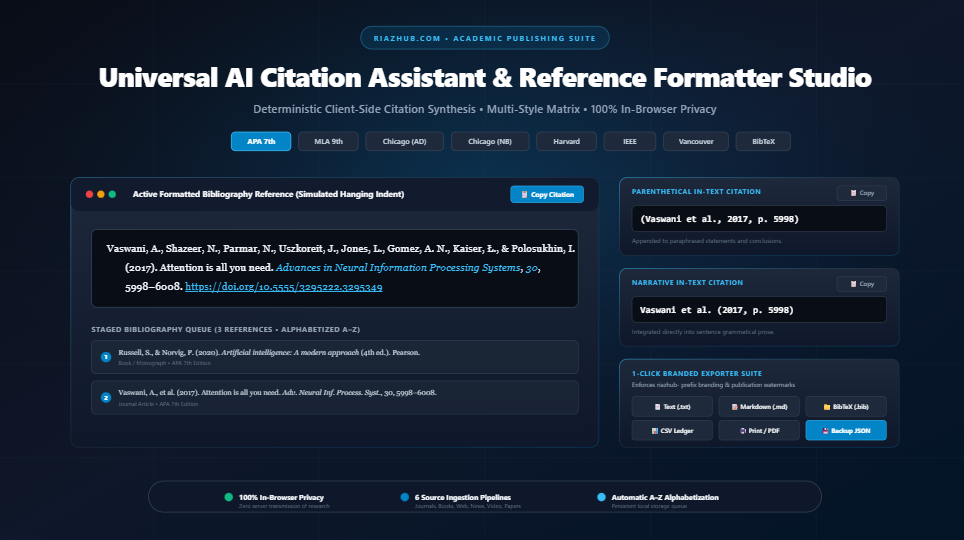
With the RiazHub Reference Formatter Studio, both parenthetical and narrative citations are generated simultaneously side-by-side. The tool also includes a pinpoint page modifier input so you can append specific page numbers (e.g., p. 42) that automatically sync across both cards in real time.
Digital Object Identifiers (DOIs) vs. Transient URLs: Why Modern Research Demands Permanent Resolvers
One of the most frequent citation errors flagged by peer reviewers is the inclusion of raw, transient web URLs (e.g., https://university-library.edu/ebsco/search?session=92348) that expire once a session terminates or a publisher restructures their website directory. This phenomenon, known in information science as link rot, compromises academic reproducibility.
“Over 35% of web links cited in scholarly journals suffer from link rot or content drift within seven years of publication.” — Journal of Information Ethics & Metrics
To combat link rot, the international academic publishing community established the Digital Object Identifier (DOI) system, governed by Crossref and the International DOI Foundation (IDF). A DOI is a permanent, persistent alphanumeric string registered directly to the digital asset’s metadata record.
Key Modern DOI Rules:
- Always present DOIs as active, clickable HTTPS hyperlinks:
https://doi.org/10.xxxx/xxxxxx. - Never precede the link with
DOI:ordx.doi.org; modern style manuals (APA 7, MLA 9, Chicago 17) mandate the cleanhttps://doi.org/resolver prefix. - Do not insert a trailing period after a DOI URL, as this can break copy-pasted link resolution in electronic PDF documents.
The ingestion pipeline inside the Universal AI Citation Assistant features an intelligent DOI auto-cleaner. Whether you paste a raw DOI string like 10.1016/j.artint.2026.103450, a prefixed string doi:10.1016/..., or an outdated resolver link, the system normalizes it instantly into a compliant HTTPS hyperlink.
Building and Managing a Multi-Source Bibliography Queue
Managing references across long-term academic projects like theses, systematic literature reviews, or multi-chapter books can quickly become chaotic when citations are scattered across separate documents.
The built-in master bibliography stager in the Universal AI Citation Assistant solves this by providing a unified in-browser queue:
- Multi-Source Staging: Ingest peer-reviewed journal papers, published monographs, institutional reports, newspaper dispatches, web documentation, video lectures, and conference proceedings into a single staging list.
- Dynamic Style Switching: Staged all your references in APA 7, but your target journal just requested Chicago Author-Date? Simply click the style switcher tab; every staged reference recalculates its typography, italics, and punctuation instantaneously.
- Deterministic A–Z Alphabetization: Click the Alphabetize (A–Z) button to sort your entire bibliography queue by the primary author’s surname (or title if anonymous) in strict accordance with academic indexing rules.
- Hanging Indent Simulation: Bibliographies are rendered with genuine hanging indents (half-inch or 2em negative text indentation), allowing you to review visual line wrapping exactly as it will appear in your printed manuscript.
- In-Place Editing: Need to correct a volume number or add a co-author? Click the edit button on any reference to reload its full metadata back into the editing form, update the fields, and save changes seamlessly.
Multi-Format Branded Export Suite: From Browser to Manuscript
Once your research queue is staged and alphabetized, exporting your citations should be frictionless. With 1-click exports on RiazHub’s Citation Studio, you can download your bibliography in five standardized formats:
- Plain Text Document (
.txt): Clean ASCII formatted text, perfect for quick pasting into emails, peer reviews, or submission textboxes. Automatically saved asriazhub-citations-[style].txt. - Annotated Markdown (
.md): Formatted with markdown headers, italic asterisks, and live hyperlinks, ready for Obsidian, Notion, GitHub wikis, or static site generators. Saved asriazhub-bibliography-[style].md. - BibTeX Academic File (
.bib): Clean machine-readable BibTeX code with automatic semantic citation keys (e.g.,@article{vaswani2017, ...}) ready for direct compilation in Overleaf, LaTeX, or LyX. Saved asriazhub-references-[style].bib. - Structured CSV Ledger (
.csv): Tabular reference spreadsheet with separated columns for Authors, Title, Container, Volume, Issue, Pages, DOI, and URL. Essential for systematic literature reviews, meta-analyses, and grant reporting. Saved asriazhub-citation-ledger.csv. - JSON Backup Configuration (
.json): Complete serialized session backup allowing you to safeguard and restore your entire research library at any time without losing custom edits. - Print & PDF Optimized Generation: Built-in print stylesheets automatically hide UI buttons, form inputs, and navigation elements, formatting your bibliography into clean, double-spaced, 12pt Times New Roman pages with authentic hanging indents ready to be saved as an archival PDF.
Zero Server Latency & 100% Client-Side Privacy: Protecting Unpublished Research
In an era where unauthorized cloud data scraping and intellectual property leaks are growing concerns for academics, privacy is paramount. Entering proprietary dissertation titles, unreleased laboratory discoveries, patent-pending formulas, or confidential student essays into third-party cloud tools poses significant security risks.
Because the AI Citation Assistant & Reference Formatter operates 100% in-browser using pure client-side vanilla JavaScript, DOM APIs, and local storage, your research data is processed exclusively on your machine.
- Zero server-side transmission of unpublished research or manuscript titles.
- Zero external cloud API dependencies or third-party tracking scripts.
- Instantaneous citation synthesis with zero latency, even in low-bandwidth or offline environments.
- Persistent local browser storage ensures your bibliography queue remains intact across page refreshes.
Frequently Asked Questions (FAQ)
A hanging indent is a typographical paragraph formatting style where the first line of a citation begins flush against the left margin, and all subsequent lines are indented by 0.5 inches (or 2em). This creates a distinct visual gutter that allows readers, peer reviewers, and editors to scan author surnames rapidly when navigating an extensive alphabetical reference list.
When citing government agencies, international organizations, or corporations (e.g., World Health Organization, NASA, or OpenAI), standard personal author inversion rules do not apply. The studio includes an “Institutional / Corporate Author” toggle that preserves the organization’s name as a single grammatical entity across APA, MLA, and Chicago styles, avoiding awkward misformatting like “Organization, W. H.”.
Yes. Once you add references to the master bibliography queue, clicking any of the style selector tabs (APA 7, MLA 9, Chicago, Harvard, IEEE, Vancouver, or BibTeX) instantly recompiles every reference in your list according to the newly selected style manual guidelines.
Yes, the Universal AI Citation Assistant Studio on RiazHub.com is 100% free with unlimited citation generation, bibliography staging, and file downloads. No registration, credit card, or software installation is required.
Streamline Your Academic Research Today
Experience fast, deterministic, private in-browser citation formatting tailored for scholars, students, and educators.
Universal AI Citation Assistant & Reference Formatter Studio
Generate fully compliant academic citations in APA 7th, MLA 9th, Chicago 17th, Harvard, IEEE, and Vancouver formats. Build comprehensive bibliographies, preview dual-mode in-text citations, and export formatted references for research papers, essays, and journals.
1 Source Metadata Studio
Deterministic Parsing📚 Master Bibliography Stager
📦 1-Click Branded Exporter & Academic File Suite
All files generated 100% client-side with guaranteed riazhub- naming branding and publication watermarks.
📚 Academic Style Manual Guidelines & Standards Reference
American Psychological Association (APA 7th Edition) is standard in Psychology, Education, and the Social Sciences. It prioritizes the publication year by placing it in parentheses immediately after the authors: Last, F. M. (2026). Titles of articles and books use sentence-case capitalization, and up to 20 authors are listed before using an ellipsis.
Modern Language Association (MLA 9th Edition) is dominant in the Humanities, Literature, and Cultural Studies. It emphasizes authorship and containers: Last, First M., and First Last. Titles of works are enclosed in quotation marks using Title-Case capitalization, while containers (journals, anthologies, websites) are italicized. The publication date appears near the end of the entry.
Chicago Author-Date is used extensively in the physical, natural, and social sciences. In-text citations appear as (Smith 2026, 45), matching a final alphabetical reference list organized by author surname and year.
Chicago Notes & Bibliography (NB) is the traditional standard in History, Art History, Philosophy, and Religion. It employs numbered footnotes or endnotes throughout the manuscript with full citations on first mention, supported by a formal bibliography at the conclusion of the text.
IEEE (Institute of Electrical and Electronics Engineers) is the standard for Computer Science, Electrical Engineering, and Robotics. References are numbered chronologically in square brackets in the order of appearance: [1]. Author names are formatted as F. M. Surname.
Vancouver Style is required by the International Committee of Medical Journal Editors (ICMJE) for medicine and clinical health sciences. It uses numbered references matching an index list, removes periods from author initials (e.g., Smith JA, Taylor BC), and formats biomedical journal titles according to standard NLM abbreviations.
Unlike standard web URLs which suffer from link rot, domain expiration, or path restructuring over time, a Digital Object Identifier (DOI) is a permanent, persistent alphanumeric string registered with Crossref or DataCite. All modern academic styles mandate using the canonical resolver format: https://doi.org/10.xxxx/... instead of transient database links.
This utility operates entirely within your browser's local sandbox using native client-side JavaScript. No manuscript titles, unpublished research notes, patent citations, or reference entries are ever transmitted to remote servers or third-party cloud APIs. Your intellectual property and thesis bibliographies remain strictly confidential.