
Mastering Market Dominance: The Complete Guide to AI Competitor Analysis, SWOT Synthesis, and 2×2 Positioning
In hyper-competitive digital markets, guesswork is fatal. Learn how to benchmark rivals, uncover hidden competitor vulnerabilities, plot 2×2 market positioning quadrants, and arm your team with weaponized sales battlecards using the free Universal AI Competitor Analysis, SWOT Matrix and Market Positioning Studio on RiazHub.
Why Traditional Competitor Research Fails Modern Founders and Marketers
Conducting thorough market analysis has traditionally been a painful, fragmented process. Founders and product strategists typically bounce between bloated spreadsheets, generic templates, and expensive market research subscriptions. Even worse, uploading proprietary pricing roadmaps, pitch notes, or competitive gap analyses to cloud-based AI tools introduces significant security and confidentiality risks.
When entering a new market or launching a challenger product, you need rapid, deterministic clarity:
- Where is the market crowded and overpriced? Identifying incumbent red oceans where companies engage in self-destructive feature wars.
- What are the exact customer friction points? Spotting the structural weaknesses that large competitors cannot fix due to legacy technical debt or bureaucratic overhead.
- How should your sales team counter incumbent brand moats? Equipping account reps and founders with actionable objection-handling battlecards and trap questions during discovery calls.
- How can you communicate your edge in seconds? Visualizing your unique price-to-value proposition on an executive-ready 2×2 scatter quadrant map.
To address these challenges directly, we developed the Universal AI Competitor Analysis Studio: a high-speed, zero-latency browser workstation that delivers executive-grade strategic dossiers while keeping your data 100% local and confidential.
Core Architecture: Inside the 5-in-1 Competitive Intelligence Engine
Unlike static checklists or superficial summaries, the studio synthesizes your brand parameters against up to three market rivals simultaneously across five foundational strategic frameworks.
Automated Strategic SWOT Analysis Matrix
The SWOT matrix is not just a collection of generic bullet points. The studio dynamically pairs your internal advantages (Strengths and Weaknesses) with external rival friction points (Opportunities and Threats):
- Strengths (S): Synthesizes your core value proposition, innovation scores, and cost efficiencies into defensible market moats.
- Weaknesses (W): Highlights natural risks such as brand mindshare gaps or enterprise perception hurdles.
- Opportunities (O): Automatically converts your competitors’ primary vulnerabilities into aggressive customer acquisition angles.
- Threats (T): Preempts rival retaliations, predatory bundling, or rapid feature cloning by incumbent teams.
Every quadrant allows direct inline editing, item removal, and the ability to add custom strategic bullets on the fly.
Interactive Feature & Pricing Benchmark Table
Evaluate your core product or service criteria against rivals in an interactive matrix. Clickable status badges toggle between:
⚠️ Partial / Paid Add-On
❌ Missing / Not Available
The table automatically calculates live Feature Win Rates and summarizes pricing tiers (Free/Budget vs Mid-Market vs Enterprise Premium), giving you an immediate quantitative scorecard of your market advantage.
High-DPI 2×2 Market Positioning Quadrant Canvas
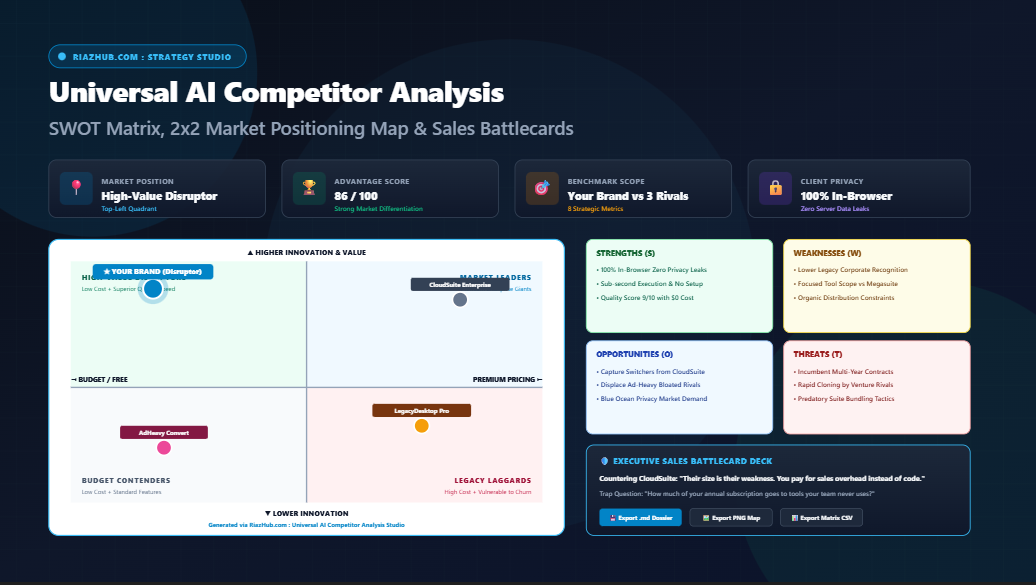
Visualizing market position is essential for board decks, investor pitches, and team alignment. The studio renders an HTML5 Canvas 2D scatter graph plotting Price Level (X-axis) against Innovation & Value Benchmark (Y-axis) across four intuitive market segments:
Fair/Budget Pricing + High Innovation (Optimal customer loyalty & viral growth)
Premium Enterprise Pricing + High Innovation (Entrenched category giants)
Low Pricing + Basic Utility (Commodity players with slim margins)
High Pricing + Low Innovation (High churn risk & prime target for switchers)
Your brand is plotted prominently with an azure glow and star badge, and you can download the high-resolution PNG chart with one click for presentations.
Executive Sales Battlecards & Trap Questions
Turning strategic intelligence into revenue requires empowering your frontline sales and marketing teams. The studio synthesizes four actionable battlecards:
- Why We Win: The core buying motive and value contrast for prospects evaluating your brand.
- Countering Competitor Strengths: Rebuttals to pivot prospects away from rival size and enterprise brand dominance.
- Discovery Trap Questions: Direct, surgical discovery questions designed to help prospective clients uncover incumbent shortcomings on their own.
- 15-Second Elevator Pitch: A conversational, jargon-free hook ready for outreach emails, podcast interviews, and cold pitches.
Each card includes one-click clipboard copying so reps can grab scripts during live calls.
Blue Ocean Strategy & Porter’s Five Forces Scorecard
Move beyond incremental competition with structured Blue Ocean Value Curve modeling:
- Eliminate: Unnecessary friction such as long sales cycles, mandatory account creations, or telemetry trackers.
- Reduce: Time to value, setup complexity, and excessive contract lock-ins.
- Raise: Speed, responsive customer interaction, and transparent data privacy.
- Create: Uncontested market opportunities through delightful modern workflows.
Combined with a five-point industry pressure evaluation (Competitive Rivalry, Threat of Entrants, Buyer Power, Substitutes, and Supplier Power), you receive a holistic strategic blueprint for your go-to-market rollout.
Explore Real-World Competitive Scenarios
Test the tool with prefilled data for SaaS Web Tools, Boutique Agencies, D2C Sustainable Brands, or Local AI Developer Plugins.
Zero Cloud Leaks: The Critical Value of In-Browser Processing
Strategic planning often involves unreleased product specs, confidential pricing experiments, and private assessments of market incumbents. Transmitting this data over unencrypted third-party APIs or storing it in external SaaS databases creates significant enterprise liability.
The Universal AI Competitor Analysis Studio is engineered with a strict local-first philosophy:
- Deterministic Client-Side Execution: All scoring algorithms, quadrant coordinate calculations, and markdown synthesizers execute in vanilla JavaScript inside your browser.
- Zero Server Transmission: No data packets containing your brand or competitor audits ever touch an external server or cloud database.
- Local State Persistence: Your inputs are automatically saved to your browser’s private local storage, allowing you to return to your workspace without creating an account.
Multi-Format Branded Export Suite
Once your competitive audit is configured, you can export your findings across multiple standard business formats:
Step-by-Step: How to Run Your First Competitor Audit
Select Your Industry and Input Your Brand Baseline
Navigate to the Competitor Analysis Studio and choose your sector (SaaS, Agency, E-Commerce, FinTech, DevTools, etc.). Enter your brand name, core value proposition, target customer profile, and assign your baseline Price (1-10) and Quality/Innovation (1-10) scores.
Profile Up to Three Key Market Rivals
Toggle the competitor panels to enter one, two, or three primary competitors. For each competitor, capture their biggest market strength (their defensive moat) and their most frequent customer frustration (their vulnerability), along with their Price and Innovation ratings.
Customize Your Feature Benchmark Matrix
Review the side-by-side feature criteria. Toggle statuses to reflect reality accurately. Use the inline input to add specialized criteria unique to your industry (e.g., SOC2 compliance, client-side speed, SLA guarantees).
Generate, Refine, and Export
Hit Generate Competitive Analysis to trigger the complete evaluation. Review the SWOT matrix, inspect your positioning quadrant, review the sales battlecards, and download your branded strategy reports for immediate distribution.
Universal AI Competitor Analysis, SWOT Matrix and Market Positioning Studio
Benchmark your business against top market competitors. Generate structured SWOT analyses, build side-by-side feature comparison tables, visualize 2x2 market positioning quadrants, and export executive battlecards with zero server latency.
Strategic SWOT Analysis Matrix
Synthesized from your brand advantages and competitors' vulnerabilities. Click any bullet to edit, or add custom points.
Interactive Feature & Benchmark Matrix
Side-by-side criteria evaluation. Click status badges to cycle through: Supported, Partial/Paid, Missing.
| Feature / Criteria | Your Brand | Competitor 1 | Competitor 2 | Competitor 3 | Action |
|---|---|---|---|---|---|
| Feature Win Rate | 8 / 8 (100%) | 5 / 8 (63%) | 4 / 8 (50%) | 2 / 8 (25%) | |
| Pricing Level | Budget / Free | Premium / Enterprise | Mid-Market | Freemium Low |
2x2 Market Positioning Quadrant Canvas
High-resolution strategic scatter plot mapping Price/Cost (X-axis) against Innovation/Quality (Y-axis).
Actionable Executive Sales Battlecards
Weaponized scripts for sales calls, pitch decks, and objection handling against market incumbents.
Why We Win: Core Differentiation Angle
Primary buying motive for prospects choosing your brandOvercoming Incumbent Strengths (Objection Handlers)
How to reframe their enterprise brand recognition and sizeDiscovery Landmine Questions (Exposing Competitor Flaws)
Direct questions that lead prospects to identify competitor friction15-Second Executive Elevator Pitch
Crisp conversational pitch for founder outreach and quick demosStrategic Blueprint & Porter's Five Forces Evaluation
Macro industry forces analysis, Blue Ocean value curve differentials, and go-to-market priorities.
🌊 Blue Ocean Strategy Value Curve: Four Actions Framework
Mandatory user registrations, telemetry trackers, and recurring paywalls.
Onboarding time, heavy installation packages, and bureaucratic pricing tiers.
Client-side processing speed, transparent data ownership, and instant tool utility.
Zero-cloud local processing with zero corporate intelligence leak risk.
⚖️ Porter's Five Forces Industry Pressure Scorecard
Crowded incumbents competing on features. Differentiation must rely on speed and customer friction-removal rather than price discounting alone.
Low barrier to build basic tools, but high barrier to establish authority, trust, and frictionless in-browser execution.
Buyers have infinite digital alternatives. Switching costs are near zero, demanding immediate value delivery within 3 seconds.
Substitutes include manual spreadsheets and complex enterprise software. Positioning on ease and zero setup wins switchers.
Pure client-side execution decouples service delivery from expensive proprietary cloud APIs and server hosting costs.
🚀 Go-To-Market Tactical Execution Roadmap
Competitive strategy is not about replicating competitor features; it is about exploiting systemic friction points that large incumbents cannot easily fix. When enterprise rivals grow, they accumulate bureaucratic technical debt, aggressive pricing quotas, and invasive telemetry tracking. By systematically mapping each competitor's primary customer complaint (e.g. sluggish interface, mandatory subscriptions, or confusing contracts), your brand can construct an asymmetric advantage: offering instant gratification, radical privacy, and predictable pricing.
In crowded red oceans, companies battle for marginal share through destructive discounting and bloated feature checklists. Blue Ocean strategy shifts the battleground by simultaneously pursuing differentiation and lower structural costs. Use the Four Actions Framework (Eliminate, Reduce, Raise, Create) to stop competing on industry standards that buyers no longer value, and instead invest in speed, seamless accessibility, and delightful user autonomy.
All SWOT matrix computations, competitive advantage scoring algorithms, feature comparison benchmarks, high-DPI canvas charts, and export generators run 100% locally inside your web browser. Zero market research inputs, pricing formulas, secret roadmaps, or corporate data are ever transmitted to external servers, cloud databases, or AI APIs. Your business plans remain exclusively on your computer.