
Mastering Duplicate Content Detection: A Practical Guide to N-Gram Shingling, Vector Similarity, and SEO Originality Audits
In modern digital publishing, duplicate content is rarely a matter of simple cut-and-paste piracy. Search engines evaluate structural repetition, subtle paraphrase overlap, and cross-page boilerplate with sophisticated mathematical shingling. Here is how modern N-Gram and vector algorithms identify cannibalized text, and how you can audit drafts with total client-side privacy.
The Evolution of Duplicate Content in the Era of AI Drafts
For years, content creators believed that avoiding literal plagiarism was sufficient to protect their search rankings. If two articles did not share word-for-word paragraphs, webmasters assumed search crawlers would treat both pages as distinct, indexable assets.
Today, that assumption creates serious organic traffic penalties. Search engine algorithms, including Google’s Helpful Content System and core ranking models, evaluate semantic density and lexical shingles. When an AI rewriter, freelance contributor, or product copywriter simply swaps adjectives while retaining identical clause order, search bots readily detect the footprint.
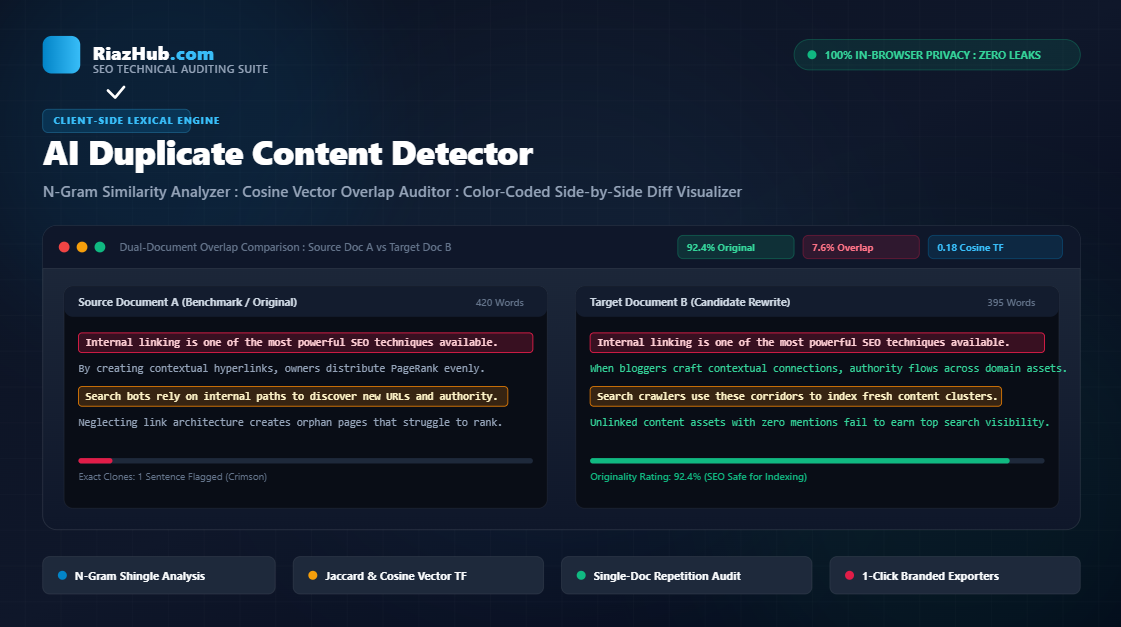
To inspect these structural clones before publishing, editors use the RiazHub AI Duplicate Content Detector & SEO Originality Studio. This interactive tool executes lexical analysis right in your browser without transmitting sensitive pre-launch drafts to third-party cloud servers.
Simple keyword searches look for contiguous blocks of identical characters. If a writer changes one word in a ten-word sentence, string search reports a 0% match. Shingle-based computational linguistics solves this limitation by dissecting sentences into rolling token windows.
The Science of N-Gram Shingling and Jaccard Similarity
How does a computational similarity engine prove that two articles are virtually identical, even when individual vocabulary words have been swapped? The core mechanism is known as N-Gram Shingling.
An N-Gram is a contiguous sequence of n items extracted from text. When analyzing text for duplicate content, words serve as the fundamental tokens:
- Unigram (1-Gram): Individual isolated words (e.g., “internal”, “linking”, “improves”, “rankings”).
- Bi-Gram (2-Gram): Paired word sequences (e.g., “internal linking”, “linking improves”).
- 3-Gram / 4-Gram Shingle: Multi-word phrases (e.g., “internal linking improves rankings”).
When you audit two text passages in the Universal AI Duplicate Content Detector, the engine constructs mathematical sets of overlapping 4-word shingles for Document A and Document B. It then calculates the Jaccard Similarity Index:
Jaccard Similarity = Size of Intersection (Shared Shingles) / Size of Union (Total Unique Shingles) × 100
If Document B shares a high proportion of four-word shingles with Document A, the content is flagged as a structural derivative, regardless of superficial punctuation tweaks or conjunction changes.
| Detection Method | What It Catches | Blind Spot | Recommended SEO Application |
|---|---|---|---|
| Exact String Match | 100% identical copy-paste text | Misses synonym swaps and minor clause edits | Code snippets, legal disclaimers, quotes |
| 4-Word Shingle Jaccard | Paraphrased drafts, rewritten sentences, spun articles | Can be affected by common domain idioms | Blog rewrites, guest posts, affiliate reviews |
| Cosine Vector TF | Topic cannibalization and keyword distribution | Does not preserve strict word sequence order | Landing page cannibalization audits |
| Sentence Overlap Ratio | Paragraph-level structural duplication | Requires sentence punctuation boundaries | Side-by-side editorial diff reviews |
Understanding the Multi-Metric Similarity HUD
No single score tells the complete story of document overlap. That is why the SEO Originality Studio on RiazHub calculates a coordinated multi-metric diagnostic telemetry grid:
1. Content Uniqueness Score
The primary key performance indicator represents the percentage of total words in the target draft that belong to genuinely unique sentences. A score above 85% is typically considered safe for search engine indexing. Scores between 50% and 84% signal moderate paraphrase overlap where restructuring is advisable, while scores below 50% indicate severe duplicate content risk.
2. Term-Frequency (TF) Cosine Vector Similarity
Cosine similarity treats both documents as multi-dimensional vectors in word space and calculates the cosine of the angle between them. A score of 0.00 denotes zero vocabulary overlap, while 1.00 represents identical term distributions. Comparing cosine metrics helps identify subtle topic cannibalization across different city landing pages.
3. Lexical Diversity (Type-Token Ratio)
The Type-Token Ratio (TTR) divides the count of unique words by the total word volume. Low TTR figures often expose keyword stuffing, repetitive filler phrases, or robotic AI pacing.
Audit Your Articles with Zero Cloud Uploads
Inspect your drafts side-by-side, spot flagged sentences in real time, and verify content uniqueness directly inside your web browser.
Dual-Document vs. Single-Document Audits: Two Essential Modes
SEO content auditing requires distinct approaches depending on whether you are verifying an external submission or refining an internal master guide. The online duplicate content auditor provides dedicated workflows for both scenarios:
Mode 1: Dual-Document Comparison (Source A vs. Draft B)
This mode places the original source (such as a manufacturer specification sheet, an existing blog post, or a competitor’s article) on the left, and the revised candidate draft on the right. Editors can immediately identify:
- Whether an outsourced freelancer provided a genuine rewrite or ran the source through a basic spinning tool.
- How much original commentary was added to syndicated news press releases.
- Whether an e-commerce product description has sufficiently differentiated itself from supplier copy.
Mode 2: Single-Document Self-Repetition and Boilerplate Audit
Long-form guides, comprehensive whitepapers, and affiliate listicles often suffer from internal repetition. Writers frequently duplicate identical call-to-action blocks, restate the same thesis across three separate subheadings, or copy-paste identical bullet introductions.
In Single-Document Mode, every sentence is compared against every other sentence in the same article. Redundant paragraphs and repeated sentences are surfaced with exact paragraph numbers, enabling editors to condense bloated prose and improve user reading retention.
Interpreting the Color-Coded Visual Diff Stager
Rather than delivering a dry numerical score, the diff stager highlights text inline with color-coded classification:
- Exact Duplicate (85% to 100%): Sentences rendered with a crimson underline indicate verbatim or near-verbatim clones. These sentences should be rewritten entirely.
- Partial Paraphrase (50% to 84%): Sentences with an amber underline share core word sequences and grammatical framing. Editors should invert the clause structure or introduce specific technical examples.
- Unique Content (<50%): Passages rendered cleanly with no background highlighting indicate distinct, original phrasing.
Clicking any highlighted sentence in the diff viewer focuses its matching counterpart on the opposite document panel, making cross-editorial comparisons quick and intuitive.
Step-by-Step Practical Workflow for Editorial Teams
- Paste or Load Content: Open the AI Duplicate Content Detector Studio and load your text via direct paste or using the local FileReader button for .txt, .md, or .html documents.
- Calibrate Sensitivity: Select your preferred N-Gram shingle size (4-word shingles work best for standard SEO articles) and toggle case or stop-word filters as needed.
- Execute Analysis: Click the “Scan & Compare Content Now” button for instant in-browser computation.
- Review Flagged Passages: Switch to the “Flagged Duplicate Sentences” tab to review each identified match alongside structural rewrite recommendations.
- Export Branded Documentation: Download a formatted Markdown (.md) report, a CSV match ledger, or a standalone HTML visual diff report to share with writers or clients.
Why 100% Client-Side Privacy Matters for Content Creators
Traditional online plagiarism checkers require you to transmit unpublished manuscripts, competitive product descriptions, or proprietary research papers to third-party web servers. Many free platforms log your drafts into internal databases to train machine learning models or check future queries.
The RiazHub SEO Originality Studio adopts an uncompromising privacy-first architecture. All tokenization, vector math, DOM rendering, and file exports occur entirely inside your browser’s local sandbox. No words ever leave your computer, ensuring absolute confidentiality for client ghostwriting and confidential corporate drafts.
Frequently Asked Questions (FAQ)
Protect Your Organic Rankings Today
Verify that your rewrites, landing pages, and long-form guides maintain top-tier structural originality before hitting publish.
Universal AI Duplicate Content Detector & N-Gram Similarity Studio
Detect exact duplicate passages, near-paraphrased overlap, and internal content repetition in seconds. Compare two drafts side-by-side, inspect color-coded sentence highlights, and export branded SEO audit reports 100% locally in your browser.