
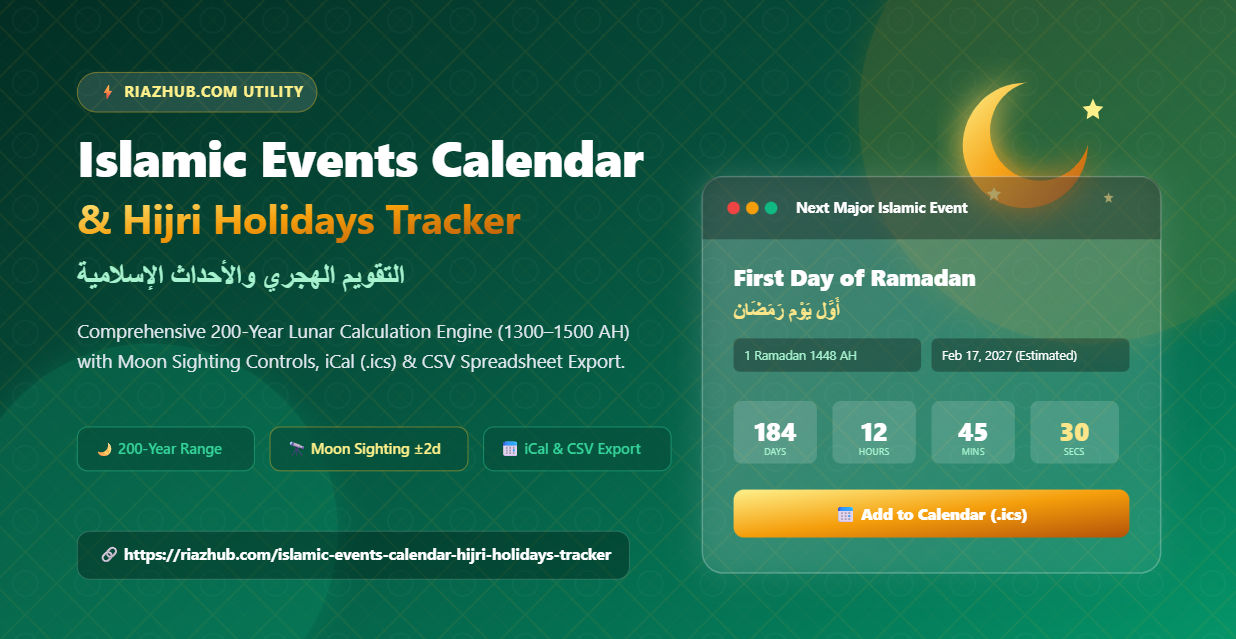
Mastering the Islamic Lunar Calendar: Your Guide to Hijri Holidays & Astronomical Tracking
For over 1.9 billion Muslims across the globe, the Islamic lunar calendar (also known as the Hijri calendar) governs the spiritual rhythm of life. From calculating the arrival of the holy month of Ramadan and celebrating the joyous festivals of Eid al-Fitr and Eid al-Adha, to observing sacred fasts on Ashura or Laylat al-Qadr, knowing the exact lunar dates is essential for religious observance.
Because the Hijri year relies strictly on lunar cycles—consisting of 12 synodic months totaling approximately 354 or 355 days—its dates shift by roughly 10 to 12 days every Gregorian calendar year. To eliminate date ambiguity and help believers plan their spiritual schedules effortlessly, we created the free online Islamic Events Calendar & Hijri Holidays Tracker on RiazHub.com.
Whether you need to project future Islamic dates up to 1500 AH, look up historical events dating back to 1300 AH, or sync key religious holidays directly with your Google, Apple, or Outlook calendars, this tool offers an all-in-one, privacy-first solution.
Why Lunar Tracking & Crescent Moon Sightings Matter
Unlike solar calendars that follow the Earth’s orbit around the Sun, the Islamic calendar commences each new month with the astronomical sighting of the crescent moon (Hilal). This local or regional moon sighting can lead to 1- or 2-day variations between different geographical zones around the world.
To accommodate local crescent sighting announcements by Islamic scholars and judicial authorities, our Islamic Events Calendar & Hijri Holidays Tracker includes an interactive Moon Sighting Offset Dropdown (-2 days, -1 day, 0 default, +1 day, +2 days). Adjusting this control immediately recalibrates all projected Gregorian date ranges across the entire tool in real time.
💡 Quick Tip for Travelers & Regional Observers
If your regional moon sighting committee (such as Umm al-Qura in Saudi Arabia or local boards in North America, Europe, or South Asia) announces a date shift, simply change the Moon Offset on the Islamic Events Calendar to match your local announcement instantly.
Key Features of the Islamic Events Calendar Tool
Designed with a mobile-first, privacy-focused client-side calculation engine, the Hijri Holidays Tracker on RiazHub requires zero server requests and stores no personal user data. Here is what makes it an indispensable tool for Muslims worldwide:
1. 200-Year Astronomical Calculation Engine (1300 AH – 1500 AH)
Unlike basic online calendars limited to 1 or 2 years, our astronomical Julian Day Number (JDN) algorithm spans two full centuries—from 1300 AH (~1882 CE) to 1500 AH (~2076 CE). This allows users to research past historical Islamic milestones or plan major life events years in advance.
2. Ticking Real-Time Countdown Hero Card
Stay informed about the nearest upcoming major Islamic milestone with a ticking countdown clock displaying days, hours, minutes, and seconds. The Hero Card automatically detects the next imminent event—such as Ramadan, Eid al-Fitr, Waqf al-Arafah, or Islamic New Year—so you never miss a sacred day.
3. Dual Display Layout Views
- Chronological Annual Events List: Browse detailed event cards featuring English transliterations, authentic Arabic calligraphy, category badges, significance summaries, and Sunnah fasting tags.
- Monthly Dual Hijri-Gregorian Matrix: View a full 1100px visual calendar grid for all 12 Hijri months (Muharram through Dhul Hijjah) showing Gregorian day numbers top-left and lunar Hijri day numbers centered.
4. Multi-Format Calendar Export Options
With a single click on the Islamic Events Calendar & Hijri Holidays Tracker toolbar, you can:
- Download iCal (.ics) Files: Import all key Islamic dates of the year directly into Google Calendar, Apple Calendar, or Outlook.
- Export CSV Spreadsheets: Download structured CSV data embedded with UTF-8 Byte Order Mark formatting for clean Arabic display in Microsoft Excel or Google Sheets.
- Copy Text Summary: Copy a formatted text breakdown of all dates directly to your clipboard with instant feedback.
Major Islamic Holidays & Events Tracked
The RiazHub Islamic Events Calendar provides comprehensive coverage of key religious holidays and historical anniversaries, including:
| Hijri Date | Event Title | Arabic Name | Category |
|---|---|---|---|
| 1 Muharram | Islamic New Year | رأس السنة الهجرية | Sacred Month / Milestone |
| 10 Muharram | Day of Ashura | يَوْم عَاشُورَاء | Sacred Month / Sunnah Fast |
| 12 Rabi’ al-Awwal | Mawlid an-Nabi (Prophet’s Birthday) | المَوْلِد النَّبَوِيّ | Major Holiday |
| 27 Rajab | Shab-e-Miraj (Isra and Mi’raj) | الإِسْرَاء وَالمِعْرَاج | Sacred Month / Milestone |
| 15 Sha’ban | Shab-e-Barat (Mid-Sha’ban) | لَيْلَة النِّصْف مِنْ شَعْبَان | Major Holiday |
| 1 Ramadan | First Day of Ramadan | أَوَّل يَوْم رَمَضَان | Major Obligatory Fasting |
| 27 Ramadan | Laylat al-Qadr (Night of Power) | لَيْلَة القَدْر | Major Holiday / Worship |
| 1–3 Shawwal | Chaand Raat & Eid al-Fitr | عِيد الفِطْر المبارك | 3-Day Major Festival |
| 9 Dhul Hijjah | Day of Arafah (Waqf al-Arafah) | يَوْم عَرَفَة | Sacred Month / Hajj Climax |
| 10–13 Dhul Hijjah | Eid al-Adha (Feast of Sacrifice) | عِيد الأَضْحَى المبارك | 4-Day Major Festival |
Spiritual Virtues of Sacred Months & Voluntary Fasting
Beyond major Eid festivals, the Islamic Events Calendar outlines the spiritual significance of the four sacred months (Al-Ashhur Al-Hurum): Muharram, Rajab, Dhul Qa’dah, and Dhul Hijjah (Surah At-Tawbah 9:36).
Additionally, users can follow voluntary Sunnah fasting recommendations highlighted within the tool:
- Ayyam al-Beed (The White Days): Fasting on the 13th, 14th, and 15th of every lunar Hijri month when the moon is full.
- Mondays & Thursdays: Recommended weekly Sunnah fasts when deeds are presented before Allah.
- Day of Arafah (9 Dhul Hijjah): A highly recommended fast for non-pilgrims that expiates sins of the preceding and upcoming year.
Access the Free Tool Today
Whether you are organizing family gatherings, planning Hajj and Umrah trips, tracking voluntary fasts, or seeking precise Hijri dates, try our interactive Islamic Events Calendar & Hijri Holidays Tracker on RiazHub.com. Bookmark it on your web browser or smartphone for instant 200-year Hijri date projections!