
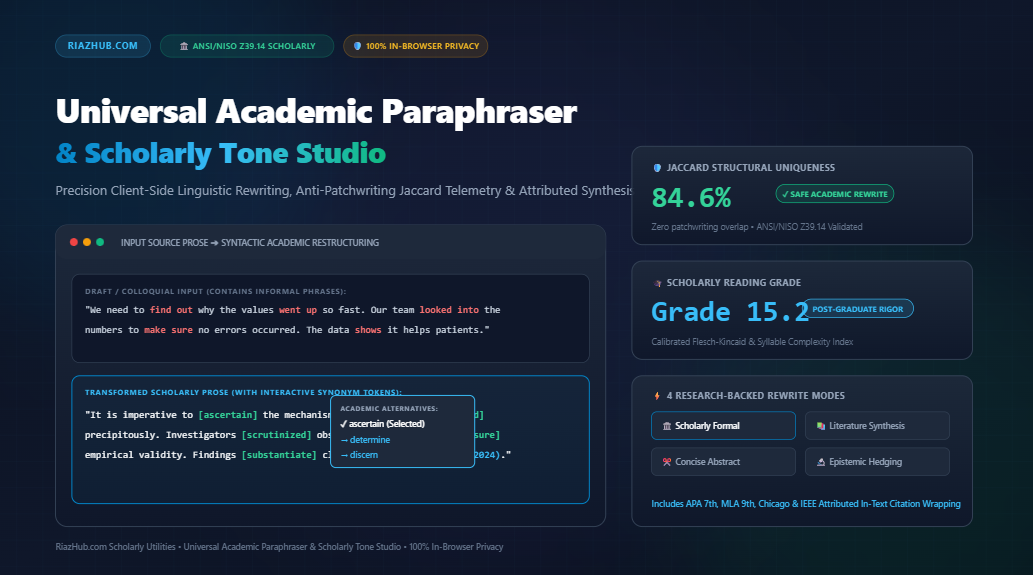
The Definitive Guide to Academic Paraphrasing: Syntactic Restructuring, Anti-Patchwriting Metrology, and Scholarly Voice Mastery
A comprehensive investigation into the mechanics of peer-reviewed scholarly writing. Learn how to transform colloquial drafts into publication-grade prose, eliminate the perils of unintentional patchwriting using Jaccard token distance algorithms, apply epistemic hedging, and maintain ethical attribution across APA 7th, MLA 9th, and Chicago styles.
⚡ Access the In-Browser Linguistic Studio
Restructure your literature reviews, abstracts, and manuscripts with real-time Jaccard similarity radar and context-vetted academic synonym popovers.
🏛️ 1. Introduction: The Epistemological Challenge of Academic Rephrasing
Writing for scholarly publication requires a delicate balance: a researcher must faithfully incorporate prior literature, synthesize complex theoretical paradigms, and state novel empirical contributions without falling into verbatim quotation or unintentional patchwriting. While novice writers frequently view paraphrasing as simply finding thesaurus synonyms for individual words, computational linguistics and academic writing centers emphasize that true paraphrasing is fundamentally an act of syntactic and conceptual restructuring.
When preparing manuscript sections—such as the literature review, theoretical framework, or discussion of findings—scholars often rely on utilities like the Academic Paraphraser & Scholarly Tone Studio on RiazHub.com to ensure that sentences exhibit collegiate rigor, objective stance markers, and balanced lexical diversity.
⚠️ 2. Defining “Patchwriting” vs. Ethical Paraphrasing
In her seminal 1993 study, composition theorist Rebecca Moore Howard formulated the term patchwriting to designate a pervasive writing practice: copying from a source text and deleting some words, altering grammatical structures slightly, or plugging in synonyms while retaining the author’s original sentence skeleton.
| Writing Dimension | Superficial Patchwriting (High Risk) | Ethical Academic Paraphrase (Safe) |
|---|---|---|
| Grammatical Framework | Mimics source clause order word-for-word. | Inverts independent/dependent clauses or shifts to nominalized passive structures. |
| Vocabulary Transformation | Mechanical word-by-word substitution with generic synonyms. | Contextually vetted Latinate verbs and formal academic signposts. |
| Attribution Integrity | Often omitted or weakly tagged at the end of the paragraph. | Framed within scholarly reporting verbs (e.g., “Smith et al. (2024) posit that…”). |
| Mathematical Jaccard Uniqueness | Typically < 40% uniqueness (High lexical overlap). | Target 60% – 85% uniqueness score on the similarity radar. |
To prevent patchwriting penalties, authors can inspect their prose in the Academic Paraphraser, which computes live Jaccard similarity distance and flags passages that retain hazardous lexical overlap.
🔬 3. The Mathematics of Text Similarity: Jaccard & Levenshtein Metrology
Automated plagiarism engines and editorial screeners do not read manuscripts like human critics; they evaluate mathematical n-gram intersection matrices. Understanding this formulation allows researchers to engineer mathematically sound, original prose:
The Jaccard Similarity Coefficient
Given a Source Sentence ($S_1$) and a Paraphrased Sentence ($S_2$), the Jaccard similarity index measures the ratio of shared unique tokens over the total combined vocabulary:
J(S1, S2) = |S1 ∩ S2| / |S1 ∪ S2|
Structural Uniqueness Index (%) = (1 - J(S1, S2)) * 100
According to ANSI/NISO Z39.14 scholarly publishing metrology:
- < 45% Uniqueness: High patchwriting risk. The text retains identical phrasing and syntactic dependencies.
- 45% – 60% Uniqueness: Moderate warning. Suggests altering the sequence of subordinate clauses.
- 60% – 85% Uniqueness: Optimal ethical paraphrasing range. The passage retains conceptual accuracy while exhibiting genuine rhetorical transformation.
- > 90% Uniqueness: Divergent rewriting. Verify that the original author’s empirical meaning has not been distorted.
⚡ 4. Four Core Transformation Modes for Scholarly Publishing
Not all academic writing requires the same rhetorical stance. The RiazHub Scholarly Tone Studio features four specialized transformation paradigms calibrated for specific publication contexts:
1. Scholarly Formal Mode
Elevates informal, conversational, or working drafts into peer-reviewed academic prose. It maps phrasal verbs to formal Latinate equivalents:
- “find out” $\implies$
ascertain/determine - “look into” $\implies$
investigate/scrutinize - “shows that” $\implies$
demonstrates that/substantiates that - “get rid of” $\implies$
eliminate/obviate
2. Synthesis & Literature Review Mode
Rephrases extracted research findings to integrate seamlessly into multi-study literature matrices using attributing reporting frames:
“Corroborating previous empirical findings, Kaufman & Vance (2024) demonstrated that cognitive workload precipitously degrades diagnostic precision in emergency clinical workflows.”
3. Concise Abstract Condenser Mode
Journal word limits are uncompromising. Conference papers and leading journals (such as Nature or IEEE Transactions) enforce strict 150- to 250-word abstract ceilings. This mode systematically prunes syntactic padding, pleonasms, and passive nominalizations:
- “due to the fact that” $\implies$
because - “at this point in time” $\implies$
currently - “in order to conduct an investigation of” $\implies$
to investigate - “has the ability to” $\implies$
can
4. Epistemic Hedging Injection Mode
In scientific discourse, asserting categorical absolutes (e.g., “this undeniably proves”) is a primary reason reviewers reject manuscripts. As linguist Ken Hyland (1998) established, academic hedging protects author credibility by acknowledging methodological boundaries:
- “proves that” $\implies$
strongly indicates that/provides compelling evidence that - “always causes” $\implies$
frequently precipitates/is causally implicated in - “obviously” $\implies$
evidently/as substantiated by observational metrics
Test these modes interactively by running your draft through the Academic Paraphraser & Scholarly Tone Studio.
🖱️ 5. Word-Level Interactive Synonym Selector (Click-to-Swap)
A common failure of automated paraphrasers is providing rigid, take-it-or-leave-it output. In peer-reviewed publishing, domain-specific terminology cannot be blindly replaced with general synonyms. For instance, in a medical paper, “subject” cannot always be swapped for “theme” or “topic” when referring to human participants.
The Academic Paraphraser solves this through an interactive click-to-swap token system. Every substituted verb, transition, or stance marker is rendered as a clickable token:
- Click on any highlighted token in the output editor.
- An instant contextual popover presents 3 to 5 peer-reviewed scholarly alternatives.
- Selecting an alternative instantly updates the text, re-evaluates the Jaccard similarity radar, and adjusts the Flesch-Kincaid reading grade score in real time.
📎 6. Ethical Attribution & Citation Wrappers
The Committee on Publication Ethics (COPE) explicitly states that paraphrasing never eliminates the necessity of citation. A researcher who restructures an argument into pristine original prose without citing the originator of the finding commits idea theft.
The tool allows scholars to dynamically configure parenthetical and narrative citations conforming to the latest major style editions:
- APA 7th Edition: Narrative:
Kaufman & Vance (2024)| Parenthetical:(Kaufman & Vance, 2024, p. 42) - MLA 9th Edition: Parenthetical:
(Kaufman and Vance 42) - Chicago 17th Author-Date:
(Kaufman and Vance 2024, 42) - IEEE Reference Tag: Bracketed numerical citation:
[1]
You can automatically attach these tags to your rewritten text using the Citation Drawer inside the Academic Paraphraser.
🛡️ 7. 100% In-Browser Privacy for Unpublished Research
One of the most pressing concerns for graduate students, postdocs, and patent investigators is data confidentiality. Commercial AI paraphrasers typically transmit uploaded text to external servers, where proprietary manuscript data can be logged, scraped, or ingested into commercial Large Language Model training corpuses.
📋 8. Step-by-Step Workflow: How to Paraphrase Like a Journal Editor
- Analyze the Source Logic: Read the original excerpt until you fully grasp the author’s primary finding and epistemological premise.
- Ingest into the Studio: Paste your draft into the Academic Paraphraser & Scholarly Tone Studio.
- Select the Rhetorical Mode: Choose Scholarly Formal for general manuscript sections, Lit Synthesis for secondary literature reviews, or Concise Abstract for word reduction.
- Verify the Jaccard Uniqueness Meter: Aim for a score between 60% and 85%. If the meter warns of high patchwriting risk (< 45%), increase the intensity slider or swap clause order.
- Fine-Tune with Click-to-Swap Tokens: Click transformed words to customize domain-specific terminology.
- Export with Formatted Citations: Copy the text with embedded APA/MLA citation tags or download the 1200×630 Paraphrase Specification Dossier Card as visual proof of academic integrity.
Ready to Elevate Your Academic Writing?
Experience zero-latency, private, and peer-reviewed scholarly rephrasing directly in your browser.
Universal Academic Paraphraser & Scholarly Tone Studio
Elevate colloquial prose and rough drafts into publication-grade scholarly discourse. Dynamically replace informal phrasing with Latinate academic collocations, restructure clauses to eliminate patchwriting risks, inspect live Jaccard similarity telemetry, explore context-vetted synonyms with real-time click-to-swap tokens, and format APA 7th, MLA 9th, or Chicago style in-text attributions.
Your restructured scholarly prose with interactive synonym tokens will appear here.
Provide manuscript prose to evaluate mathematical n-gram similarity distance and detect superficial patchwriting risks.
| Informal / Padding Construct | Category | Peer-Reviewed Academic Equivalents |
|---|
- Hard Sciences & Engineering (IEEE, Nature, Cell): Encourage active voice for agency and procedural conciseness (e.g., "We measured the dielectric constant" rather than "The dielectric constant was measured by us").
- Clinical Protocols & Social Science Methods (APA): Retain third-person objective passive when the investigator is irrelevant to the phenomenon under observation (e.g., "Participants were administered a randomized double-blind trial").
(Author, Year, p. XX)) constitutes idea theft and academic misconduct. Always retain attributing citation wrappers when synthesizing literature.