
The Complete Collegiate Degree Audit & Title IV SAP Survival Guide: Mastering Quality Points, Federal 67% Pace Rules, and Graduation Honors
Navigating a university degree in higher education requires far more than attending lectures and passing midterm exams. Behind every academic transcript lies a rigorous institutional metrology governed by AACRAO transcript standards and statutory US Department of Education Title IV Satisfactory Academic Progress (SAP) regulations. A single uncalculated course withdrawal or an overlooked credit hour can jeopardize federal Pell Grants, Direct Student Loans, or disqualify a student from graduating with coveted Latin Honors.
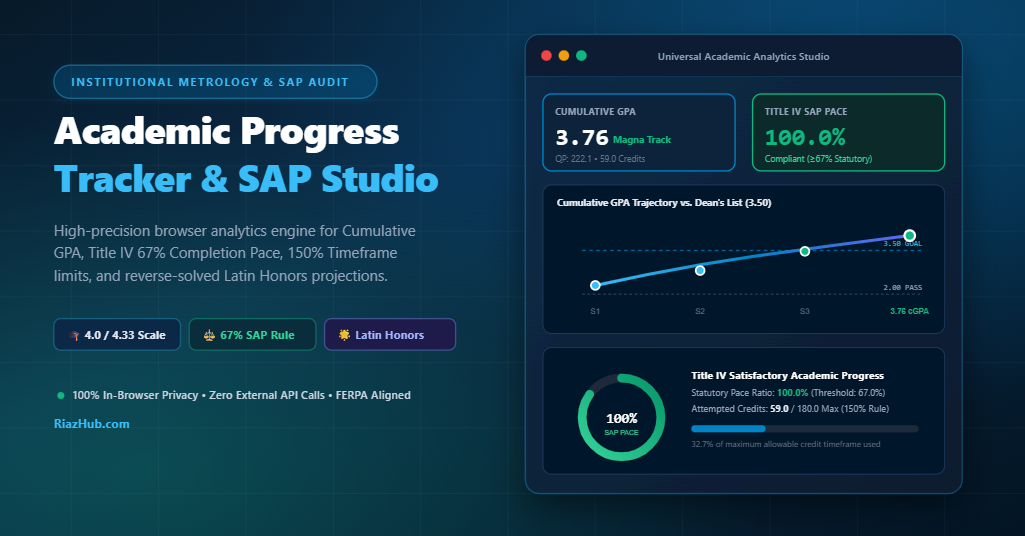
To eliminate the guesswork, registrar delays, and mathematical uncertainty of academic tracking, you can audit your standing instantly with the free, browser-based Universal Academic Progress Tracker & Title IV SAP Audit Studio on RiazHub.com. In this comprehensive guide, we unpack the institutional mathematics of collegiate transcripts, deconstruct federal financial aid compliance, and demonstrate how to reverse-forecast your target cumulative GPA.
Calculate your cumulative GPA on standard 4.0 and 4.33 scales, simulate course repeat forgiveness, monitor your Title IV 67% pace ratio, and download an official 1200×630 academic dossier card with zero external data leaks.
1. Understanding Quality Points (QP) and Weighted Collegiate GPA
One of the most widespread misconceptions among undergraduate and graduate students is treating GPA as a simple arithmetic average of earned letter grades. In North American and AACRAO-compliant institutions, GPA is always a credit-weighted ratio of accumulated Quality Points (QP) to total graded credit hours.
The Quality Points Formulation
Every course assignment awards quality points based on two variables: the credit unit weight (typically derived from Carnegie Credit Hours) and the numeric grade point value assigned by your institution:
Cumulative GPA = Total Cumulative Quality Points ÷ Total Cumulative GPA Credit Hours
Consider the following comparison:
- Earning an A (4.0) in a 4-credit Organic Chemistry course yields
4 × 4.0 = 16.0 Quality Points. - Earning an A (4.0) in a 1-credit Laboratory yields only
1 × 4.0 = 4.0 Quality Points. - Earning a C (2.0) in a 4-credit course produces
8.0 Quality Points, which severely drags down cumulative standing because of the 4-credit divisor.
You can explore this exact weighting mechanism live in the Universal Academic Progress Tracker, which computes term-by-term Quality Points across both standard 4.0 (+/-) scales and 4.33 honors scales (where an A+ awards 4.33 grade points).
| Letter Grade | Standard 4.0 Scale | 4.33 Honors Scale | Title IV SAP Impact | Earned Credit Status |
|---|---|---|---|---|
| A+ | 4.00 QP | 4.33 QP | Attempted & Earned | Pass (Satisfactory) |
| A / A- | 4.00 / 3.70 QP | 4.00 / 3.70 QP | Attempted & Earned | Pass (Satisfactory) |
| B+ / B / B- | 3.30 / 3.00 / 2.70 QP | 3.30 / 3.00 / 2.70 QP | Attempted & Earned | Pass (Satisfactory) |
| C+ / C / C- | 2.30 / 2.00 / 1.70 QP | 2.30 / 2.00 / 1.70 QP | Attempted & Earned | Pass (Satisfactory) |
| D+ / D | 1.30 / 1.00 QP | 1.30 / 1.00 QP | Attempted & Earned | Marginal Pass (Credits count) |
| F (Failure) | 0.00 QP | 0.00 QP | Attempted, NOT Earned | No Credit (Lowers Pace & GPA) |
| W (Withdrawn) | Excluded from GPA | Excluded from GPA | Attempted, NOT Earned | No Credit (Lowers Pace %) |
| I (Incomplete) | Excluded from GPA | Excluded from GPA | Attempted, NOT Earned | Pending (Counts as Attempted) |
2. Title IV Satisfactory Academic Progress (SAP) & The Federal 67% Rule
Under federal regulations codified in 34 CFR 668.34, the United States Department of Education mandates that every higher education institution enforce strict Satisfactory Academic Progress (SAP) standards. Students who fail to meet these statutory checkpoints lose eligibility for Title IV federal financial aid, including:
- Federal Pell Grants
- Federal Direct Subsidized and Unsubsidized Stafford Loans
- Federal Direct PLUS Loans (Parent & Graduate)
- Federal Supplemental Educational Opportunity Grants (FSEOG)
- Federal Work-Study Programs
The Quantitative Standard: Completion Pace Ratio
The federal government requires students to successfully pass at least 67.0% of all cumulative credit hours attempted. This is evaluated as:
Attempted Credits include all courses in which a student was enrolled past the university add/drop census date, regardless of whether a passing grade was achieved. This includes grades A, B, C, D, F, W (Withdrawal), and I (Incomplete).
Earned Credits only include courses completed with a passing grade (typically A through D).
Many students believe that withdrawing from a course with a “W” notation is consequence-free because it does not affect their cumulative GPA. However, under Title IV regulations, a “W” is classified as Attempted Credits with 0 Earned Credits. Accumulating just two 3-credit withdrawals in a 30-credit freshman year drops your completion pace to 80.0%, and a third drop can push you into immediate financial aid warning territory.
The 150% Maximum Timeframe Ceiling
In addition to completion pace, Title IV establishes an absolute ceiling on degree duration. A student cannot receive financial aid once their total attempted credits exceed 150% of the published program length:
- Standard 120-Credit Bachelor’s Degree: 180 Attempted Credits Maximum
- Standard 60-Credit Associate’s Degree: 90 Attempted Credits Maximum
- Standard 30-Credit Master’s Degree: 45 Attempted Credits Maximum
Using the Title IV SAP Audit Studio, students can monitor both their current completion pace ratio and their real-time progress toward the 150% maximum timeframe limit with instant compliance alerts.
3. Course Repeat Policies & Grade Forgiveness Mechanics
When retaking a course to improve academic standing, institutions enforce one of two prevailing policies:
- Grade Replacement (Forgiveness): The subsequent course attempt replaces the initial failing or sub-par grade in your cumulative GPA denominator. While the earlier attempt remains permanently recorded on your official transcript with an
[R]notation, its quality points are purged from your cumulative GPA. - Grade Averaging: Both course attempts remain active in the cumulative GPA denominator, requiring you to carry twice the credit burden to offset an earlier low grade.
Crucial Title IV Note: Even if your university forgives an initial ‘F’ grade for internal GPA calculation, federal Title IV SAP regulations require both attempts to count in total attempted credits when measuring the 67% pace ratio and 150% maximum timeframe ceiling. The Universal Academic Progress Tracker includes dedicated repeat flags ([Rep]) that allow you to simulate institutional forgiveness on your GPA while maintaining accurate federal attempted credit accounting.
4. Reverse-Engineering Graduation GPA & Latin Honors
As students approach their junior and senior years, the primary question shifts from “What is my current GPA?” to “What exact GPA do I need across my remaining credits to graduate with Latin Honors?”
The Mathematical Reverse Solver
To determine your required future GPA across remaining credit hours, the algebraic formulation solves for:
Latin Honors Benchmark Thresholds
- Cum Laude (“With Praise”): Typically requires a cumulative GPA between 3.50 and 3.69.
- Magna Cum Laude (“With Great Praise”): Typically requires a cumulative GPA between 3.70 and 3.89.
- Summa Cum Laude (“With Highest Praise”): Represents the pinnacle of collegiate scholarship, requiring a cumulative GPA of 3.90 to 4.00.
With the Cumulative GPA Predictor & Reverse Forecaster, you simply drag the target slider to your desired graduation goal (e.g., 3.75), and the algorithm calculates whether the target is mathematically achievable, a demanding sprint, or unattainable given your remaining degree credit hours.
5. Studio Walkthrough: How to Audit Your Standing in Seconds
The Universal Academic Progress Tracker & Title IV SAP Audit Studio operates 100% inside your browser sandbox with zero external server dependencies, guaranteeing strict FERPA compliance. Here is how to complete a degree audit:
- Configure Your Degree Profile: Enter your major title (e.g., “B.S. in Computer Science”), total required graduation credits (e.g., 120), and select your institution’s grading system (Standard 4.0 or 4.33 Scale).
- Populate Semester Rosters: Organize your courses term-by-term. Input course codes, credit hours (1–6), letter grades, and curriculum categories (Major Core, General Ed, Electives, Support Labs). Mark repeated courses using the repeat checkbox.
- Analyze Visual Telemetry: Switch between the 5 interactive tabs:
- 📈 Trajectory: View historical GPA evolution against the 3.50 Dean’s List honor zone and review your circular Title IV SAP gauge.
- 🎯 Target GPA: Solve for your required future term GPA to secure Latin Honors.
- ⚖️ SAP Audit: Review a formal breakdown of attempted hours, earned hours, statutory pace ratio, and 150% maximum timeframe headroom.
- 🧩 Credit Tiers: Check completion progress across major core and elective requirements.
- 🖼️ Dossier Card Studio: Preview a high-DPI 1200×630 official standing card in Cyber Azure, Collegiate Emerald, Deep Obsidian, or University Crimson themes.
- Export & Share: Use the tactile export bar to copy a formatted text overview for academic advisors, download a full CSV transcript ledger, or generate a clean print/PDF layout.
Take control of your collegiate transcript and federal financial aid eligibility today. No account creation or software download required.
Frequently Asked Questions (Collegiate Academic Audits)
Term GPA evaluates the weighted quality points earned strictly within a single semester or quarter. Cumulative GPA computes the grand weighted average across all collegiate semesters undertaken at the institution.
While transcript history remains permanent, restoring your cumulative GPA above 2.00 and your completion pace above 67.0% automatically returns you to “Good Standing” and clears financial aid holds under Title IV regulations.
Standard Pass/Fail courses carry zero quality points and are excluded from your GPA denominator. However, under Title IV rules, a “Pass” counts toward both attempted and earned credits, whereas a “Fail/No Pass” counts as attempted but unearned credits, negatively impacting your completion pace.
Yes, 100%. The Academic Progress Tracker executes all mathematical models, canvas charts, and dossier rendering directly inside your browser client. No grades or personal information are ever transmitted to external servers.
Universal Academic Progress Tracker & Title IV SAP Studio
Institutional-grade academic telemetry operating 100% in-browser. Audit cumulative GPA, track Title IV Satisfactory Academic Progress (67% Pace rule), reverse-forecast Latin Honors thresholds, and generate verified academic dossier cards.
📖 Institutional Grading Guides, SAP Regulations & Methodology
Course Quality Points = Credit Hours × Grade Points
For example, earning an A (4.0) in a 4-credit Organic Chemistry course yields 16.0 Quality Points, whereas earning an A in a 1-credit laboratory contributes only 4.0 Quality Points. Cumulative GPA is computed by dividing total accumulated quality points by the total GPA-bearing credit hours. Non-punitive grades such as Withdrawn (W) or Incomplete (I) are excluded from the GPA denominator.
- Completion Pace (Quantitative Standard): A student must complete at least 67.0% of all cumulative credit hours attempted. Pace = (Earned Credits ÷ Attempted Credits) × 100.
- Maximum Timeframe (150% Ceiling): A student cannot exceed 150% of the published credit requirements for their academic credential (e.g., 180 attempted credits for a standard 120-credit Bachelor of Science).
- Grade Replacement (Forgiveness): The subsequent attempt replaces the earlier attempt in the cumulative GPA calculation. The earlier grade remains on the transcript with an [R] notation, but its quality points are purged from the cumulative GPA.
- Grade Averaging: Both attempts remain in the GPA calculation, doubling the credit burden.
- Title IV Note: Even if a grade is forgiven institutional-wise, all prior attempts typically still count toward Title IV SAP attempted credits.