
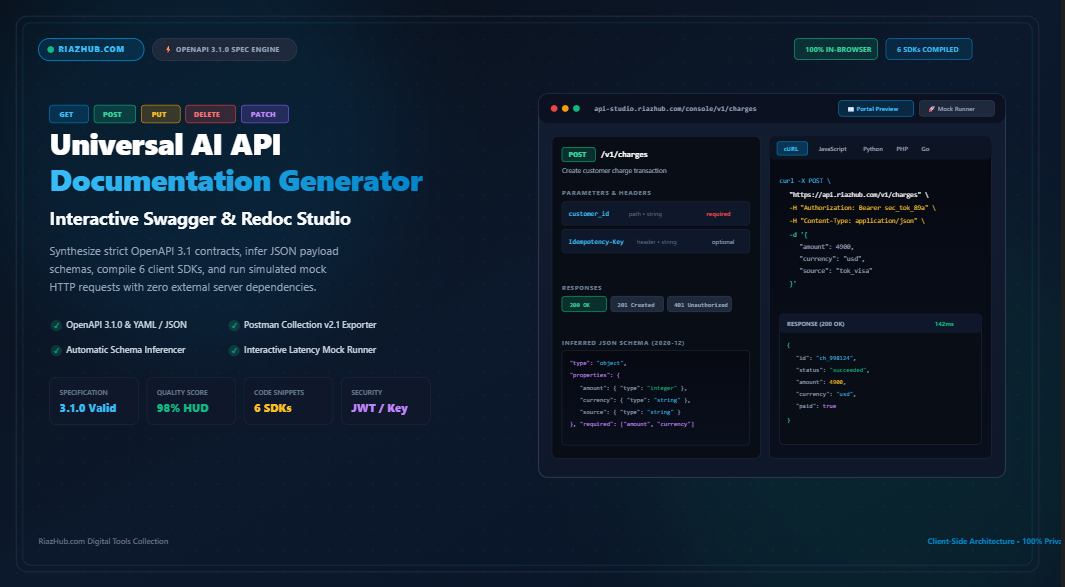
AI API Documentation Generator & Interactive Developer Portal: The Definitive OpenAPI 3.1 & RFC 9110 Guide
- The Modern API Documentation Challenge
- What is the AI API Documentation Generator?
- OpenAPI 3.1.0 vs. OpenAPI 3.0: Why JSON Schema 2020-12 Matters
- Under the Hood: Automatic JSON Schema Inference
- 6-Language Multi-SDK Code Snippet Engine
- Interactive ‘Try It Out’ Mock Runner Bench
- Stripe & Redoc-Style 2-Column Documentation Portal
- Contract Quality Score HUD & Schema Audit
- 1-Click Multi-Format Exporters (YAML, JSON, Postman, Markdown)
- Zero-Leak Privacy: 100% Client-Side Architecture
- Step-by-Step Tutorial: Generating API Docs in 60 Seconds
- Frequently Asked Questions (FAQ)
1. The Modern API Documentation Challenge
In modern software engineering, an API is only as good as its documentation. Even the most robust microservice architecture becomes unusable if client developers struggle with untyped JSON parameters, missing HTTP status codes, or absent code execution samples.
Historically, technical teams had to choose between two painful trade-offs:
- Hefty Static Site Generators: Tools like Docusaurus, Slate, or Redoc requiring Node.js installations, complex build steps, Git webhooks, and manual markdown wrangling.
- Expensive SaaS Platforms: Hosted developer portals charging thousands of dollars per month while requiring teams to upload private internal route schemas and proprietary endpoint tokens to third-party databases.
To eliminate this friction, RiazHub developed the AI API Documentation Generator & Interactive Developer Portal, delivering an enterprise-grade documentation and testing environment operating directly in the web browser.
2. What is the AI API Documentation Generator?
The AI API Documentation Generator is a client-side specification engine and documentation studio. It empowers developers, technical writers, and API architects to design, audit, and preview RESTful endpoints in real time.
Key architectural pillars include:
- Strict OpenAPI 3.1.0 Contract Generation: Generates standards-compliant YAML and JSON specifications matching the official OpenAPI Initiative and RFC 9110 HTTP semantics.
- Autonomous JSON-to-Schema Inference: Ingests raw JSON request and response payloads, recursively mapping primitive types, arrays, nested objects, and required fields.
- Instant Multi-Language SDK Snippets: Produces ready-to-copy code across 6 programming languages: cURL, JavaScript (Fetch), Python (Requests), Node.js (Axios), PHP (cURL), and Go.
- Interactive Mock Runner: Allows engineers to simulate HTTP requests with simulated latency timers (85ms–260ms), response headers, and HTTP status verification.
- Stripe-Grade 2-Column Developer Portal: Renders a sticky, responsive documentation view with color-coded HTTP method badges (GET, POST, PUT, DELETE) and parameter tables.
⚡ Launch the Interactive AI API Documentation Studio Free →
3. OpenAPI 3.1.0 vs. OpenAPI 3.0: Why JSON Schema 2020-12 Matters
Many legacy Swagger tools are still constrained to OpenAPI 3.0 or even Swagger 2.0. However, the AI API Documentation Generator is built natively around OpenAPI 3.1.0.
The critical distinction lies in schema alignment:
| Standard Aspect | OpenAPI 3.0.x | OpenAPI 3.1.0 (Our Studio) |
|---|---|---|
| JSON Schema Alignment | Modified subset (dialect mismatch) | 100% Complete alignment with JSON Schema Draft 2020-12 |
| Nullability | Non-standard nullable: true keyword |
Standard type union: type: ["string", "null"] |
| Polymorphism | Limited oneOf / anyOf semantics |
Full JSON Schema conditional validation (if, then, else) |
| Webhooks | Not natively supported in root | Top-level webhooks object for event-driven architectures |
By producing OpenAPI 3.1 contracts, specs generated through the tool integrate flawlessly with modern code generators, API gateways (Kong, AWS API Gateway), and validation libraries without dialect warnings.
4. Under the Hood: Automatic JSON Schema Inference
Manually typing schema properties in YAML or JSON Schema is notoriously tedious. If an endpoint payload contains nested customer metadata, writing the schema by hand takes dozens of lines of error-prone boilerplate.
The AI API Documentation Generator solves this with an intelligent client-side inference engine. When you paste any sample payload:
{
  "order_id": "ord_998124",
  "amount": 4900,
  "currency": "usd",
  "is_recurring": true,
  "items": [
    { "sku": "pro_annual", "qty": 1, "unit_price": 4900 }
  ]
}
The engine’s recursive algorithm automatically decomposes the data structure:
- Primitive Detection: Distinguishes integers from floating numbers, strings, and booleans.
- Array Inspection: Inspects array item elements and builds uniform
itemsschemas. - Nested Objects: Traverses child keys recursively, constructing nested
propertiestrees and populating mandatoryrequiredarrays.
With a single click on “⚡ Infer OpenAPI 3.1 Schema Types From JSON”, your payload is converted into a fully typed JSON Schema ready for production validation.
5. 6-Language Multi-SDK Code Snippet Engine
High-converting developer portals (like Stripe, Twilio, and GitHub) recognize that client developers rarely want to write HTTP requests from scratch. They want copyable code snippets in their language of choice.
The API Documentation Studio generates synchronized, executable code snippets across 6 primary environments in real time:
- cURL (Bash): Clean command syntax formatting
-X METHOD,-H "Authorization: ...",-H "Content-Type: application/json", and-d '...'payload bodies. - JavaScript (Modern Fetch): Clean ES6+
async/awaitpattern using nativefetch(), request options, and error handling. - Python (Requests): Pythonic
import requestscode with structured dictionaries for headers and automaticjson=payloadserialization. - Node.js (Axios): Standard Promise-based Axios configuration with error handling.
- PHP (cURL Native): Production PHP implementation using
curl_init(),curl_setopt_array(), and error inspection. - Go (net/http): Idiomatic Go code with
http.NewRequest(), buffer reading, and response parsing.
6. Interactive ‘Try It Out’ Mock Runner Bench
Static API documentation leaves developers wondering: “What does the actual response look like when this endpoint runs?”
The AI API Documentation Generator incorporates a built-in HTTP Mock Runner inside the browser container:
- Simulated Network Latency: Simulates realistic network roundtrip latency (85ms to 260ms) with a live millisecond counter.
- Simulated Gateway Headers: Injects telemetry headers including
X-RateLimit-Limit,X-RateLimit-Remaining, andX-Request-Id. - Formatted Payload Envelopes: Synthesizes real response data based on the endpoint parameters and request schemas, giving client developers instant visual confirmation.
7. Stripe & Redoc-Style 2-Column Documentation Portal
The visual presentation of technical documentation directly impacts developer adoption. The studio provides a modern Stripe-inspired 2-Column layout designed with strict overflow guards:
- Left Column (Specifications): Displays HTTP method pill badges, route paths, endpoint summaries, parameter definitions (Path, Query, Header), and response status tabs (200, 201, 400, 401, 404, 500).
- Right Column (Sandbox & Execution): Features a sleek dark code terminal with tabbed language chips, 1-click clipboard copying, and live response preview envelopes.
The preview is bound within an 1100px isolated container, ensuring it adapts gracefully across desktop monitors, laptops, and mobile viewports without horizontal scrollbar blowout.
8. Contract Quality Score HUD & Schema Audit
How do you know if your API documentation meets enterprise standards? The studio features a real-time Contract Audit & Schema Completeness HUD that scores your documentation from 0% to 100%.
The automated auditor verifies 6 critical architectural factors:
- HTTP Method Compliance: Ensures the route conforms to RFC 9110 HTTP semantics.
- Base URL Protocol: Verifies that server URLs use secure
https://protocols. - Typed Parameter Signatures: Confirms that query, path, and header parameters have explicit data types (string, integer, boolean).
- Parameter Documentation: Flags missing parameter descriptions that could confuse client developers.
- Payload Schema Validation: Verifies that mutation routes (POST, PUT, PATCH) contain valid JSON Schema representations.
- Client Error Envelopes: Ensures 4xx and 5xx error responses (400 Bad Request, 401 Unauthorized, 404 Not Found) are defined.
9. 1-Click Multi-Format Exporters
Once your API documentation is configured, the AI API Documentation Studio lets you export your work across multiple formats with a single click:
- OpenAPI 3.1 YAML: Pure client-side serialized YAML specification ready to be saved into your repository (e.g.,
openapi.yaml). - OpenAPI 3.1 JSON: Fully compliant JSON OpenAPI specification for automated CI/CD pipelines.
- Postman Collection v2.1.0: Direct JSON collection with paths, methods, and header mappings, ready for direct import into desktop Postman clients.
- Markdown Developer Guide (.md): Formatted Markdown documentation complete with parameter tables and code snippets for your GitHub README or documentation wiki.
- High-DPI Blueprint Dossier Card (PNG): High-resolution 1200×630 specification certificate generated via Canvas 2D for social previews or technical presentations.
- Print/PDF Reference: Dedicated
@media printstylesheet enabling clean PDF documentation export with white backgrounds and optimized page breaks.
10. Zero-Leak Privacy: 100% Client-Side Architecture
Proprietary APIs often involve confidential endpoints, internal route paths, and sensitive mock credentials. Sending these payloads to third-party web servers introduces unnecessary security risks.
The AI API Documentation Generator executes 100% client-side in your browser using vanilla JavaScript, HTML5 Canvas, and native Web APIs. Zero endpoints, proprietary payload schemas, or tokens are ever transmitted across the network or stored on external servers.
11. Step-by-Step Tutorial: Generating API Docs in 60 Seconds
Follow these quick steps to create complete API documentation for your endpoint:
- Open the Studio: Navigate to the AI API Documentation Generator on RiazHub.com.
- Select a Preset or Enter Route: Click one of the quick preset buttons (e.g., Stripe Charge or User Login), or manually input your API Title, Base URL, HTTP Method, and Route Path.
- Configure Parameters: Click “+ Add Parameter” to add any path variables (e.g.,
{customer_id}), query filters (e.g.,limit=20), or custom headers (e.g.,Idempotency-Key). - Paste Sample Payload: If documenting a POST or PUT endpoint, paste your raw JSON request body into the payload box and click “⚡ Infer OpenAPI 3.1 Schema Types From JSON”.
- Inspect & Test: Switch between the “📖 Interactive Portal” tab to review your parameters and code snippets, and the “🚀 Mock Runner” tab to execute simulated tests.
- Export Your Spec: Click “📄 Export OpenAPI YAML” or “📦 Export Postman v2.1” to download your production specification files instantly.
🚀 Try the AI API Documentation Generator Now →
12. Frequently Asked Questions (FAQ)
properties tree and marks the observed keys in the required list.Ready to Elevate Your Developer Experience?
Build enterprise-grade documentation, generate SDK snippets in 6 languages, and export OpenAPI 3.1 specifications in seconds.
⚡ Open the Free AI API Documentation Studio on RiazHub.com →
Universal AI API Documentation Generator & Developer Portal
Synthesize production-grade OpenAPI 3.1 specifications, infer JSON schemas, compile SDK snippets in 6 languages, and test mock endpoints client-side with zero external server leaks.
| Parameter | In | Type | Description |
|---|
nullable: true versus type: ["string", "null"]). OpenAPI 3.1 enables true polymorphic schemas, standard type arrays, and direct reuse of enterprise JSON Schemas without translation layers.
Idempotency-Key header to prevent duplicate billing upon network retries.
Location header), and 204 No Content (successful deletion). For client errors, portals must distinguish between 400 Bad Request (malformed payload), 401 Unauthorized (missing or expired token), 403 Forbidden (insufficient ACL permissions), 404 Not Found, and 429 Too Many Requests (rate limit breached).
X-RateLimit-Limit (allowed requests in sliding window), X-RateLimit-Remaining (remaining budget), and Retry-After (seconds until window reset). Incorporating these headers into OpenAPI contracts prevents client-side timeout cascades.