
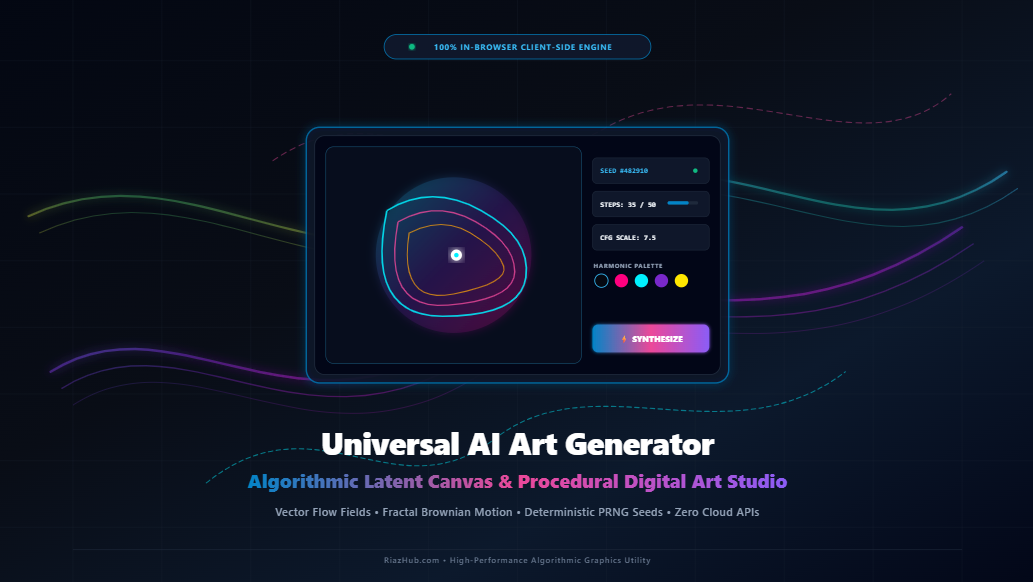
Universal AI Art Generator & Procedural Studio: The Complete Guide to In-Browser Latent Synthesis and Vector Flow Fields
Generative computer art has traditionally demanded massive cloud server clusters, power-hungry GPUs, and recurring monthly subscription fees. When services like Midjourney, Stable Diffusion, and DALL-E popularized text-to-image synthesis, they simultaneously introduced network latency, proprietary model gates, rate limits, and serious privacy concerns regarding creative concept ownership.
The Universal AI Art Generator & Procedural Latent Studio completely reimagines this paradigm by operating 100% client-side inside your web browser. Engineered on pure JavaScript, the HTML5 Canvas API, continuous gradient noise equations, and mathematical flow field physics, this lightweight studio delivers instant generative visual synthesis with zero external API calls, zero server latency, and absolute privacy.
Whether you are a digital designer generating atmospheric concept moodboards, an algorithmic artist studying procedural vector trajectories, or an enthusiast seeking high-resolution artwork for prints and social media, this comprehensive guide explores the computational mathematics, prompt tokenization heuristics, and deterministic seed mechanics powering this in-browser creative studio.
1. Client-Side Procedural Generation vs. Cloud GPU Diffusion Models
To understand the architectural breakthrough behind the Universal AI Art Generator, it is helpful to contrast local algorithmic synthesis against traditional cloud-based neural networks:
| Architectural Dimension | Cloud Neural Networks (Midjourney / SD) | RiazHub Procedural In-Browser Engine |
|---|---|---|
| Execution Environment | Remote multi-GPU data centers (A100 / H100) | Local Browser CPU/RAM via HTML5 Canvas |
| Latency & Wait Time | 15 to 45 seconds per image queue | Instant (1.0s to 2.5s synthesis time) |
| Data Privacy & IP Rights | Prompts logged on third-party cloud servers | 100% Private (No prompt ever leaves your device) |
| API Fees & Costs | Monthly subscriptions or per-credit pricing | Zero cost (Free, unlimited generations forever) |
| Reproducibility | Stochastic across model version iterations | 100% Deterministic Bit-Exact Seed Trajectories |
By shifting computation from remote server infrastructure directly to the client’s device, the RiazHub AI Art Generator grants creators instantaneous creative autonomy.
2. Mathematical Mechanics: Vector Flow Fields & Fractal Brownian Motion (fBM)
At the mathematical heart of the generator lies a continuous multi-dimensional vector field. Instead of assembling pixels randomly, the canvas establishes a hydrodynamic grid governed by 2D gradient noise and multi-octave Fractal Brownian Motion (fBM).
Fractal Brownian Motion combines multiple frequencies (octaves) of continuous noise, where each successive octave increases in frequency and decreases in amplitude according to predefined lacunarity and gain parameters:
// Fractal Brownian Motion Equation (fBM)
fBM(x, y) = ∑ (gain^i × Noise(x · lacunarity^i, y · lacunarity^i))
from i = 0 to (octaves - 1)
The resulting scalar noise value at coordinate (x, y) is normalized between 0.0 and 1.0 and mapped to a directional polar angle:
θ = fBM(x · scale, y · scale) × 2π
Simulated brush particles injected across the canvas evaluate this directional angle at every movement step. By calculating velocity vectors vx = cos(θ) × speed and vy = sin(θ) × speed, thousands of digital pigment strokes traverse the surface organically, mimicking the physical fluid dynamics of oil paint impasto, watercolor absorption, and atmospheric cosmic dust.
3. Simulated Progressive Latent Diffusion Denoising
Diffusion-based image generation operates on the principle of removing Gaussian noise incrementally across discrete time steps. The RiazHub Procedural Studio simulates this iterative denoising schedule directly within its canvas pipeline:
- Initial Gaussian Noise Stage: At step 0, the engine initializes a dense matrix of high-variance luminosity noise and deep tonal background gradients derived from prompt keywords.
- Coarse Structural Formation (Steps 1 to 15): High-opacity, broad-radius strokes establish the primary spatial composition, directional flow corridors, and tonal contrast zones.
- High-Frequency Detail Refinement (Steps 16 to 50): As the step counter progresses, particle radii decrease and stroke transparency shifts toward fine line-weights, depositing delicate impasto highlights, neon light streaks, and sharp geometric edges.
Through asynchronous non-blocking rendering chunks, users witness their artwork forming progressively before their eyes with a live step counter and animated progress bar.
4. Semantic Prompt-to-Palette Tokenization & Curated Art Mediums
When you enter a creative description into the prompt deck of the AI Art Generator, the built-in tokenizer evaluates descriptive tokens for aesthetic sentiment, chromatic temperatures, and subject matter:
🌌 Cyberpunk Neon
Features hyper-saturated magenta (#FF007F), cyan (#00F0FF), and deep obsidian backdrops with simulated horizontal neon flare streaks.
🎨 Van Gogh Impasto
Employs swirling cobalt blues, cadmium ambers, and heavy square-tipped brush strokes with thick textural turbulence.
🌊 Ethereal Watercolor
Generates gentle pastel gradients, seafoam greens, and soft translucent pigment washes with low vector turbulence.
📐 Geometric Abstract
Combines vivid primary hues with sharp polygon facets, crisp equilateral lattices, and sacred golden ratio symmetries.
📼 Retro Synthwave
Evokes 1980s retro-futurism with neon magenta grids, glowing cyan sunburst horizons, and deep violet space.
🌑 Dark Cosmic Nebula
Renders billowing ultraviolet interstellar gas clouds, cosmic stellar nurseries, and sparkling star clusters.
Keywords such as “gold”, “emerald”, “crimson”, or “violet” dynamically override palette weights, ensuring your text prompts directly influence the harmonic color ramps.
5. The Power of Deterministic PRNG Seeds (Mulberry32)
One of the greatest frustrations with conventional generative tools is the inability to reproduce an exact composition later. In the Universal AI Art Generator, randomness is anchored to a deterministic Mulberry32 Pseudo-Random Number Generator.
Given identical prompt parameters and numerical seed values (e.g., #482910), the mathematical sequence of particle coordinates, angle queries, and stroke lengths is guaranteed to execute identically across any browser, operating system, or device in the world. You can save your seed recipes directly into the built-in Recipe & Seed Vault for 100% bit-exact replication.
6. Step-by-Step Workflow Guide: Formulating Masterpieces
To achieve exhibition-grade algorithmic compositions, follow this recommended 5-step creative workflow:
- Formulate a Descriptive Text Prompt: Focus on tangible subject matter, atmospheric lighting, and architectural context (e.g., “A cybernetic lotus blooming in a rainy neon metropolis, reflective puddles, ethereal bioluminescence, cinematic lighting”). Use the 🎲 Random Creative Prompt button for instant inspiration.
- Select an Artistic Style & Aspect Ratio: Choose between Square (
1024×1024), Cinema (1280×720), Story (720×1280), or Gallery (1024×768). - Tune Generative Physics (CFG & Steps): For painterly and organic flows, set Inference Steps to
30–35and CFG Scale to7.0–8.5. Increase turbulence to High Detail for intricate fractal swirls. - Synthesize Artwork: Click the prominent
⚡ Generate Artworkbutton and watch the canvas denoise progressively. - Inspect & Export: Switch to the Fullscreen Lightbox or Zoom controls to inspect brush fidelity, then export as Lossless PNG, Scalable SVG, or generate a 1200×630 specification dossier card.
7. Multi-Format Exporters & Social Specification Dossier Cards
The studio offers four dedicated export pipelines tailored for artists, designers, and web creators:
- 💾 Lossless PNG Download: Direct 1-click raster export preserving full color depth, brush edges, and contrast without compression artifacts.
- 📐 Scalable SVG Vector Path Export: Generates clean SVG path curves from underlying flow vectors, perfect for pen plotters, vinyl cutters, and infinite-resolution prints.
- 📋 JSON Recipe Specification: 1-click clipboard copy detailing text prompt, negative modifiers, seed number, CFG, and step parameters.
- 🪪 1200×630 Specification Dossier Cards: Generates high-DPI social media summary cards displaying your artwork thumbnail alongside technical telemetry in Cyber Azure, Gallery Emerald, Deep Obsidian, or Celestial Amber themes.
8. Commercial Ownership, Intellectual Property & Privacy
A common concern among artists is copyright ownership of AI-synthesized imagery. With the RiazHub AI Art Generator:
- Public Domain & Commercial Freedom: All visuals are synthesized through pure client-side mathematical algorithms and your custom input prompts. No copyrighted scraped database is stored or reproduced. You possess full legal freedom to use, distribute, and commercially monetize all resulting PNG and SVG outputs.
- Absolute Confidentiality: Your creative concepts never touch a remote server. The entire synthesis cycle executes inside your device’s browser memory.
9. Frequently Asked Questions (FAQ)
No. Once the tool page is loaded in your browser, the entire generative engine operates 100% locally on your machine. You can even synthesize artwork offline.
Yes. Simply record the numerical Seed number from the KPI card or copy the JSON specification recipe from Tab 3. Re-entering the exact same seed and prompt will reproduce the exact same composition bit-for-bit.
None. Because the synthesis runs on your own device rather than expensive server farms, generations on RiazHub.com are 100% free with zero limits.
Inference Steps control how many progressive denoising iterations are executed (15 to 50), while Guidance Scale (CFG) controls the contrast weight and particle radius density applied to the pigment strokes.
10. Conclusion: The Future of In-Browser Computational Art
The emergence of browser-based procedural latent studios demonstrates that captivating, high-resolution digital art does not need to be tethered to expensive cloud server clusters or closed commercial APIs. By harnessing the mathematical elegance of vector flow fields, multi-octave Fractal Brownian Motion, and deterministic seed trajectories, creators enjoy instantaneous visual synthesis with absolute privacy and zero ongoing costs.
Ready to explore procedural graphics, experiment with algorithmic styles, and create stunning digital compositions? Launch the tool today on RiazHub:
Universal AI Art Generator & Procedural Latent Studio
Synthesize high-fidelity digital art and painterly compositions using browser-based vector flow fields, multi-octave Fractal Brownian Motion (fBM), and simulated diffusion denoising heuristics.
Each directional needle visualizes the continuous 2D gradient noise field directing the simulated pigment brush trajectories.
{ "loading": true }
🌀 Vector Flow Fields
Particles move across a continuous Perlin/gradient noise angle field ($\theta$). As simulated particles step across the grid, they leave behind pigment strokes with variable opacity.
🎲 Deterministic PRNG Seeds
Using Mulberry32, every integer seed establishes an identical initial state. Entering the same seed and prompt yields the exact same algorithmic composition anywhere in the world.
🎨 Prompt Tokenization
Descriptive tokens (e.g., 'neon', 'sunset', 'ocean', 'dark') are parsed to extract dominant color ramps, tuning pigment density and brush velocity automatically.
🌫️ Simulated Latent Denoising
Emulates multi-step diffusion synthesis by transitioning from coarse high-variance background structures into refined high-frequency stroke details across 15 to 50 progressive steps.