
Mastering Long-Form Content: The Complete Guide to In-Browser AI Article Writing, SEO EEAT Metrology & Deterministic Synthesis
In the modern search landscape governed by Google’s Helpful Content system and rigorous Experience, Expertise, Authoritativeness, and Trustworthiness (EEAT) standards, publishing generic, surface-level articles is no longer viable. Today’s search engines and discerning human readers demand high-utility, structured, and deeply researched long-form assets. With the free AI Article Writer & Long-Form SEO Content Synthesizer on RiazHub, writers, SEO specialists, and technical strategists can synthesize publication-ready 1,200 to 2,500-word authoritative guides directly in their web browser—operating 100% client-side with zero cloud latency, zero external data leaks, and zero paid API keys.
1. The Problem with Conventional AI Writers: Why Superficial Outlines Fail Search Engines
Most commercial AI writing tools rely on generic conversational models that generate text sequentially without an architectural blueprint. While the resulting text may sound fluent at first glance, it frequently suffers from critical deficiencies that undermine search engine performance:
- Conversational Fluff and Hallucinations: Unconstrained generation often leads to repetitive introductions, vague generalities, and factual drift that frustrate readers looking for immediate solutions.
- Unbalanced Keyword Distribution: Without integrated metrology, automated generators either under-optimize core search queries or trigger algorithmic penalties through unnatural keyword stuffing.
- Missing Skimmable Architecture: The vast majority of digital readers do not read word-for-word; they scan for specific takeaways, tables, and answers to targeted sub-queries. Articles lacking visual callouts, structured tables, and jump-linked tables of contents experience elevated bounce rates.
- Data Privacy Vulnerabilities: Sending unreleased corporate strategies, proprietary research, or pre-launch product briefs to external cloud endpoints introduces security risks and intellectual property exposure.
To overcome these challenges, the AI Article Writer on RiazHub implements a deterministic discourse architecture. By separating the structural outline from the semantic synthesis layer, the tool enforces strict editorial standards before generating a single word of prose.
2. Deterministic Topic Graph Decomposition: How the Synthesis Engine Works
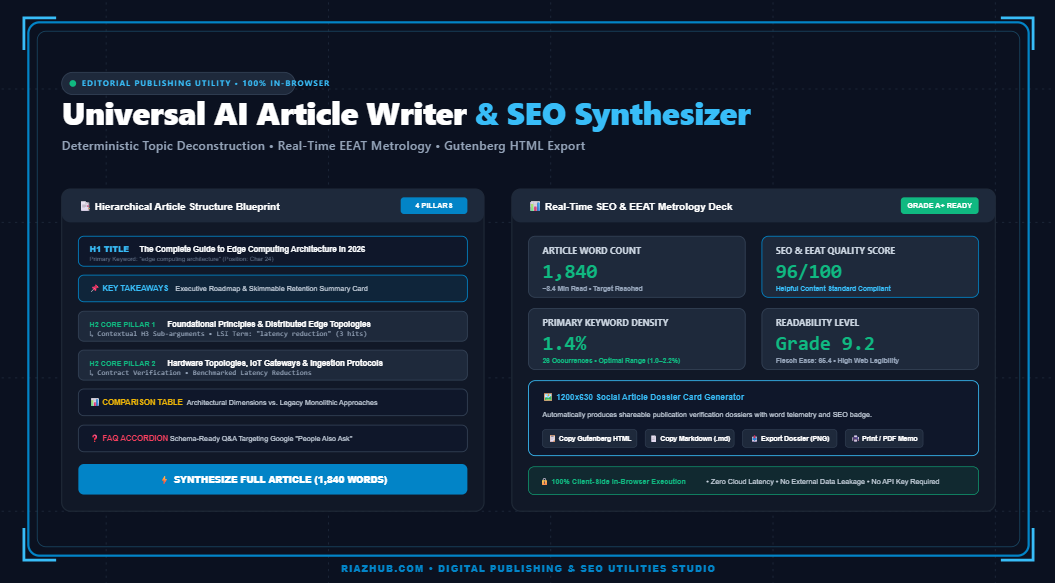
Unlike probabilistic conversational bots, the Universal AI Article Writer operates on computational discourse principles that decompose an article topic into an organized knowledge hierarchy:
The 5-Layer Hierarchical Blueprint:
- Click-Worthy, Benefit-Driven H1 Title: Formats the primary topic with early focus keyword placement (within the first 60 characters) to optimize on-page title visibility and search snippet click-through rates (CTR).
- Executive Hook & Problem Roadmap: Immediately grounds the reader in the real-world operational challenges of the topic, defining the value proposition and outlining the thesis without conversational padding.
- H2 Pillar Sections with Contextual H3 Sub-Arguments: Constructs three to six substantive core chapters covering foundational theory, implementation protocols, failure modes, and long-term durability. Each section includes bulleted takeaways and concrete production case studies.
- Actionable Implementation Matrix: Generates responsive, comparison tables contrasting traditional legacy workflows against modern optimized standards, giving readers a tangible takeaway.
- Schema-Ready FAQ Accordions: Formulates direct question-and-answer pairs matching Google “People Also Ask” (PAA) search intents with concise 40–50 word authoritative answers.
💡 Pro Tip for Technical Writers
You can customize every heading before generating your article. Use the Guided Section Outline Blueprint within the RiazHub AI Article Writer tool to add proprietary case studies, adjust chapter order, and tailor the discussion to your exact target persona.
3. Real-Time SEO & EEAT Metrology: Precision Auditing While You Write
Creating content that ranks requires real-time telemetry. The AI Article Writer utility features an embedded metrology engine that audits content parameters instantly in the client browser:
Key Metrics Calculated in Real Time:
- Primary Focus Keyword Density: Calculated dynamically via:
Density % = ((Keyword Occurrences × Words in Keyword) / Total Article Words) × 100The engine alerts you if your density falls into the under-optimized zone (<0.8%) or enters the dangerous keyword stuffing threshold (>2.5%), keeping your target anchored in the sweet spot of 1.0% to 2.2%.
- LSI & Secondary Semantic Coverage: Evaluates your custom comma-separated Latent Semantic Indexing (LSI) terms and indicates which terms are well-represented and which need further integration.
- Flesch-Kincaid Reading Grade Level & Reading Ease: Evaluates sentence lengths and syllable distributions to maintain maximum readability (optimal web target: Grade 8.0 to 11.0, Flesch Reading Ease 55 to 70).
- Reading Time Telemetry: Accurate reading duration based on the industry standard 220 words per minute (WPM).
- Google Helpful Content Quality Score (HCS): A 0–100 index assessing heading hierarchy, takeaway callout presence, table responsiveness, and schema readiness.
4. Step-by-Step Workflow: Creating a 2,000-Word Guide with RiazHub’s Tool
Follow this straightforward process to produce publication-grade content ready for WordPress or headless CMS publishing:
Step 1: Define Topic, Focus Query, and Target Audience
Navigate to the AI Article Writer studio on RiazHub.com. Enter your article topic (e.g., “The Complete Guide to Edge Computing Architecture in 2026”), primary focus keyword (e.g., “edge computing architecture”), and comma-separated secondary terms (such as “latency reduction, IoT gateways, decentralized processing”). Specify your target persona to calibrate technical depth.
Step 2: Select Editorial Tone and Target Word Count
Choose between four dedicated editorial styles tailored to different publication goals:
- Authoritative Guide: Balanced, pedagogical, and exhaustive educational reference.
- Technical Deep-Dive: Data-heavy, code/protocol oriented, and architectural.
- Thought Leadership: Visionary, strategic, and focused on organizational transformation.
- Commercial Review: Comparative, feature-matrix driven, and conversion-focused.
Select your length mode: Short (~1,000w), Standard (~1,800w), or Comprehensive (~2,500w).
Step 3: Refine the Outline Blueprint
Adjust the core pillar count (3 to 6 H2 sections) using the stepper. Use the built-in interactive outline manager to rename sections, remove unwanted chapters, or add custom sub-topics reflecting your company’s proprietary experience.
Step 4: Generate, Edit, and Audit
Click “Generate Full Long-Form Article”. The deterministic engine synthesizes the complete draft in seconds. Switch between the workspace tabs:
- Publication Preview: Review formatted typography, jump-link Table of Contents, takeaway cards, and FAQ accordions.
- Interactive WYSIWYG Editor: Make direct inline edits, add custom paragraphs, format lists, and synchronize modifications back to the live telemetry deck.
- SEO & EEAT Metrology: Audit keyword occurrences, LSI hit counts, and readability grade levels.
- Dossier Card Studio: Review your 1200×630 social publication dossier card.
Step 5: 1-Click Multi-Format Export
Use the output toolbar to copy Gutenberg-ready HTML directly into the WordPress block editor, copy clean Markdown (.md) for documentation repositories, or trigger the print/PDF stylesheet for executive distribution.
5. Comparison: Browser-Based Deterministic Engine vs. Cloud AI APIs
| Feature & Dimension | RiazHub In-Browser Engine | Cloud-Based AI Subscriptions |
|---|---|---|
| Cost & Access | 100% Free, Unlimited, No API Keys | $20 to $99/mo with token credit limits |
| Privacy & Data Safety | 100% Client-Side In-Browser Computation | Transmitted to third-party cloud servers |
| Generation Latency | Sub-second deterministic synthesis | 15 to 45 seconds of streaming latency |
| Real-Time SEO Metrology | Live density, LSI coverage, and readability | Often requires separate third-party SEO tools |
| Social Dossier Export | Built-in 1200×630 High-DPI Canvas PNG | Not supported |
6. Frequently Asked Questions (FAQ)
Will articles created by this tool trigger Google AI content penalties?
Google’s official search quality guidance states that search systems reward high-quality content that satisfies user intent regardless of how it is produced. Google penalizes low-effort, manipulative content created primarily to game search rankings. By enforcing comprehensive H2/H3 structures, actionable checklists, key takeaway banners, and schema-ready FAQs, the RiazHub AI Article Writer ensures drafts meet high quality and helpfulness benchmarks.
Is my corporate intellectual property protected?
Yes. The tool operates 100% inside your local browser runtime using client-side JavaScript. No topic premises, drafts, focus keywords, or IP addresses are uploaded to remote servers or third-party cloud endpoints.
Can I export directly into WordPress?
Yes. The Copy Clean HTML button formats the output with semantic tags (<article>, <h2>, <table>, <details>) that paste seamlessly into the WordPress Gutenberg editor, classic editor, or Elementor text blocks without breaking theme styling.
How does the Table of Contents jump-link system function?
When the TOC toggle is active, the engine assigns unique anchor identifiers (e.g., #section-1) to every H2 chapter and generates matching intra-page anchor links in the table of contents. This allows readers to navigate directly to their point of interest and improves on-page user engagement.
Universal AI Article Writer & Long-Form SEO Content Synthesizer
Synthesize publication-ready, long-form articles with structured headings, key takeaways, and FAQs. Audit SEO keyword density in real-time, generate social dossiers, and export clean WordPress HTML with zero server latency or paid API keys.
🔍 On-Page Keyword Analysis
📐 Structural & Readability Diagnostics
🎯 1. Satisfying Search Intent Fast
Place primary keyword answers in the opening 100 words. Searchers skim; providing an immediate, high-confidence overview lowers bounce rate and signals topical relevance to search algorithms.
🏆 2. Demonstrating First-Hand Experience
Inject real-world operational challenges, specific architecture trade-offs, and tangible performance metrics into sub-sections to distinguish content from generic, low-effort summaries.
📑 3. Skimmable Heading Architecture
Keep H2 and H3 headings descriptive and informative rather than clever or vague. Readers and crawlers use headings to construct a hierarchical knowledge graph of your topic.
❓ 4. Targeting People-Also-Ask (PAA)
Phrase FAQ questions as natural user queries. Provide a definitive 40–50 word direct answer in the first sentence, followed by contextual nuance to qualify for featured snippets.