
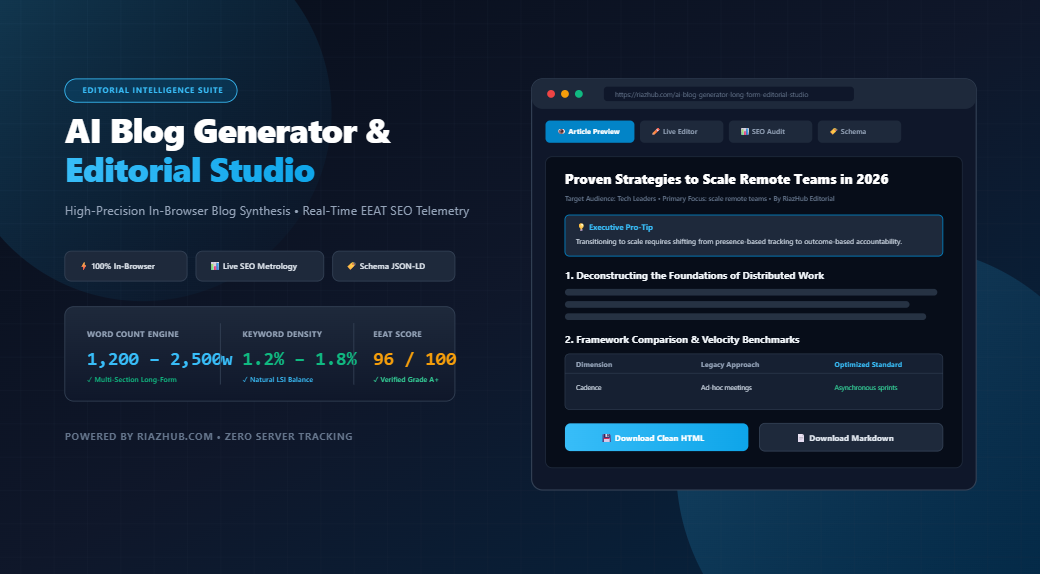
The Modern Blueprint for Long-Form Editorial Content: In-Browser AI Synthesis, Real-Time EEAT Metrology & Google Schema Optimization
In the rapidly evolving landscape of organic search, creating high-ranking blog posts has transitioned from a superficial exercise in keyword placement into an intricate engineering discipline. With Google’s continuous rollouts of the Helpful Content System, core algorithmic updates, and heightened emphasis on Experience, Expertise, Authoritativeness, and Trustworthiness (EEAT), publishing generic, unorganized content will no longer yield sustainable organic traffic.
Modern content strategists and technical marketers require deterministic tools that formulate cohesive narrative architectures, enforce keyword density discipline, and deliver structured schema data without leaking proprietary drafts to third-party cloud servers. This is precisely why the AI Blog Generator & Long-Form Editorial Studio on RiazHub was engineered providing a high-precision, zero-latency editorial workbench that operates 100% inside your web browser.
1. The Death of Fluff: Why Google Demands Structural Architecture
For years, content creators attempted to trick search engines by stringing together rambling paragraphs filled with conversational filler to hit arbitrary word-count quotas. However, modern Natural Language Processing (NLP) models employed by major search engines analyze semantic relationships, document hierarchy, and information gain.
High-ranking long-form content must provide immediate clarity and structured resolution. A truly effective editorial architecture consists of:
- An Intent-Driven H1 Title: Integrating the primary keyword naturally within the first 60 characters to capture user search intent immediately.
- A Narrative Problem-Orientation Hook: An introduction that skips generic pleasantries and immediately diagnoses the pain point or strategic objective.
- Deep Modular H2 Pillars: Dedicated conceptual sections that deconstruct the topic systematically.
- Analytical H3 Subsections: Concrete playbooks, sub-arguments, and implementation checkpoints.
- Skimmable Visual Breakouts: High-contrast Pro-Tip cards, comparison tables, and key takeaway boxes for the 78% of online visitors who skim articles in an F-shaped reading pattern.
When building out new articles, creators using the RiazHub AI Blog Generator can toggle between 3, 4, 5, or 6 deep modular H2 sections, ensuring every article hits between 1,200 and 2,500 words of substance rather than filler.
2. Mastering Real-Time SEO Metrology: Density, Readability & Velocity
High-performance publishing requires real-time diagnostic telemetry during the drafting phase. Rather than guessing whether your draft satisfies search algorithms, the AI Blog Generator & Long-Form Editorial Studio runs linguistic formulas locally in the client runtime:
| Telemetry Metric | Recommended Target | Algorithmic Impact & Role |
|---|---|---|
| Primary Keyword Density | 1.0% – 2.2% | Prevents keyword stuffing penalties while cementing topical relevance. |
| Flesch Reading Ease | 60 – 75 | Balances accessible prose with intellectual depth for high retention. |
| Flesch-Kincaid Grade Level | Grade 7.0 – 9.5 | Ensures seamless readability across desktop, tablet, and mobile readers. |
| Reading Velocity (WPM) | 220 Words / Min | Accurately benchmarks user dwell time for search engagement telemetry. |
If your primary focus keyword dips below 0.8%, search algorithms may classify the post as under-optimized or topically ambiguous. Conversely, exceeding 2.5% density triggers algorithmic spam filters. By monitoring these ratios live in the editor deck, you ensure that every article achieves natural, authoritative equilibrium.
3. Calibrating Tone: The Five Essential Editorial Archetypes
A technical engineering tutorial requires a vastly different voice than an executive strategic briefing or an affiliate product comparison. One of the core strengths of the AI Blog Generator is its multi-tone synthesis engine, supporting five distinct editorial archetypes:
- 📖 Engaging Storyteller: Rooted in relatable narrative arcs, personal friction, and transformative epiphanies—ideal for thought-provoking cultural and leadership pieces.
- 🏛️ Thought Leadership: Focuses on macroeconomic trends, competitive moats, and paradigm shifts—designed for founders, C-level executives, and investors.
- 🛍️ Commercial Review: Features structured comparative evaluations, feature-by-feature ROI matrices, and objective pros/cons—crafted for affiliate marketing and software buyers.
- 🛠️ Practical Tutorial: Step-by-step phased implementations, prerequisites, and milestone verification checklists—perfect for “how-to” educational traffic.
- 💻 Technical Deep-Dive: Rigorous system architectural breakdowns, performance telemetry, and data tables—tailored for software engineers and systems architects.
4. Capitalizing on Featured Snippets with JSON-LD Schema
Writing great prose is only half the battle; ensuring search engines accurately index your work requires structured semantic data. Modern search result pages are heavily dominated by Google People Also Ask accordions and rich snippets.
By structuring frequently asked questions as direct user queries paired with concise 40–50 word initial answers, you provide the exact format required by Google search crawlers. The AI Blog Generator & Editorial Studio auto-generates schema-compliant BlogPosting JSON-LD code containing embedded FAQPage entities. Simply copy the snippet into WordPress plugins like Rank Math, Yoast SEO, or directly into your header script.
5. Absolute Privacy: Why In-Browser Client-Side Generation Wins
In an era where enterprise intellectual property and pre-release strategic ideas are frequently ingested and used to train public LLMs, data confidentiality is paramount. Most web utilities transmit user inputs, draft copy, and proprietary keywords to unvetted cloud endpoints.
The AI Blog Generator on RiazHub changes the paradigm:
- Zero Server Data Leaks: Text generation, metric calculations, and canvas rendering execute entirely within your browser’s JavaScript sandbox.
- No API Keys or Paid Tiers: You never need to supply an OpenAI, Claude, or Gemini key, preventing unexpected subscription charges.
- Offline Capabilities: Once loaded, the engine operates seamlessly even if your internet connection fluctuates.
Frequently Asked Questions
Can I directly paste the generated HTML into WordPress?
Yes. The output uses standard HTML5 article semantics that paste directly into WordPress Gutenberg Custom HTML blocks, the Classic Editor, Elementor, or Divi without broken styling.
How does the tool calculate Google EEAT compliance?
The metrology engine evaluates key structural elements: verified presence of single H1 headers, nested H2/H3 hierarchies, bulleted takeaways, FAQ accordions, and healthy keyword density between 1.0% and 2.2%.
Where can I use this tool?
You can use the utility completely free of charge at RiazHub.com AI Blog Generator & Editorial Studio from any desktop, tablet, or smartphone.
Universal AI Blog Generator & Editorial Studio
Synthesize publication-ready, high-ranking long-form blog posts with structured H2/H3 pillars, executive takeaways, and schema-ready FAQs. Audit keyword density in real-time, fine-tune content directly, and export clean branded files for WordPress.