
Mastering Semantic Topical Authority: The Architectural Guide to AI Blog Post Outlining & Content Brief Systems
Why 80% of content marketing failures happen before writing begins and how hierarchical heading tree synthesis, mathematically balanced section word budgets, and search intent clustering create articles that dominate search engines.
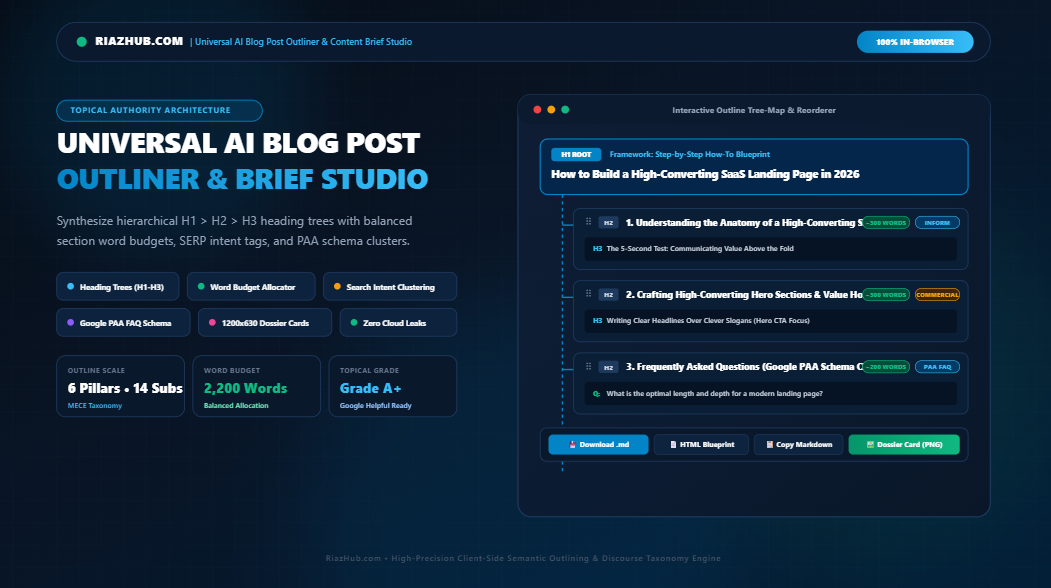
Architect production-ready blog outlines in seconds with client-side privacy, heading tree connectors, and word budgets using the
Universal AI Blog Post Outliner, Topical Authority Architecture & Content Brief Studio on RiazHub.
1. The Fatal Flaw in Modern Blog Creation: The Unstructured Draft
In modern digital publishing, the greatest bottleneck to consistent organic search growth is rarely writer creativity or vocabulary. Instead, it is structural chaos. When content creators, growth marketers, or agency copywriters sit down to write an article without a mathematically sound information architecture, drafts inevitably fall prey to three systemic failure modes:
- The Bloated Introduction: Authors spend 40% of their word count setting up background context, wandering through broad industry observations before reaching actionable solutions.
- Intent Misalignment: Articles jump indiscriminately between informational definitions, commercial software comparisons, and tactical implementation guides, confusing search engine crawlers and frustrating readers.
- Topical Incompleteness (Information Debt): Overlooking critical secondary entities and Google “People Also Ask” questions leaves gaping holes that competitors readily exploit.
Solving these issues requires shifting the paradigm from writing prose directly to architecting discourse taxonomies. By designing a rigid semantic scaffold upfront, content teams eliminate writer’s block, establish topical completeness, and satisfy Google’s Helpful Content System.
2. Deconstructing the Hierarchical Heading Tree (H1 > H2 > H3)
Search engine ranking algorithms do not read articles linearly like human readers do; they parse Document Object Model (DOM) heading trees to generate semantic knowledge graphs. Utilizing the
AI Blog Post Outliner Studio ensures that heading levels adhere to strict ontological logic:
- The H1 Root Node: Encapsulates the primary premise, target audience, and primary focus keyword. Exactly one H1 tag should exist per page.
- Modular H2 Conceptual Pillars (4 to 8 Pillars): Divide the overarching subject into mutually exclusive, collectively exhaustive (MECE) phases, categories, or principles.
- Contextual H3 Sub-Arguments: Nest directly beneath their parent H2 to unpack tactical steps, feature breakdowns, and counter-intuitive nuances.
A key rule enforced by our diagnostic telemetry HUD is the Heading Ratio Balance: maintaining an ideal ratio of 1.5 to 2.5 H3 sub-arguments per H2 pillar. This prevents single-sentence headings while avoiding overwhelming micro-segmentation.
3. The Five Core Editorial Frameworks for Search Dominance
Every user query carries a distinct psychological search intent. A single generic outline formula cannot serve every article type. Our studio synthesizes five distinct discourse taxonomies:
| Framework | Primary Search Intent | Ideal Structural Cadence |
|---|---|---|
| 📚 Ultimate Pillar Guide | Informational (Comprehensive) | Foundations → Prerequisites → Phased Execution → Optimization → Governance → Toolkits |
| 🛠️ Step-by-Step How-To | Informational → Transactional | Anatomy → Step 1 Setup → Step 2 Trust → Step 3 Execution → Step 4 Optimization |
| 🛍️ Commercial Round-Up | Commercial Investigation | Ranking Criteria → Leader Deep-Dive → Scale Contender → Budget Pick → Decision Matrix |
| 💡 Thought Leadership | Informational (Contrarian) | Conventional Dogma Flaw → First-Principles Paradigm → Cost of Inaction → Leadership Blueprint |
| 📊 Technical Case Study | Commercial / Proof | Baseline Crisis Metrics → Custom Architecture → Deployment Friction → Quantitative ROI |
4. The Mathematical Science of Section Word Budget Allocation
One of the core innovations inside the
Universal AI Blog Post Outliner is deterministic word budget modeling. Rather than leaving section lengths to subjective whim, our algorithm allocates targets dynamically based on your total planned word count:
For instance, in a 2,000-word blueprint across 5 core H2 pillars, each section receives a precise allocation of approximately 300 words. This ensures writers deliver depth without exhausting their budget before reaching the decisive conclusion and call to action.
When outsourcing articles to freelance writers or AI drafting pipelines, provide the exported Markdown brief directly from the
RiazHub Content Brief Studio. Having pre-calculated word targets per section eliminates 90% of editorial revisions.
5. Capturing Zero-Click SERP Real Estate with Google ‘People Also Ask’ (PAA) Clusters
Search Engine Results Pages (SERPs) are increasingly dominated by interactive features: Featured Snippets, Knowledge Panels, and “People Also Ask” dropdown accordions.
To capture these positions, every outline synthesized in our studio includes a dedicated Google PAA Schema FAQ block. Each FAQ node features:
- Explicit Natural-Language Heading: Phrased exactly as searchers type queries (e.g., “What is the optimal length for a SaaS landing page?”).
- Concise Direct Answer Brief (45–60 words): Formatted to deliver immediate, fluff-free value within the snippet extraction limit.
- Follow-up Expansion Pointers: Guiding the reader toward the next logical step in the topical journey.
6. Interactive Staging: Drag-and-Drop Reordering & Custom Section Nodes
Editorial strategies evolve as you explore a topic. The studio features a dynamic, tactile tree-map staging deck:
- TACTILE DRAG HTML5 Drag & Drop: Grab any H2 card by its grip handle (⠿) and drag it up or down to re-sequence narrative flow.
- TOUCH FRIENDLY Mobile Up/Down Controls: One-tap ▲ and ▼ buttons ensure fluid reorganization on smartphones and tablets.
- IN-PLACE EDITING ContentEditable Nodes: Click directly into any H1, H2, or H3 title to customize language; changes instantly synchronize across the Markdown and HTML exporters.
- DYNAMIC NODES Custom Add & Delete: Inject specialized H2 pillars or granular H3 sub-arguments with single-click confirmation dialogs.
7. 100% Client-Side Privacy: Why In-Browser Computing Protects Your Strategy
Content roadmaps, upcoming product announcements, and proprietary keyword research represent confidential intellectual property. Cloud-based generative outliners often transmit your topics and draft premises to remote third-party AI endpoints or log them in central databases.
The
Universal AI Blog Post Outliner at RiazHub.com operates on a 100% client-side privacy architecture:
- Zero Remote API Calls: Semantic decomposition, budget equations, and tree construction occur entirely within your browser’s JavaScript engine.
- Zero Cloud Databases: Your outlines are never stored on external servers or used to train third-party machine learning models.
- Local Storage Persistence: Topic parameters and section customizations persist safely within your device’s native browser cache.
8. Multi-Format Branded Exporting & The 1200×630 Dossier Card Studio
Once your outline reaches architectural maturity, the studio provides instant, branded multi-format export capabilities:
- Markdown Outline (.md): Formatted with clean H1–H3 syntax, bullet directives, and metadata ready for Obsidian, Notion, or GitHub. Saved as
riazhub-outline-[slug].md. - Clean HTML Blueprint (.html): Standalone semantic document for web editors and CMS staging. Saved as
riazhub-outline-[slug].html. - Content Brief JSON (.json): Structured machine-readable data for headless workflows and automated drafting pipelines.
- High-DPI 1200×630 Dossier Card (PNG): High-resolution specification certificate rendered dynamically via Canvas in Cyber Azure, Editorial Emerald, Deep Obsidian, or Publishing Amber palettes.
Universal AI Blog Post Outliner, Topical Authority & Content Brief Studio
Architect high-ranking blog post outlines with structured H2/H3 heading trees, search intent clustering, allocated section word budgets, and generate branded editorial briefs with 100% in-browser privacy.
| Outline Structural Block | Allocation Formula | Target Word Budget | Search Intent Alignment |
|---|
A structured outline prevents content drift, ensures every paragraph directly satisfies user search intent, and enables writers or AI assistants to draft high-density prose without repetitive fluff.
Google search crawlers utilize HTML heading levels as an ontological map. Always nest H3 nodes strictly under their logical parent H2. Never jump heading levels or use bold text in place of true semantic headers.
Capturing featured snippets and zero-click answers requires explicit question headers answered succinctly in 45-60 words immediately following the heading.
All outline calculations, budget equations, and dossier renders occur purely client-side on your device. Zero proprietary content roadmaps or intellectual property are ever sent to external cloud servers.