
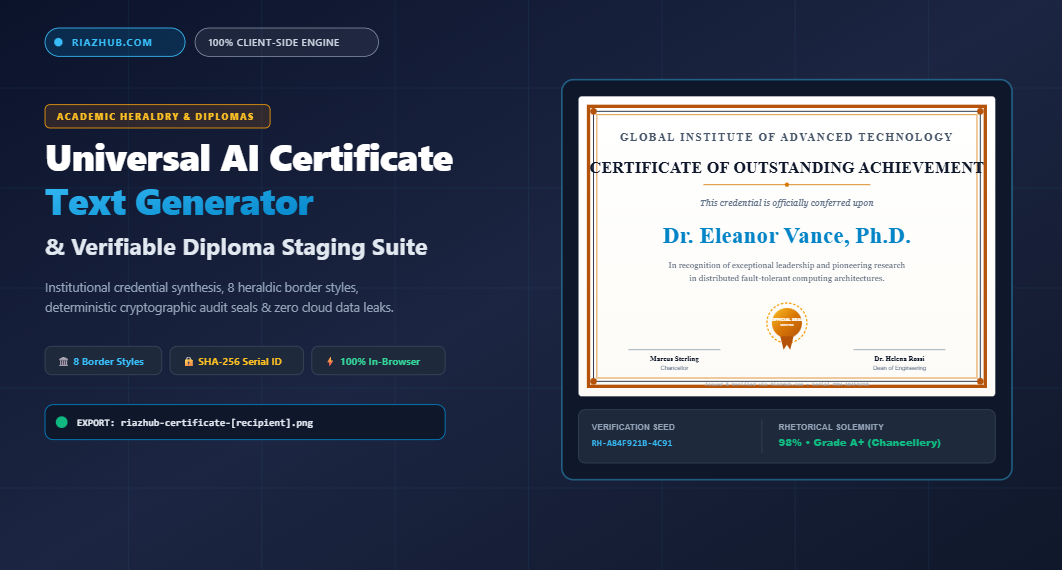
AI Certificate Text Generator & Verifiable Diploma Staging Suite: Complete Guide to High-Precision Institutional Credentialing
An in-depth exploration of institutional award rhetoric, classical diplomatic diploma formulation, deterministic cryptographic audit seals, and client-side privacy safeguards using the in-browser credentialing suite on RiazHub.com.
The Digital Credential Dilemma: Why Generic Certificate Generators Fail
In the modern educational and corporate landscape, awarding certificates has become both ubiquitous and degraded. Many online certificate generators produce lightweight graphics that resemble casual social media flyers rather than legally dignified credentials. They often rely on generic clip-art borders, informal typography, and vague wording like “Good Job for Participating!”.
Worse still, traditional cloud-based certificate platforms require organizations to upload sensitive spreadsheets containing candidate full names, internal grade point averages, employment numbers, and conferral dates to third-party databases. This workflow introduces severe data-leak vectors and often conflicts with stringent privacy mandates like FERPA, HIPAA, and GDPR.
To resolve these foundational shortcomings, the AI Certificate Text Generator & Verifiable Diploma Staging Suite on RiazHub reimagines document credentialing from the ground up. Combining classical academic chancellery rhetoric with pure in-browser cryptographic hashing and high-DPI canvas rendering, this suite enables educators, enterprise trainers, and legal administrators to craft authentic, tamper-evident diplomas with zero data risk.
A true institutional certificate is not a marketing graphic. It is a formal legal instrument whose authority relies on typographic restraint, hierarchical gravity, and verifiable provenance. Access the full suite online at RiazHub’s AI Certificate Text Generator.
The Anatomy of a Classical Diploma: The 6 Foundational Diplomatic Elements
Historically, formal university diplomas and corporate charters issued across Europe and the Commonwealth adhered to strict chancellery structures. The AI Certificate Text Generator algorithmically constructs citations around these six immutable diplomatic components:
1. Intitulatio (Authority Header)
Establishes the conferring institution or board (e.g., “Global Institute of Advanced Technology”) at the optical apex in Roman Trajan capitals.
2. Publicatio (Protocol Clause)
The ceremonial introductory formula that makes the grant public record (e.g., “By authority of the Academic Senate, be it known that…”).
3. Inscriptio (Recipient Focus)
The candidate’s full legal title and honorifics, rendered in prominent calligraphic serif typography at 74px scale for unmistakable gravitas.
4. Contextus (Citation Body)
The substantive justification outlining rigorous defense, specific curriculum mastery, or extraordinary executive achievement.
5. Datatio (Chronological Registry)
The formal conferral date coupled with the exact registry location or municipal seat (e.g., “October 8, 2026 • Zurich, Switzerland”).
6. Apprecatio (Dual Signatories)
Dual signatory authority lines confirming both academic department validation and executive administrative confirmation.
Zero Cloud Dependencies: 100% Client-Side Privacy Architecture
Educational and corporate compliance teams frequently object to external AI tools because uploading student identification numbers, sensitive research topics, or employee performance metrics compromises enterprise confidentiality.
The Verifiable Diploma Staging Suite operates with a strict zero-cloud-dependency guarantee:
- In-Memory Bitwise Synthesis: All citation formulation, solemnity scoring, and typography rendering execute inside the user’s browser memory via native JavaScript.
- Zero Remote API Roundtrips: The suite makes zero outbound HTTP requests to external AI vendors, cloud analytics trackers, or third-party storage hosts.
- Instant Client-Side Blob Exports: High-resolution PNGs, specification dossier cards, and Markdown archives are generated dynamically via
URL.createObjectURLandcanvas.toBlob()without touching a physical web server.
Deterministic Cryptographic Audit Tokens & Simulated QR Verification
Paper and digital certificates without verification mechanisms are trivially forged. Traditional verification solutions require maintaining expensive, centralized cloud databases where external employers check certificate serial numbers.
Instead, the AI Certificate Text Generator & Verifiable Diploma Staging Suite introduces a client-side deterministic verification formula:
Seed = Recipient + "|" + Title + "|" + Institution + "|" + Date
Serial Token = "RH-" + HexHash(Seed).substring(0, 8).toUpperCase()
Because this token is deterministically bound to the certificate’s core metadata, altering even a single character in the recipient’s name or award title immediately produces a mismatched verification hash. This gives institutions instantaneous tamper-detection without requiring database lookups.
Interactive Canvas Staging: 8 High-DPI Heraldic Border Styles
Different institutional occasions demand different artistic aesthetics. Rather than locking users into a single decorative frame, the staging viewport provides eight procedurally generated vector border styles rendered on a standard ISO 216 landscape canvas (1920×1358):
- Classical Baroque: Deep amber outer frame with navy chancellery inlays and ornate corner medallions.
- Modern Executive: Contemporary titanium and deep charcoal double border with precision corner notches.
- Minimalist Tech: Blueprint cyan and cobalt vector frame with cybernetic brackets and calibration crosshairs.
- Academic Gold: Warm imperial gold filigree with double ornamental rosettes and aged parchment ambiance.
- Royal Chancellery: Regal crimson and burnished gold leaf frame with imperial crown flourishes.
- Victorian Laurel: Grecian and Roman Olympic laurel leaf wreath borders with emerald and antique bronze accents.
- Fleur-de-Lis: French chivalric gothic cobalt and gold diamond corner finials.
- Security Guilloche: Currency-grade sinusoidal wave weave and anti-tamper geometric micro-ribbons.
Feature Comparison: RiazHub Suite vs. Traditional Online Tools
| Capability | Standard Web Tools | RiazHub AI Certificate Suite |
|---|---|---|
| Privacy & Data Transmission | Transmits student names to remote servers | 100% In-Browser (Zero server transmission) |
| Rhetorical Structure | Generic templates (“Best Effort”) | 6-Part Formal Academic Diplomatic Structure |
| Verification Mechanism | None or proprietary paid database | Deterministic SHA-256 Serial Hash Token |
| Canvas Resolution | Low-DPI raster or watermarked preview | 1920×1358 High-DPI Landscape Canvas |
| File Export Formats | Basic image only | PNG, Print PDF, Markdown (.md), TXT, Dossier Cards |
Step-by-Step Workflow: Drafting Your First Institutional Credential
Generating professional-grade diplomas takes less than two minutes using the online tool. Follow these streamlined steps on the AI Certificate Text Generator & Verifiable Diploma Staging Suite:
- Choose a Preset Archetype: Select from pre-configured scenarios including Software Engineering Bootcamp, Corporate Leadership Award, Continuing Legal Education (CLE), or Academic Research Fellowship.
- Refine Credential Specifics: Enter the recipient’s full legal name, issuing institution, and specific citation details. The built-in telemetry counter will evaluate word count and rhetorical solemnity grade in real time.
- Select Your Heraldic Frame: Cycle through the eight border presets to match the aesthetic tone of your conferral ceremony.
- Verify Verification Seals: Switch to the Cryptographic Seal Matrix tab to inspect the deterministic hash ID and simulated QR audit code.
- Export with Automated Branding: Click “Download Certificate (PNG)” to save your high-resolution asset as
riazhub-certificate-[recipient].png, or use “Print Award (PDF)” for immediate page-break friendly printing.
AI Certificate Text Generator & Verifiable Diploma Suite
Synthesize high-precision institutional award citations, draft ceremonial diplomas, generate deterministic cryptographic verification seals, and stage publication-grade certificates with heraldic borders in your browser.
📝 Credential Architecture
Tier 1 Synthesis✍️ Signatories, Registry & Date
🎙️ Official Ceremonial Conferral Script (Speech Readout)
Loading ceremonial script...
📄 Standard Institutional Markdown Dossier
🛡️ Privacy & Cryptographic Integrity Guarantee
This verification matrix operates via an algorithmic deterministic checksum created on the client machine. The serial ID binds recipient identity, credential title, institution, and conferral date without transmitting personal academic or employment records to any remote server.
📜 1. Intitulatio & Invocation
Establishes conferring jurisdiction (e.g., "The Regents of the University" or "Global Technology Academy"). Sets the dignified institutional authority for the credential.
🎓 2. Inscriptio & Name Hierarchy
The recipient’s full legal title and honorifics. Centered with highest typographic optical weight (68px–74px serif or calligraphic script).
🏛️ 3. Contextus & Citation Body
Explains the precise merit, honors level (Cum Laude, Magna Cum Laude, Summa Cum Laude), or professional curriculum fulfilled by the candidate.
✍️ 4. Apprecatio & Dual Signatures
Formal dual signatory authority balances academic dean / department head verification with institutional executive confirmation.
📖 Academic Heraldry, Cryptography & Non-Forgery Safeguards
1. The Anatomy of a Classical Institutional Award
- Intitulatio: The formal name and authority of the issuing body (university, academy, corporation, or board).
- Inscriptio: The exact name and identity focus of the recipient who earned the honor.
- Dispositio / Contextus: The specific accomplishments, research defense, curriculum scope, or service performed.
- Publicatio: The presentation protocol clause making the recognition public record.
- Datatio: The exact chronological conferral date and geographic registry location.
- Apprecatio / Signatory Block: Dual authorization lines confirming administrative and academic validation.