
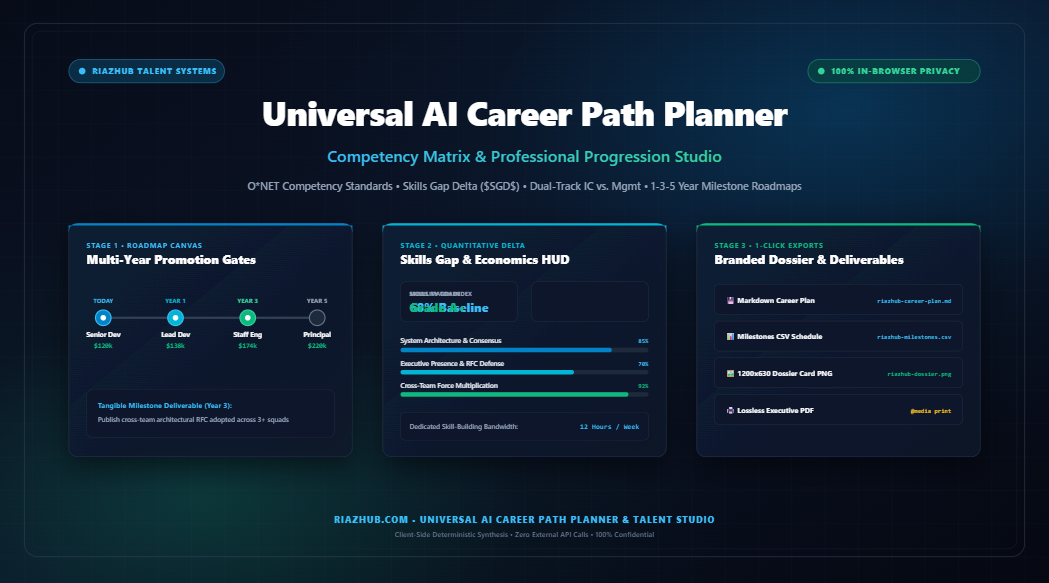
Engineering High-Velocity Career Trajectories: The O*NET Competency Framework, Skills Gap Delta Analysis, and the Dual-Track IC vs. Management Ladder
In modern high-concurrency industries ranging from distributed cloud systems and AI orchestration to quantitative product strategy career progression is frequently misconstrued as an organic consequence of chronological tenure. Professionals often assume that accumulating annual hours inside an organization will naturally yield promotion to Staff Engineer, Principal Architect, or Director of Engineering. Empirical compensation data and promotion committee deliberations demonstrate the opposite: career progression is a deterministic, quantitative engineering system governed by competency deltas, organizational leverage, and asymmetric proof artifacts.
When high-performing contributors stall in their progression, the root cause is rarely technical incompetence. Rather, it is the inability to formulate a rigorous multi-year roadmap that maps current baseline competencies against target domain standards. To bridge this critical execution divide, you can immediately model your 5-year progression curve, calculate your skills deficit, and generate executive dossiers with the interactive Universal AI Career Path Planner, Competency Matrix & Professional Progression Studio on RiazHub.
⚡ Map Your 5-Year Career Trajectory in 60 Seconds
Calculate your Skills Gap Delta Index ($SGD$), model compounding compensation targets ($C_t$), and export a publication-ready Markdown or CSV career roadmap 100% in-browser with zero resume uploads or privacy leaks.
1. The Mathematics of Career Mobility: The Skills Gap Delta ($SGD$) Index
At the core of systematic career planning lies the difference between where your capabilities stand today ($C_{\text{current}}$) and the empirical benchmark mandated by enterprise hiring bars and promotion committees for your target aspiration ($C_{\text{target}}$).
The Occupational Information Network (O*NET) framework, established by the U.S. Department of Labor, codifies professional roles into discrete capability vectors spanning technical depth, architectural synthesis, resource coordination, and cognitive problem complexity. Mathematically, your capability deficit can be quantified using the Skills Gap Delta ($SGD$) Index:
Where |C_target ∩ C_current| represents the mutual intersection of verified competencies, and |C_target| represents the total baseline requirements for the desired target role.
A contributor possessing an $SGD$ score above 50% faces a prolonged transition horizon (typically 24 to 36 months). Conversely, by executing focused deliberate practice within an allocated weekly bandwidth (e.g., 10 to 15 hours per week), you systematically collapse the delta into the sub-20% tier the statistical threshold where promotion committees acknowledge undeniable role readiness.
2. Dual-Track Evolution: Staff-Plus Individual Contributor (IC) vs. Engineering Management
One of the most consequential strategic decisions in an engineer or product practitioner’s career occurs at the Senior crossroads (typically L5 in Big Tech terminology). Historically, the only mechanism for upward compensation and organizational authority was transitioning into people management.
Modern tech enterprises maintain parallel compensation bands and organizational parity. A Principal Architect or Staff Engineer commands identical compensation, prestige, and influence to a Director or Senior Director, without managing direct reports, approving vacation schedules, or conducting quarterly performance improvement plans.
| Progression Dimension | Staff / Principal IC Track | Engineering Management Track |
|---|---|---|
| Primary Currency | Technical leverage, system reliability & architectural vision | Talent density, team velocity & cross-functional execution |
| Scope of Accountability | Cross-pod architectural consensus & technical debt triage | Squad throughput, headcount budgeting & organizational design |
| Key Artifact | Technical RFCs, reference architectures, fault postmortems | Engineering operating system, quarterly OKR plans, career ladders |
| Failure Mode | Ivory tower architecture divorced from production realities | Micromanagement and failure to hire stronger talent than oneself |
Selecting the wrong track results in rapid burnout and professional friction. You can model both tracks interactively inside the RiazHub AI Career Path Planner to observe how deliverables, compensation bands, and milestones diverge between individual technical leadership and managerial governance.
3. Bridging the “Staff Engineer Chasm”: The Non-Linear Pivot
The transition from Junior to Mid-Level, and from Mid-Level to Senior, is predominantly linear: you are assigned well-scoped engineering tickets or feature sprints, and your success is benchmarked by delivery speed, code hygiene, and test coverage.
However, the leap to Staff and Principal represents a discontinuous phase change often termed the Staff Engineer Chasm:
- Autonomous Problem Identification: Senior engineers solve problems presented to them. Staff engineers independently identify systemic organizational bottlenecks, latent architectural risks, or cross-service technical debt that nobody else noticed.
- Authoring High-Stakes Technical RFCs: High-velocity ICs do not write 10x more code; they multiply the output of 30 other engineers by establishing definitive Request for Comments (RFC) standards that streamline distributed consensus, data consistency, and observability.
- Force Multiplication: If your presence merely increments individual team output by 1, you remain a Senior engineer. When your architectural decisions, code reviews, and mentorship lift entire squads by 25%, you operate at Principal scope.
🎯 Discover Your Primary Competency Gaps
Whether targeting Distributed Systems Architecture, AI/ML Engineering, Product Strategy, or DevSecOps, input your existing tech stack into RiazHub’s studio to immediately visualize your 5-axis Radar Competency chart.
4. Compounding Career Economics: Modeling the $C_t$ Trajectory
Compensation does not increment arithmetically it compounds based on market demand premiums and strategic scarcity. When an engineer shifts from generic full-stack implementation to high-concurrency distributed systems, vector database orchestration, or cloud governance, their market leverage expands exponentially.
The quantitative trajectory of annual compensation ($C_t$) across milestone horizons ($t$) can be approximated by:
Where C_0 is current annual baseline compensation, r is the annualized skill/promotion premium (typically 12% to 18% in high-leverage transitions), and t is elapsed milestone duration in years.
By planning across sequential 1-Year (Immediate Scope Expansion), 3-Year (Strategic Multi-Team Influence), and 5-Year (Industry Vanguard Leadership) checkpoints, professionals turn vague salary hopes into predictable financial milestones.
5. The Power of Asymmetric Proof Artifacts
Resumes are notoriously low-signal instruments. Anyone can claim experience with Kubernetes, PyTorch, or microservices architecture. Enterprise leaders and compensation review boards require asymmetric proof artifacts deliverables whose very existence demonstrates undeniable competence:
- Open-Source Reference Implementations: A GitHub repository demonstrating a production-grade distributed consensus saga orchestrator or an end-to-end LLM evaluation harness with automated test suites provides irrevocable evidence of mastery.
- Authoritative Technical Whitepapers & Teardowns: Publishing in-depth analyses of real-world production outages, architectural tradeoffs, or database indexing strategies builds external authority that insulates your career against company-specific layoffs.
- Comprehensive Internal RFCs & Operating Systems: If you pursue the management ladder, authoring a company-wide engineering handbook that reduces onboarding cycle time by 40% acts as a permanent promotion portfolio asset.
“Your career equity is not defined by the company you work for today. It is defined by the compounding portfolio of durable technical and strategic artifacts you own forever.”
6. 100% In-Browser Privacy: Why Client-Side Synthesis Matters
Career planning involves highly sensitive personal data: unannounced target titles, proprietary current tech stacks, internal compensation metrics, and deliberate pivot timelines. Storing this information on third-party cloud servers or uploading proprietary resumes into cloud-hosted AI APIs introduces unacceptable privacy and non-disclosure agreement (NDA) risks.
The Universal AI Career Path Planner on RiazHub executes entirely within your browser’s local JavaScript runtime. All calculations, radar chart rendering, markdown compilation, CSV parsing, and 1200×630 dossier canvas cards are generated client-side with zero external API calls or server transmission.
📋 Download Your Branded 5-Year Career Plan Today
Ready to take control of your professional progression? Generate your customized roadmap, download a branded Markdown dossier (riazhub-career-plan-[role].md), milestone CSV schedule, or print a clean executive PDF directly from your browser.
Conclusion: Taking Command of Your Progression Vector
Top-tier career velocity is never an accident of luck. It is the result of continuous diagnostic auditing, precise skills delta elimination, deliberate track selection, and the compounding accumulation of high-leverage deliverables.
Whether you are an aspiring Staff Engineer planning your first organization-wide RFC, an experienced Tech Lead transitioning into Engineering Management, or an analyst pivoting to Senior AI Systems, utilize the Universal AI Career Path Planner & Competency Matrix Studio on RiazHub to transform abstract career aspirations into a structured, executable roadmap.
Universal AI Career Path Planner & Progression Studio
Synthesize 5-year career progression roadmaps, bridge technical and executive skill gaps, project compounding compensation curves, and export branded career development plans. Operating 100% in-browser with zero server transmission.
🧭 Professional Background & Aspirations
High-DPI multi-year career trajectory canvas rendering immediate gates (0–12m), strategic expansion (1–3y), and vanguard target leadership (3–5y).
| Capability Domain | Specific Competency Gap | Priority | Time to Acquire | High-Impact Artifact |
|---|