
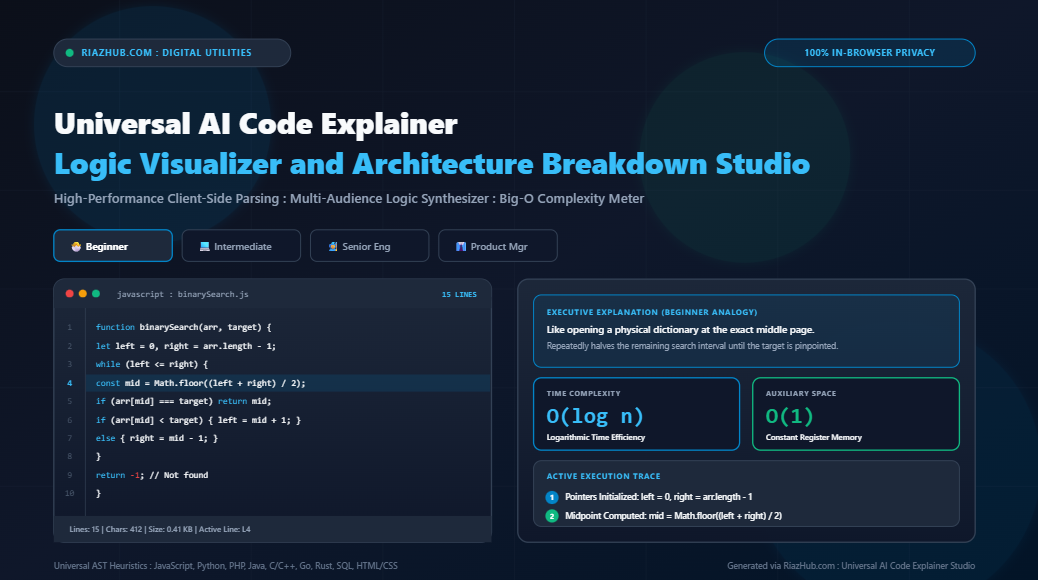
Demystifying Complex Algorithms: Inside the Universal AI Code Explainer and Architecture Breakdown Studio
Reading other people’s source code is widely acknowledged as one of the hardest cognitive challenges in computer programming. Whether you are ramping up on a massive legacy codebase, preparing for high-stakes technical coding interviews, or reviewing pull requests under tight deadlines, deciphering intricate algorithmic logic line by line drains immense focus.
To solve this ubiquitous engineering friction point, RiazHub has deployed a high-speed, privacy-first diagnostic solution: the Universal AI Code Explainer, Logic Visualizer and Architecture Breakdown Studio. Built to run deterministically and entirely within modern web browsers, this platform transforms dense, opaque algorithms into plain, lucid explanations customized for your exact technical perspective.
The Fundamental Problem with Reading Unfamiliar Code
Software engineers spend significantly more time reading, tracing, and refactoring existing code than writing brand-new instructions from scratch. When parsing an unfamiliar implementation, several hurdles compound the difficulty:
- Cryptic Variable Naming and Pointers: Identifiers like
i,j,mid,curr, andptrobscure what real-world entity or boundary condition is being tracked. - Implicit Algorithmic State: Loops that mutate indices, recurse down call stacks, or modify memory buffers in-place require developers to maintain an exhausting mental simulation of the computer memory.
- Unknown Time and Space Complexities: Determining whether a nested loop executes in O(n log n), quadratic O(n^2), or exponential O(2^n) time requires manual mathematical proof.
- Privacy Concerns with Cloud Tools: Standard AI services transmit company code, proprietary algorithms, and sensitive database queries to external cloud servers, violating corporate data security agreements.
Core Privacy Guarantee: The Universal AI Code Explainer Studio executes 100% in-browser using pure client-side JavaScript. Zero lines of source code, zero database schemas, and zero algorithm tokens are ever uploaded to cloud endpoints or third-party servers.
A Multi-Audience Lens: Four Pedagogical Perspectives
One size never fits all in software education. A junior apprentice needs intuitive physical metaphors to grasp why an algorithm works, whereas a principal systems architect seeks memory cache implications and asymptotic bounds.
The AI Code Explainer Studio on RiazHub introduces an instant Multi-Audience Persona Switcher that reconstructs code explanations across four distinct professional roles:
🐣 Beginner Perspective
Eliminates intimidating jargon. Uses intuitive real-world metaphors (such as opening a dictionary at the exact middle page for binary search, or sticky notes on a desk for memoization caches).
💻 Intermediate Developer
Deconstructs algorithmic design patterns (Two-Pointer, Divide and Conquer, Dynamic Programming, Guard Clauses) and explains idiomatic language patterns.
🧙 Senior Architect
Delves into asymptotic runtime bounds, stack frame allocation, cache locality, pointer traversal mechanics, defensive edge-case traps, and concurrency safety.
👔 Non-Technical PM
Translates abstract programming instructions into business value, customer latency impact, system throughput, and input-output transformation contracts.
Deep Algorithmic Telemetry: Beyond Basic Highlighting
Most online code editors simply colorize tokens. The Universal AI Code Explainer and Logic Visualizer performs structured heuristic AST inspection to generate a complete diagnostic profile:
1. Chronological Execution Sequence
Code rarely executes linearly from top to bottom. Function definitions hoist, loops circle back conditionally, and guard clauses terminate routines early. The studio builds a numbered step-by-step runtime timeline tracking variable setup, iterative condition checks, branch mutations, and final return values.
2. Big-O Complexity Telemetry Deck
The platform features an Asymptotic Complexity HUD that immediately computes:
- Big-O Time Complexity: Automatically identifies whether your code scales in constant O(1), logarithmic O(log n), linear O(n), linearithmic O(n log n), quadratic O(n^2), or exponential O(2^n) time.
- Auxiliary Space Complexity: Determines whether the implementation operates in-place with O(1) registers or allocates auxiliary buffer memory scaling linearly with input size.
- Asymptotic Growth Spectrum: Places your algorithm on an interactive computer science efficiency ranking bar so you immediately see where optimization is needed.
3. Interactive Line-by-Line Annotations
Every active statement in your code is parsed and paired with its precise operational purpose. Clicking or hovering over any line in the editor instantly highlights the corresponding card in the annotation deck, explaining variable mutations, pointer shifts, or return conditions.
4. Interactive Algorithmic Flow Visualizer
Visual thinkers benefit immensely from flowcharts. The studio dynamically maps your code logic into connected visual nodes (Entry Point > Initial Setup > Loop Condition > Processing > Return Sentinel), allowing you to trace execution paths without confusion.
5. Defensive Edge-Case and Vulnerability Audit
The built-in audit engine highlights subtle production traps:
- Unchecked index lookups risking array out-of-bounds exceptions.
- Missing null checks or absent optional chaining on nested properties.
- Dynamic division operations lacking zero-denominator guards.
- While loops that fail to advance pointers monotonically, risking infinite loops.
- Empty collection inputs that cause unexpected runtime crashes.
1-Click Multi-Format Exporting for Teams and Students
Knowledge is most valuable when it can be shared and archived. The studio includes an automated exporter suite equipped with official RiazHub site branding in every document header:
- Markdown Dossier (.md): Downloads a publication-ready study sheet titled
riazhub-code-explanation-[lang]-[slug].mdcomplete with executive summary, complexity metrics, execution steps, and source code. - Annotated Source Code (.txt): Exports a clean reference text file pairing every line of source code with developer commentary.
- Line-by-Line Reference Sheet (.csv): Creates a structured spreadsheet of operations, lines, and explanations for classroom instruction or code review checkoffs.
- Knowledge Graph (.json): Provides the complete structured telemetry data object for programmatic pipelines.
- Print / PDF Study Guide: Launches a specialized, print-optimized document view with clear page-break handling.
Supported Programming Languages
Whether you build modern web interfaces, systems software, enterprise backend services, or complex relational databases, the Universal AI Code Explainer Studio provides syntax support for:
- JavaScript and TypeScript (ES6+, Async/Await, Closures, DOM APIs)
- Python 3 (List Comprehensions, Decorators, Typing, Dict Caches)
- PHP 8.x (Typed Classes, PDO Queries, Attributes, Array Pipelines)
- Java (Object-Oriented Architecture, Streams, Generics)
- C and C++ (Pointers, References, Memory Allocation, Vectors)
- Go (Goroutines, Channels, Structs, Defer Statements)
- Rust (Ownership, Borrowing, Pattern Matching, Enums)
- SQL (Relational Joins, Aggregations, GROUP BY, Window Functions)
- HTML5 and CSS3 (Semantic Layouts, Flexbox, Grid)
Universal AI Code Explainer, Logic Visualizer and Architecture Breakdown Studio
Understand any code snippet in seconds. Convert complex algorithms into simple Plain English, inspect line-by-line annotations, evaluate Big-O time and space complexity, and export comprehensive study dossiers.
High-Speed Binary Lookup in Pre-Sorted List
Chronological Execution Sequence
How the program executes from initial invocation to final return value:
Interactive Line-by-Line Annotator
Click or hover any row to inspect syntax nuances, variables transformed, and execution purpose:
The algorithm halves the problem search space in each iteration, scaling exceptionally well on millions of entries.
Only stores fixed index pointer variables (left, right, mid). No additional buffer structures or stack frames allocated.
Asymptotic Growth Hierarchy
Where this algorithm ranks on the computer science efficiency spectrum:
Architectural Complexity Breakdown
Robustness, Pitfalls, and Edge Case Audit
Heuristic analysis of defensive boundary conditions and unexpected input vulnerabilities:
Interactive Algorithmic Flow Visualizer
Visual architecture sequence illustrating the chronological control flow and decision branches:
Educational Principles and Code Deconstruction Guides
When encountering a completely unfamiliar codebase, script, or algorithm, avoid reading it top-to-bottom like prose. Instead, follow this four-phase mental model:
- Identify Inputs and Outputs First: Examine function arguments and the return statement. Knowing what enters and what exits constrains the problem space immediately.
- Map State Variables: Locate variables declared before loops. What data do they hold, and how are their values mutated as execution progresses?
- Trace Control Flow Branches: Identify the termination or loop conditions (e.g.,
while (left <= right)or recursion base cases). When does the function exit early? - Test Boundaries: Mentally walk through empty arrays, single-item collections, negative numbers, or null values to identify edge cases and defensive guards.
Big-O notation describes the limiting behavior of a function when the argument tends towards a particular value or infinity. It measures how execution time or memory footprint scales relative to input size n:
- O(1) Constant: Instant lookup (e.g., Hash map key access or array index retrieval). Execution time is identical whether you have 10 elements or 100 million elements.
- O(log n) Logarithmic: Divide-and-conquer strategy (e.g., Binary Search or Balanced Binary Search Trees). Each step cuts the search space in half. 1,000,000 elements take roughly 20 comparisons.
- O(n) Linear: Single loop over elements (e.g., finding the maximum value in an unsorted list). Runtimes double as dataset size doubles.
- O(n log n) Linearithmic: Optimal comparison sorting algorithms (e.g., Merge Sort, Quicksort, Timsort). The industry benchmark for fast collection sorting.
- O(n^2) Quadratic: Nested loops comparing elements against each other (e.g., Bubble Sort or naive duplicates detection). Catastrophic slowdown on production datasets.
Traditional AI tools send your raw source code, proprietary algorithms, database schemas, and intellectual property over the internet to third-party model APIs. This studio operates with a fundamentally different security guarantee:
- Local In-Browser Processing: All syntax interpretation, heuristic parsing, Big-O estimations, line annotations, and markdown compilation execute 100% locally on your machine using native JavaScript.
- Zero Cloud Transmission: No backend API calls, no analytics trackers, no third-party CDNs, and zero code caching on remote servers.
- Enterprise and Student Safe: Safe for proprietary company repositories, university homework assignments, confidential financial models, and sensitive database queries.