
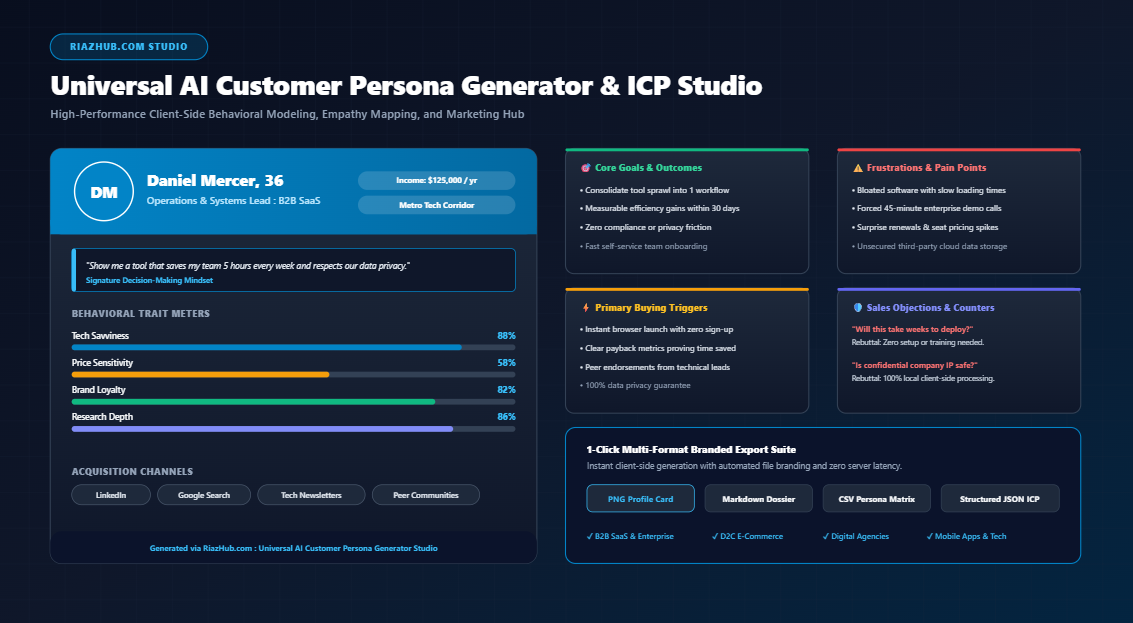
How to Build High-Converting Customer Personas with AI: The Complete Guide to ICP Modeling, Empathy Mapping, and Behavioral Segmentation
Synthesize Your Ideal Customer Profile in Seconds
Generate visual executive persona cards, empathy maps, and objection battlecards with zero cloud storage and zero sign-up requirements.
Why Demographic Data Alone Fails in Modern Product Marketing
Demographics answer who a customer is on paper, but psychographics and behavioral triggers answer why they pull out their credit card.
Consider two thirty-six-year-old Operations Directors living in Austin, Texas, both earning $125,000 annually. On a traditional demographic persona card, they appear identical. In reality:
- Director A (Risk-Averse Bureaucrat): Demands SOC2 certifications, legal procurement approval, and multi-month trial pilots. Their core job-to-be-done is avoiding regulatory penalties and protecting their job security.
- Director B (Pragmatic Speed Enthusiast): Despises long sales cycles and bloated enterprise contracts. Their core job-to-be-done is saving their engineering team five hours every week through instant browser utilities.
If your landing page speaks to Director A’s compliance concerns, Director B bounces immediately. You cannot write compelling copy without separating these behavioral archetypes, which is where the AI Customer Persona Generator and ICP Studio provides deep utility by synthesizing psychographic trait meters and exact counter-arguments.
The Jobs-To-Be-Done (JTBD) Framework in Action
Pioneered by Harvard Business School professor Clayton Christensen, the Jobs-To-Be-Done theory states that customers do not buy products: they “hire” products to make progress in a specific circumstance.
Core JTBD Principle: When a founder buys subscription management software, they are not buying a database: they are buying freedom from surprise credit card renewals and peace of mind before board meetings.
Every complete persona model must map three distinct job dimensions:
- Functional Jobs: The tangible operational tasks they need to execute (e.g., format data, export CSV matrices, schedule meetings).
- Emotional Jobs: How they desire to feel during and after using your product (e.g., confident, unburdened, focused, capable).
- Social Jobs: How they desire to be perceived by colleagues, superiors, or industry peers (e.g., innovative, budget-conscious, reliable).
The 3 Key Stakeholders in Every Purchase Decision
In modern B2B SaaS and agency workflows, the person discovering your tool is rarely the sole buyer. High-performing go-to-market teams build multi-persona comparison rosters covering three distinct archetypes:
| Archetype | Primary Motivation | Top Friction / Fear | Where to Address in Funnel |
|---|---|---|---|
| End User Champion | Speed, ergonomics, daily workflow ease | Complex onboarding, steep learning curves | Product onboarding, self-service utility |
| Economic Buyer (CFO / VP) | Payback period, team ROI, license consolidation | Unpredictable usage fees, vendor lock-in | Pricing page, ROI calculator, FAQ |
| Security / Gatekeeper | Data privacy, legal compliance, uptime | Data breaches, unauthorized cloud storage | Security whitepaper, footer privacy badges |
Using the Saved Persona Roster Vault inside the Universal AI Customer Persona Generator, marketing architects can model these three personas side-by-side and export them directly into comparison spreadsheets.
Empathy Mapping: The 4 Quadrants That Drive Conversions
An empathy map bridges qualitative customer observations with tactical marketing copy. When generating a profile in the studio, the engine structures your target buyer into four core quadrants:
1. Core Goals and Desired Outcomes
What does victory look like for the customer thirty days after adopting your solution? This quadrant defines your landing page value propositions and onboarding milestone metrics.
2. Deep Frustrations and Daily Pain Points
The daily recurring friction points that trigger agitation. When marketing copy describes a prospect’s exact frustration with pinpoint clarity, the prospect automatically assumes you possess the solution.
3. Primary Buying Triggers
The specific catalyst that pushes an interested prospect into buying today rather than next month. Examples include budget renewal deadlines, audit notices, or frustration with broken tools.
4. Sales Objections and Winning Counter-Arguments
The unspoken doubts holding prospects back (e.g., “Will this take weeks to deploy?” or “Is our confidential company IP exposed?”). High-converting sales funnels address these objections directly in section subheadlines and battlecards.
Need to Map Your Target Buyer’s Objections?
Select your industry segment, enter your product name, and instantly generate an empathy map complete with high-converting marketing hooks.
Step-by-Step Guide: How to Generate Your Branded Persona Dossier
Follow these simple steps to synthesize and export an executive persona package on RiazHub:
- Select Your Business Model: Choose from six specialized models (B2B SaaS & Enterprise, D2C E-Commerce & Retail, Digital Agency & Consulting, Mobile App & Consumer Tech, Online Education & Creator Economy, or Local Services & Healthcare).
- Input Your Value Proposition: Enter your product name, a brief description of the core problem solved, and any specific customer pain points.
- Pick a Price Tier: Select Freemium, Mid-Market, or Enterprise to dynamically calibrate the persona’s price sensitivity and research depth meters.
- Click “Generate AI Customer Persona”: The client-side synthesis engine evaluates your brief and produces a comprehensive visual dossier in milliseconds.
- Explore Alternate Persona Angles: Click “Generate Alternative Persona Angle” to model secondary buyers (e.g., Economic Buyer vs End User Champion).
- Download Branded Exports: Export high-resolution PNG profile cards via HTML5 Canvas, formatted Markdown dossiers (.md), multi-persona CSV matrices, or clean printable PDF sheets.
You can test this workflow immediately at https://riazhub.com/ai-customer-persona-generator-buyer-journey-mapper-and-icp-studio/.
Why 100% Client-Side Privacy Matters for Strategic Product Research
Customer research notes, unreleased feature roadmaps, and proprietary go-to-market strategies represent highly sensitive business intelligence. Pasting confidential product details into third-party cloud tools exposes founders to potential data leaks and model retraining policies.
The RiazHub Universal AI Customer Persona Studio operates 100% inside your browser session using native JavaScript, HTML5 Canvas, and local memory. Zero strategic briefs, unreleased product positioning notes, or customer quotes are ever transmitted to external servers, providing complete data privacy and peace of mind.
Frequently Asked Questions (FAQ)
Unlike static fill-in-the-blank PDF templates, this studio uses real-time behavioral modeling to synthesize psychological trait meters, tailored ad hooks, and exact objection battlecards customized to your specific product value proposition and price positioning tier.
Yes. The studio features dedicated synthesis engines for B2B SaaS, D2C retail, digital agencies, mobile consumer apps, online education, and local healthcare services, providing industry-specific behavioral metrics for each.
The tool uses the HTML5 Canvas 2D engine to programmatically render a crisp 1200×750 high-DPI executive profile graphic directly in your browser. It includes demographic badges, custom SVG avatar styling, signature quotes, and trait meters ready to paste into stakeholder presentation decks.
Yes, 100%. All processing occurs locally within your web browser. Nothing is sent to cloud servers or stored in remote databases, ensuring complete security for unreleased products and proprietary research.
Universal AI Customer Persona Generator, Buyer Journey Mapper and ICP Studio
Synthesize detailed ideal customer profiles, empathy maps, and sales objection handlers in seconds. Operates 100% in-browser with zero external cloud dependencies, third-party trackers, or proprietary data leaks.