
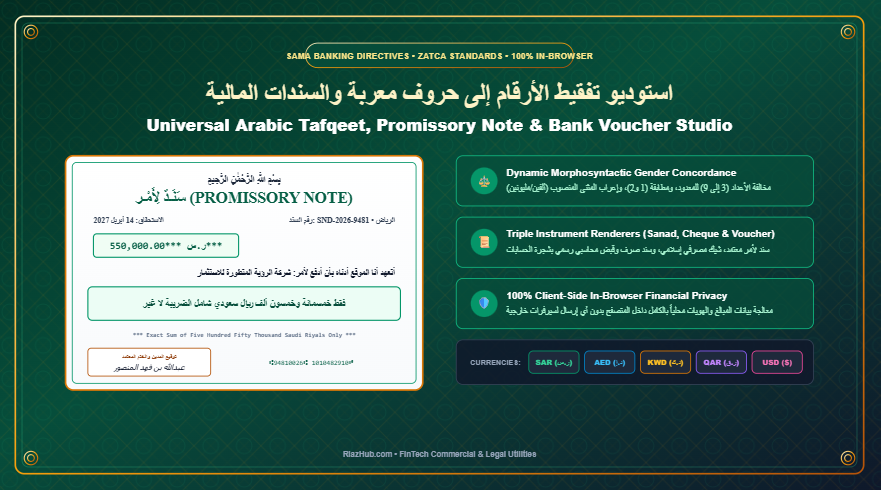
Mastering Arabic Tafqeet (تفقيط الأرقام إلى حروف): The Ultimate Guide to Grammatical Concordance, Sharia Promissory Notes (سند لأمر), and Commercial Financial Vouchers
1. Introduction: Why Arabic Tafqeet (التفقيط المالي) Is a Critical Legal Safeguard
In modern Arab and GCC commercial transactions, transcribing numeric figures into Classical Arabic words known formally as Tafqeet (تفقيط الأرقام إلى حروف) is not merely an aesthetic formality. It is an indispensable legal bulwark against fraud, forgery, and arbitration disputes. Under international commercial codes and regional banking jurisprudence (including the Saudi Commercial Court Law and the Uniform Commercial Code § 3-114), the “Written Word Supremacy” (سيادة الكلمات المكتوبة على الأرقام الحسابية) rule establishes that whenever a discrepancy arises between the numeric digits and the spelled-out words on a cheque, draft, or promissory note, the verbal words govern unconditionally.
However, the Arabic language boasts one of the most intricate morphosyntactic numerical systems in the world. Errors in number-gender agreement (تذكير وتأنيث العدد والمعدود), dual noun inflections (إعراب المثنى), or accusative nunation (تمييز العدد المنصوب) frequently jeopardize the enforceability of multi-million-riyal contracts.
To solve this enterprise hurdle without transmitting sensitive financial records to cloud servers, RiazHub developed the Arabic Tafqeet Financial & Legal Voucher Studio, a deterministic in-browser computational grammar engine tailored for GCC banking and legal standards.
2. Classical Arabic Computational Grammar: The 4 Core Rules of Numerical Concordance
Unlike English, where number verbalization is linear and gender-blind, Classical Arabic grammar (نحو وصرف الأعداد) requires dynamic agreement depending on whether the counted currency unit (المعدود) is masculine or feminine:
Rule A: Concordance of Units 1 and 2 (مطابقة الواحد والاثنين)
The numbers 1 and 2 strictly agree with the gender of the currency unit:
- Masculine Currency (ريال سعودي / درهم إماراتي): ريال واحد (One Riyal) and ريالان اثنان / ريالين اثنين (Two Riyals).
- Feminine Subunit (هللة / بيسة): هللة واحدة (One Halala) and هللتان اثنتان / هللتين اثنتين (Two Halalas).
Rule B: Gender Reversal for Units 3 to 9 (مخالفة الأعداد من 3 إلى 9)
Numbers 3 through 9 take the opposite gender of the singular form of the currency unit:
- Since ريال is masculine, the number takes the feminine marker تاء مربوطة: خمسة ريالات (Five Riyals), سبعة دراهم (Seven Dirhams).
- Since هللة is feminine, the number drops the feminine marker: خمس هللات (Five Halalas), تسع بيسات (Nine Baisas).
Rule C: Accusative Duals in Financial Instruments (إعراب المثنى بالنصب والجر)
In financial vouchers, bank cheques, and promissory notes, the amount is almost universally introduced by prepositions (مبلغاً وقدره or بموجب هذا السند). Consequently, dual denominations (200, 2,000, 2,000,000) must be rendered in the accusative/genitive case (حالة النصب والجر) with ياء ونون rather than the nominative ألف ونون:
- مائتين rather than مائتان (Two Hundred).
- ألفين rather than ألفان (Two Thousand).
- مليونين rather than مليونان (Two Million).
Rule D: Accusative Singular Distinction for Numbers 11 to 99 (تمييز العدد المفرد المنصوب)
For all compound and coordinate numbers between 11 and 99, the currency noun must appear in the singular accusative case with nunation (تنوين النصب):
- أحد عشر ريالاً (Eleven Riyals).
- خمسة وخمسون ألف ريالٍ, but خمسة وتسعون ريالاً سعودياً.
3. GCC & Arab Currency Matrix: Major & Minor Denominations
Different Arab central banks (including SAMA in Saudi Arabia, CBUAE in the UAE, and CBK in Kuwait) utilize distinct fractional precision. The following matrix illustrates how the RiazHub Arabic Tafqeet Studio handles currency subunit declensions:
| Currency Code | Major Currency (المعدود الرئيسي) | Minor Subunit (الكسر / الجزء) | Decimal Precision | Official Sample Tafqeet Phrase |
|---|---|---|---|---|
| SAR (ر.س) | ريال سعودي (مذكر) | هللة (مؤنثة) | 2 decimals | فقط خمسمائة وخمسون ألف ريال سعودي وخمسون هللة لا غير |
| AED (د.إ) | درهم إماراتي (مذكر) | فلس (مذكر) | 2 decimals | فقط مائة وخمسة وعشرون ألف درهم إماراتي وخمسون فلساً لا غير |
| KWD (د.ك) | دينار كويتي (مذكر) | فلس (مذكر – 1000 فلس) | 3 decimals | فقط خمسة وأربعون ألفاً وسبعمائة وخمسون ديناراً كويتياً وسبعمائة فلس لا غير |
| QAR (ر.ق) | ريال قطري (مذكر) | درهم (مذكر) | 2 decimals | فقط خمسون ألف ريال قطري وخمسة وعشرون درهماً لا غير |
| OMR (ر.ع) | ريال عماني (مذكر) | بيسة (مؤنثة – 1000 بيسة) | 3 decimals | فقط عشرة آلاف ريال عماني ومائتان وخمسون بيسة لا غير |
| EGP (ج.م) | جنيه مصري (مذكر) | قرش (مذكر) | 2 decimals | فقط سبعون ألف جنيه مصري وخمسة وسبعون قرشاً لا غير |
| USD ($) | دولار أمريكي (مذكر) | سنت (مذكر) | 2 decimals | فقط مائة ألف دولار أمريكي وعشرون سنتاً لا غير |
4. The Legal Anatomy of Sanad Al-Amr (السند لأمر) Under Saudi Enforcement Law
In the Kingdom of Saudi Arabia, a Promissory Note (سند لأمر) holds special statutory status under the Saudi Commercial Enforcement Law (نظام التنفيذ التجاري السعودي). When properly executed, it acts as a self-executing commercial paper (سند تنفيذي واجب النفاذ) that can be submitted directly to the Enforcement Courts without undergoing lengthy civil litigation.
To preserve its executive enforceability, Article 87 of the Commercial Papers Law mandates seven compulsory legal pillars:
- Explicit Instrument Title: The exact term “سند لأمر” must be prominently written in the body text.
- Unconditional Payment Promise: An explicit undertaking to pay a specified sum without contingent conditions (تعهد ناجز غير معلق على شرط).
- Stipulated Maturity Date: Definite maturity date (تاريخ الاستحقاق) or specified as payable on demand (عند الاطلاع).
- Place of Payment: Designated jurisdiction city (مكان الوفاء).
- Beneficiary Designation: The legal name of the payee (اسم المستفيد الأول).
- Date and Location of Creation: Verified date and jurisdiction of issue.
- Debtor Signature and National ID: Physical or electronic verification seal linking to the National Single Sign-On (Nafath / Absher).
When you use the Sanad Al-Amr Staging Deck on RiazHub, each of these statutory elements is automatically embedded into a high-DPI 1600×900 graphic certificate ready for print or lossless PNG download.
5. Preventing Commercial Fraud: The Protective Bounding Markers (فقط … لا غير)
Financial history is replete with alteration fraud where bad actors prepended or appended numbers to loosely drafted documents. Classical Arabic financial jurisprudence mandates the protective bounding formula:
فقط وقدره [المبلغ المفقط بالحروف] [اسم العملة] و [الكسور] [اسم الكسر] لا غير
Bound by protective three-star asterisks (***) at both borders.
The initial word “فقط” (Solely / Exact sum of) establishes that no preceding digits exist. The terminal phrase “لا غير” (Nothing else / No more) legally terminates the clause, rendering any subsequent hand-written addition immediately invalid in commercial arbitration.
6. How to Use the RiazHub Arabic Tafqeet Studio in 4 Simple Steps
Whether you are preparing corporate payment vouchers, auditing electronic invoices for ZATCA, or drafting sharia promissory notes, the workflow on RiazHub.com takes under 10 seconds:
- Enter Numeric Amount & Select Currency: Type your transaction sum (e.g.,
550000.00) and choose from the 9-currency matrix. - Select Your Document Form: Click between 📜 سند لأمر (Sanad Al-Amr), 🏛️ شيك مصرفي (Bank Cheque), or 📑 سند صرف وقبض (Corporate Voucher).
- Customize Debtor & Beneficiary Records: Enter the beneficiary name, bank IBAN, debtor national ID/CR, issue date, and maturity date. All fields update the preview canvas in real time.
- Export in 1 Click: Download high-resolution branded PNG graphics, export structured accounting CSV ledgers, save formatted Markdown audit slips, or print legal PDF documents directly from your browser.
7. Conclusion: Enhancing Corporate FinTech Compliance
In an era of rapid digital transformation across Saudi Arabia and the GCC, ensuring absolute legal rigor in financial instruments is non-negotiable. By marrying Classical Arabic grammar with modern browser-based vector rendering, the Universal Arabic Tafqeet (تفقيط الأرقام للحروف) Financial & Legal Voucher Studio on RiazHub.com empowers financial officers, legal advisors, and enterprise accountants to draft flawless commercial instruments in seconds.
Universal Arabic Tafqeet & Legal Voucher Studio
Transform numeric currency amounts into Classical Arabic words with morphosyntactic gender concordance, generate Sharia-compliant Sanad Al-Amr promissory notes, preview authentic bank cheques, and render corporate payment vouchers directly in your browser.
| رمز الحساب | اسم الحساب المحاسبي | مدين (Debit) | دائن (Credit) | البيان والتفاصيل المحاسبية |
|---|---|---|---|---|
| 120101 | أوراق قبض تجارية (سندات لأمر) | 550,000.00 ر.س | - | إثبات استحقاق السند رقم SND-2026-9481 |
| 210205 | المدين: عبدالله بن فهد المنصور | - | 550,000.00 ر.س | محرر السند لأمر المستفيد الأول |
| 220301 | أمانات ضريبة القيمة المضافة (15% VAT) | - | 71,739.13 ر.س | مدرجة ضمن إجمالي المعاملة |
📖 Classical Arabic Tafqeet, Financial Sharia Law & Sanad Al-Amr Guide
- الشيك المصرفي: أمر بالدفع مسحوب على بنك تجاري ومستحق الوفاء بمجرد الاطلاع، وتترتب على إصداره بدون رصيد عقوبات جنائية فورية.
- سند الصرف والقبض: مستند محاسبي داخلي يوثق حركة خروج أو دخول الأموال من الخزينة أو الحسابات البنكية للمؤسسة وتوزيعه على مراكز التكلفة وحسابات الضرائب.