
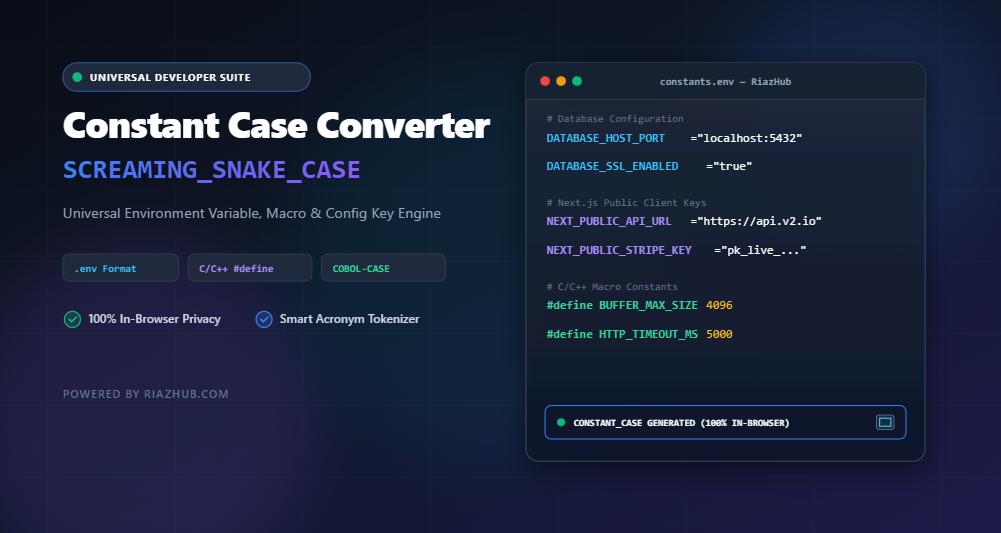
Universal Constant Case Converter & Environment Variable Suite: The Complete Guide to SCREAMING_SNAKE_CASE, Config Keys, and C/C++ Macros
1. Introduction: The Role of Constants & Immutability in Modern Software Engineering
In software architecture, few concepts are as vital to system stability, security, and readability as immutability. When an identifier represents a value that is fixed at compile time, declared globally, or loaded during application bootstrap from external environment variables, software engineers rely on a universal visual signal: CONSTANT_CASE (also known across programming communities as SCREAMING_SNAKE_CASE, UPPER_SNAKE_CASE, or MACRO_CASE).
Using all-uppercase characters separated by underscores signals to any developer reading the codebase that the identifier is fixed, globally scoped, and strictly non-reassignable. It eliminates guesswork, prevents accidental mutations during runtime, and clearly distinguishes static configuration keys from mutable local variables.
However, modern software engineering stacks are inherently heterogeneous. Developers constantly migrate data across disparate naming conventions: converting camelCase JavaScript objects into uppercase .env files, transforming snake_case database schema definitions into C/C++ macro headers, or standardizing multi-word phrases into public Next.js and Vite environment variables. Doing this manually across dozens or hundreds of lines is tedious, repetitive, and vulnerable to syntax typos.
The Universal Constant Case Converter & Environment Variable Suite provides an instant, privacy-first, client-side transformation engine that tokenizes strings and converts them into production-ready constant formats in real time.
2. Deep Dive into SCREAMING_SNAKE_CASE and Uppercase Casing Taxonomy
While SCREAMING_SNAKE_CASE is the undisputed king of environment configuration, various developer domains and programming paradigms utilize specialized uppercase formats. Here is a breakdown of the primary formats supported by the Constant Case Converter:
| Naming Convention | Example Output | Separator Rule | Primary Ecosystems & Use Cases |
|---|---|---|---|
| SCREAMING_SNAKE_CASE | DATABASE_HOST_PORT |
Uppercase words separated by underscores (_) |
Environment variables (.env), Python (PEP 8), Java constants, TypeScript global configs |
| SCREAMING-KEBAB-CASE | DATABASE-HOST-PORT |
Uppercase words separated by hyphens (-) |
COBOL, Lisp, Custom HTTP Request/Response Headers (e.g., X-CORRELATION-ID) |
| SCREAMING.DOT.CASE | DATABASE.HOST.PORT |
Uppercase words separated by periods (.) |
Java Spring Boot application.properties, Log4j logging namespaces, Kafka topics |
| C/C++ Header Macro | #define DATABASE_HOST_PORT 1 |
Preprocessor directive prefix with uppercase identifier | C and C++ header files (.h, .hpp), conditional compilation flags, buffer sizes |
| .env Config Format | DATABASE_HOST_PORT="" |
Constant key assigned with empty or parameterized quotation syntax | Docker, Kubernetes ConfigMaps, Node.js dotenv, Laravel, Django, Ruby on Rails |
2.1 SCREAMING_SNAKE_CASE (UPPER_CASE / CONSTANT_CASE)
The standard convention across virtually every modern language for immutable static variables. Words are converted entirely to uppercase and joined by underscores. Examples include MAX_BUFFER_CAPACITY, API_SECRET_KEY, and DEFAULT_TIMEOUT_MS.
2.2 SCREAMING-KEBAB-CASE / COBOL-CASE (HTTP Headers, Lisp)
Also termed COBOL-CASE due to historical usage in mainframe COBOL programming, this format uses uppercase characters separated by hyphens. In modern web architectures, it is widely utilized for custom HTTP headers (such as X-API-RATE-LIMIT or STRICT-TRANSPORT-SECURITY) and specific cloud configuration manifests.
2.3 SCREAMING.DOT.CASE (Java Properties, Spring Configs)
Enterprise Java frameworks, Spring Cloud environments, and logging configuration systems frequently organize hierarchical keys using dot notation. SCREAMING.DOT.CASE standardizes hierarchical property trees (such as SERVER.PORT or SPRING.DATASOURCE.URL).
2.4 C/C++ Preprocessor #define Macro Format
In low-level systems programming, preprocessor macros defined via #define substitute code before compilation. Because macros lack scope isolation, systems engineers strictly mandate all-caps identifiers (e.g., #define MAX_RETRY_COUNT 5) to prevent accidental collisions with local variable names.
2.5 .env Key-Value Configuration Format
Dotenv configuration files require strict KEY=value or KEY="" pairings. The RiazHub Environment Variable Suite automates the formatting of multi-line variable lists directly into valid .env syntax ready for instant copying or file export.
3. The Twelve-Factor App & Environment Variable Architecture
The renowned Twelve-Factor App methodology outlines the foundational principles for building scalable, cloud-native software applications. Factor III explicitly mandates: “Store config in the environment.”
3.1 Strict Separation of Code and Config (Factor III)
An application’s configuration is everything that varies between deployment environments (Development, Staging, Production). This includes database connection handles, third-party API credentials (Stripe, Twilio, AWS), encryption secrets, and canonical hostnames. By extracting these values into uppercase environment variables (.env), the application codebase becomes 100% stateless and portable.
3.2 Preventing Accidental Secret Leaks to Version Control
Hardcoding database passwords or API keys inside source files is one of the leading causes of enterprise security breaches. When developers standardize on .env templates using the Constant Case Converter, they can generate clean .env.example files with empty quotes (e.g., STRIPE_SECRET_KEY="") to commit into Git while keeping private credentials in ignored local files.
3.3 Eliminating Operating System Case-Sensitivity Collisions
Different operating systems handle environment variable casing differently. Linux and UNIX kernels are strictly case-sensitive (treating API_KEY, Api_Key, and api_key as three distinct variables), whereas Microsoft Windows environments are often case-insensitive. Standardizing on SCREAMING_SNAKE_CASE across your entire DevOps pipeline eliminates subtle cross-platform bugs when deploying code from a Windows developer workstation to a Linux Docker container in Kubernetes.
4. Framework-Specific Variable Prefixes & Client-Side Scoping
Modern frontend bundlers (Next.js, Vite, Webpack, Nuxt) enforce strict security boundaries. By default, bundlers prevent server-side environment secrets from being bundled into client-side JavaScript where visitors could inspect them. Bundlers only expose variables that carry explicit framework prefixes.
4.1 Next.js: NEXT_PUBLIC_ Client Scoping
In Next.js, any environment variable intended for the browser must be prefixed with NEXT_PUBLIC_:
# Server-Side Only (Secret)
DATABASE_URL="postgres://user:password@host:5432/db"

# Client-Side Exposed (Public)
NEXT_PUBLIC_STRIPE_PUBLISHABLE_KEY="pk_live_51ABC..."
NEXT_PUBLIC_API_BASE_URL="https://api.riazhub.com/v1"
Using the Quick Preset feature in the Universal Constant Case Converter instantly prepends NEXT_PUBLIC_ to all converted keys.
4.2 Vite: VITE_ Environment Expositions
Vite utilizes import.meta.env and requires public variables to be prefixed with VITE_:
VITE_APP_TITLE="RiazHub Developer Utilities"
VITE_FIREBASE_AUTH_DOMAIN="riazhub-prod.firebaseapp.com"
4.3 Create React App & Webpack: REACT_APP_
Legacy and enterprise Webpack setups relying on Create React App require all injected variables to start with REACT_APP_:
REACT_APP_GOOGLE_ANALYTICS_ID="G-XYZ123456"
REACT_APP_ENABLE_FEATURE_FLAGS="true"
4.4 Docker, Kubernetes & Cloud ConfigMaps
Container orchestrators require configuration manifests formatted with all-caps keys. The RiazHub converter allows bulk-transforming lists of application keys into YAML/JSON ConfigMaps and Docker Compose environment blocks effortlessly.
5. Industry Style Guides & Constant Conventions
Major programming languages have formalized constant naming conventions in their official style guides:
5.1 Python PEP 8 Module Constants
The official Python style guide (PEP 8) states that constants must be declared at the module level and written in all capital letters with underscores:
# Correct PEP 8 Style
MAX_OVERFLOW = 50
TOTAL_RETRY_ATTEMPTS = 3
DEFAULT_CACHE_TTL_SECONDS = 3600
5.2 Google Java Style Guide: static final & Enums
According to Google’s Java Style Guide (§5.2.4), constant field names must use UPPER_SNAKE_CASE. Every constant is a static final field whose contents are deeply immutable:
public static final int BUFFER_SIZE = 4096;
public static final String DEFAULT_ENCODING = "UTF-8";

public enum ServerStatus {
    SERVER_ACTIVE,
    SERVER_MAINTENANCE,
    SERVER_DEPRECATED
}
5.3 C / C++: Header Guards, Macros, and constexpr
In C and C++, #define macros and header include guards must always be uppercase:
#ifndef NETWORK_SOCKET_HANDLER_H
#define NETWORK_SOCKET_HANDLER_H

#define MAX_PACKET_LENGTH 65535
#define CONNECTION_TIMEOUT_MS 10000

#endif // NETWORK_SOCKET_HANDLER_H
5.4 JavaScript / TypeScript: Primitive Constants vs Frozen Objects
In JavaScript and TypeScript, while the const keyword is used for block-scoped variables, only true compile-time constants and configuration dictionaries should use SCREAMING_SNAKE_CASE:
// Compile-time configuration constant (Correct SCREAMING_SNAKE_CASE)
const API_BASE_TIMEOUT_MS = 5000;

// Deeply frozen configuration map
const APP_ENDPOINTS = Object.freeze({
    AUTH_LOGIN: "/api/v1/auth/login",
    USER_PROFILE: "/api/v1/user/profile"
});

// Runtime variable instance (Use lowerCamelCase)
const activeUserSession = getUserSession();
6. Algorithmic Tokenization: Compound Boundaries & Acronym Handling
Converting arbitrary text strings into clean constants is mathematically non-trivial. Naive splitting on spaces or underscores fails when dealing with complex compound casing and contiguous uppercase acronyms.
6.1 Intelligent Acronym Parsing (apiV2EndpointUrl, getHTTPResponseCode)
Consider the variable name getHTTPResponseCode. A primitive lowercase/uppercase regex splitter will mistakenly fragment HTTPResponse into individual letters (G_E_T_H_T_T_P_R_E_S_P_O_N_S_E). The RiazHub Constant Case Converter employs a dual-stage lookahead regex tokenizer:
// Regex 1: Split lowercase-to-uppercase transitions
str.replace(/([a-z\d])([A-Z])/g, '$1 $2')

// Regex 2: Disambiguate contiguous acronym blocks before title-cased words
str.replace(/([A-Z]+)([A-Z][a-z\d]+)/g, '$1 $2')
This ensures that getHTTPResponseCode cleanly resolves to GET_HTTP_RESPONSE_CODE, and apiV2EndpointUrl transforms seamlessly into API_V2_ENDPOINT_URL.
6.2 Splitting Mixed Delimiters (Spaces, Hyphens, Slashes, Periods)
Raw developer strings often contain mixed delimiters from URLs, file paths, or database schemas (e.g., auth/jwt-token.expire_time). The tokenizer normalizes all hyphens, slashes, periods, and underscores into unified word boundaries before assembling the final constant.
6.3 Symbol Sanitization & Bulk Deduplication
Special characters (@, $, #, %, !) that cause syntax errors in .env files or compiler parsers are automatically stripped using Unicode property escapes ([^\p{L}\p{N}\s]). Furthermore, when converting large batch files in Bulk Mode, an optional deduplication filter eliminates duplicate constant keys automatically.
7. 6 High-Impact Developer Workflows
Here are six practical scenarios where the Universal Constant Case Converter accelerates daily engineering productivity:
7.1 Bootstrapping Production .env Files from API Documentation
When integrating third-party APIs (Stripe, Twilio, SendGrid), documentation often lists settings in natural language (e.g., “webhook signing secret”, “publishable api key”, “account sid”). Paste the raw list into the converter to instantly generate formatted .env keys with assigned quotes ready for your config file.
7.2 Converting Database Column Schemas into ORM Config Keys
Copying table column names from PostgreSQL or MySQL (e.g., billing_address_line_1, is_account_verified) and converting them into uppercase configuration maps and environment mappings.
7.3 Bulk Generating C/C++ Header Files and Macro Enums
Systems programmers can paste lists of hardware registers, error codes, or buffer settings to instantly produce formatted #define REGISTER_NAME 1 macro blocks.
7.4 Standardizing Custom Microservice HTTP Headers
Convert internal service variable names into standardized SCREAMING-KEBAB-CASE (e.g., X-AUTHENTICATION-BEARER-TOKEN, X-REQUEST-CORRELATION-ID) for API gateway routing.
7.5 Refactoring Hardcoded Magic Numbers into Immutable Constants
During code refactoring sessions, convert messy inline string literals and numerical constants into clean, centralized constant declarations at the top of your files.
7.6 Bulk Formatting Kubernetes ConfigMaps & Docker Envs
Drag and drop multi-line configuration text files to instantly format Docker environment lists and Kubernetes ConfigMap key-value sets with zero manual formatting.
8. Step-by-Step Guide: How to Use the RiazHub Constant Case Converter
Using the Constant Case Converter is intuitive and lightning-fast:
- Input Your Text: Type or paste variable names into the source textarea, or drag and drop any
.txt,.env,.json, or.sqlfile directly onto the upload zone. - Select a Quick Preset (Optional): Choose from pre-configured presets like .env Config File (
KEY=""), React / Next.js Public Key (NEXT_PUBLIC_), C/C++ Header Macro (#define), or HTTP / COBOL-CASE. - Customize Transformation Rules: Toggle acronym preservation, special character stripping, bulk line-by-line processing, deduplication, or enter a custom prefix (e.g.,
VITE_). - Copy or Export: Click the prominent Copy CONSTANT_CASE button for 1-click clipboard copying, or use the Export .env / .txt button to download the formatted file. You can also copy any of the 7 alternative developer formats from the synchronized showcase cards.
9. Zero-Telemetry & In-Browser Privacy Architecture
In modern enterprise development, environment variable names and configuration keys frequently contain sensitive information—such as database hostnames, proprietary project identifiers, and internal service paths. Sending this data to a remote third-party cloud server poses severe security and compliance risks.
The Universal Constant Case Converter & Environment Variable Suite operates under a strict 100% Client-Side In-Browser Architecture. Every regular expression replacement, word tokenizer pass, and file export occurs exclusively inside your local browser runtime. Zero text strings, variable keys, or telemetry payloads are ever transmitted across the network.
10. Frequently Asked Questions (FAQ)
What is the difference between SCREAMING_SNAKE_CASE and standard snake_case?
snake_case uses all lowercase letters separated by underscores (e.g., user_profile_data) and is standard for regular variables and functions in Python, Rust, and SQL. SCREAMING_SNAKE_CASE uses all uppercase letters (e.g., USER_PROFILE_DATA) and is strictly reserved for immutable constants, environment keys, and preprocessor macros.
Why do Next.js and Vite require specific variable prefixes?
Frontend frameworks compile code that executes publicly inside the visitor’s browser. To prevent accidental leakage of sensitive backend database passwords and secret API tokens, bundlers only inject variables into the client-side JavaScript bundle if they carry an explicit security prefix such as NEXT_PUBLIC_ or VITE_.
Does the converter support multi-line bulk lists and files?
Yes. By default, Bulk Mode is enabled, allowing you to paste hundreds of lines at once or drag and drop .env, .txt, .csv, or .sql files to format each line independently with real-time word, character, and line count statistics.
How does the tool handle compound words with acronyms like JWT or HTTP?
The converter features an intelligent lookahead regex parser that identifies consecutive capital letters before title-cased words. For example, getHTTPResponseCode is cleanly converted to GET_HTTP_RESPONSE_CODE rather than breaking the acronym into separate letters.
Can I use this tool offline?
Yes. Once loaded in your web browser, the tool operates completely offline without requiring active internet connectivity.
Is there any cost or registration required to use the suite?
No. The Universal Constant Case Converter is 100% free with unlimited conversions, zero account requirements, and zero advertising barriers on RiazHub.
11. Conclusion & Start Converting Online
Standardizing on clean, immutable naming conventions and structured environment variables is essential for modern, scalable, and secure software engineering. Whether you are bootstrapping a new Next.js project, refactoring legacy database columns, writing C/C++ macro headers, or auditing your production .env configuration files, automated tokenization saves time and eliminates human error.
Experience the fastest, most versatile in-browser developer casing engine today. Try the free Universal Constant Case Converter & Environment Variable Suite on RiazHub and streamline your development workflow in seconds.
Universal Constant Case Converter
Transform text, variables, and multi-line keys into clean CONSTANT_CASE (SCREAMING_SNAKE_CASE) for environment variables, config files, and programming macros in real time.
Source Input
Auto-DetectCONSTANT_CASE
Primary OutputRIAZ-HUB-ONLINE-TOOLS
RIAZ.HUB.ONLINE.TOOLS
#define RIAZ_HUB_ONLINE_TOOLS 1
RIAZ_HUB_ONLINE_TOOLS=""
riazHubOnlineTools
RiazHubOnlineTools
riaz_hub_online_tools
Programming Constants, Naming Conventions & Style Guide
Why Do Global Constants and Config Keys Use SCREAMING_SNAKE_CASE?
In software engineering, SCREAMING_SNAKE_CASE (also known as CONSTANT_CASE or MACRO_CASE) is the universal industry standard for identifiers whose values are strictly immutable and known at compile time or application startup.
- Python (PEP 8): All top-level module constants, magic numbers, and default settings must be uppercase with words separated by underscores (e.g., MAX_CONNECTIONS = 100).
- Java (Google Java Style Guide): Constant fields (static final) and enum constants must be written in UPPER_SNAKE_CASE.
- C / C++: Preprocessor macros and header definitions utilize uppercase identifiers (e.g., #define BUFFER_SIZE 4096) to visually distinguish them from mutable runtime variables.
- JavaScript / TypeScript: Global configuration flags and frozen object constants rely on API_TIMEOUT_MS.
How .env & Environment Variables Safeguard Production Deployments
The Twelve-Factor App methodology mandates strict separation of configuration from code. Storing config in environment variables (.env) provides immense security and operational benefits:
- Zero Credential Leaks: Prevents hardcoding secret tokens, API keys, and database passwords inside version-controlled Git repositories.
- Environment Parity: Allows the same codebase to run across Development, Staging, and Production by simply modifying the .env file.
- Immutability & Predictability: Standardizing environment keys as DATABASE_URL or REDIS_PORT prevents case-sensitivity collisions across Linux, macOS, and Windows operating systems.
Framework-Specific Variable Prefixes (Vite, Next.js, React)
Modern web bundlers only expose environment variables to client-side browser JavaScript if they are explicitly prefixed:
- Next.js: Variables exposed to the browser must start with NEXT_PUBLIC_ (e.g., NEXT_PUBLIC_STRIPE_KEY).
- Vite: Variables must start with VITE_ (e.g., VITE_API_ENDPOINT).
- Create React App: Variables must be prefixed with REACT_APP_ (e.g., REACT_APP_AUTH_DOMAIN).
- Nuxt: Public runtime configs use NUXT_PUBLIC_.
Client-Side Browser Execution & Zero-Telemetry Privacy
Your confidential tokens, environment variable names, database credentials, and proprietary code identifiers never leave your computer:
- 100% In-Browser Computation: All regex splitting, word extraction, acronym disambiguation, and formatting runs strictly within your browser's JavaScript V8/SpiderMonkey engine.
- Zero Cloud Telemetry: No external API requests, logging servers, or remote databases are ever contacted.
- Offline Capable: The converter operates completely without active internet connectivity once loaded.