
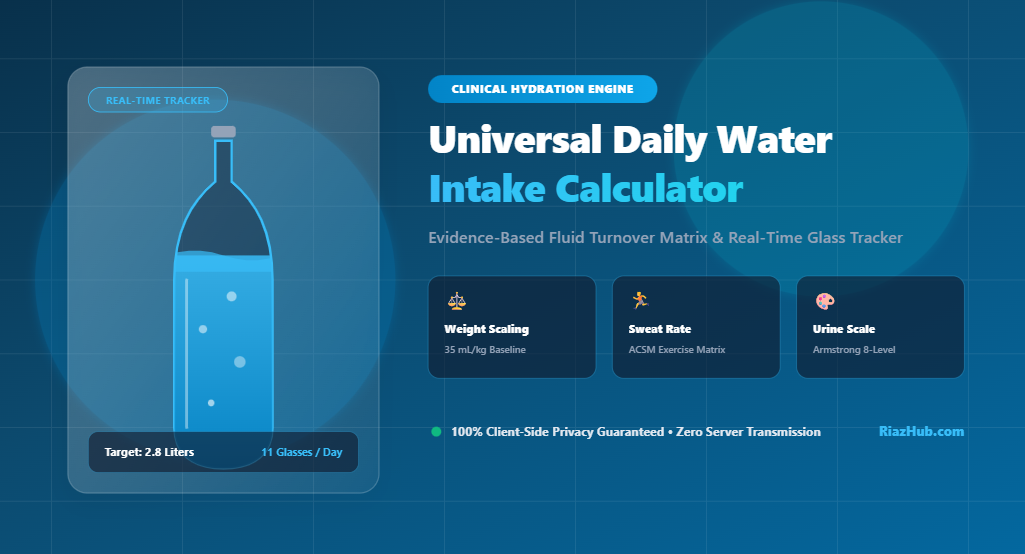
Universal Daily Water Intake & Hydration Architecture: The Clinical & Exercise Physiology Guide to Optimal Fluid Balance
Yet despite water’s biological centrality, the average adult routinely operates in a state of chronic low-grade hypohydration. Epidemiological data indicates that an acute loss of just 1% to 2% of total body mass in fluid precipitates tangible declines in short-term working memory, mental acuity, psychomotor coordination, and aerobic endurance.
To eliminate ambiguity and individualize your daily fluid needs across diverse climates and activity levels, utilize the interactive Universal Daily Water Intake Calculator & Hydration Architecture Studio on RiazHub.com.
⚡ Discover Your Precise Daily Fluid Requirement
Do not guess your fluid demands based on rigid, outdated rules. Calculate your exact biological hydration target tailored to your exact body weight, sweat rate, workout minutes, climate, and life stage.
The Demise of the “8 Glasses a Day” Rule
The venerable “8×8 rule” the recommendation to drink eight 8-ounce glasses of water per day (~1.9 Liters) remains one of the most persistent dogmas in popular wellness. However, physiological science reveals that this guideline originated from a widespread misinterpretation of a 1945 Food and Nutrition Board recommendation.
The original 1945 text proposed a baseline fluid allowance of 1 milliliter for each calorie of food ingested (amounting to ~2,500 mL daily for an active adult). Crucially, the authors appended a sentence that history largely ignored: “Most of this quantity is contained in prepared foods.”
Applying a static 1.9-liter rule across all humans fails to account for three fundamental biophysical realities:
- Body Mass Discrepancies: A 50-kilogram sedentary individual requires fundamentally less basal turnover than a 100-kilogram athlete.
- Metabolic Water & Food Moisture: Humans naturally absorb between 20% and 30% of their daily fluid volume through solid foods like cucumbers, apples, watermelon, and nourishing broths.
- Insensible Environmental & Exertional Sweating: Cutaneous evaporation and respiratory vapor loss can fluctuate by more than 2,000 mL daily depending on ambient temperature, altitude, and physical exertion.
Clinical Baseline Fluid Formulations: Weight Scaling vs. IOM Standards
Modern clinical nephrology and nutritional medicine utilize two primary evidence-based benchmarks to establish basal fluid needs:
1. The Clinical Body-Weight Scaling Standard (35 mL/kg)
In clinical practice, maintenance fluid requirements are calculated directly proportional to functional body mass:
Baseline Fluid (mL/day) = Body Weight (in kg) × 35 mL/kg
For example, a 70 kg individual requires a basal fluid volume of 2,450 mL (70 × 35 mL), whereas an 85 kg individual requires 2,975 mL baseline turnover before factoring in physical exercise or climate additions.
2. The National Academy of Medicine (IOM) Dietary Reference Intakes
The Institute of Medicine (IOM) sets broad population Dietary Reference Intakes (DRI) for adequate total daily fluid intake from all dietary sources:
- Adult Men: 3.7 Liters (3,700 mL / ~125 fl oz) of total fluid daily.
- Adult Women: 2.7 Liters (2,700 mL / ~91 fl oz) of total fluid daily.
You can instantly compare these methodologies and observe your personalized breakdown on the Universal Water Intake Calculator & Hydration Studio.
Comparative Fluid Demand Matrix Across Lifestyles
| Profile Persona | Body Mass | Modifiers (Sweat / Climate / Life Stage) | Direct Liquid Target | Daily 250mL Glasses |
|---|---|---|---|---|
| Sedentary Desk Worker | 70 kg (154 lbs) | Temperate climate, 0 min workout | ~2.0 Liters | 8 Glasses |
| Recreational Gym Goer | 75 kg (165 lbs) | 45 min workout, normal sweat rate | ~2.5 Liters | 10 Glasses |
| Marathon Runner in Training | 65 kg (143 lbs) | 90 min training, heavy sweat, warm weather | ~3.8 Liters | 15 Glasses |
| Lactating / Nursing Mother | 62 kg (136 lbs) | +800 mL breastmilk demand | ~3.1 Liters | 12 Glasses |
| Desert Construction Worker | 85 kg (187 lbs) | Arid heat (+500 mL), 60 min heavy sweat | ~4.4 Liters | 18 Glasses |
Dietary Fluid Partitioning: Direct Liquids (80%) vs. Food Moisture (20%)
A common mistake in daily hydration tracking is assuming that every milliliter of required fluid must be consumed out of a drinking glass. In human nutritional architecture, fluid intake partitions into two distinct categories:
1. Direct Drinking Beverages (~80% of Total Turnover)
This includes pure filtered tap water, mineral water, unsweetened herbal infusions, black coffee, and electrolyte solutions. This is the volume monitored by the real-time glass counter on the RiazHub Hydration Architecture Tool.
2. Solid Food Moisture Absorption (~20% of Total Turnover)
Whole, unprocessed foods carry high cellular moisture concentrations that release slowly throughout the digestive process, aiding intracellular hydration:
- Cucumbers: 96% water content
- Celery & Lettuce: 95% water content
- Watermelon & Strawberries: 91% to 92% water content
- Grapefruit & Oranges: 87% to 88% water content
- Apples & Pears: 84% to 85% water content
📊 Generate Your 1200×630 Social Hydration Blueprint Card
Want a visual snapshot of your daily water schedule, glass requirements, and sweat compensations? Generate and download high-DPI hydration cards directly inside the browser using the built-in Canvas Studio.
The Chronological Hydration Blueprint: How to Distribute Your Daily Water
Guzzling 1.5 Liters of water in a single sitting causes rapid volumetric distention of the stomach, stimulates rapid renal excretion, and flushes valuable electrolytes before cells can adequately absorb them. Scientific fluid management requires structured, timed intervals:
- Phase 1: Morning Awakening Priming (500 mL / 2 Glasses): Immediately upon waking, rehydrate the vascular tree. Humans lose between 300 mL and 700 mL of fluid overnight through insensible cutaneous respiration. Morning water kickstarts glomerular filtration and activates colon motility.
- Phase 2: Pre-Meal Gastric Hydration (250 mL / 1 Glass): Consume a glass approximately 30 minutes before lunch and dinner. This hydrates the stomach’s mucosal barrier and stimulates digestive enzyme secretion without blunting gastric acid concentrations during active digestion.
- Phase 3: Peri-Workout Window (350 mL to 700 mL): Consume fluids before and during physical activity to preserve cardiac output, blood plasma volume, and thermoregulatory sweat rate.
- Phase 4: Afternoon Maintenance Sipping: Maintain steady cognitive focus and prevent mid-afternoon lethargy by sipping 250 mL every 90 minutes.
- Phase 5: Bedtime Taper (150 mL to 200 mL Max): Taper liquid intake 60 to 90 minutes before sleep to prevent nocturia, nocturnal awakenings, and sleep architecture disruption.
To copy a pre-formatted, individualized timeline schedule directly to your clipboard, launch the Daily Water Intake Calculator and click “Copy Daily Schedule”.
Monitoring Hydration in Real-Time: The Armstrong Clinical Urine Color Scale
While thirst is a vital evolutionary safety signal, hypothalamic thirst perception is triggered only after plasma osmolality has already risen by 1% to 2% (a state of mild functional dehydration). The gold standard for non-invasive, day-to-day hydration assessment is the Armstrong Dehydration Index:
- Level 1 (Pale Straw / Clear): Optimal hydration. Fluid intake is fully meeting cellular demands.
- Level 2 (Transparent Light Yellow): Well hydrated. Healthy metabolic and renal equilibrium.
- Level 3 (Light Yellow): Euhydrated. Typical healthy baseline status.
- Level 4 (Golden Honey Yellow): Borderline dehydrated. Sip 250 mL to 500 mL over the next hour.
- Level 5 (Dark Yellow / Amber): Dehydrated. Significant fluid deficit; drink 500 mL immediately.
- Level 6 to 7 (Dark Amber / Tea Colored): Severe fluid deficit. Elevated risk of heat cramps, dizziness, and cognitive impairment.
- Level 8 (Brown / Dark Rust): Extreme dehydration or potential clinical rhabdomyolysis / hepatic disorder. Seek medical evaluation if persistent.
Renal Clearance Limits & Dilutional Hyponatremia (Water Intoxication)
More is not always better. Healthy human kidneys possess a maximum water excretion capacity of approximately 800 to 1,000 mL (0.8 to 1.0 Liter) per hour under resting conditions.
When an individual rapidly forces down excessive plain water especially during endurance sporting events without adequate sodium replacement the rate of fluid intake outpaces renal excretion. This dilutes extracellular sodium concentrations below 135 mEq/L, precipitating Exercise-Associated Hyponatremia (EAH).
Under acute hyponatremia, an osmotic gradient forces water out of the vascular space into brain cells, leading to cerebral edema, nausea, disorientation, seizures, and life-threatening medical emergencies. This is why the Universal Water Intake Calculator on RiazHub features an automated clinical caution gate whenever direct drinking targets exceed 5.0 Liters daily.
Frequently Asked Questions (FAQ)
Does coffee or caffeinated tea count toward my daily water intake?
Yes. Extensive clinical trials (such as the landmark Killer et al., 2014 study) have conclusively demonstrated that moderate daily caffeine consumption (up to 400 mg daily, equivalent to 3–4 cups of brewed coffee) provides hydrating qualities statistically indistinguishable from pure water in habitual consumers. The fluid ingested in coffee or tea counts directly toward your total fluid targets.
When should I drink electrolyte drinks instead of plain water?
Plain water is completely sufficient for light-to-moderate physical activity lasting under 60 minutes. However, for continuous vigorous exercise exceeding 60 to 90 minutes—or any activity performed in extreme ambient heat (>35°C / 95°F) with heavy sweating electrolyte supplementation (containing 300 mg to 600 mg of sodium per liter) is critical to maintain extracellular tonicity and avoid hyponatremia.
Does the calculator save my personal health data on a server?
No. The Universal Daily Water Intake Calculator on RiazHub.com operates 100% inside your local web browser. All biometrics, glass tracking counts, and dossier renderings execute client-side via JavaScript with zero server data leakage.
💧 Take Control of Your Daily Hydration Balance
Stop guessing your body’s vital fluid requirements. Calculate your personalized water intake, track your glasses in real-time, and download your free Hydration Blueprint Card today.
Universal Daily Water Intake & Hydration Studio
Calculate your scientifically tailored daily fluid requirement based on body weight, climate insolation, sweat rates, and life stages, track your glasses in real-time, and preserve optimal fluid-electrolyte balance.
🥛 Direct Beverages (80% of Intake)
Consists of pure tap or filtered drinking water, sparkling mineral water, unsweetened herbal teas, and electrolyte solutions. This volume is strictly necessary for gastrointestinal transit, thermoregulation, and renal waste clearance.
🥒 Whole Food Moisture (20% of Intake)
Absorbed through cellular moisture bound in whole foods: Cucumbers (96% water), Watermelon (92%), Strawberries (91%), Oranges (87%), Apples (85%), and nourishing vegetable broths.
⏱️ Workouts < 60 Minutes
- Primary Fluid: Plain drinking water is completely sufficient.
- Timing: Consume 250–350 mL 20 minutes before training.
- During Exercise: Sip 150–200 mL every 15–20 minutes as thirst dictates.
- Electrolytes: Generally unnecessary unless exercising in extreme heat (>35°C / 95°F).
🏃 Endurance Workouts > 60 Minutes
- Electrolyte Mandate: Add 300–600 mg Sodium per liter to maintain extracellular tonicity.
- Carbohydrates: 30–60g rapid carbohydrates/hour to sustain glycogen oxidation.
- Hyponatremia Defense: Avoid consuming copious plain water without sodium to prevent blood dilution.
- Recovery Rule: Rehydrate with 1.25 to 1.5 L of fluid for every 1.0 kg of body mass lost post-workout.
Clinical Nephrology, Osmoregulation & Hydration Science
Evidence-based insights into renal fluid handling, neuroendocrine feedback loops, and physiological hydration myths.
Human fluid balance is governed by specialized osmoreceptors located in the anteroventral third ventricle (AV3V) region and subfornical organ of the hypothalamus. When plasma osmolality increases by as little as 1% to 2% (above the normal threshold of ~285 to 295 mOsm/kg), these osmoreceptors stimulate both the conscious sensation of thirst and the posterior pituitary release of Arginine Vasopressin (AVP / Antidiuretic Hormone - ADH).
ADH binds to V2 receptors on the basolateral membrane of renal collecting duct principal cells, triggering the intracellular translocation of Aquaporin-2 (AQP2) water channels. This allows water to be reabsorbed from the tubular lumen back into the hypertonic medullary interstitium, concentrating the urine and conserving biological fluid.
The ubiquitous "8x8 rule" (eight 8-ounce glasses of water daily, ~1.9 Liters) originated in large part from a misinterpretation of a 1945 Food and Nutrition Board recommendation, which stated that adults require approximately 2.5 Liters of fluid daily but critically noted that most of this quantity is contained in prepared foods.
Static rules fail to account for individual body weight (a 50 kg individual requires substantially less basal fluid than a 100 kg athlete), lean muscle mass percentage, physical activity levels, ambient climate temperature, and humidity. Using the clinical body weight formula (30–35 mL/kg) calibrated against sweat losses yields an accurate, individualized hydration architecture.
The maximal excretory capacity of healthy human kidneys is approximately 800 to 1,000 mL (0.8 to 1.0 Liter) of water per hour under normal glomerular filtration rates. If fluid intake exceeds this rate, or if pure hypotonic water is consumed in massive volumes during endurance exertion without sodium replacement, Exercise-Associated Hyponatremia (EAH) can develop.
When serum sodium concentration plummets below 135 mEq/L (and particularly below 120 mEq/L), an osmotic gradient drives water into brain cells, leading to cerebral edema, nausea, headache, ataxia, seizures, and acute life-threatening encephalopathy. Pacing fluid consumption and including dietary electrolytes during extended exertion is physiologically vital.
A widespread nutritional myth claims that coffee and caffeinated tea cause net dehydration. While caffeine acts as a mild adenosine receptor antagonist with weak natriuretic properties in caffeine-naive individuals, extensive randomized clinical trials (e.g., Killer et al., 2014) demonstrate that moderate daily caffeine intake (up to 400 mg, equivalent to 3–4 cups of brewed coffee) provides hydrating qualities statistically indistinguishable from pure water in habituated consumers.
The fluid volume ingested in coffee, tea, or infusions counts directly toward daily total fluid targets.
This utility operates 100% inside your local web browser. All biometric calculations, workout compensations, local storage states, and canvas document generations are executed exclusively using client-side JavaScript. No biometrics, weights, lifestyle entries, or device IP addresses are ever dispatched or stored on remote servers.