
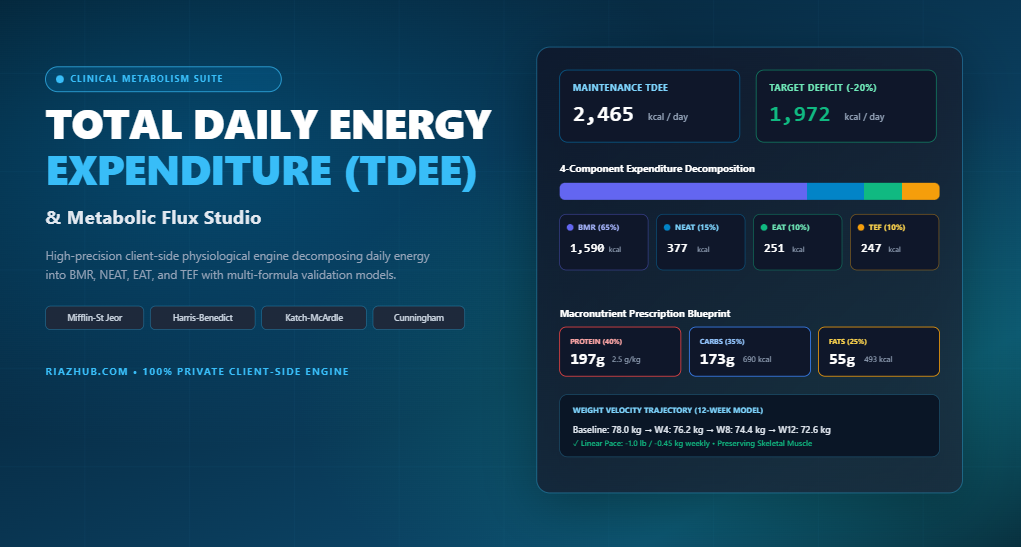
The Clinical Science of Total Daily Energy Expenditure (TDEE): Deconstructing Human Metabolism, Caloric Flux, and Macro Partitioning
1. The Thermodynamic Reality of Human Metabolism
In fitness culture, weight management is frequently oversimplified into “calories in versus calories out” (CICO). While the physics of thermodynamics cannot be broken, human physiology is not a static combustion engine. It is an adaptive, endocrinologically mediated biological ecosystem.
When you consume calories, your body converts chemical energy into adenosine triphosphate (ATP), heat, and cellular tissue. Conversely, when you expend energy, you are not merely burning fat your body strategically orchestrates enzymatic fuel oxidation across adipose stores, intramuscular glycogen, and circulatory glucose. To accurately plan weight loss, muscle hypertrophy, or athletic fueling, you must first accurately quantify your Total Daily Energy Expenditure (TDEE).
Before slashing your food intake or prescribing unsustainable deficit protocols, utilizing an empirical clinical engine like the RiazHub TDEE & Metabolic Flux Studio provides a verified physiological baseline based on population-validated formulas.
2. Demystifying the 4 Tiers of Energy Expenditure
TDEE is not a monolithic number. Clinical exercise physiologists deconstruct 24-hour human caloric expenditure into four distinct physiological compartments:
| Expenditure Component | Typical Share (%) | Physiological Function & Mechanism | Degree of Lifestyle Control |
|---|---|---|---|
| BMR (Basal Metabolic Rate) | 60% – 70% | Resting cellular homeostasis, cardiopulmonary work, ion gradient maintenance, liver/kidney filtration. | Involuntary / Fixed Short-Term (Governed by Lean Body Mass & Age) |
| NEAT (Non-Exercise Activity Thermogenesis) | 15% – 20% | Spontaneous physical movement, posture maintenance, workplace walking, typing, fidgeting. | High Behavioral Variance (Differs by up to 800 kcal/day between individuals) |
| EAT (Exercise Activity Thermogenesis) | 5% – 15% | Structured cardiovascular sessions, resistance training, athletics, and high-intensity interval training. | 100% Purposeful & Programmed |
| TEF (Thermic Effect of Food) | 8% – 10% | Metabolic cost of mastication, enzymatic gastrointestinal digestion, nutrient absorption, and cellular storage. | Modulated by Dietary Protein & Fiber Intake |
Tier 1: Basal Metabolic Rate (BMR) — The Cellular Floor
Even if you were to remain motionless in bed for 24 hours in a post-absorptive state, your body would consume a tremendous quantity of energy. Your brain alone accounts for roughly 20% of resting metabolic rate, while the liver and skeletal muscle account for an additional 20% and 18% respectively. BMR sets the absolute biological threshold below which caloric restriction should almost never occur.
Tier 2: NEAT — The Silent Weight Loss Catalyst
Non-Exercise Activity Thermogenesis is the most variable and adaptable component of human metabolism. Two individuals of identical body weight and height can experience a daily expenditure divergence of up to 800 to 1,000 calories purely due to differences in occupational pacing, occupational standing, walking volume, and nervous fidgeting. When dieting, the body’s natural defense mechanism is to unconsciously down-regulate NEAT, inducing lethargy to preserve energy.
Tier 3: EAT — Structured Training Sessions
While cardiovascular exercise and weightlifting are essential for cardiorespiratory fitness and skeletal muscle hypertrophy, they surprisingly account for only 5% to 15% of total daily expenditure for the vast majority of non-elite individuals. A rigorous 60-minute resistance training workout typically combusts between 200 and 400 calories far less than most commercial wearable fitness trackers estimate.
Tier 4: TEF — The Energetic Cost of Eating
Digesting food requires biological work. Macronutrients carry vastly different thermic costs:
- Dietary Protein: 20% – 30% of ingested calories are consumed during digestion and amino acid peptide transport.
- Carbohydrates: 5% – 10% energetic conversion cost.
- Fats: 0% – 3% energetic storage cost.
By consuming a high-protein diet, you inherently amplify your thermic effect of food, boosting daily caloric combustion passively. You can analyze your exact 4-tier decomposition model anytime using the Metabolic Flux Studio decomposition tool.
3. Mathematical Foundations: Which BMR Formula Should You Use?
Not all metabolic equations are created equal. Different mathematical models are optimized for distinct body compositions and demographics:
1. Mifflin-St Jeor Equation (Clinical Population Gold Standard)
Formulated in 1990, the Mifflin-St Jeor equation is recognized by the Academy of Nutrition and Dietetics as the most reliable predictor of resting metabolic rate in contemporary populations without direct body composition metrics:
BMR (Men) = (10 × Weight_kg) + (6.25 × Height_cm) - (5 × Age_yrs) + 5
BMR (Women) = (10 × Weight_kg) + (6.25 × Height_cm) - (5 × Age_yrs) - 161
2. Revised Harris-Benedict Equation (1984 Human Metabolism Standard)
While originally published in 1919, the Roza and Shizgal revision in 1984 updated this historic formula. It tends to slightly overestimate BMR in sedentary modern individuals with higher adiposity levels, but remains a trusted clinical benchmark.
3. Katch-McArdle Equation (Lean Body Mass Dependent)
If you know your verified body fat percentage (via DEXA scan, hydrostatic weighing, or validated calipers), the Katch-McArdle equation is mathematically superior because it bases resting metabolism exclusively on Lean Body Mass (LBM) rather than gross body weight:
LBM_kg = Gross Weight_kg × (1 - (Body Fat % / 100))
BMR = 370 + (21.6 × LBM_kg)
Adipose tissue is metabolically inert compared to skeletal muscle. By removing fat mass from the calculation, muscular lifters avoid underestimation, while overweight individuals avoid overestimation.
4. Cunningham Equation (Athletic & High-Performance Standard)
Tailored specifically for competitive athletes and strength competitors possessing significant skeletal muscular hypertrophy:
BMR = 500 + (22 × LBM_kg)
You can cross-compare results from all four formulas side-by-side using the comparative matrix tab inside the Universal TDEE Calculator & Metabolic Flux Studio.
4. Caloric Prescriptions & Deficit Safety Thresholds
Once your maintenance TDEE is established, adjusting your caloric intake must be guided by clear physiological horizons:
- Mild Recomposition (-10% Deficit): Recommended for lean individuals seeking to preserve maximum muscle mass and athletic performance while shedding stubborn subcutaneous fat.
- Standard Fat Loss (-15% to -20% Deficit): The clinical gold standard for steady, sustainable fat loss. Provides optimal satiety while creating a reliable 300 to 600 kcal daily deficit.
- Aggressive Cut (-25% Deficit): Suited only for individuals with significant adipose reserves or short-term contest preparation under clinical supervision.
- Clean Hypertrophy (+10% Surplus): Provides the necessary surplus energy for muscle protein synthesis without accumulating excessive adipose tissue.
Prescribing caloric targets lower than your calculated Basal Metabolic Rate (BMR) triggers acute adaptive thermogenesis. The endocrine system lowers active triiodothyronine (T3), suppresses leptin, elevates cortisol, down-regulates gonadal hormones (testosterone/estrogen), and initiates skeletal muscle catabolism. Never sustain a sub-BMR intake without direct medical supervision.
5. Macronutrient Partitioning: Protecting Lean Mass During Deficits
Calories dictate the *magnitude* of weight change, but macronutrients dictate the *composition* of that change (whether you lose adipose tissue or sacrificial skeletal muscle).
Protein: The Muscle-Sparing Anchor
During an energetic deficit, whole-body protein oxidation accelerates. Clinical literature demonstrates that consuming 1.6 to 2.4 grams of protein per kilogram of body weight (0.7 to 1.1 g/lb) is mandatory to preserve lean tissue, stimulate muscle protein synthesis (MPS), and enhance fullness via ghrelin suppression.
Essential Fats: Endocrine Preservation
Dietary fats must never be eliminated. A baseline intake of at least 0.6 to 0.8 g/kg of dietary lipids is critical for the cellular synthesis of steroid hormones (including testosterone and progesterone), lipid-soluble vitamin absorption (A, D, E, K), and nervous system myelin sheath integrity.
Carbohydrates: Glycogen Repletion & Thyroid Support
The remaining caloric allotment is partitioned into complex carbohydrates. Adequate carbohydrate availability maintains muscle glycogen concentrations, fuels glycolytic resistance training, and prevents excessive suppression of thyroid hormone conversion in peripheral tissues.
Explore pre-built partition models including High-Protein, Balanced, Low-Carb, and Ketogenic splits on the interactive macro partition module of our TDEE engine.
6. Realistic Weight Velocity: The 3,500 kcal Rule vs. Metabolic Adaptation
Historically, nutritional science relied on Max Wishnofsky’s 1958 rule: an energetic deficit of 3,500 kcal equates to exactly 1 pound (0.45 kg) of lost adipose tissue (7,700 kcal per kilogram). While mathematically convenient, real-world biological systems adapt over time.
As you lose mass, your BMR decreases because there is less tissue to metabolically sustain. Concurrently, your NEAT drifts downward due to unconscious movement suppression. Therefore, scale weight progression is rarely linear across 12 weeks. Clinical consensus recommends reassessing your numbers every 4 to 6 weeks on the RiazHub TDEE Studio to adjust your caloric targets as your total mass evolves.
7. Summary Workflow: How to Architect Your Energy Balance
- Calculate Baseline TDEE: Determine your maintenance requirement using the Mifflin-St Jeor or Katch-McArdle formula on our Universal TDEE Calculator.
- Select an Evidence-Based Deficit or Surplus: Choose a sustainable goal factor (e.g., -15% or -20% for fat loss; +10% for clean bulking).
- Secure Protein Requirements: Target 1.6 to 2.2 g/kg of protein to protect skeletal muscle architecture.
- Track Weekly Trends: Monitor scale weight alongside morning waist circumferences and training performance.
- Recalibrate Every 4–6 Weeks: Adjust activity multipliers and caloric prescriptions as metabolic adaptation occurs.
Universal TDEE Calculator & Metabolic Flux Studio
Calculate your precise maintenance calories, deconstruct daily energy expenditure into BMR, NEAT, EAT, and TEF, allocate target deficits or surpluses, and project weekly fat loss milestones.
⚙️ Biometric Inputs & Activity Deck
4-Component Daily Energy Decomposition
Deconstruction of your total daily caloric output into resting cellular life, lifestyle walking/movement, intentional exercise, and food thermics.
Target Calorie & Macronutrient Blueprint
Precision partitioning of your daily prescribed calories into gram weights and energetic yields.
| Biomarker / Metric | Calculated Value | Clinical Adequacy Standard |
|---|---|---|
| Protein Relative to Body Mass | 2.5 g / kg (1.1 g / lb) | ✓ Optimal Sparing Range (1.6 – 2.4 g/kg) |
| Essential Fatty Acid Minimum | 0.7 g / kg | ✓ Safe Endocrine Threshold (≥0.6 g/kg) |
| Glycogen Repletion Energy | 2.2 g / kg | Moderate Activity Support |
Chronological Weight Velocity & Milestone Model
Forecasted body weight trajectories based on the cumulative thermodynamic fat loss constant (3,500 kcal / lb or 7,700 kcal / kg).
| Chronological Horizon | Projected Weight (kg / lbs) | Cumulative Mass Delta | Estimated Metabolic Status |
|---|---|---|---|
| Baseline (Day 0) | 78.0 kg / 172.0 lbs | 0.0 kg (0.0 lbs) | Active Baseline |
| Week 4 Milestone | 76.2 kg / 168.0 lbs | -1.8 kg (-4.0 lbs) | Glycogen Equilibrium Reached |
| Week 8 Milestone | 74.4 kg / 164.0 lbs | -3.6 kg (-8.0 lbs) | Mild Downward NEAT Drift Possible |
| Week 12 Milestone | 72.6 kg / 160.0 lbs | -5.4 kg (-12.0 lbs) | Diet Break / Maintenance Phase Recommended |
Multi-Equation BMR & TDEE Cross-Comparison
Evaluating variance between physiological and body-composition based mathematical formulas.
| Metabolic Equation | Estimated BMR | Maintenance TDEE | Ideal Target Demographic |
|---|---|---|---|
| Mifflin-St Jeor | 1,735 kcal | 2,689 kcal | General Modern Population (Validated ±10%) |
| Revised Harris-Benedict | 1,780 kcal | 2,759 kcal | Traditional Clinical Reference (1984 Revision) |
| Katch-McArdle (LBM) | 1,778 kcal | 2,756 kcal | Requires Lean Mass (Accounts for Muscularity) |
| Cunningham Equation | 1,941 kcal | 3,009 kcal | Athletes & High-Performance Competitors |
Shareable Metabolic Blueprint Card Studio (1200x630)
Generate high-resolution social cards, coach client summaries, or meal prep references.
Clinical Physiology of Energy Metabolism, NEAT & Caloric Partitioning
- Basal Metabolic Rate (BMR ~60–70%): The obligatory cellular metabolic cost of sustaining life (protein synthesis, ion gradients, renal filtration, cardiopulmonary function).
- Non-Exercise Activity Thermogenesis (NEAT ~15%): All spontaneous bodily movement that is not purposeful exercise—such as workplace pacing, typing, fidgeting, and walking.
- Exercise Activity Thermogenesis (EAT ~5–15%): Calories intentionally expended during planned physical exercise, resistance bouts, or sports.
- Thermic Effect of Food (TEF ~8–10%): Energy required for the chemical breakdown, gastrointestinal transport, and storage of dietary proteins (~20–30%), carbs (~5–10%), and fats (~0–3%).