
The Science of Optimal Protein Intake: How to Calculate Daily Grams, Trigger Muscle Protein Synthesis (MPS), and Avoid Muscle Loss
For decades, dietary protein guidelines have been muddled by contradictory advice. On one extreme, conventional government guidelines continue to promote 0.8 grams per kilogram of body weight (0.36 g/lb) as a sufficient universal standard. On the opposite extreme, fitness subcultures advocate indiscriminate mass feeding of 1.5 to 2.0 grams per pound regardless of body fat, renal function, or actual metabolic tissue mass.
Modern sports biochemistry, stable-isotope tracer trials, and the International Society of Sports Nutrition (ISSN) have permanently dismantled both extremes. Determining your exact daily protein requirement is not a one-size-fits-all guesswork exercise—it is a physiological calculation based on lean body mass, training modality, energy balance, and per-meal amino acid kinetics.
1. The 0.8 g/kg RDA Myth: Survival Floor vs. Optimal Adaptation
To understand proper protein prescription, you must understand what the Recommended Dietary Allowance (RDA) actually represents. Formulated from nitrogen balance studies conducted in the mid-20th century, the 0.8 g/kg threshold was calculated as two standard deviations above the Estimated Average Requirement (EAR) to prevent overt clinical deficiency symptoms (such as muscle wasting, edema, and impaired wound healing) in 97.5% of healthy sedentary adults.
In clinical terms: 0.8 g/kg is a survival floor, not an optimization ceiling. It was never intended to:
- Maximize resistance training-induced muscular hypertrophy;
- Preserve functional skeletal muscle during caloric restriction;
- Accelerate recovery from high-volume endurance or concurrent training;
- Overcome age-related anabolic resistance in adults aged 65 and older.
2. The Molecular Mechanism: The “Leucine Trigger” & mTORC1
Muscle tissue is not static. It exists in an ongoing equilibrium between Muscle Protein Synthesis (MPS) and Muscle Protein Breakdown (MPB):
Net Protein Balance = Muscle Protein Synthesis (MPS) − Muscle Protein Breakdown (MPB)
For muscle accrual or retention to occur, Net Protein Balance must remain positive over time. At the intracellular level, MPS is an “all-or-none” signaling event driven primarily by the intracellular concentration of the branched-chain amino acid L-Leucine.
When intracellular leucine concentrations reach the critical threshold—often referred to in exercise physiology as the “Leucine Trigger”—it activates the mechanistic Target of Rapamycin Complex 1 (mTORC1) kinase cascade. Research shows that:
- Sub-threshold Doses (<1.8g Leucine / <20g Protein): Result in suboptimal mTORC1 phosphorylation and truncated fractional synthetic rates.
- Optimal Leucine Bolus (2.5g to 3.5g Leucine): Completely saturates the aminoacyl-tRNA synthetase-sestrin2 sensing mechanism, producing peak ribosomal translation. In whole-food terms, this requires approximately 25 to 40 grams of high-quality complete protein per meal (or roughly 0.40 g/kg body weight per serving).
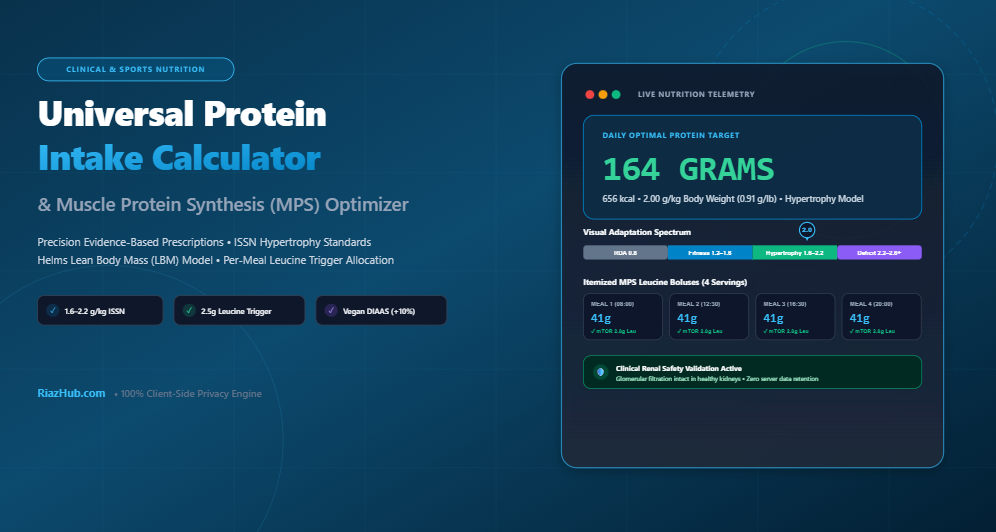
You can simulate different meal frequencies and test whether your individual feedings meet this threshold using the RiazHub Protein Intake Calculator & MPS Studio.
3. The Clinical & Sports Nutrition Matrix: Evidence-Based Targets
Depending on your primary physical context and metabolic goals, your daily protein intake multiplier ($M_{\text{g/kg}}$) should be calibrated according to rigorous clinical consensus guidelines:
| Physiological Context | Target (g/kg) | Target (g/lb) | Scientific Rationale & Authoritative Source |
|---|---|---|---|
| Sedentary Clinical Baseline | 0.8 g/kg | 0.36 g/lb | WHO / DRI minimum to maintain nitrogen equilibrium in inactive individuals. |
| General Active Health | 1.2–1.4 g/kg | 0.55–0.64 g/lb | Supports metabolic turnover, cellular maintenance, and modest cardiovascular exercise. |
| Endurance & Stamina | 1.4–1.7 g/kg | 0.64–0.77 g/lb | ACSM Standard: Supports mitochondrial enzyme remodeling, red blood cell turnover, and glycogen re-synthesis. |
| Athletic Hypertrophy | 1.6–2.2 g/kg | 0.73–1.00 g/lb | ISSN Consensus: Plateau threshold for maximum myofibrillar protein synthesis during resistance training. |
| Fat Loss & Muscle Sparing | 2.0–2.4 g/kg | 0.91–1.10 g/lb | Helms et al. & Eric Trexler: Sparing lean tissue from oxidation during sustained caloric deficits. |
| Healthy Aging (65+) | 1.2–1.5 g/kg | 0.55–0.68 g/lb | PROT-AGE Study Group: Overcomes age-associated anabolic resistance and blunts sarcopenia. |
4. Total Body Weight vs. Lean Body Mass (LBM) Normalization
One of the most frequent errors in sports nutrition calculators is calculating protein recommendations purely based on gross scale weight. For lean athletes with 8% to 15% body fat, total scale weight correlates closely with metabolic lean tissue. However, for individuals classified as overweight or obese (body fat >25% in men, >32% in women), calculating protein as $2.2\text{ g/kg}$ of total body weight can prescribe 240+ grams of protein per day.
Adipose tissue (body fat) is metabolically inactive regarding amino acid oxidation and muscle protein synthesis. Over-prescribing protein based on fat mass displaces dietary carbohydrates and essential fatty acids, creating an unnecessarily restrictive and expensive diet.
In such cases, clinical sports dietitians utilize Lean Body Mass (LBM) Normalization, using either direct DEXA/caliper body fat inputs or the validated Boer Formula:
- Men: $\text{LBM}_{\text{kg}} = (0.407 \times \text{Weight}_{\text{kg}}) + (0.267 \times \text{Height}_{\text{cm}}) – 19.2$
- Women: $\text{LBM}_{\text{kg}} = (0.252 \times \text{Weight}_{\text{kg}}) + (0.473 \times \text{Height}_{\text{cm}}) – 48.3$
Under this model (popularized by Dr. Eric Helms), protein is targeted to 2.3 to 3.1 g/kg of Lean Body Mass, providing optimal muscle protection while maintaining caloric equilibrium. You can view your side-by-side total weight vs. LBM comparison directly inside the RiazHub Protein Intake Calculator.
5. Protein Quality: DIAAS, PDCAAS & The 10% Plant-Based Scaling Factor
All dietary protein is not created equal. While nutritional labels quantify total nitrogen content, the biological utilization of amino acids depends on the Digestible Indispensable Amino Acid Score (DIAAS), which measures true ileal amino acid absorption:
- Whey Protein Isolate & Whole Eggs: Feature DIAAS scores above 1.15 to 1.30, packing exceptionally high biological value and complete branched-chain amino acid densities.
- Unrefined Plant Proteins (Lentils, Beans, Wheat Gluten): Typically have lower DIAAS scores (0.45 to 0.70) due to limiting essential amino acids (such as methionine or lysine) and intact cellular fibers that reduce digestive enzymatic cleavage.
The Practical Fix: Plant-based athletes do not need to consume meat to build equal amounts of muscle; however, sports nutrition studies indicate that vegan and strict vegetarian athletes should apply a 10% to 15% volumetric compensation factor to their daily baseline target. This compensates for lower ileal digestibility and guarantees an equivalent circulating pool of essential amino acids.
6. Distribution Kinetics: The 3 to 5 Meal Frequency Advantage
Is it acceptable to consume your entire 160g protein target in a single massive evening dinner? While total 24-hour intake is the primary determinant of nitrogen balance, research in The Journal of Physiology and The American Journal of Clinical Nutrition reveals that distribution matters significantly for maximal muscle accretion.
When you ingest protein:
- MPS rates spike rapidly, peaking at approximately 90 to 120 minutes post-ingestion.
- After 3 to 4 hours, MPS returns to basal levels despite sustained circulating amino acid levels—a phenomenon known as the “Muscle Full Effect”.
Consequently, an individual who consumes 30g at breakfast, 35g at lunch, 35g at dinner, and 30g before bed triggers the mTORC1 synthesis cascade four distinct times throughout the day. Conversely, someone who consumes 10g at breakfast, 15g at lunch, and 105g at dinner only triggers peak MPS once, oxidizing excess amino acids for fuel.
7. Clinical Renal Safety: Debunking the High-Protein Kidney Myth
Extensive meta-analyses and long-term randomized controlled trials (including investigations by Dr. Jose Antonio evaluating intakes up to 3.3 to 4.4 g/kg/day) confirm that high protein diets do not impair glomerular filtration rate (GFR), elevate serum creatinine pathologically, or induce renal disease in healthy individuals. The observed increase in GFR following a high-protein meal is a benign physiological adaptation (functional reserve capacity), not pathology.
Strict Caution: Individuals with pre-existing Chronic Kidney Disease (CKD), stage 3–5 renal disease, or reduced baseline eGFR must strictly adhere to their nephrologist’s restricted clinical protein prescription.
8. Translating Grams into Real Food: Quick Reference Table
Hitting your daily goal is straightforward once you memorize the standard protein yield of staple whole foods:
| Whole Food Source | Standard Serving Size | Approximate Protein Yield | Estimated Leucine Content |
|---|---|---|---|
| Boneless Chicken Breast (Cooked) | 150 grams (5.3 oz) | ~46 grams | ~3.7 grams |
| Wild Atlantic Salmon (Cooked) | 150 grams (5.3 oz) | ~38 grams | ~3.0 grams |
| Whole Large Eggs | 3 Whole Eggs | ~19 grams | ~1.6 grams |
| 0% Plain Greek Yogurt | 200 grams (1 cup) | ~20 grams | ~2.0 grams |
| Whey Protein Isolate | 1 Scoop (30g powder) | ~27 grams | ~3.1 grams |
| Extra Firm Tofu (Soy) | 150 grams (5.3 oz) | ~25 grams | ~1.9 grams |
| Cooked Green Lentils | 1 Cup (198 grams) | ~18 grams | ~1.3 grams |
Conclusion: Build Your Personal Nutrition Dossier Today
Whether your objective is adding lean tissue during a resistance training block, safeguarding muscle while cutting stubborn body fat, or maintaining functional autonomy as you age, precision protein nutrition is your most potent tool.
To get an exact breakdown calibrated to your sex, age, weight, height, body fat %, training goal, and meal schedule complete with a downloadable high-resolution 1200×630 nutrition dossier card use our dedicated interactive studio:
🥩 Universal Protein Intake & MPS Studio
Precision macronutrient engine calibrated to ISSN, ACSM, PROT-AGE, and Helms Lean Mass models. Calculate optimal daily grams, evaluate per-meal leucine triggers, compensate for plant-based bioavailability, and prevent muscle catabolism.
Visual Protein Spectrum & Physiological Adaptation Range
See where your target lands across evidence-based physiological intake tiers (from clinical RDA baseline to high-intensity athletic hypertrophy and lean preservation).
Itemized Per-Meal Leucine Trigger & MPS Allocation
Stimulating muscle protein synthesis (MPS) requires surpassing the ~2.5g–3.0g leucine threshold per bolus. Spacing protein evenly every 3 to 4 hours produces superior fractional synthetic rates compared to a single skewed dinner meal.
Protein Source & Whole Food Equivalency Guide
Translating your daily target of 164g into tangible whole foods. Includes Digestible Indispensable Amino Acid Score (DIAAS) context:
| Food Source | Density / Serving | Quality (DIAAS) | Portion to Match Target |
|---|
Lean Body Mass (LBM) vs. Total Weight Comparative Matrix
For individuals with elevated body fat percentages (>25% men, >32% women), calculating protein strictly against total scale weight can lead to over-prescribing protein grams that needlessly inflate caloric targets. Basing prescriptions on Boer Lean Mass prevents this distortion:
| Nutritional Model | Calculation Formula | Daily Grams | Clinical Rationale |
|---|
Generates an ultra-crisp 1200x630 High-DPI OpenGraph social card ready for download, meal prep logs, or sharing with your trainer or clinical dietitian.