
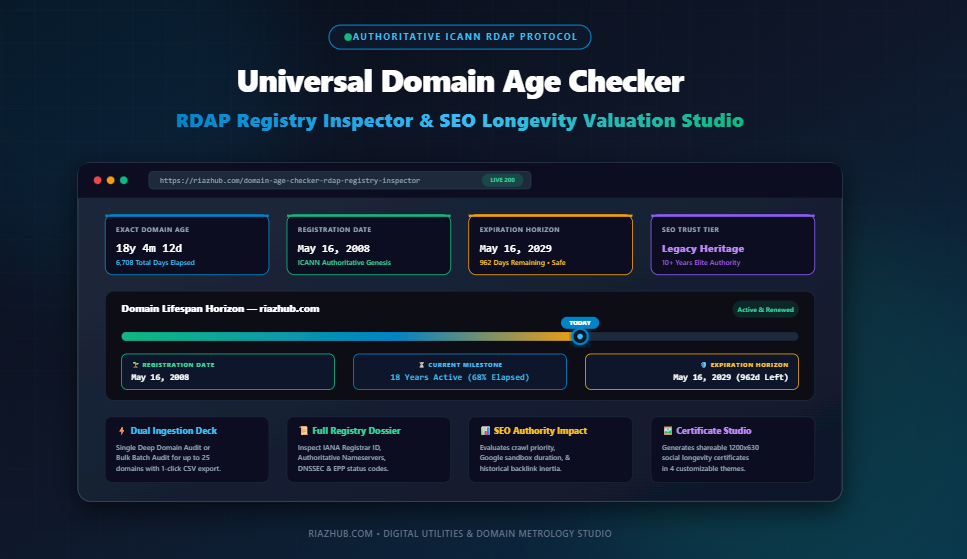
In search engine optimization, domain investing, and digital brand protection, a domain’s registration date is one of the most critical foundational data points available. Whether you are evaluating a competitor’s organic search footprint, vetting an expired domain candidate for purchase, or performing due diligence on a new web project, understanding how to read authoritative ICANN registration records gives you a decisive competitive edge. You can audit any domain instantly using the Universal Domain Age Checker & RDAP Registry Inspector on RiazHub.
This guide explains how domain longevity impacts organic search visibility, why modern ICANN RDAP protocols replace outdated WHOIS scraping, how to distinguish between continuous domain age and dropped history, and how to perform both single-domain and bulk batch audits efficiently.
Check Domain Age with RDAP Inspector →
1. Why Domain Age Matters in Modern Technical SEO
A frequent debate among digital marketers and webmasters is whether chronological domain age is a direct Google ranking factor. While search engine representatives have clarified that domain age in isolation is not a magic ranking switch, the empirical correlation between established domain longevity and sustained search engine visibility is undeniable.
Older, continuously registered domains possess three compounding structural advantages that newly registered domains simply cannot replicate overnight:
- Accumulated Backlink Inertia: A domain that has been live for five, ten, or fifteen years has had years to earn natural editorial citations, industry directory listings, news mentions, and contextual references. These accumulated backlinks create an algorithmic trust buffer that insulates the website against minor algorithm updates.
- Crawl Priority and Indexing Velocity: Search engine crawlers maintain historical telemetry on hosts. Websites hosted on domains with unbroken uptime and stable DNS delegation receive higher crawl frequency and rapid indexation of newly published content compared to newly registered domains.
- Google Sandbox Immunity: Brand-new domains typically undergo an initial probationary observation period (commonly referred to as the Google Sandbox). During this phase, organic impressions for competitive commercial keywords are often throttled while algorithms observe publishing consistency, backlink velocity, and user engagement signals. Established domains cleared this barrier years ago.
To verify the exact chronological milestones of your domain or your competitors, run a diagnostic audit on the RiazHub Domain Age Checker.
2. RDAP vs. Traditional WHOIS: The Architectural Transition
For more than four decades, domain ownership and lifecycle lookups relied exclusively on the legacy WHOIS protocol (RFC 3912), which operates over raw TCP port 43. Developed in the 1980s, legacy WHOIS was built for plain text terminal displays. It had no standardized schema, no native internationalization support, and forced developers to write brittle regular expression scrapers to extract dates across hundreds of different registrar outputs.
To resolve these technical vulnerabilities, the Internet Corporation for Assigned Names and Numbers (ICANN) mandated the transition to the Registration Data Access Protocol (RDAP) (RFC 7480–7484) as the modern global standard.
| Protocol Feature | Legacy WHOIS (Port 43) | Modern ICANN RDAP (HTTPS) |
|---|---|---|
| Transport Layer | Unencrypted TCP Port 43 | Encrypted HTTPS RESTful API (Port 443) |
| Data Structure | Unstructured free-form text strings | Standardized, machine-readable JSON |
| Privacy Compliance | Coarse, inconsistent text masking | Granular, role-based vCard redaction |
| International Domains (IDN) | Limited or broken character encoding | Native UTF-8 support for all languages |
| Authoritative Routing | Manual multi-hop referral chasing | Direct IANA registry bootstrap routing |
Rather than relying on fragile port 43 terminal scraping, our tool queries authoritative RDAP endpoints directly, delivering exact millisecond-level registry dates, DNSSEC verification, and registrar metadata. Test your domain on the live RDAP Registry Inspector.
3. Continuous Domain Age vs. Dropped and Expired Domain History
One of the most frequent misconceptions in domain acquisition and SEO is assuming that a domain originally created twenty years ago retains twenty years of continuous search engine trust if it was dropped or abandoned along the way.
Search engines evaluate continuous, unbroken DNS resolution rather than merely the calendar date of the first registration. When a domain is allowed to expire and drop back into the public pool, several critical events occur:
- DNS Delegation Severance: The registry removes the nameservers from the root TLD zone file, stopping all website traffic and returning server errors to visiting search crawlers.
- De-indexation of Historical Content: Search engines de-index previously ranked pages once persistent HTTP 404 or connection failures are confirmed over consecutive crawl cycles.
- Algorithmic Trust Reset: When a new owner re-registers a dropped domain, search algorithms detect the change in registrar, registrant entity, IP hosting block, and content profile. In most cases, historical authority resets to prevent manipulative link-network schemes.
Consequently, a domain that has been continuously hosted, renewed, and maintained for five consecutive years holds substantially higher practical authority than a fifteen-year-old domain that was dropped, abandoned, and re-registered multiple times.
4. The 5 SEO Longevity Authority Tiers
To help webmasters and domain investors evaluate where a web property stands in its lifecycle, domain lifespans can be categorized into five practical authority tiers:
1. Newborn Tier (< 1 Year)
Domains in their first year of registration. These domains are actively navigating search engine sandbox filters. Algorithms are measuring publishing consistency, visitor engagement patterns, and link velocity before granting significant organic search visibility for competitive terms.
2. Developing Tier (1–3 Years)
Domains that have established an initial indexing footprint and confirmed stability. Having avoided early spam penalties, developing domains begin earning predictable organic search impressions and steady crawl schedules.
3. Established Authority Tier (3–5 Years)
Web properties with proven multi-year stability. At this stage, websites have built a foundation of contextual backlinks and internal content depth. They demonstrate high resilience against minor search engine core algorithm shifts.
4. Veteran Authority Tier (5–10 Years)
Domains with extensive operating history. Search engines allocate generous crawl budgets to these properties, frequently indexing and ranking newly published articles on primary terms within hours of publication.
5. Legacy Heritage Tier (10+ Years)
Elite internet properties that have maintained active status for over a decade. Legacy domains possess substantial backlink equity and brand authority, commanding premium valuations in domain secondary markets.
You can discover which authority tier your website occupies by using the RiazHub Domain Longevity Studio.
5. Managing Expiration Risk and Renewal Urgency
Another vital signal tracked by registries is the Expiration Horizon. This metric measures the exact number of days remaining before a domain’s current registration term lapses.
Allowing domains to drift within thirty to sixty days of expiration introduces significant operational risks:
- Drop-Catching Exposure: Automated drop-catching services monitor registry drop lists twenty-four hours a day. If an administrative oversight or expired payment card causes a renewal failure, opportunistic domain speculators can register your domain within seconds of release.
- Commercial Commitment Signals: Legitimate commercial organizations routinely renew critical domain assets for multi-year terms (three, five, or ten years in advance). Maintaining a healthy multi-year registration horizon protects against accidental lapse and signals long-term stability.
Auditing your renewal horizon regularly on the Domain Age Checker ensures you never miss a renewal deadline.
6. Auditing Technical Registry Dossier Records
In addition to registration and expiration dates, a thorough domain audit inspects four fundamental technical records:
- Sponsoring Registrar and IANA ID: Confirms the ICANN-accredited registrar managing the domain records (e.g., Cloudflare, Namecheap, GoDaddy, Hostinger) along with their official IANA organization number.
- Authoritative Nameservers: Lists the designated DNS servers responsible for resolving your domain name to web servers, mail exchangers, and CDN routing networks.
- DNSSEC Delegation: Confirms whether Domain Name System Security Extensions are active. DNSSEC adds cryptographic signatures to DNS records, protecting users against DNS spoofing and man-in-the-middle cache poisoning attacks.
- EPP Status Codes: Shows active security flags such as
clientTransferProhibited(preventing unauthorized registrar transfers) andclientDeleteProhibited.
7. How to Use the RiazHub Domain Age Checker
The utility is structured with two operating modes tailored for both individual domain diagnostics and high-volume batch auditing:
Mode 1: Single Domain Deep Diagnostic
- Visit the Universal Domain Age Checker on RiazHub.
- Type your target domain name (e.g.,
riazhub.comorwikipedia.org) or paste a full URL. The input normalizer automatically strips protocols (https://),www.prefixes, and trailing path segments. - Click Check Domain Age.
- Review the KPI summary grid displaying your Exact Age in years, months, and days, Total Elapsed Lifetime Days, Registration Date, and Expiration Countdown.
- Inspect the Visual Timeline for your tenure percentage, explore the RDAP Dossier for technical records, and download a high-resolution 1200×630 social domain certificate card in your choice of color theme.
Mode 2: Bulk Multi-Domain Batch Ingestion
- Select the Bulk Audit (25) tab.
- Paste a list of competitor websites, portfolio domains, or acquisition targets (up to twenty-five domains, one per line).
- Click Batch Audit All. The engine processes each domain in sequence using authoritative registry connections.
- Examine the Batch Ledger table, which ranks domains by age, expiration status, and SEO trust tier.
- Click Export CSV to save the complete audit dataset to your computer for portfolio analysis.
Audit Your Domains on RiazHub Now →
Frequently Asked Questions
Why are registrant names and personal contact details hidden in WHOIS?
Under international privacy regulations such as GDPR, ICANN mandates that personal contact information (registrant names, phone numbers, and physical addresses) be masked by default to prevent spam, identity theft, and unauthorized scraping. Crucial technical data including registration timestamps, expiration dates, registrars, and nameservers—remains fully transparent through RDAP.
Can someone forge or fake a domain registration date?
No. Domain creation timestamps are cryptographically maintained and signed directly by top-level domain registry operators (such as Verisign for .com and .net). Neither domain owners nor third parties can alter these authoritative registry timestamps.
How does the tool achieve instantaneous query speeds on repeat searches?
The system utilizes secure server-side transient caching for twelve hours. Subsequent inquiries for the same domain are served directly from local cache, avoiding registry rate limits while providing sub-second results.
How does the tool handle regional country-code domains across all countries (e.g., .sa, .uk, .in, .ae, .pk, .ca, .au, .de, .fr, .br, etc.)?
Unlike generic top-level domains (.com, .org) that utilize ICANN RDAP protocols, country-code top-level domains (ccTLDs) are governed by dedicated national sovereign registries such as .sa (Saudi Arabia), .uk (Nominet United Kingdom), .in (NIXI India), .ae (aeDA United Arab Emirates), .pk (PKNIC Pakistan), .ca (CIRA Canada), .au (auDA Australia), .de (DENIC Germany), .fr (AFNIC France), .br (Registro.br Brazil), and over 180 additional national registries worldwide. Our tool features multi-layered authoritative registry integration connecting directly to national RDAP gateways, primary ccTLD WHOIS socket servers, and universal HTTPS registry bridges to extract exact registration dates, expiration horizons, and nameserver delegation directly from each country’s official registry without falling back to misleading root delegation dates.
Is this domain age checker completely free?
Yes. The tool is entirely free to use with no account registration, no subscription tiers, and no query limits. You can evaluate individual domains or batch-audit portfolios anytime at RiazHub.com.
Universal Domain Age Checker & Registry Inspector
Inspect exact domain registration dates, calculate elapsed age down to the day, verify expiration horizons, and audit registrar authority using live ICANN RDAP protocols.
Domain Lifespan Horizon
📚 Domain Metrology & ICANN RDAP Standards
.sa (Saudi Arabia), .uk (United Kingdom), .in (India), .ae (UAE), and .pk (Pakistan) operate under sovereign national registries rather than standard ICANN gTLD registrar rules. Our engine utilizes a multi-layered lookup pipeline—querying national RDAP gateways (Nominet, NIXI, etc.), authoritative port 43 socket connections with IANA root safeguards, and secure HTTPS registry bridges—to retrieve original creation and expiration milestones down to the exact day.