
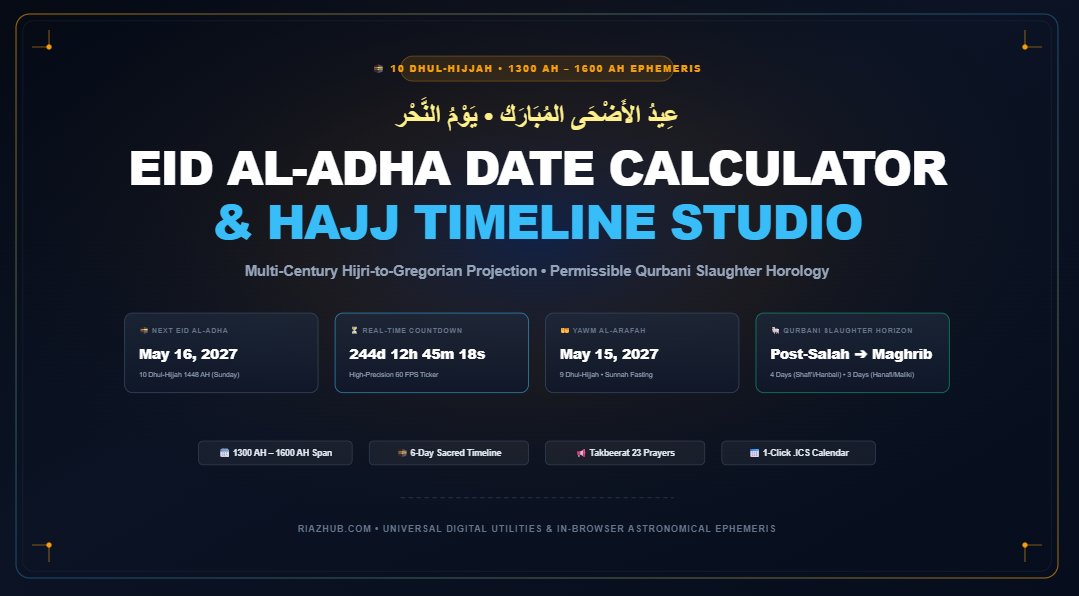
The Astronomy, Hajj Chronology & Qurbani Fiqh of Eid al-Adha: Multi-Century Projections (1300–1600 AH)
Eid al-Adha (عيد الأضحى المبارك), celebrated on the 10th of Dhul-Hijjah as Yawm al-Nahr (The Day of Sacrifice), represents the sacred culmination of the annual Hajj pilgrimage in Makkah. While common civil calendars simply list a holiday date, the true determination of Eid al-Adha weaves together rigorous lunar ephemeris, Julian Day mathematics, moon-sighting protocols, and precise juristic boundaries governing sacrifice and prayer.
Whether planning family travel, booking livestock for sacrifice, tracking work leave, or preparing your heart for the sacred Days of Tashreeq, utilizing the digital Universal Eid al-Adha Date Calculator, Hajj Timeline & Qurbani Studio on RiazHub enables believers and researchers to project exact dates across more than three centuries from 1300 AH up to 1600 AH (1882 CE – 2174 CE).
1. The Astronomical Ephemeris: How Eid al-Adha Dates are Calculated
The Islamic calendar is purely lunar, consisting of 12 synodic months with an average duration of approximately 29.530589 solar days. Consequently, an Islamic year spans 354 days in a common year and 355 days in a leap year (known as Kabisa). Over each 30-year cycle, 11 leap days are introduced according to precise astronomical arithmetic.
Because the lunar year is roughly 10.875 days shorter than the solar Gregorian year (365.2422 days), Islamic holidays retrogress through the solar seasons over a ~33-year cycle. An Eid al-Adha celebrated in the blazing mid-summer heat will, 16 years later, fall during the crisp chill of winter.
🔭 Mathematical Julian Day Number (JDN) Formulation
To compute the exact 10th of Dhul-Hijjah across 1300 AH – 1600 AH, the engine translates Hijri year H, month M = 12, and day D = 10 into the continuous Julian Day Number (JDN):
JDN = ⌊(11 × H + 3) / 30⌋ + 354 × H + 30 × M - ⌊(M - 1) / 2⌋ + D + 1948440 - 385
The resulting JDN is subsequently converted into the standard Gregorian calendar via the Fliegel-Van Flandern algorithm, matching verified civil ephemeris data from the Umm al-Qura calendar of Makkah while allowing bidirectional exploration across three full centuries.
With the interactive engine at RiazHub’s Eid al-Adha Date Calculator, visitors can select any target year between 1300 AH and 1600 AH to see immediate synchronization between the Hijri year and Gregorian year, complete with day-of-week indicators and seasonal tags.
2. Moon-Sighting Calibration: Umm al-Qura vs. Global & Regional Horizons
A frequent question among Muslims worldwide is why Eid al-Adha dates can occasionally differ by 24 to 48 hours across continents. The tool accounts for this variance through its built-in Moon-Sighting Calibration Matrix:
- 🕋 Umm al-Qura Calendar (Makkah Standard): In the Kingdom of Saudi Arabia, the start of Dhul-Hijjah is decreed by the Supreme Court based on official moonsighting reports. Because the rites of Hajj on Mount Arafah take place physically in Makkah, the majority of the Muslim world aligns Eid al-Adha with the day immediately following Waqfat ‘Arafah.
- 🌙 Global Crescent Sighting: Communities adhering strictly to physical crescent observation (Ru’yat al-Hilal) may determine the 1st of Dhul-Hijjah based on naked-eye or optical crescent sightings in their own longitude, which can lead to a 1-day variance in parts of North America, Europe, or South Asia.
- 🔭 Astronomical Calculation: Bodies such as the Fiqh Council of North America (FCNA) and the European Council for Fatwa and Research (ECFR) adopt astronomical conjunction criteria (the crescent birth prior to sunset in Makkah or local horizon), ensuring years of predetermined calendar certainty.
- 📍 Manual Regional Offset Steppers (-2 to +2 Days): Allows local mosque committees and individuals to adjust the baseline calendar by -2, -1, 0, +1, or +2 days to reflect local moon declarations with zero mathematical error.
3. The Complete 6-Day Sacred Chronology: From Tarwiyah to Tashreeq
Eid al-Adha cannot be understood in isolation from the sacred choreography of Hajj. The Eid al-Adha Horology Studio details each step of the sacred timeline:
Yawm al-Tarwiyah (يَوْمُ التَّرْوِيَة)
Pilgrims enter Ihram, depart Makkah for Mina, and pray Dhuhr, Asr, Maghrib, Isha, and Fajr shortened without combining. Non-pilgrims enter spiritual readiness.
Yawm al-Arafah (يَوْمُ عَرَفَة)
The greatest pillar of Hajj: Standing at Mount Arafah (Wuquf) until sunset. Non-pilgrims observe the highly virtuous Sunnah Fast, expiating sins of two years.
Yawm al-Nahr / Eid al-Adha (يَوْمُ النَّحْر)
Eid congregational prayer, animal sacrifice (Qurbani), stoning Jamarat al-Aqaba, shaving hair (Tahallul), and Tawaf al-Ifadah. Fasting is strictly prohibited.
Ayyam al-Tashreeq: Day 1 (يَوْمُ القَرّ)
Pilgrims reside in Mina, stoning all three Jamarat pillars after midday. Takbeerat al-Tashreeq recited audibly after each obligatory prayer.
Ayyam al-Tashreeq: Day 2 (يَوْمُ النَّفْرِ الأَوَّل)
Continuation of stoning. Early departure from Mina (Ta’ajjul) permitted before sunset. Hanafi/Maliki Qurbani window closes at sunset today.
Ayyam al-Tashreeq: Day 3 (يَوْمُ النَّفْرِ الثَّانِي)
Final stoning of the 3 Jamarat and Farewell Tawaf. Takbeerat al-Tashreeq conclude after Asr. Shafi’i/Hanbali Qurbani window closes at sunset today.
4. Permissible Qurbani (Udhiyah) Slaughtering Horizons
One of the most vital functionalities within the Hajj & Qurbani Studio is its legal sacrifice horizon calculator. The slaughtering of livestock (sheep, goats, cattle, or camels) is strictly bounded by canonical Islamic jurisprudence:
The Inviolable Starting Boundary (Onset)
The slaughter may only begin after the completion of the local Eid prayer on the morning of the 10th of Dhul-Hijjah. As narrated by Al-Bara’ bin ‘Azib, the Prophet Muhammad ﷺ stated:
“Whoever slaughters before the prayer, it is only meat that he provided for his family; but whoever slaughters after the prayer, his sacrifice is complete and he has conformed to the Sunnah of the Muslims.” (Sahih al-Bukhari 955)
The Closing Boundary (Madhhab Comparison)
Islamic scholars differ on the final cutoff for permissible slaughtering:
| Madhhab / Juristic School | Permissible Duration | Final Cutoff Time |
|---|---|---|
| Shafi’i & Hanbali (Majority Jumhur) | 4 Days (10th, 11th, 12th, and 13th) | Sunset (Maghrib) on 13th Dhul-Hijjah |
| Hanafi & Maliki | 3 Days (10th, 11th, and 12th) | Sunset (Maghrib) on 12th Dhul-Hijjah |
By selecting your Madhhab in the RiazHub Qurbani Studio, you can immediately visualize the countdown to the exact hour and minute when your slaughtering window opens and closes.
5. Takbeerat al-Tashreeq: Rules, Recitation & The 23 Prayers Schedule
The Takbeerat al-Tashreeq represent an illustrious Sunnah (and an emphasized obligation according to the Hanafi school) proclaimed audibly after every obligatory (Fard) prayer.
“Allāhu Akbar, Allāhu Akbar, Lā ilāha illallāh, Wallāhu Akbar, Allāhu Akbar, wa lillāhil-ḥamd.”
The prescribed window encompasses precisely 23 consecutive prayers:
- Fajr of 9th Dhul-Hijjah (Day of Arafah) Recitation begins immediately after the salam of the obligatory prayer.
- Continuing through all 5 daily prayers on the 9th, 10th, 11th, and 12th of Dhul-Hijjah (20 prayers).
- Concludes after Asr prayer on the 13th of Dhul-Hijjah (3 prayers: Fajr, Dhuhr, Asr).
The tool provides a digital 23-prayer checklist alongside built-in Arabic speech synthesis audio and a digital Tasbeeh counter to help you track your recitations seamlessly.
6. Multi-Century Projection Reference Matrix (Sample 1445–1455 AH)
Below is an illustrative snapshot of projected Eid al-Adha dates calculated through the astronomical engine:
| Hijri Year | Day of Arafah (9 Dhul-Hijjah) | Eid al-Adha (10 Dhul-Hijjah) | Day of the Week | Season |
|---|---|---|---|---|
| 1445 AH | June 15, 2024 | June 16, 2024 | Sunday | Summer |
| 1446 AH | June 5, 2025 | June 6, 2025 | Friday | Summer |
| 1447 AH | May 26, 2026 | May 27, 2026 | Wednesday | Late Spring |
| 1448 AH | May 15, 2027 | May 16, 2027 | Sunday | Spring |
| 1449 AH | May 4, 2028 | May 5, 2028 | Friday | Spring |
| 1450 AH | April 23, 2029 | April 24, 2029 | Tuesday | Spring |
| 1451 AH | April 12, 2030 | April 13, 2030 | Saturday | Spring |
| 1452 AH | April 2, 2031 | April 3, 2031 | Thursday | Early Spring |
| 1453 AH | March 21, 2032 | March 22, 2032 | Monday | Early Spring |
| 1454 AH | March 10, 2033 | March 11, 2033 | Friday | Late Winter |
| 1455 AH | February 28, 2034 | March 1, 2034 | Wednesday | Late Winter |
To examine dates before 1445 AH (back to 1300 AH / 1882 CE) or future decades up to 1600 AH (2174 CE), visit the full Universal Eid al-Adha Date Calculator on RiazHub.
7. Practical Holiday Planning: Leave Estimators & iCalendar Sync
Because Eid al-Adha is accompanied by four consecutive festive days where fasting is forbidden (“Days of eating, drinking, and remembering Allah” Sahih Muslim 1141), planning public holiday leaves is crucial for families and businesses.
The tool incorporates an intelligent Leave & Vacation Estimator that pairs your community’s weekend structure (Friday/Saturday vs. Saturday/Sunday) with official government holiday spans to calculate total uninterrupted consecutive off-days.
Furthermore, with the 1-Click .ICS Export, you can download an Apple, Google, and Outlook-compatible calendar schedule loaded with automated notification alarms:
- 12-hour advance reminder to prepare intentions for fasting the Day of Arafah.
- 1-day advance alarm to prepare Eid prayer attire, Takbeerat, and Qurbani arrangements.
- Automated alert spanning the Days of Tashreeq to maintain recitation after every obligatory prayer.
Universal Eid al-Adha Date Calculator, Hajj Timeline & Qurbani Studio
Calculate the exact astronomical dates of Eid al-Adha (10th Dhul-Hijjah / Yawm al-Nahr) across three centuries (1300 AH – 1600 AH / 1882 CE – 2174 CE), track high-precision live countdowns, explore the complete 6-day Hajj chronology, calculate permissible Qurbani sacrifice windows, practice Takbeerat al-Tashreeq with audio, generate social greeting cards, and sync 1-click calendar events.
Countdown to Eid al-Adha (10 Dhul-Hijjah 1448 AH)
Target Dawn: Sunday, May 16, 2027 (Makkah Calibration)
Permissible Qurbani (Udhiyah) Window
Window opens immediately following Eid Prayer on Sunday, May 16, 2027 (~06:30 AM).
Complete 6-Day Sacred Hajj & Eid Chronology Matrix
Step-by-step roadmap from the 8th of Dhul-Hijjah (Yawm al-Tarwiyah) through the 13th of Dhul-Hijjah (Final Day of Tashreeq).
اللَّهُ أَكْبَرُ، اللَّهُ أَكْبَرُ، لَا إِلٰهَ إِلَّا اللَّهُ، وَاللَّهُ أَكْبَرُ، اللَّهُ أَكْبَرُ، وَلِلّٰهِ الحَمْدُ
🕌 The 23 Obligatory Prayers Recitation Schedule Fajr 9th Dhul-Hijjah ➔ Asr 13th Dhul-Hijjah
According to the majority of scholars (and strictly obligatory in the Hanafi madhhab), Takbeerat al-Tashreeq must be recited immediately after completing every obligatory (Fard) prayer for 23 consecutive prayers:
Multi-Century Hijri-to-Gregorian Projection (1300 AH – 1600 AH)
Comprehensive astronomical lookup table mapping the 10th of Dhul-Hijjah across 300+ years (1882 CE – 2174 CE).
| Hijri Year | Yawm al-Arafah (9 Dhul-Hijjah) | Eid al-Adha (10 Dhul-Hijjah) | Day of Week | Season | Timeline Status | Action |
|---|
📖 Significance of Eid al-Adha, Qurbani Fiqh & Ephemeris Guide
Eid al-Adha (عيد الأضحى المبارك), also known as the Feast of the Sacrifice or Yawm al-Nahr (يوم النحر), is the second of the two canonical Islamic holidays. It marks the culmination of the annual Hajj pilgrimage in Makkah and commemorates the supreme obedience and steadfast devotion of Prophet Ibrahim (Abraham) and Prophet Isma'il (Ishmael) when commanded by Allah. Allah redeemed Isma'il with a momentous sacrificial ram, establishing an enduring rite of devotion for all believers.
The slaughter of the sacrificial animal (Udhiyah / Qurbani) has strict juristic temporal boundaries:
- Onset (Start): Strictly following the completion of the local Eid prayer on the 10th of Dhul-Hijjah. Prophet Muhammad ﷺ explicitly stated: "Whoever slaughters before the prayer, it is only meat that he provided for his family, and it is not in any way a sacrifice" (Sahih al-Bukhari 955).
- Cutoff (End) in Shafi'i & Hanbali Madhhabs: Closes at sunset (Maghrib) on the 13th of Dhul-Hijjah (a total of 4 full sacrifice days).
- Cutoff (End) in Hanafi & Maliki Madhhabs: Closes at sunset (Maghrib) on the 12th of Dhul-Hijjah (a total of 3 full sacrifice days).
Takbeerat al-Tashreeq are proclaimed audibly after every obligatory (Fard) congregational prayer starting from the Fajr prayer of the 9th of Dhul-Hijjah (Day of Arafah) until the Asr prayer of the 13th of Dhul-Hijjah. This encompasses exactly 23 consecutive prayers:
- 9th Dhul-Hijjah: Fajr, Dhuhr, Asr, Maghrib, Isha (5 prayers)
- 10th Dhul-Hijjah: Fajr, Dhuhr, Asr, Maghrib, Isha (5 prayers)
- 11th Dhul-Hijjah: Fajr, Dhuhr, Asr, Maghrib, Isha (5 prayers)
- 12th Dhul-Hijjah: Fajr, Dhuhr, Asr, Maghrib, Isha (5 prayers)
- 13th Dhul-Hijjah: Fajr, Dhuhr, Asr (3 prayers — concludes at Asr)
Fasting is strictly prohibited (Haram) on the 10th of Dhul-Hijjah (the Day of Eid) as well as the three subsequent Days of Tashreeq (11th, 12th, and 13th of Dhul-Hijjah). The Prophet Muhammad ﷺ declared: "The days of Tashreeq are days of eating, drinking, and remembering Allah" (Sahih Muslim 1141). Non-pilgrims are, however, strongly encouraged to fast on the 9th of Dhul-Hijjah (Day of Arafah), which expiates the sins of the preceding and coming year.
All calendar transformations across 1300 AH – 1600 AH, countdown ticking intervals, ephemeris alignments, audio speech synthesis, and iCalendar file generations are executed strictly within your local browser. Zero personal schedules, IP addresses, or user parameters are ever sent to an external server.