
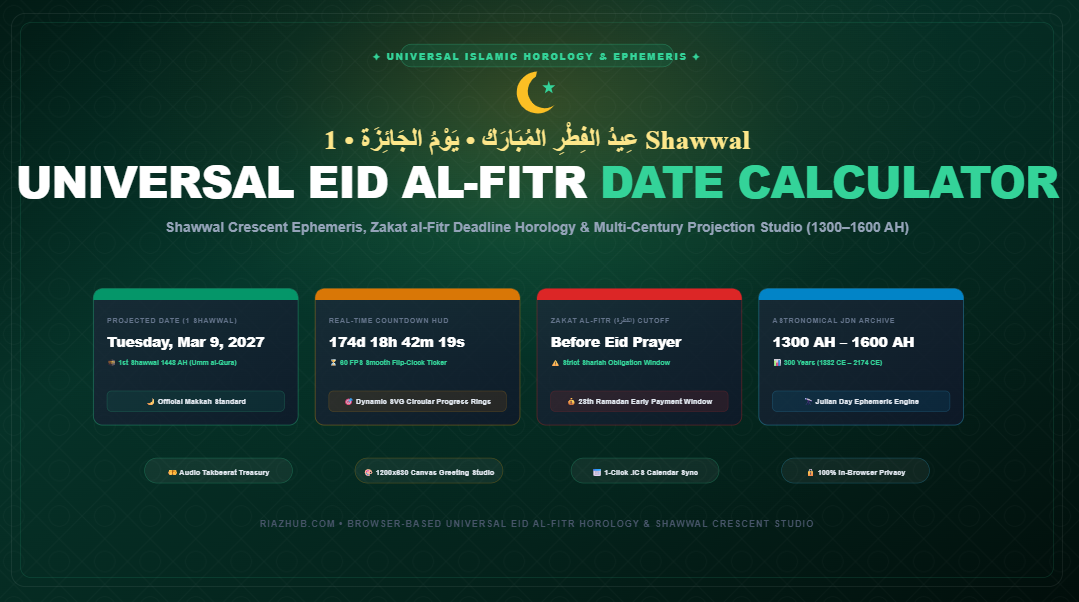
The Astronomy, Shawwal Crescent Ephemeris & Zakat al-Fitr Horology of Eid al-Fitr (1300–1600 AH)
An authoritative master guide exploring the exact mechanics of 1st Shawwal moon sighting, the Shariah deadlines of Zakat al-Fitr, the spiritual majesty of Yawm al-Jā’izah, and three centuries of astronomical projections using the Universal Eid al-Fitr Date Calculator.
🌙 1. The Spiritual Foundations of Eid al-Fitr (يَوْمُ الجَائِزَة)
Eid al-Fitr (عِيدُ الفِطْرِ المُبَارَك), known linguistically as the “Festival of Breaking the Fast,” constitutes the first of the two canonical celebrations mandated in Islamic sacred tradition. Falling on the 1st day of Shawwal (شَوَّال), the tenth month of the lunar Hijri calendar, it marks the joyous culmination of Ramadan’s rigorous month-long discipline of fasting (Sawm), Quranic recitation, night prayers (Tarawih), and heightened spiritual contemplation.
In classical Islamic scholarship, Eid al-Fitr is honored as يَوْمُ الجَائِزَة (Yawm al-Jā’izah The Day of Reward). Traditional hadith compilations record that as the believers proceed to the open prayer grounds (Musalla) on Eid morning, celestial ranks of angels line the roads proclaiming:
“O Ummah of Muhammad! Go forth to a Generous Lord who bestows abundant gifts and pardons immense transgressions!”
Narrated in classical hadith transmissions; Bayhaqi in Shu’ab al-Iman
Unlike secular holidays centered upon personal indulgence, Islamic festivals are fundamentally rooted in grateful worship (Shukr). The day is consecrated not by negligence, but by collective remembrance: beginning with the obligatory disbursement of Zakat al-Fitr to eradicate hunger among the impoverished, vocalizing resonant praise through the Takbeerat, and prostrating together in the congregational Eid Salah.
🔭 2. Crescent Sighting Ephemeris: The Science of Chaand Raat
Because the Islamic calendar is strictly lunar (synodic), the declaration of Eid al-Fitr is inextricably tied to the astronomical birth of the new moon and the physical or calculated sighting of the young Shawwal crescent (Hilal). The evening preceding Eid is celebrated culturally across South Asia and the diaspora as Chaand Raat (Night of the Moon).
On the 29th day of Ramadan, Muslim communities worldwide scan the western horizon immediately after sunset (Maghrib). If the razor-thin crescent is observed, Ramadan concludes at 29 days, and the following morning is celebrated as 1st Shawwal. If the crescent is obscured by atmospheric occlusion, clouds, or has not achieved sufficient altitude and solar elongation, the Prophet Muhammad ﷺ decreed that Ramadan must complete its full span of 30 days:
“Fast upon sighting it [the crescent], and break your fast upon sighting it; and if it is obscured from you, complete the count of thirty days.”
Sahih al-Bukhari 1909; Sahih Muslim 1081
Modern astronomical horology utilizes four primary sighting paradigms, all of which are modeled directly inside the Universal Eid al-Fitr Date Calculator:
| Convention | Geographical Focus | Ephemeris Criteria | Offset Baseline |
|---|---|---|---|
| Umm al-Qura (Official) | Makkah / Saudi Arabia & GCC | Sun sets before moonset at the coordinates of the Holy Ka’bah after astronomical conjunction. | 0 Day Baseline |
| Global Naked-Eye Sighting | Traditional International | Verified authentic optical sighting anywhere in the world where the crescent achieves visibility threshold. | 0 to +1 Day Offset |
| Astronomical / FCNA | North America & Europe | Calculated conjunction where moonset occurs after sunset with minimum 8° solar elongation anywhere on Earth. | Calibrated Calculation |
| Regional Local Horizon | Local Communities (Asia, UK, Americas) | Restricted strictly to the optical horizon (Matla’) of the local territory or contiguous borders. | Manual Tuner (-2 to +2) |
You can test and visualize these sighting conventions in real time with the RiazHub Eid al-Fitr Studio, which features a dedicated Moonsighting Variance Offset tuner to align dates with your local Islamic shura.
💰 3. Zakat al-Fitr Horology: Fiqh Rules, Sa’ Measurement & Strict Deadlines
Unlike Zakat al-Mal (which depends upon wealth thresholds and the passage of one lunar year), Zakat al-Fitr (زَكَاةُ الفِطْرِ also called Sadaqat al-Fitr or Fitrah) is an obligatory tax upon the person (Zakat al-Nafs). It is incumbent upon every Muslim individual male or female, young or old, freeman or servant—who possesses sustenance beyond their and their family’s immediate needs for the day and night of Eid.
“The Messenger of Allah ﷺ enjoined Zakat al-Fitr as a purification for the fasting person from idle talk and obscenities, and as food for the needy. Whoever pays it before the prayer, it is an accepted Zakat, and whoever pays it after the prayer, it is merely a charity among charities.”
Sunan Abi Dawood 1609; Ibn Majah 1827 (Hasan)
How Much is One Sa’ (صَاع)?
Classical jurists defined Zakat al-Fitr as one Sa’ (صاع) of staple food (wheat, barley, dates, raisins, or rice). Scientifically, one Sa’ equals four Mudd (the volume held by two cupped average adult hands), which equates to roughly 2.5 kg to 3.0 kg (5.5 to 6.6 lbs) of raw grain.
While the Maliki, Shafi’i, and Hanbali madhhabs advocate distributing actual staple foodstuffs, the Hanafi jurists (and numerous contemporary scholars) permit discharging the equivalent monetary valuation (typically $10 to $15 per family member in North America, £5 to £7 in the UK, or equivalent local purchasing power) to maximize utility for the needy.
The Two Payment Windows:
- The Sunnah Early Payment Window (28th–30th Ramadan): As established in Sahih al-Bukhari (1511), the noble Companion Abdullah ibn Umar (رضي الله عنه) gave Zakat al-Fitr one or two days before Eid. This guarantees relief organizations have ample time to convert funds into food and deliver it to recipients before Eid morning.
- The Day of Eid Morning: From dawn (Fajr) on 1st Shawwal until the commencement of Eid Salah. This is the optimal window (Waqt al-Fadilah).
To help families track their fulfillment, the Universal Eid al-Fitr Studio incorporates an interactive Zakat status tracker with deadline warnings and reminders.
📊 4. Multi-Century Projection Engine (1300 AH – 1600 AH / 1882 CE – 2174 CE)
A core architectural hallmark of the Eid al-Fitr Date Calculator is its dual-layer mathematical engine. Rather than relying upon static, short-term lookups, it pairs a verified Umm al-Qura observational calibration matrix (1440 AH – 1460 AH) with an astronomical Julian Day Number (JDN) Fliegel-Van Flandern conversion engine capable of projecting 1st Shawwal across three centuries:
Notable Eid al-Fitr Ephemeris Landmarks (1445 AH – 1455 AH):
| Hijri Year (AH) | Gregorian Date (CE) | Day of Week | Chaand Raat | Seasonal Climate |
|---|---|---|---|---|
| 1445 AH | April 10, 2024 | Wednesday | April 9, 2024 | 🌸 Spring |
| 1446 AH | March 30, 2025 | Sunday | March 29, 2025 | 🌸 Spring |
| 1447 AH | March 20, 2026 | Friday | March 19, 2026 | 🌸 Spring (Jumu’ah Eid) |
| 1448 AH | March 9, 2027 | Tuesday | March 8, 2027 | 🌸 Spring |
| 1449 AH | February 27, 2028 | Sunday | February 26, 2028 | ❄️ Winter |
| 1450 AH | February 15, 2029 | Thursday | February 14, 2029 | ❄️ Winter |
| 1455 AH | December 23, 2033 | Friday | December 22, 2033 | ❄️ Deep Winter |
Explore the complete multi-century archive across the 14th, 15th, and 16th centuries directly inside the RiazHub Multi-Century Projection Archive.
☀️ 5. Sunnah Etiquettes & Takbeerat al-Fitr Treasury
The morning of Eid al-Fitr is adorned with authentic Prophetic traditions that bring joy, dignified decorum, and immense barakah to the believer’s household:
- Performing Ghusl (Ritual Bath): Purifying oneself completely before heading out to the Eid prayer (Ibn Majah 1315).
- Eating an Odd Number of Dates: The Prophet ﷺ never departed on the morning of Eid al-Fitr until he had eaten some dates in odd numbers (1, 3, 5, or 7) to signify the termination of fasting (Sahih al-Bukhari 953).
- Wearing One’s Finest Permissible Garments: Dressing in one’s best clothes and applying fine perfume (for men).
- Reciting Takbeerat Aloud: Men recite aloud and women recite softly while walking to the prayer ground.
- Taking Alternate Routes (مخالفة الطريق): Walking to the Musalla via one path and returning by another to witness and greet different neighbors and angels (Sahih al-Bukhari 986).
- The Classical Eid Greeting: Exchanging the traditional greeting of the Companions: تَقَبَّلَ اللَّهُ مِنَّا وَمِنْكُمْ (Taqabbalallāhu minnā wa minkum — “May Allah accept from us and from you”).
The Two Authentic Wordings of Takbeerat al-Fitr:
The Universal Eid al-Fitr Date Calculator features built-in audio pronunciation and one-click transliteration copy buttons for both standard and extended Takbeerat formulas:
Allāhu Akbar, Allāhu Akbar, Lā ilāha illallāh, Allāhu Akbar, Allāhu Akbar, Wa lillāhil hamd
Standard Formula; practiced by the Sahabah (Ibn Abi Shaybah)
Allāhu Akbar kabīrā, wal-hamdu lillāhi kathīrā, wa subhānallāhi bukratan wa asīlā. Lā ilāha illallāhu wahdah, sadaqa wa’dah, wa nasara ‘abdah, wa a’azza jundah, wa hazamal ahzāba wahdah.
Extended Formula; narrated by Ibn Mas’ud (Musnad Ahmad)
🌟 6. The Six Days of Shawwal: Spiritual Significance & Timing
While fasting on the first day of Shawwal (Eid day itself) is strictly forbidden (harām), a celebrated Sunnah begins immediately on the 2nd day of Shawwal: fasting six voluntary days (صِيَامُ الْسِّتِّ مِن شَوَّال).
“Whoever fasts Ramadan and then follows it with six days of Shawwal, it is as if he fasted for a lifetime [the entire year].”
Sahih Muslim 1164
The mathematical beauty of this reward is grounded in the Quranic principle that every righteous deed is rewarded tenfold (Surah Al-An’am 6:160). Fasting 30 days of Ramadan equals 300 days of reward; fasting 6 days of Shawwal equals 60 days of reward. Combined, 360 days equal a complete lunar year!
- Opening Window: 2nd of Shawwal (immediately following Eid day).
- Closing Window: Sunset on the 30th of Shawwal.
- Consecutive vs. Scattered: According to the majority of scholars (including the Shafi’i and Hanbali madhhabs), it is permissible to fast these six days either consecutively or scattered throughout the month.
🎨 7. Exploring the Universal Eid al-Fitr Calculator & Studio
Built to serve modern Muslim families, travelers, mosques, and event organizers, the Universal Eid al-Fitr Date Calculator packages professional-grade astronomical calculations into an ultra-fast, responsive web studio:
- 60 FPS Live Countdown HUD: Watch smooth flip-clock timers and circular progress rings tick down to the exact dawn of Eid.
- Interactive Sunnah Checklist: Track your morning preparations step-by-step with real-time percentage completion bars.
- Audio Takbeerat Treasury: Listen to authentic pronunciations with smart Arabic voice detection and acoustic chime backups.
- 1200×630 Canvas Greeting Card Studio: Personalize luxury greeting cards with your family’s name in Imperial Emerald, Royal Gold, Midnight Navy, Moroccan Crimson, or Desert Obsidian palettes, downloadable instantly as high-resolution PNGs.
- Vacation Optimization Engine: Calculate consecutive holiday off-days based on regional weekend models (Fri–Sat or Sat–Sun).
❓ 8. Frequently Asked Questions (Juristic & Astronomical)
Universal Eid al-Fitr Date Calculator, Shawwal Crescent & Zakat al-Fitr Studio
Calculate the exact astronomical dates of Eid al-Fitr (1st Shawwal / يوم الجائزة) across three centuries (1300 AH – 1600 AH / 1882 CE – 2174 CE), track high-precision live countdowns, monitor Zakat al-Fitr deadlines, practice Takbeerat al-Fitr with audio, generate social greeting cards, and sync holiday schedules in real time.
📖 Significance of Eid al-Fitr, Zakat Rules & Sunnah Etiquettes
Eid al-Fitr — literally "the Festival of Breaking the Fast" — marks the completion of the blessed month of Ramadan. It falls on the 1st day of Shawwal, the 10th month of the Islamic Hijri calendar.
It is called يَوْمُ الجَائِزَة (Yawm al-Jā'izah — "The Day of Reward") because scholars narrate that on this day, Allah distributes the immense rewards earned by the fasting believers during Ramadan. The angels stand at the roads calling: "O Muslims! Hasten to your Generous Lord, for He gives bountifully and forgives great sins."
Unlike Eid al-Adha which is tied to the Hajj pilgrimage, Eid al-Fitr is a celebration of gratitude — thanking Allah ﷻ for enabling the completion of fasting (Sawm) and the nightly Tarawih prayers throughout Ramadan.
وَلِتُكْمِلُوا الْعِدَّةَ وَلِتُكَبِّرُوا اللَّهَ عَلَىٰ مَا هَدَاكُمْ وَلَعَلَّكُمْ تَشْكُرُونَ
"…that you should complete the number (of days of Ramadan), and that you should magnify Allah for having guided you, and that perhaps you may be grateful." — Surah Al-Baqarah 2:185
Every Muslim who possesses food beyond their and their dependents' basic needs for Eid day. The head of household pays on behalf of themselves, spouse, children, and dependent parents.
One Sa' (صاع) of staple food — approximately 2.5 kg to 3 kg of wheat, rice, dates, barley, or raisins. In modern cash, usually $10–$15 per person according to local Islamic councils.
1. Purifies the fasting person from idle talk or indecent conduct during Ramadan. 2. Provides food for the poor so they can celebrate Eid without begging (Abu Dawood 1609).
Must reach the poor before the Eid Salah starts. If delayed until after the prayer, it counts only as ordinary voluntary charity (Sadaqah) and the obligation remains delinquent.
- Perform Ghusl — Take a complete ritual bath before the Eid prayer (Ibn Majah 1315).
- Eat an Odd Number of Dates — The Prophet ﷺ ate an odd number of dates before leaving for Eid prayer (Sahih al-Bukhari 953). Typically 3, 5, or 7 dates.
- Wear Best Clothes & Apply Fragrance — Dress in the finest available garments and apply perfume (for men).
- Recite Takbeerat — Recite the Takbeerat aloud while walking to the Musalla. Men recite audibly; women recite quietly.
- Walk to the Prayer Ground if Possible — It is Sunnah to walk to the Eid prayer and to use a different route when returning (مخالفة الطريق) (Sahih al-Bukhari 986).
- Exchange the Islamic Eid Greeting — Say: تَقَبَّلَ اللَّهُ مِنَّا وَمِنْكُمْ (Taqabbalallāhu minnā wa minkum) — "May Allah accept from us and from you."
After completing Ramadan, Muslims are encouraged to voluntarily fast six additional days during Shawwal. The Prophet ﷺ guaranteed the reward of fasting an entire year.
مَنْ صَامَ رَمَضَانَ ثُمَّ أَتْبَعَهُ سِتًّا مِنْ شَوَّالٍ كَانَ كَصِيَامِ الدَّهْرِ
"Whoever fasts Ramadan and then follows it with six days of Shawwal, it is as if he fasted for a lifetime." — Sahih Muslim 1164
This tool performs 100% of all calculations entirely inside your browser using pure vanilla JavaScript. No data, queries, location information, vacation dates, or personal schedules are ever transmitted to any external server.