
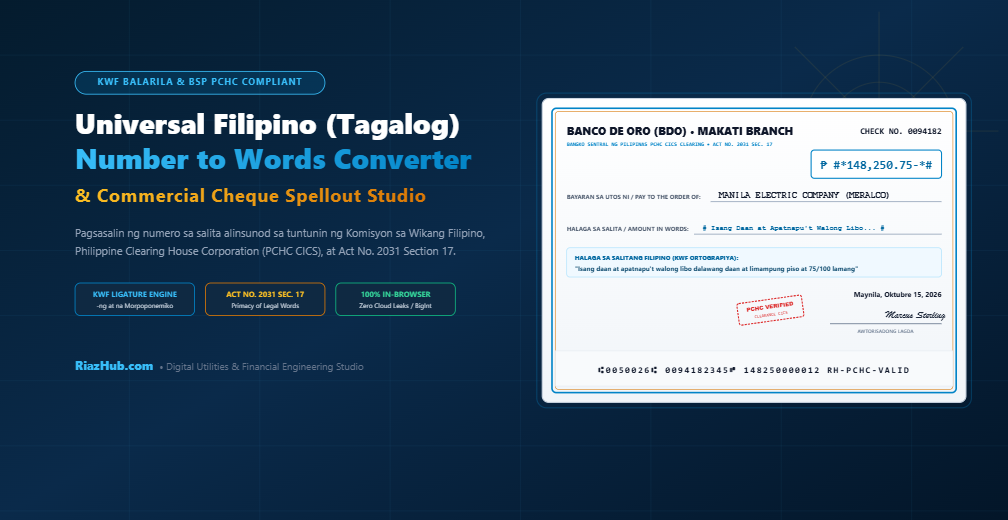
The Complete Guide to Filipino Tagalog Number to Words Conversion, BSP Cheque Clearing, and Act No. 2031 Legal Spellout
To eliminate transcription errors, ligature mistakes, and check alteration vulnerabilities, financial controllers and business owners rely on the Filipino (Tagalog) Number to Words Converter & Currency Spellout Studio. This browser-based suite transforms raw figures into certified Filipino words while previewing bank draft cheques and accounting disbursement slips with complete data privacy.
1. The Legal Foundation: Statutory Primacy of Words over Figures (Act No. 2031)
Many business owners assume that the numeric box on a bank check or voucher determines the amount to be disbursed. Under Philippine law, this assumption is incorrect. The governing statute for all negotiable paper in the Philippines is Act No. 2031, known as the Philippine Negotiable Instruments Law.
Section 17(c) of Act No. 2031 Mandates:
“Where the sum payable is expressed in words and also in figures and there is a discrepancy between the two, the sum denoted by the words is the sum payable; but if the words are ambiguous or uncertain, reference may be had to the figures to fix the amount.”
In the jurisprudence of the Supreme Court of the Philippines, when a discrepancy occurs between the written letters (halaga sa salita) and the numeric digits (halaga sa numero), clearing banks are legally obligated to honor the amount written in words. If a check states ₱ 148,250.75 in the numerical figure box but the legal words line reads Isang Daan at Apatnapu't Walong Libo Dalawang Daan at Limampung Piso Lamang (omitting the 75 centavos), the legal tender payable is strictly limited to the word amount.
This statutory rule makes the exact grammatical verbalization of currency paramount. Utilizing a verified utility like the Philippine Currency Spellout Studio on RiazHub ensures that every centavo and scale magnitude is explicitly inflected to protect issuers against costly payment disputes.
2. Morphophonological Ligatures: The KWF Balarila Protocol
Unlike English or Spanish, which link numerals through simple conjunctions or juxtaposition, the Filipino national language (Wikang Pambansa) operates on an intricate morphophonological system governed by ligatures (pang-angkop). In accordance with the Ortograpiyang Pambansa issued by the Komisyon sa Wikang Filipino, numbers must attach appropriate linkers when preceding counting nouns or denomination scales.
The Primary Ligature Rules:
- The Linker
-ng(Pang-angkop na -ng): Attaches directly to the root when the preceding number ends in a vowel (a, e, i, o, u) or the letter n.- isa + daan →
isang daan(One hundred) - dalawa + libo →
dalawang libo(Two thousand) - tatlo + milyon →
tatlong milyon(Three million) - pito + libo →
pitong libo(Seven thousand) - siyam + na daan →
siyam na raan/siyam na daan
- isa + daan →
- The Linker
na(Pang-angkop na na): Remains a standalone word when the preceding number ends in a consonant other than n (e.g., t, m, k, p, s).- apat + libo →
apat na libo(Four thousand) - anim + na daan →
anim na daan(Six hundred)
- apat + libo →
- Contracted Tens and Unit Coupling: Tens joining units utilize the conjunction at (and), which undergoes contraction to
'twhen attached to vowel-ending tens.- 21 →
dalawampu't isa - 32 →
tatlumpu't dalawa - 45 →
apatnapu't lima - 58 →
limampu't walo - 77 →
pitumpu't pito - 99 →
siyamnapu't siyam
- 21 →
In standard financial drafting, casual contractions like sandaan (100) or sanlibo (1,000) are discouraged in favor of full-precision formulations: isang daan and isang libo. This practice prevents fraudulent stroke alterations on bank documents.
3. Dual Counting Paradigms: Native Filipino vs. Hispano-Tagalog
The Philippine commercial landscape maintains two parallel counting systems. Understanding when to apply each paradigm is vital for financial documentation:
| Numeric Figure | Native Wikang Pambansa (Purist Tagalog) | Hispano-Tagalog (Commercial Colloquial) |
|---|---|---|
| 1 to 10 | isa, dalawa, tatlo, apat, lima, anim, pito, walo, siyam, sampu | uno, dos, tres, kuwatro, singko, sais, syete, otso, nuwebe, diyes |
| 20, 50, 100 | dalawampu, limampu, isang daan | bente, singkuwenta, siyento |
| 1,000 & 10,000 | isang libo, sampung libo | mil, diyes mil |
| 1,000,000 | isang milyon | un milyon / isang milyon |
While Hispano-Tagalog remains widely spoken in informal trading hubs (e.g., Divisoria, Binondo, or local public markets), corporate bank drafts, government payroll sheets, and legal contracts predominantly enforce the Native Filipino (Wikang Pambansa) system. The Filipino Number to Words Converter on RiazHub supports both paradigms, allowing users to toggle between purist KWF orthography and colloquial commercial counting with instant real-time re-rendering.
4. PCHC Check Truncation System (CICS) & Cheque Security Standards
Under the Philippine Clearing House Corporation (PCHC) Memorandum Circular No. 3738, all Philippine commercial banks operate under the Check Image Clearing System (CICS). Under CICS, physical checks are scanned at high resolutions and cleared digitally. This process imposes strict formatting requirements:
- Zero Erasure or Alteration Tolerance: Unlike older manual clearing rules where an account holder could counter-sign beside an erasure, CICS strictly rejects checks with any visible alteration, correction fluid, or scratched-out lines. A spelling error requires issuing a completely fresh check.
- Mandatory Terminal Marker (“Lamang”): Philippine banking custom requires appending the word
Lamang(Only) orPiso Lamangat the end of the legal words line. This terminal closure prevents unauthorized parties from inserting supplementary sums (e.g., transforming “One Thousand Pesos” into “One Thousand Five Hundred Pesos”). - Protective Boundary Hash Delimiters: The legal words line should be bounded by security hashes or asterisks, such as
# Isang Daan at Limampung Libong Piso Lamang #. - The Magnetic Ink Character Recognition (MICR) Clear Band: The bottom 5/8-inch of a check is reserved exclusively for the magnetic clearing line containing the routing code, serial number, and account number. No handwritten text or company stamps may bleed into this zone.
Anti-Fraud Tip: Always verify that the words line fills the entire designated space on the bank draft. If excess space remains, draw a horizontal safety line extending to the right border to block unauthorized additions.
5. Corporate Disbursement Vouchers & BIR Tax Alignment
Beyond check leaves, Philippine enterprises must maintain strict corporate ledgers conforming to Bureau of Internal Revenue (BIR) regulations. Official payment transactions typically require a Disbursement Voucher (DV) or Official Receipt (OR) detailing:
- Beneficiary Tax Identification Number (TIN): The 9-digit or 12-digit tax registration number of the payee.
- Gross Commercial Invoice Sum: The pre-tax contracted value.
- Expanded Withholding Tax (EWT): In corporate services, a standard 1% or 2% creditable withholding tax is deducted prior to net check disbursement.
- Authorized Comptroller Audit Trail: A threefold signature sequence representing Prepared By, Certified Correct (Internal Audit), and Approved for Payment (Treasurer/Comptroller).
By using the Filipino Currency Spellout Studio, accountants can generate both the check preview and an official BIR-compliant disbursement voucher with automated 2% EWT tax breakdowns, exportable directly to Markdown or CSV format.
6. Multi-Currency Support (ISO 4217 Matrix)
While the Philippine Peso (PHP / ₱) represents the primary domestic medium of exchange, Philippine multinational companies and import/export firms routinely process international currencies. The RiazHub studio integrates full morphosyntactic declensions across major global currencies:
- PHP: Piso ng Pilipinas (₱) / Subunit: Sentimo
- USD: Dolyar ng Amerika ($) / Subunit: Sentimo / Cents
- EUR: Euro (€) / Subunit: Sentimo / Cents
- JPY: Yen ng Hapon (¥) / Subunit: Sen
- GBP: Pound ng Britanya (£) / Subunit: Pence
- SGD: Dolyar ng Singapore (S$) / Subunit: Sentimo
- SAR: Riyal ng Saudi Arabia (ر.س) / Subunit: Halala
- AED: Dirham ng UAE (د.إ) / Subunit: Fils
- Pure Numbers: Cardinal non-currency digits up to 1030 via custom BigInt logic.
7. 100% In-Browser Privacy & Zero Data Transmission
In financial operations, data privacy is non-negotiable. Traditional web converters often send sensitive payload values such as executive payroll amounts, corporate invoice balances, and vendor bank details to external cloud servers or third-party tracking APIs. This architecture introduces compliance risks under the Philippine Data Privacy Act of 2012 (Republic Act No. 10173).
The Universal Filipino Number to Words Converter operates 100% in-browser using pure client-side JavaScript. All number chunking, KWF ligature linking, HTML5 Canvas 2D check rendering, and document compilation execute locally within your device’s memory. Zero private financial data is ever stored, logged, or transmitted across network connections.
8. Step-by-Step: How to Use the Studio
- Input the Financial Sum: Type any numerical amount into the ingestion field (e.g.,
148250.75). The engine accommodates large numbers through custom BigInt math. - Select the Currency: Choose the currency standard (defaulting to
PHP - Piso ng Pilipinas). - Review the Dedicated Words-Only Display: Directly beneath the input field, the dedicated Halaga sa Salita container will present the inflected Filipino sentence. Click the tactile 📋 Kopyahin ang Salita button to copy the exact text to your clipboard.
- Configure Document Particulars: Enter the Payee name (e.g., Manila Electric Company), check serial number, bank branch, and transaction date.
- Inspect the Staging Draft: Switch between the interactive Bank Cheque Visualizer, Dual-Language Words Deck, Disbursement Voucher, or Shareable Dossier Card.
- Export Your Branded Documentation: Utilize the 1-click export toolbar to download a lossless PNG check image, an accounting voucher Markdown file, a check register CSV, or a print-ready PDF.
Frequently Asked Questions (FAQ)
In Philippine commercial banking, appending Lamang (the Tagalog equivalent of “Only”) marks the terminal end of the amount in words. This prevents unauthorized third parties from writing additional words into vacant spaces on the check.
Both signify 100 in Filipino. However, sandaan is a colloquial contraction. In banking and legal paper, isang daan is strictly preferred because it explicitly spells out the root unit isa, preventing fraudulent alteration or dispute.
Under Section 17(c), if an error exists between the figure box (₱ 50,000) and the written words (Limampung Libong Piso), the words line legally governs. This protects against typographical errors or fraudulent changes made solely to the numerical box.
Yes. The format conforms to the standard PCHC CICS regulations adopted by all licensed commercial and universal banks in the Philippines, including BDO, BPI, Metrobank, Landbank, Security Bank, PNB, and UnionBank.
Completely. The entire linguistics and canvas generation engine operates 100% inside your web browser. No figures, payee names, or bank account references are ever uploaded to any external server.
Universal Filipino (Tagalog) Number to Words Converter & Currency Spellout Studio
Convert numbers and currencies into grammatically verified Filipino words according to Komisyon sa Wikang Filipino (KWF) orthography rules and Bangko Sentral ng Pilipinas (BSP) / PCHC commercial cheque clearing standards.
⚙️ Linguistic & Cheque Formatting Options ▼
Disbursement Voucher & Opisyal na Resibo ng Pagbabayad
| Deskripsyon / Particulars | Pormat sa Salita (Wikang Filipino) | Halaga (Gross) |
|---|---|---|
| Bayad sa Serbisyong Pang-Korporasyon at Suplay | — | — |
| Expanded Withholding Tax (EWT 2%): | — | |
| Kabuuang Halaga ng Tseke (Net Payable): | — | |
📖 Balarila ng Wikang Filipino sa Pagsulat ng Halaga (KWF)
Ayon sa Komisyon sa Wikang Filipino (KWF) Ortograpiyang Pambansa, ang wastong pagsulat ng bilang sa salita ay sumusunod sa mahigpit na alituntunin sa morpoponemikong pang-angkop:
- Pang-angkop na «-ng»: Ikakabit kapag ang salita ay nagtatapos sa patinig (a, e, i, o, u) o sa titik 'n'. Halimbawa: isa + daan = isang daan; dalawa + libo = dalawang libo; tatlo + milyon = tatlong milyon.
- Pang-angkop na «na»: Ginagamit bilang hiwalay na salita kapag ang salita ay nagtatapos sa katinig maliban sa 'n'. Halimbawa: apat na libo; anim na daan.
- Tambalang Sampuan at Isahan: Ginagamitan ng gitling at pandugtong na «'t» (at) tulad ng: dalawampu't isa, tatlumpu't dalawa, pitumpu't lima.
🏦 PCHC CICS at BSP Cheque Clearing Guidelines
Alinsunod sa Philippine Clearing House Corporation (PCHC) Memorandum Circular No. 3738 hinggil sa Check Truncation System (CICS):
- Kahalagahan ng Salita kaysa Numero: Alinsunod sa Section 17(c) ng Negotiable Instruments Law (Act No. 2031), kapag may pagkakaiba ang halagang nakasulat sa numero at sa salita, ang halagang nakasulat sa salita ang siyang pinal at may legal na bisa.
- Paggamit ng Salitang «Lamang»: Ipinag-uutos ang paglalagay ng salitang «Lamang» sa dulo upang matiyak na walang espasyo para sa karagdagang halaga o pandaraya.
- Pag-iingat sa Pagsulat: Tiyaking walang bura o anumang alterasyon upang hindi ma-reject sa clearing ng bangko.