
Mastering Duth Number to Words: The Complete Accounting, Banking & Currency Spellout Guide
In Dutch commercial banking, corporate treasury operations, and notarial conveyancing across the Netherlands and Flanders (Belgium), expressing numeric currency figures in written words known as getallen voluit in woorden schrijven is not merely an editorial convention. It is a strict legal requirement governed by statutory commercial law and standardized computational orthography.
Whenever an organization executes an invoice payment, files a tax report with the Dutch Tax and Customs Administration (Belastingdienst), or signs a corporate negotiable instrument, the written word representation legally supersedes any conflicting numeric figure. To assist financial controllers, software engineers, and accountants in generating infallible Dutch financial spellouts, RiazHub developed the Universal Dutch Number to Words Converter & Currency Spellout Studio.
⚡ Instant Interactive Dutch Number Spellout Studio
Convert any numeric transaction into grammatically verified Dutch words conforming to the Nederlandse Taalunie Groene Boekje, European Long Scale, and Chequewet 1936 standards with 100% in-browser client-side privacy.
1. The Foundation: Nederlandse Taalunie (Groene Boekje) Compounding Rules
The primary authority for spelling in the Dutch language is the Nederlandse Taalunie (Dutch Language Union), whose official orthographic codex is published in the Woordenlijst Nederlandse Taal (popularly known as het Groene Boekje or the Green Booklet).
Under Dutch grammatical rules, numbers have specific concatenation guidelines that differ sharply from English, French, or Spanish:
The Sub-Million Agglutination Rule
All numbers under one million (< 1.000.000) are written as a single continuous compound word without spaces:
148→honderdachtenveertig(oreenhonderdachtenveertigfor fraud protection)2.350→tweeduizenddriehonderdvijftig148.250→eenhonderdachtenveertigduizendtweehonderdvijftig
In Germanic linguistics, numerals form morphological compounds. Concatenating hundreds, thousands, tens, and units into an unbroken word prevents tampering in legal contracts and financial ledgers, as no third party can inject extraneous words into the text.
2. Inverted Units-before-Tens Syntax & The Trema (Diaeresis) Glue Rule
Like German, Dutch syntax reverses the order of numbers between 21 and 99: the unit precedes the ten, joined by the coordinating conjunction en (“and”). For example, 24 is literally “four and twenty” (→ vierentwintig).
The Trema / Diaeresis Orthographic Rule
When the unit ends in the letter e (specifically twee [2] and drie [3]), appending the conjunction en causes a vowel collision (ee + en or ie + en). To preserve the correct phonetic pronunciation and avoid forming an unintended diphthong, a trema (diaeresis: ë) is strictly required on the e of en:
| Number | Dutch Verbalization | Grammar Rule |
|---|---|---|
21 |
eenentwintig |
No vowel collision; standard en joiner. |
22 |
tweeëntwintig |
Mandatory Trema on ë to separate ee from en. |
23 |
drieëntwintig |
Mandatory Trema on ë to separate ie from en. |
24 |
vierentwintig |
No vowel collision; standard en joiner. |
32 |
tweeëndertig |
Mandatory Trema. |
33 |
drieëndertig |
Mandatory Trema. |
62 |
tweeënzestig |
Mandatory Trema. |
83 |
drieëntachtig |
Mandatory Trema. |
Omitting the trema (e.g. writing “tweeentwintig”) is considered a grammatical error by the Taalunie. The algorithm inside the Dutch Number to Words Studio handles this phonetic boundary dynamically.
3. The European Long Scale: Miljoen vs. Miljard vs. Biljoen
One of the most dangerous and expensive pitfalls in international banking is the confusion between the Short Scale (used in the United States and modern British English) and the traditional Chuquet-Pellos Long Scale (Europese Lange Schaal, standard in the Netherlands, Flanders, Germany, and France).
In American English, $10^9$ (1,000,000,000) is termed a “billion”. In Dutch, $10^9$ is exclusively één miljard. The Dutch word biljoen represents a million millions ($10^{12}$), equivalent to the American “trillion”. Confusing these terms in a loan agreement or bond offering results in a 1,000-fold valuation error!
| Power of 10 | Dutch (Lange Schaal) | American English (Short Scale) | British Historical |
|---|---|---|---|
10^6 |
Miljoen | Million | Million |
10^9 |
Miljard | Billion | Thousand Million |
10^12 |
Biljoen | Trillion | Billion |
10^15 |
Biljard | Quadrillion | Thousand Billion |
10^18 |
Triljoen | Quintillion | Trillion |
10^21 |
Triljard | Sextillion | Thousand Trillion |
Unlike numbers below one million, large magnitude nouns such as miljoen, miljard, and biljoen are written as separate words:
2.148.250 → twee miljoen eenhonderdachtenveertigduizendtweehonderdvijftig🔍 Test European Long Scale Radix Math Live
Need to convert figures up to 1030 (decillions) without floating-point inaccuracies? Test arbitrary BigInt numbers in the studio now.
4. Dutch Banking Law: Chequewet 1936 Art. 9 & Statutory Word Supremacy
In Dutch commercial and financial jurisprudence, statutory negotiable instruments are governed by the Wetboek van Koophandel and the Chequewet van 1936.
“Is het bedrag van de cheque voluit in letters en tevens in cijfers uitgedrukt, dan geldt bij verschil het in letters uitgedrukte bedrag.”
(If the amount of the cheque is expressed in full letters as well as in figures, in the event of a discrepancy, the amount expressed in letters legally prevails.)
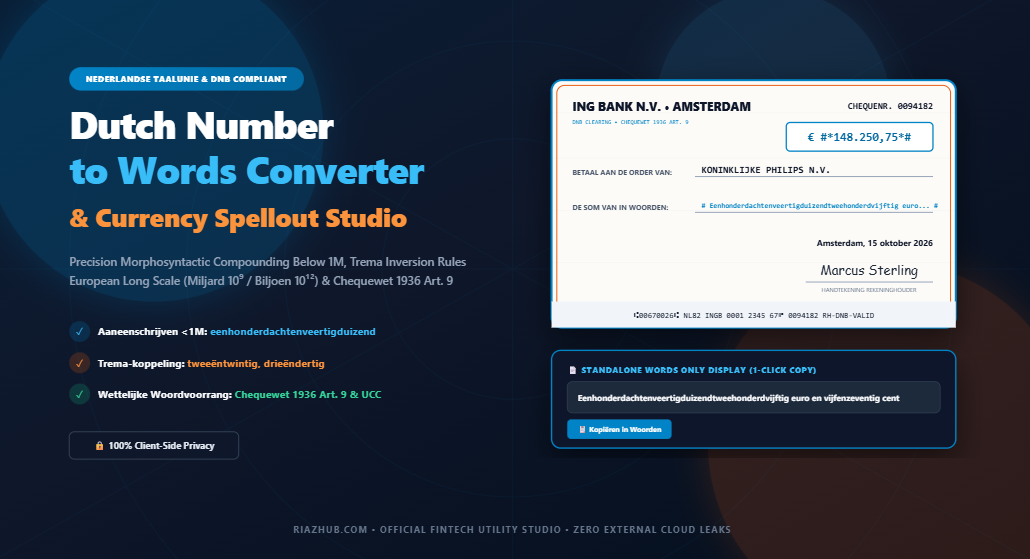
This principle harmonized internationally under UCC § 3-114 ensures that if a machine prints € 148.250,00 in figures but the legal written line states “Eenhonderdachtenveertigduizend euro”, commercial banks and courts recognize the written letters as the unassailable legal obligation.
Anti-Fraud Bounding Delimiters (# Bedrag #)
To prevent unauthorized third parties from inserting fraudulent prefixes or suffixes into a cheque or voucher, Dutch financial controllers utilize safety bounding delimiters:
- Protective Hash Cladding:
# Eenhonderdachtenveertigduizend euro # - Explicit Unit Enforcement: Writing
eenhonderdinstead of barehonderd, andeenduizendinstead of bareduizend, preventing fraudsters from writing “twee” or “vijf” in front of the amount.
5. Currency Concordance: Euro and Cent Rules in the Netherlands
In Standard Dutch, currency nouns follow unique grammatical plurality rules:
- Euro is Invariable: The word euro remains singular when preceded by a cardinal number:
1 euro,10 euro,250 euro(not “euro’s” in commercial spellouts). - Cents Formulation: Minor currency subunits can be expressed in written words (
vijfenzeventig cent) or as a fractional accounting notation (75/100).
6. Step-by-Step Practical Conversion Tutorial
Let us convert the commercial payment amount € 148.250,75 step-by-step:
- Extract Integer Part:
148.250. - Break into Thousands and Remainder:
- Thousands block:
148→eenhonderdachtenveertig+duizend=eenhonderdachtenveertigduizend. - Remainder block:
250→tweehonderdvijftig. - Sub-million agglutination:
eenhonderdachtenveertigduizendtweehonderdvijftig.
- Thousands block:
- Append Currency Unit:
euro. - Process Minor Subunit (75):
75→vijfenzeventig cent. - Synthesize Final Legal String:
Eenhonderdachtenveertigduizendtweehonderdvijftig euro en vijfenzeventig cent - Apply Cheque Bounding Delimiters:
# Eenhonderdachtenveertigduizendtweehonderdvijftig euro en vijfenzeventig cent #
7. Dual Accounting Voucher & Cheque Clearances in Action
Modern accounting workflows require clean documentation for internal audit trails and VAT (BTW) verification. The Dutch Currency Spellout Studio generates:
- High-DPI Bank Drafts: Realistic Dutch commercial bank check canvases rendering Guilloche security patterns, bank header, date in Dutch format (Amsterdam, 15 oktober 2026), payee line, and MICR / IBAN clearing numbers.
- Official Accounting Vouchers (Betalingsbewijs): Ready-to-print vouchers complete with BTW breakdown (21%), KvK registration, and dual controller sign-off blocks.
- Multi-Format Exports: Downloadable PNG graphics, Markdown (.md) transaction slips, and ledger CSV reports—all branded automatically with official authenticity marks.
📑 Experience the Full Dutch Financial Staging Suite
Generate certified commercial cheques, English translation mirrors, and audit-ready accounting vouchers directly in your browser.
Frequently Asked Questions (FAQ)
Why does Dutch write 148.250 as a single continuous word?
According to the Nederlandse Taalunie, all cardinal numbers below one million are written as a single compound word without spaces. This rule preserves Germanic compounding syntax and prevents fraudulent alteration of financial documents.
What is the difference between a miljard and a biljoen?
Dutch uses the European Long Scale. Miljard represents $10^9$ (1,000,000,000, equivalent to the American “billion”), whereas biljoen represents $10^{12}$ (1,000,000,000,000, equivalent to the American “trillion”).
Is my financial data kept private when using the studio?
Yes. The tool operates 100% client-side inside your browser using vanilla JavaScript and BigInt arithmetic. No invoice figures, payee names, bank details, or IP addresses are ever transmitted to external servers.
Conclusion
Mastering Dutch number verbalization requires careful attention to sub-million compounding, trema insertion on vowel collisions, European long-scale designations, and statutory banking precedents. Whether preparing multi-million euro real estate settlements or routine supplier checks, utilizing an automated, certified tool eliminates human error and guarantees statutory compliance.
Visit the Universal Dutch Number to Words Converter & Currency Spellout Studio on RiazHub to convert figures, preview bank drafts, and streamline your Dutch financial documentation today.
Universal Dutch Number to Words Converter & Currency Spellout Studio
Convert numerical figures into grammatically sound Dutch words (Nederlandse Getallen in Woorden) according to the Woordenlijst Nederlandse Taal, stage anti-fraud commercial bank drafts under Chequewet 1936 Art. 9, render European Long Scale figures up to 1030, and export certified accounting payment vouchers with zero external network dependencies.
🛠️ Advanced Grammar & Banking Formatting Options ▾
RiazHub Corporate Treasury B.V.
KvK: 84920145 • BTW: NL849201450B01
Keizersgracht 421, 1016 EK Amsterdam
Koninklijke Philips N.V.
Betrokken Bank: ING Bank N.V.
Betaalmethode: Bankcheque (Chequewet Art. 9)
| Grootboekrekening | Omschrijving Betaling | BTW Tarief | Bedrag |
|---|---|---|---|
| 4000 Zakelijke Kosten | Leveranciersfactuur conform goedgekeurde inkooporder | 21% Algemeen | € 148.250,75 |
Drs. J. van den Berg RA
Status: Akkoord voor Verrekening
Marcus Sterling
Gevolmachtigd Tekenbevoegde
148.250 wordt eenhonderdachtenveertigduizendtweehonderdvijftig.Omkering met verplichte Trema (Deelteken): De eenheden gaan vooraf aan de tientallen, verbonden door 'en'. Indien de eenheid eindigt op een 'e' (zoals
twee of drie), is een trema op 'en' (ën) orthografisch verplicht om botsing van klinkers (diftongering) te voorkomen:
22=tweeëntwintig(met trema)33=drieëndertig(met trema)24=vierentwintig(geen trema)
miljoen, miljard en biljoen worden als afzonderlijke zelfstandige naamwoorden los geschreven: twee miljoen driehonderdduizend.
10^6= Miljoen10^9= Miljard (in de Amerikaanse korte schaal is dit een "billion")10^12= Biljoen (een miljoen miljoen; 1.000.000.000.000)10^15= Biljard10^18= Triljoen
"Is het bedrag van de cheque voluit in letters en tevens in cijfers uitgedrukt, dan geldt bij verschil het in letters uitgedrukte bedrag."
Om die reden hanteren banken veiligheidsbegrenzers (zoals
# Bedrag in letters # of *** Som ***) en beschermende voorloop-termen zoals eenhonderd in plaats van honderd, om te verhinderen dat fraudeurs cijfers of woorden tussenvoegen.