
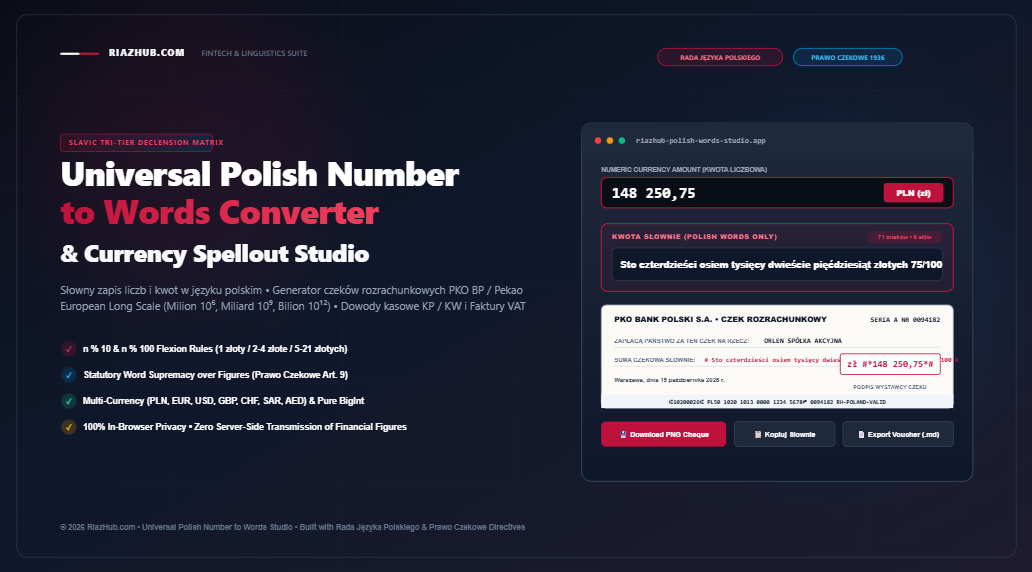
Mastering Polish Number to Words: Linguistic Rules, Cheque Precedence & Financial Spellout Standards
Whether drafting a commercial tax invoice (Faktura VAT), generating a cash expense voucher (Dowód Wypłaty KW), or preparing a bank settlement draft, relying on manual calculations or primitive anglicized converters invariably introduces catastrophic grammatical errors, incorrect declension endings, or scale misunderstandings. To eliminate these errors with automated precision, financial teams utilize the Polish Number to Words Converter & Currency Spellout Studio on RiazHub.
⚡ Need Instant, Error-Free Polish Currency Spellout?
Convert any numeric currency figure or pure BigInt integer into grammatically authentic Polish words with full declension, NBP cheque staging, and instant 1-click clipboard copying.
1. The Slavic Tri-Tier Declension Matrix for Numbers and Currency
Unlike the English language, where numeral inflections are minimal (e.g., “one dollar” vs. “two dollars”), the Polish linguistic system features a sophisticated morphological case agreement governed by the noun’s grammatical gender and modulo mathematics:
- Form 1 (Mianownik liczby pojedynczej – Singular Nominative): Used strictly for $n = 1$ (e.g., 1 złoty, 1 tysiąc, 1 milion, 1 grosz).
- Form 2 (Mianownik liczby mnogiej – Plural Nominative): Applies when the final digit of the integer $n \pmod{10}$ is $2, 3,$ or $4$, excluding numbers ending in $12, 13,$ or $14$ (e.g., 2 złote, 24 tysiące, 103 miliony, 4 grosze).
- Form 3 (Dopełniacz liczby mnogiej – Plural Genitive): Applies for zero, numbers ending in $5$ through $9$, $0$, and the teen exceptions $11$ through $14$ (e.g., 5 złotych, 12 tysięcy, 14 milionów, 25 groszy).
| Magnitude / Currency | Form 1 (Singular $n=1$) | Form 2 (Plural $2\text{–}4$) | Form 3 (Genitive $5\text{–}21$, teens) |
|---|---|---|---|
| Polski złoty (PLN) | 1 złoty | 2, 3, 4 złote | 5, 12, 20 złotych |
| Grosz (Subunit 1/100) | 1 grosz | 2, 3, 4 grosze | 5, 14, 75 groszy |
| Tysiąc ($10^3$) | 1 tysiąc | 2, 3, 4 tysiące | 5, 11, 50 tysięcy |
| Milion ($10^6$) | 1 milion | 2, 3, 4 miliony | 5, 13, 100 milionów |
| Miliard ($10^9$) | 1 miliard | 2, 3, 4 miliardy | 5, 14, 500 miliardów |
You can instantly verify any complex numeric combination using the live concordance inspector on the RiazHub Polish Currency Spellout Studio, which automatically evaluates both modulo 10 and modulo 100 constraints in real time.
2. European Long Scale (Skala Długa) vs. Anglo-American Short Scale
One of the most dangerous pitfalls in cross-border European finance is the radix scale disparity. Poland and continental Europe adhere strictly to the Traditional European Long Scale (skala długa), which indexes magnitude tiers by powers of one million ($10^6$):
$$10^6 = \text{Milion}, \quad 10^9 = \text{Miliard}, \quad 10^{12} = \text{Bilion}, \quad 10^{15} = \text{Bilard}, \quad 10^{18} = \text{Trylion}$$
In contrast, American and British English utilize the Short Scale, where $10^9$ is termed a “billion”. In Polish financial instruments, translated literally, mistaking a US “billion” ($10^9$) for a Polish «bilion» ($10^{12}$) represents a one-thousand-fold error. In standard Polish accounting, $1.000.000.000$ zł is unequivocally verbalized as «jeden miliard złotych», never «bilion».
The engine driving RiazHub’s Polish Number to Words Converter executes native arbitrary-precision BigInt chunking, ensuring that figures up to 30 digits are articulated in strict accordance with European Long Scale standards without standard JavaScript floating-point truncation.
3. Prawo Czekowe Art. 9: Statutory Word Supremacy over Figures
Why do banks and commercial courts demand written words in financial transactions? The legal foundation is codified in Article 9 of the Polish Cheque Law of April 28, 1936 (Ustawa z dnia 28 kwietnia 1936 r. – Prawo czekowe):
„Czek, w którym sumę czekową napisano literami i liczbami, w razie niezgodności ważny jest na sumę napisaną literami.”
(If the cheque amount is stated in both words and figures, in case of discrepancy the amount written in words legally prevails.)
This doctrine mirrors Article 3, Section 114 of the Uniform Commercial Code (UCC § 3-114) in international law. Because numerals can be easily forged or altered by adding trailing zeros, altering commas, or modifying leading digits, written words represent the true, deliberate intent of the issuer.
To guard against unauthorized additions, commercial cheque staging enforces anti-tampering delimiters:
*** Słownie: Sto czterdzieści osiem tysięcy dwieście pięćdziesiąt złotych 75/100 ***
When drafting commercial documents, you can automatically enclose your spellouts inside these legal delimiters using the configuration drawer inside the Universal Polish Spellout Studio.
4. Commercial Accounting Formats: Fractional Grosz vs. Written Words
When preparing corporate accounting records, how should subunit fractions (grosze) be recorded? Polish accounting practice under the Polish Accounting Act (Ustawa o rachunkowości) recognizes two standard conventions:
Convention A: Fractional Representation (xx/100)
The fractional convention is the dominant standard for corporate invoices (Faktury VAT), SAP and Comarch ERP systems, bank transfer orders, and commercial cheques:
Kwota liczbowa: 148 250,75 zł
Słownie: Sto czterdzieści osiem tysięcy dwieście pięćdziesiąt złotych 75/100
Convention B: Fully Verbalized Subunits
The fully verbalized style spells out the subunits using proper declension forms. It is predominantly required in notary deeds, real estate conveyances, and ceremonial financial commitments:
Słownie: Sto czterdzieści osiem tysięcy dwieście pięćdziesiąt złotych i siedemdziesiąt pięć groszy
Both styles can be selected interchangeably with a single click inside the Polish Number to Words Converter & Currency Spellout Studio.
5. Commercial Cheques and Cash Vouchers (Dowód KP / KW)
Commercial transactions in Poland often require formal internal vouchers alongside bank drafts:
- Czek Rozrachunkowy (Crossed Cheque): A specialized bank cheque marked with the explicit clause «do rozrachunku» (only for settlement). Under Polish banking regulations, crossed cheques cannot be cashed out in physical banknotes at a teller counter; they can strictly be cleared by crediting the recipient’s verified corporate bank account.
- Dowód Wpłaty KP (Kasa Przyjmie): An internal cash receipt certifying incoming funds into a company’s treasury vault.
- Dowód Wypłaty KW (Kasa Wypłaci): A petty cash voucher authorizing cash disbursements, requiring the chief accountant’s signature and the exact amount written in words.
Rather than manually formatting these documents in spreadsheets, you can test and export pre-formatted accounting cash slips and High-DPI bank cheque drafts with the RiazHub Polish Currency Studio.
📄 Try the Free Interactive Polish Number to Words Studio
Access real-time tri-tier Slavic declensions, download High-DPI cheque graphics, export accounting voucher Markdown slips, and generate audit-ready CSV ledgers directly in your browser.
6. 100% Client-Side Privacy: Why Browser-Based Architecture Matters
In an era of cloud-based APIs and third-party data aggregators, pasting sensitive commercial invoice amounts, corporate payroll figures, or vendor transaction details into online tools poses significant privacy and compliance liabilities under the General Data Protection Regulation (GDPR / RODO).
🔒 Client-Side Deterministic Processing Guarantee
The Polish Number to Words Converter & Currency Spellout Studio on RiazHub executes 100% of its computational linguistics, BigInt parsing, canvas cheque generation, and ledger formatting directly inside your web browser. Zero financial values, bank routing details, or payee identities are ever transmitted to external web servers.
Summary & Best Practices
To ensure strict compliance with Rada Języka Polskiego directives and Polish banking statutes, always verify:
- Correct tri-tier declension for both major currency units (złoty / złote / złotych) and minor subunits (grosz / grosze / groszy).
- Adherence to the European Long Scale when handling figures of $10^9$ (miliard) and above.
- Enclosure of written amounts in protective delimiters (
# ... #) on bank drafts to safeguard against fraud under Prawo Czekowe Art. 9. - Zero server transmission when processing confidential corporate payroll and vendor figures.
For guaranteed accuracy, bookmark the Universal Polish Number to Words Converter & Currency Spellout Studio on RiazHub as your standard utility for daily Polish accounting, commercial banking drafts, and legal document preparation.
Universal Polish Number to Words Converter & Currency Spellout Studio
High-precision morphosyntactic Polish number-to-words engine (Zapis słowny kwot w języku polskim) conforming to Rada Języka Polskiego (RJP) orthography rules, Slavic tri-tier declension matrix ($n \pmod{10}$, $n \pmod{100}$), European Long Scale, and official Narodowy Bank Polski (NBP) & Prawo Czekowe commercial cheque staging directives.
DOWÓD WPŁATY / WYPŁATY (KP / KW)
| Pozycja Księgowa | Konto Wn (Winien) | Konto Ma (Ma) | Kwota Netto | VAT (23%) | Kwota Brutto |
|---|---|---|---|---|---|
| Rozrachunki z dostawcami | 201-01 (Dostawcy krajowi) | 130-01 (Rachunek bieżący) | 120 529,07 zł | 27 721,68 zł | 148 250,75 zł |
📚 Reguły Deklinacji Liczebników w Języku Polskim (Rada Języka Polskiego)
Język polski posiada jeden z najbardziej precyzyjnych i złożonych systemów fleksyjnych wśród języków słowiańskich. Przy zapisie kwot pieniężnych oraz jednostek wielkich rzędów wielkości stosuje się algorytm trójstopniowej deklinacji:
- Forma 1 (Mianownik liczby pojedynczej): Dla liczby $1$ (np. 1 złoty, 1 tysiąc, 1 milion, 1 grosz).
- Forma 2 (Mianownik liczby mnogiej): Gdy ostatnia cyfra to $2, 3, 4$, z wyjątkiem liczb z przedziału $12 \dots 14$ (np. 2 złote, 24 tysiące, 103 miliony, 4 grosze).
- Forma 3 (Dopełniacz liczby mnogiej): Dla $0$, od $5$ do $21$, oraz dla wszystkich końcówek od $11$ do $14$ (np. 5 złotych, 12 tysięcy, 14 milionów, 25 groszy).
Europejska Skala Długa (Long Scale) vs Skala Krótka
W Polsce oraz w większości państw Europy kontynentalnej obowiązuje tradycyjna skala długa. Liczba $10^9$ to w języku polskim Miliard, a termin Bilion oznacza $10^{12}$ (milion milionów). Pomyłka ze skalą anglosaską (gdzie $10^9$ to billion) jest w polskiej bankowości kardynalnym błędem.